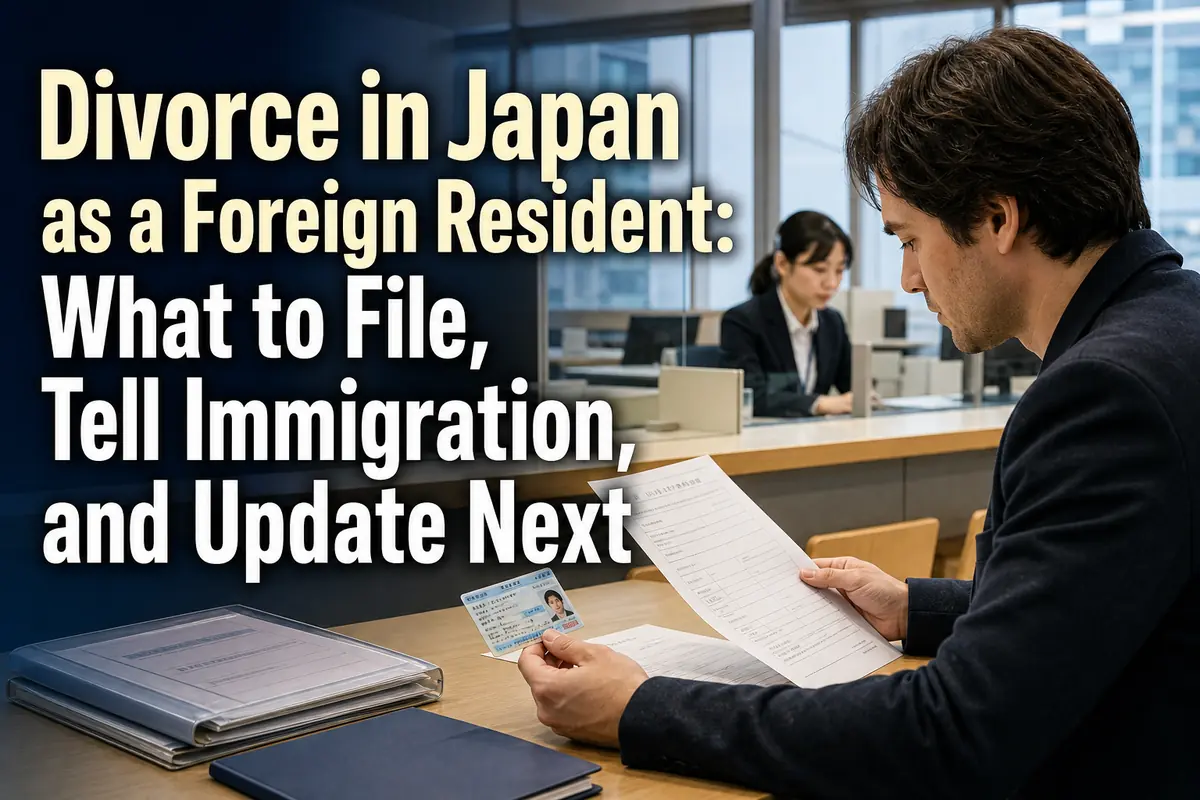
Divorce in Japan as a Foreign Resident: What to File, Tell Immigration, and Update Next
A divorce completed in Japan does not finish every related procedure. Foreign residents may need to deal with three separate systems: the municipal divorce record, recognition in their home country, and their Japanese residence status.
The most urgent immigration rule is simple: if you hold an eligible spouse-based status or live in Japan as a spouse under Dependent status, you generally must notify the Immigration Services Agency within 14 days of the divorce. This notification is not itself an application for a new residence status.
This guide is for foreign residents divorcing a Japanese citizen, a permanent resident, or another foreign national. It reflects public information available in August 2026, including family-law changes that took effect on April 1, 2026.
At a glance:
- Confirm first whether a Japanese municipal filing can legally establish your divorce.
- Obtain official proof that the filing was accepted.
- Check whether your embassy or home-country authority requires a second registration.
- Notify Japanese immigration within 14 days if your residence status is covered.
- If your right to stay depends on the marriage, discuss a status change promptly rather than waiting for your current card to expire.
ここがポイント: A city-office filing, recognition abroad, and immigration permission are separate matters. Completing one does not automatically complete the other two.
Start by identifying which divorce route applies
Nationality, habitual residence, and whether both spouses agree can change the correct route. Do not assume that every international couple can end a marriage simply by submitting the same form used by a Japanese couple.
Divorce by agreement
A consensual divorce is called kyōgi rikon (協議離婚, divorce by agreement). Where Japanese law and the applicable foreign law permit this route, the spouses submit a rikon todoke (離婚届, divorce notification) to a municipal office.
The current municipal form reflects the family-law rules effective from April 1, 2026. For a standard divorce by agreement, it generally requires:
- both spouses’ signatures;
- signatures from two adult witnesses;
- details about any minor children and parental authority where applicable; and
- identification for the person taking the form to the counter.
The filing date becomes the legal divorce date if the municipality accepts the notification. There is no general filing deadline for a divorce by agreement.
However, two foreign nationals cannot safely decide that this route applies merely because they live in Japan. Yokohama City’s English guidance states that the governing law applicable to the couple determines how such a divorce is handled. The couple should ask the municipal family-register desk and, when necessary, a lawyer familiar with international family law before signing or filing anything.
Family-court proceedings
When the spouses do not agree—or when the applicable law does not allow the intended consensual procedure—the matter may need to go through the family court.
Japan generally follows a conciliation-first approach for a disputed divorce. The usual sequence is:
- Chōtei (調停, family-court conciliation or mediation)
- If no settlement is reached, litigation or another court procedure appropriate to the case
Court proceedings are conducted in Japanese. Ask the court or a lawyer about interpretation, translated evidence, jurisdiction, and service of documents before filing.
After a court divorce becomes effective, a municipal notification is normally required within 10 days. The supporting document depends on the result—for example, a mediation record, judgment, or certificate showing that a decision is final. Confirm the exact documents with the receiving municipality.
File at the municipality—and obtain proof
The municipal counter records the Japanese procedure, but the documents required for an international case vary. Contact the office before visiting, especially when one or both spouses are foreign nationals.
A filing may be accepted at the municipality connected to a spouse’s registered domicile or current location, depending on the case. The relevant desk may be called koseki-ka (戸籍課, Family Register Division) or koseki jūmin-ka (戸籍住民課, Family and Resident Registration Division).
Bring or confirm the need for:
- the completed divorce notification;
- passports or other official identification;
- residence cards;
- documents showing nationality or the marriage record;
- court documents, if the divorce was not by agreement;
- Japanese translations of foreign-language documents; and
- any municipality-specific supplementary form.
Foreign nationals do not receive their own Japanese koseki (戸籍, family register). When one spouse is Japanese, the divorce is recorded in that Japanese national’s family register. A foreign spouse may instead need a rikon todoke juri shōmeisho (離婚届受理証明書, certificate of acceptance of the divorce notification) or another certified record.
Ask the counter which certificate will be useful for:
- your embassy or home-country civil registry;
- an immigration application;
- changing contracts or insurance records; and
- future proof of marital status.
Municipal submission itself normally does not carry a filing charge, but certified copies have local fees. Translation, authentication, apostille, postage, court, and professional fees are separate and can vary considerably.
Do not rely on an after-hours submission for a complex case
Many municipalities accept family-register documents outside normal counter hours, but staff may only hold the form for later examination. If information is missing, you may be asked to return during business hours.
For an international divorce, a daytime pre-check is safer. It gives staff time to examine foreign documents, translations, nationality rules, and the new parental-authority fields before the intended filing date.
Check whether your home country recognizes the divorce
A divorce validly recorded in Japan may not automatically update—or even be recognized by—your country of nationality. This can affect remarriage, inheritance, passports, children’s documents, and future visa applications.
Contact your embassy, consulate, or home-country civil registry and ask:
- Must the Japanese divorce be reported or registered?
- Which Japanese certificate is accepted?
- Is a full family-register extract needed when the former spouse is Japanese?
- Must the document receive an apostille or consular authentication?
- Is a certified translation required?
- Does the country recognize a Japanese divorce by agreement?
Japan’s Ministry of Foreign Affairs notes that possible proof includes a family-register certificate, a certificate describing the accepted divorce notification, and a certificate of acceptance. The correct choice depends on the authority receiving it.
This check is especially important when both spouses are foreign nationals. A procedure accepted in Japan does not guarantee that either spouse’s country will recognize its legal effect.
Tell immigration within 14 days when your status is covered
Certain spouse-related residents must submit a separate immigration notification within 14 days. Filing the divorce at city hall does not replace this duty.
The Immigration Services Agency identifies the following covered statuses when the holder was residing as a spouse:
- Spouse or Child of Japanese National;
- Spouse or Child of Permanent Resident; and
- Dependent, when the permitted family activity was based on being the spouse.
The resident—not the former spouse—is responsible for the notification. It can generally be filed:
- through the Immigration Services Agency’s electronic notification system;
- at a regional immigration office; or
- by post, using the official form and required copy of the residence card.
The agency’s electronic system changed in January 2026, so use the current portal and manual rather than an old bookmarked login page.
Who is not covered by this specific spouse notification?
A divorce does not create this particular 14-day duty merely because the resident is foreign. For example, someone whose independent status is Engineer/Specialist in Humanities/International Services, Student, or another work or activity status is not using a spouse status.
A holder of Permanent Resident status also does not lose permanent residence simply because the marriage ends. This differs from holding Spouse or Child of Permanent Resident, which is a separate status.
Other notifications may still be necessary if the person moves, changes a registered name, leaves a job, changes schools, or experiences another reportable event.
A divorce notice does not automatically grant a new status
The 14-day notice reports the divorce; it does not decide how you may remain in Japan afterward. A separate application is needed if your current basis of residence no longer fits your circumstances.
The Immigration Services Agency explains that a person does not have to submit a status-change application at the exact same time as the divorce notification. It also warns that a spouse-status holder who no longer performs spouse-related activities for more than six months without a justifiable reason may become subject to status-revocation procedures.
That is not a guaranteed six-month grace period. Nor does divorce automatically cancel the residence card on the same day. Individual facts matter, and an application may take preparation and examination time.
Possible routes depend on your own circumstances
A person may explore a change to a status supported by facts such as:
- qualifying employment;
- study at an eligible institution;
- independent business activity meeting the relevant requirements;
- family circumstances, including actually raising and supporting a Japanese child; or
- another basis recognized under Japan’s residence-status system.
None of these routes is automatic. Having lived in Japan for several years, speaking Japanese, or having a job does not by itself guarantee approval under a particular category.
Make an early appointment with a regional immigration office, an immigration lawyer, or a qualified gyōsei shoshi (行政書士, administrative scrivener) who handles residence applications. Bring your residence card, passport, divorce proof, employment and income records, tax and social-insurance records, and documents concerning children if relevant.
If you have children, the rules changed in April 2026
Parents divorcing on or after April 1, 2026 can choose sole or joint parental authority, subject to the child’s interests and the applicable procedure. This is a major change from the former system, under which only one parent held parental authority after divorce.
The Japanese term is shinken (親権, parental authority). It concerns responsibility and authority for matters including a child’s care, education, legal representation, and property.
Parents divorcing by agreement may agree on:
- tandoku shinken (単独親権, sole parental authority); or
- kyōdō shinken (共同親権, joint parental authority).
If they cannot agree, the family court decides. The court must select sole parental authority when joint authority would harm the child’s interests, including situations involving abuse, domestic violence, or circumstances that make joint decision-making impractical.
Joint parental authority does not mean that the child must divide time equally between two homes. Parents should separately address:
- the child’s main residence;
- daily care and school routines;
- important education and medical decisions;
- contact with the parent living separately;
- travel and passport arrangements;
- child support; and
- how urgent decisions will be handled.
For an international family, also obtain advice before taking a child across a national border or withholding the child’s location. Parental authority, relocation, immigration status, passports, and the Hague Convention may interact in ways that cannot be resolved by a municipal form alone.
Settle money and records, not only marital status
The divorce form ends the marriage, but it does not automatically divide every asset, transfer every contract, or create a detailed payment plan. Written arrangements reduce later disputes.
Items to review include:
- zaisan bunyo (財産分与, division of marital property);
- child support and payment dates;
- housing deposits, mortgages, and lease responsibility;
- joint bank accounts and credit cards;
- pension division;
- health insurance and dependent coverage;
- employer benefits and emergency contacts;
- utilities, mobile-phone plans, and subscriptions; and
- tax and municipal records.
Under the family-law changes effective April 1, 2026, the period for making a property-division claim after divorce is generally five years for divorces covered by the new rules. Older divorces may be subject to the previous period, so confirm which law applies to your dates.
A former spouse who was covered as a dependent under employee health insurance may need new coverage promptly. Depending on work and household circumstances, that could mean joining an employer’s plan or completing kokumin kenkō hoken (国民健康保険, National Health Insurance) procedures at the municipality.
Moving to a new address requires a separate resident-registration procedure. Do not assume that the divorce desk automatically changes your address, household composition, insurance, or every linked service.
Common mistakes that create later problems
Most avoidable problems come from treating the divorce as one form instead of a chain of separate procedures. Watch for these errors:
- Missing the immigration notification because city hall already accepted the divorce
- Waiting until the residence card is close to expiry before discussing a status change
- Assuming a Japanese divorce is automatically recognized by the foreign spouse’s country
- Using an old divorce form after the April 2026 family-law changes
- Filing at night without first checking foreign-document requirements
- Leaving child support, the child’s main residence, or major decisions as oral promises
- Assuming joint parental authority means equal residence time
- Forgetting health insurance, pension, housing, tax, and employer updates
- Moving a child internationally without case-specific legal advice
If you do not consent to a divorce by agreement and fear that a form may be submitted without your genuine agreement, ask the municipality or a lawyer immediately about a fu-juri mōshide (不受理申出, non-acceptance request). Eligibility and effect depend on the parties and the type of filing; it does not replace urgent safety or legal help.
A practical order for the first month
Deal first with deadlines and the documents that unlock later procedures. A workable sequence is:
- Confirm the legally valid divorce route and applicable law.
- Before filing, make written arrangements about children, money, housing, and immediate expenses where safe and possible.
- Submit the municipal notification or complete the court process.
- Obtain several suitable certificates of the result.
- Within 14 days, make the immigration spouse notification if your status is covered.
- Start any necessary residence-status consultation or application promptly.
- Ask your embassy or home-country registry how to record the divorce.
- Update your address, health insurance, pension, employer, bank, lease, utilities, and emergency contacts.
- Keep copies of submissions, translations, receipts, tracking records, and written agreements.
Requirements differ by nationality, municipality, residence status, and family circumstances. Before choosing a divorce route—or making decisions involving children or continued residence—confirm the current position with the relevant municipal office, Immigration Services Agency, embassy, and a qualified professional.
Where to get help
Use a specialist when nationality, children, residence status, safety, or disputed assets make the case more than a routine filing. Useful starting points include:
- Houterasu (Japan Legal Support Center): multilingual information and referrals; eligible lawful residents with limited financial resources may qualify for legal aid.
- Family court: procedural guidance about conciliation and family cases, although court staff cannot provide personal legal advice.
- Regional immigration office or FRESC: official information about residence procedures.
- Your municipality: forms, accepted documents, certificates, resident registration, insurance, and local single-parent support.
- Your embassy or consulate: recognition and civil-registration requirements in your country.
If there is domestic violence, coercion, threats, or concern that a child may be removed, prioritize safety and obtain urgent specialist assistance before negotiating documents directly. The practical next step is not simply “submit the divorce form”; it is to identify which deadline—court, immigration, safety, or child-related—cannot wait.
参照リンク
- Immigration Services Agency: Procedures for Entry/Residence
- Immigration Services Agency: Notification of Relationship with Spouse
- Immigration Services Agency: Electronic Notification System Portal
- Immigration Services Agency: Questions and Answers, including divorce notifications
- Immigration Services Agency: Examples concerning revocation of spouse-based status
- Ministry of Justice: Getting a Divorce in Japan
- Ministry of Justice: 2026 amendment concerning parental responsibilities
- Ministry of Justice: Divorce Portal
- Supreme Court of Japan: Questions and Answers on Family-Related Cases
- Yokohama City: Registering Marriages and Divorces
- Yokohama City: Current Divorce Notification Requirements
- Ministry of Foreign Affairs: Authentication FAQ
- Houterasu: Family Affairs—Engagement, Marriage, and Divorce
- Houterasu: About Houterasu and Multilingual Access