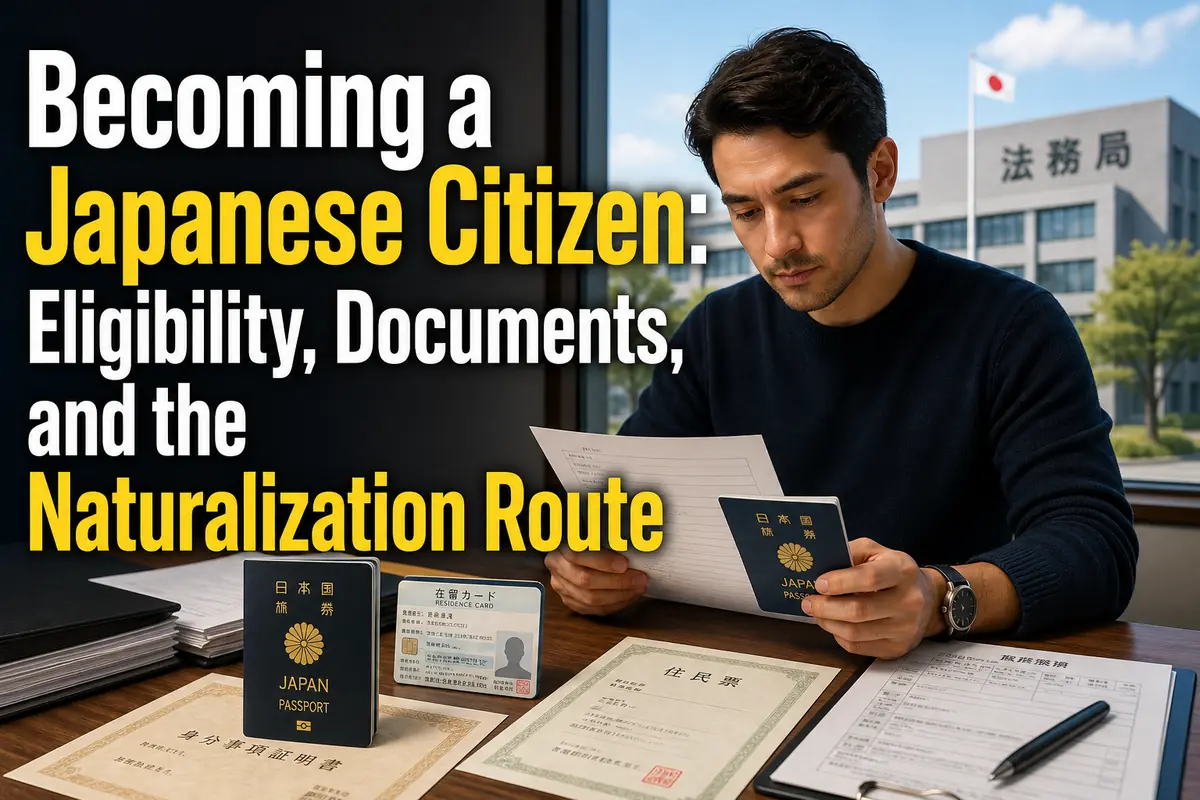
Becoming a Japanese Citizen: Eligibility, Documents, and the Naturalization Route
The usual route for a foreign resident to become a Japanese citizen is naturalization, called kika (帰化). You apply in person through the Legal Affairs Bureau that covers your home address. The Minister of Justice makes the final decision.
For a standard application, you generally need at least five consecutive years of domicile in Japan with valid residence status. You must also meet conditions concerning age, conduct, financial stability, nationality, and compliance with Japan’s Constitution. Meeting every minimum condition does not guarantee approval.
This guide is for adult foreign residents considering citizenship, including workers, spouses, students approaching long-term settlement, and permanent residents. It reflects official information available in August 2026, but your nationality, family, job, and residence history will determine the exact requirements.
In brief:
- Naturalization and permanent residence are different procedures.
- The standard residence condition is five consecutive years, but exceptions exist.
- You should consult your local Legal Affairs Bureau before collecting every document.
- Tax, pension, income, family, travel, and driving records may be examined.
- Japan generally requires a naturalized person to lose their previous nationality, subject to a limited exception.
Naturalization changes your nationality, not only your residence status
Naturalization makes you a Japanese national. Permanent residence, by contrast, lets a foreign national remain in Japan without a fixed period of stay while retaining foreign nationality.
A naturalized citizen can obtain a Japanese passport and is no longer managed under Japan’s residence-status system as a foreign resident. A Japanese family register, or koseki (戸籍), is also created after permission.
This makes naturalization a much larger legal and personal decision than renewing a visa or applying for permanent residence. Before starting, consider how the change could affect:
- your current nationality and passport;
- property, inheritance, military-service, or family-law obligations in your country of nationality;
- your children or other family members;
- travel to and residence in your former country;
- any work that requires your current nationality.
Naturalization applies to the individual applicant. Do not assume that a spouse or child will automatically become Japanese at the same time.
The six general conditions
Article 5 of the Nationality Act sets six minimum conditions for an ordinary naturalization application. Articles 6 through 8 provide relaxed conditions for certain people with close ties to Japan.
1. Domicile in Japan
The general rule is at least five consecutive years of domicile in Japan, with valid residence status throughout the required period.
This is more than counting five calendar years since your first arrival. Long absences, gaps in residence status, or the actual location of your home may affect whether the period is treated as continuous. Bring your passport history and discuss significant time abroad with the bureau.
The residence condition may be relaxed for some applicants, including certain people born in Japan, former Japanese nationals, children of Japanese nationals, and spouses of Japanese citizens. The precise exception depends on the relevant provision of the Nationality Act; marriage to a Japanese citizen does not by itself create automatic citizenship.
2. Legal capacity
An ordinary applicant must generally be at least 18 and have full legal capacity under the law of their country of nationality.
Different provisions can apply to children who apply with a parent or to people covered by a special exception. Ask the bureau how a family application should be organized rather than preparing each case independently.
3. Upright conduct
The Ministry of Justice considers whether the applicant has observed the law and fulfilled public obligations. Official guidance specifically identifies criminal records, tax payment, and conduct that disturbs society as relevant factors.
In practice, prepare to explain matters such as:
- late or unpaid national and local taxes;
- pension and health-insurance payment problems;
- criminal convictions or pending cases;
- repeated or serious traffic violations;
- inconsistencies between official records and your application.
A minor issue does not produce a universal published outcome. Its date, seriousness, repetition, and surrounding circumstances can matter. Disclose requested information accurately and ask the responsible officer how supporting documents should be supplied.
4. Stable livelihood
You must be able to maintain a livelihood in Japan. This condition is assessed by household, so an applicant without personal earnings may still qualify when a spouse or another relative in the same household provides sufficient income, assets, or skills.
There is no single nationwide salary figure published as an automatic pass line in the Ministry’s general conditions. Officers instead review the household’s actual circumstances. Depending on the case, they may request evidence covering:
- employment and recent pay;
- annual income and tax records;
- savings or property;
- rent and regular household expenses;
- business accounts and tax filings;
- income earned by a spouse or household member;
- money sent to relatives abroad.
Changing jobs is not listed as an automatic disqualification. However, a recent change can require updated employment and income documents.
5. Prevention of multiple nationality
An applicant must normally have no nationality or must, in principle, lose their existing nationality upon acquiring Japanese nationality.
There is a limited statutory exception when the person cannot lose the other nationality regardless of their own intention. Whether and when another nationality is lost is governed by that country’s law, not by Japan alone.
Contact your embassy, consulate, or the responsible authority in your country before taking any irreversible renunciation step. Ask the Legal Affairs Bureau when proof concerning loss of nationality will be needed. The order of procedures can be crucial because countries use different rules.
6. Constitutional compliance
A person who has plotted or advocated the violent overthrow of Japan’s government—or formed or joined an organization doing so—does not meet the condition.
Here is the key point: The six conditions are minimum legal requirements, not a checklist that creates a right to approval. The Minister of Justice decides whether to grant naturalization after the applicant’s full circumstances are examined.
Japanese ability also matters in the procedure
Applicants should be able to manage ordinary life in Japanese, including conversation and basic reading and writing. Tokyo Legal Affairs Bureau guidance expressly refers to Japanese ability sufficient for daily life.
The Nationality Act’s six-item list does not set a universal Japanese-Language Proficiency Test level. Bureau guidance may nevertheless ask applicants who have taken tests such as the JLPT to bring their results. The officer can also confirm ability through consultations, forms, an interview, or other case-specific checks.
Do not treat an online claim such as “JLPT N3 always guarantees eligibility” as an official nationwide rule. A test certificate may support your file, but the bureau assesses whether you can deal with the procedure and daily life in Japanese.
Useful terms to recognize include:
- kika kyoka shinsei (帰化許可申請): application for naturalization permission;
- kika no dōkisho (帰化の動機書): statement of reasons for naturalization;
- rirekisho (履歴書): personal history or résumé form;
- seikei no gaiyō (生計の概要): outline of household finances;
- nōzei shōmeisho (納税証明書): tax-payment certificate;
- kazei shōmeisho (課税証明書): taxation certificate;
- jūminhyō (住民票): certificate of residence;
- koseki (戸籍): Japanese family register.
The application process, step by step
Start with the office that has jurisdiction over your address, not with a generic document list. Necessary documents differ greatly by nationality, occupation, household, and family history.
Step 1: Find the responsible Legal Affairs Bureau
Naturalization applications are handled by the Legal Affairs Bureau or Regional Legal Affairs Bureau with jurisdiction over your home address. A city hall, immigration office, embassy, or bureau in a more convenient prefecture is not automatically the correct filing office.
Check the official bureau website or call the local office. Some branch offices do not handle nationality matters.
Consultation arrangements also vary. Tokyo, Yokohama, Kofu, and several other offices publish advance-reservation requirements. Tokyo states that nationality consultations are not provided by telephone, email, or fax; applicants use the telephone to reserve an in-person consultation.
Step 2: Attend an initial consultation
At the consultation, the officer reviews your basic circumstances and explains the documents needed for your case. The applicant should normally attend personally because the officer needs information about nationality, work, family, and residence history.
Bring the items requested by that office. These commonly begin with:
- residence card;
- current and previous passports;
- basic family information;
- employment or business details;
- a record of time spent outside Japan;
- any preliminary checklist issued by the bureau.
Do not order every foreign certificate before this meeting unless your bureau instructs you to do so. Certificates may have validity periods, and the required type can depend on your family history.
Step 3: Collect and prepare the documents
The Ministry of Justice lists the following main categories:
- application for naturalization permission, with a photograph;
- information about relatives;
- statement of purpose;
- résumé and residence history;
- outline of livelihood;
- outline of business activities, when applicable;
- certificate of residence;
- proof of nationality;
- proof of relationships with parents and other family members;
- tax-payment documents;
- proof of income;
- proof of residence history.
That is only a national overview. A worker, company director, sole proprietor, student, or financially dependent spouse will receive a different evidence list. Documents can also vary by country because birth, marriage, divorce, and nationality are recorded differently.
Step 4: Translate foreign-language records
Foreign-language documents require Japanese translations. Current Tokyo and Nagoya bureau guidance says the translation must cover the whole document and identify the translator’s name, address, and translation date.
Those offices also state that the translator does not have to be a professional if the person can translate accurately; the applicant may translate their own documents. Follow your own bureau’s instructions because formatting and copy requirements can differ.
Keep names, dates, places, and family relationships consistent across the original record, translation, application forms, passports, and Japanese public records. If spellings differ, ask how to explain them rather than silently choosing one version.
Step 5: Submit the application in person
The applicant files a written application personally at the responsible bureau and attaches evidence showing that the conditions are met. The Ministry’s general Q&A provides for a parent or legal representative when the applicant is under 15.
Local guidance may require originals plus copies, specific paper sizes, photographs, and a particular order. For example, current Tokyo guidance asks applicants in covered categories to prepare two sets and explains how A4 copies should be arranged. Treat this as Tokyo guidance, not an automatic nationwide copying rule.
Step 6: Respond to checks and changes
The bureau may request further documents or clarification after accepting the application. Keep tax, pension, health-insurance, employment, and residence matters current while the case is being examined.
Tell the officer promptly about material changes, such as:
- a new address or telephone number;
- marriage, divorce, birth, or death in the family;
- a change of job or loss of employment;
- a long trip outside Japan;
- an arrest, charge, or traffic matter;
- a change involving nationality or passport status.
Japan does not publish one guaranteed processing time for every naturalization case. Document complexity, overseas verification, additional requests, and the applicant’s circumstances can change the schedule. Do not make irreversible travel or nationality plans around an unofficial estimate.
Step 7: Permission and the family register
If permission is granted, the naturalization is announced in the Kanpō (官報), Japan’s Official Gazette. Under the Nationality Act, naturalization takes effect on the date of that public notice.
The applicant must then complete the instructed post-approval procedures, including matters needed to establish a family register. Follow the bureau’s directions concerning your residence card, municipal records, former passport, and proof relating to your previous nationality.
What the process can cost
The largest practical costs usually come from obtaining and preparing evidence, not from filling in the Japanese forms. The Ministry’s general naturalization guidance does not provide one standard total because every file requires different records.
Possible expenses include:
- birth, marriage, divorce, and nationality certificates from abroad;
- authentication, legalization, or apostille procedures when requested;
- embassy or consular services;
- Japanese tax and residence certificates;
- photographs and copying;
- postage and travel to public offices;
- professional translation or legal assistance if you choose to use it.
Ask the Legal Affairs Bureau whether any government charge applies at the filing stage and request current fees directly from each document issuer. Foreign certificates and consular procedures can account for much of the total.
Hiring a lawyer or administrative scrivener is optional; the applicant must still provide accurate personal information and may need to appear personally. A representative cannot guarantee permission.
Exceptions that require individual confirmation
A shorter residence history may be possible, but only when a specific statutory exception applies. Do not shorten the standard five-year period merely because you have a Japanese relative or have lived in Japan before.
Potentially relevant groups include:
- a person born in Japan;
- a person with a Japanese parent;
- a former Japanese national;
- a child of someone who was naturalized in Japan;
- the spouse of a Japanese citizen;
- a person providing distinguished service to Japan.
The exception may relax one condition without removing every other condition. For example, a person may still need to show good conduct, a stable household, and how their existing nationality will be handled.
Citizenship by notification is also different from naturalization. Certain acknowledged children of Japanese nationals and some people who lost Japanese nationality at birth may acquire nationality by notification if they satisfy the statutory rules. If your parent is or was Japanese, ask the bureau which route applies before preparing a naturalization application.
Common mistakes that delay preparation
Most avoidable problems begin with collecting the wrong documents or allowing records to contradict one another. A careful first consultation can prevent both.
Using a permanent-residence checklist
Permanent residence is administered through the immigration system. Naturalization is a nationality procedure handled by the Legal Affairs Bureau. The forms, authority, legal effects, and evidence are not interchangeable.
Hiding an inconvenient fact
A late tax payment, traffic violation, previous marriage, overseas child, or long absence may require explanation. Omitting it can create a second problem when official records reveal the discrepancy.
Assuming marriage guarantees citizenship
A Japanese spouse can make a relaxed statutory condition relevant, but the applicant still goes through an examination. Marriage is neither automatic citizenship nor automatic approval.
Collecting certificates too early
Some records must be recent, and the correct certificate may depend on your nationality and family structure. Wait for case-specific instructions where possible.
Renouncing nationality too soon
Nationality loss can be difficult or impossible to reverse. Confirm the required order with both the Legal Affairs Bureau and your country’s competent authority before taking action.
Treating local instructions as national law
The Nationality Act and Ministry requirements apply nationally, but appointment systems, jurisdiction, preliminary checklists, copy formatting, and consultation arrangements can differ among bureaus. Use the website for the office responsible for your address.
Practical checklist before making the first call
You do not need a complete application to begin, but you should understand your own history. Prepare a simple timeline covering:
- every residence status held in Japan;
- addresses and employers in Japan;
- trips and extended stays abroad;
- marriages, divorces, children, and other relevant family changes;
- tax, pension, and health-insurance payment history;
- criminal or traffic matters;
- all current and previous nationalities and passports.
Then take three concrete actions:
- Find the Legal Affairs Bureau with jurisdiction over your present address.
- Check whether nationality consultation requires an appointment and what to bring.
- Ask your embassy or national authority how Japanese naturalization would affect your current nationality—but do not renounce it before receiving procedural instructions.
The first important watchpoint is continuity. Keep your residence status valid and continue meeting tax, social-insurance, and legal obligations while the application is being prepared and examined. A naturalization file describes your life over several years; current records must continue to support that description.
参照リンク
- Ministry of Justice: Nationality Q&A
- Ministry of Justice: Nationality Administration
- Ministry of Justice: Choice of Nationality
- Ministry of Justice: Nationality Act
- Tokyo Legal Affairs Bureau: About Naturalization
- Tokyo Legal Affairs Bureau: How to Arrange a Nationality Consultation
- Tokyo Legal Affairs Bureau: Information for an Initial Naturalization Consultation
- Tokyo Legal Affairs Bureau: Naturalization Application Forms
- Nagoya Legal Affairs Bureau: Documents for Applicants of Other Nationalities