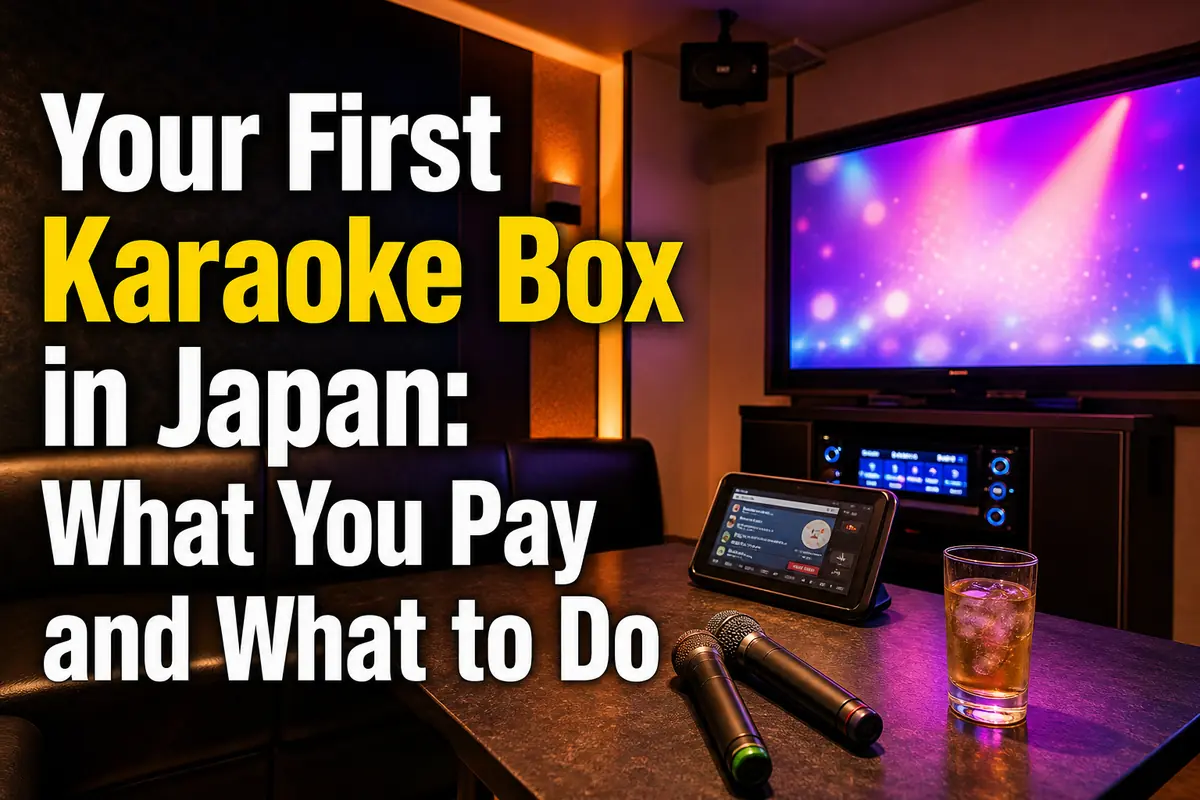
Your First Karaoke Box in Japan: What You Pay and What to Do
In Japan, a karaoke box usually charges each person for time in a private room, not one flat price for the whole group. A drink may be included, required separately, or covered by a drink-bar plan.
The safest first-time approach is simple: check the price category at reception, confirm whether a drink is extra, state how long you want the room, and keep the receipt or room slip until checkout.
This guide is for newcomers, students, workers, long-term residents, and visitors who want to enjoy karaoke without being surprised by the bill.
The essentials
- Room fees are normally shown per person, often in 30-minute units.
- Daytime weekdays are generally cheaper than evenings, weekends, and holiday periods.
- A one-drink system means every guest must order at least one drink in addition to the displayed room fee.
- Free time means a fixed-price session within stated hours, not unlimited use at any time.
- Prices and operating rules differ by branch, season, membership status, and room type.
Understand the price before choosing a plan
The number beside “30 minutes” is rarely the complete group total. You must account for the number of people, the length of the session, and any required drinks.
A typical calculation looks like this:
Room rate per person × number of time blocks × number of guests, plus required drinks and optional food
Suppose a rate is ¥400 per person for 30 minutes. Two people staying for one hour would pay ¥1,600 in room fees: ¥400 × two blocks × two people. If the plan requires one drink per person, both drinks are added.
This is only a calculation example. It is not a standard national price, and the actual branch may apply different rates.
Common words on a price board
Look for these Japanese terms at the entrance, reception desk, or branch website:
- shitsuryō (室料) — room fee
- hitori-sama (お一人様) — per person
- 30-pun (30分) — 30 minutes
- ippan (一般) — general or non-member rate
- kaiin (会員) — member rate
- gakuwari (学割) — student discount
- hiru (昼) — daytime
- yoru (夜) — evening or nighttime
- heijitsu (平日) — weekday
- shūmatsu (週末) — weekend
- shukujitsu (祝日) — national holiday
- shukujitsu zenjitsu (祝前日) — the day before a national holiday
Do not assume that “weekend” has one universal definition. A branch may treat Friday night as a weekend period even though its daytime Friday rate remains a weekday rate.
A current price example—and why it is only an example
JOYSOUND’s official price guide states that rates vary by store. Its published nationwide guidance separates one-drink plans from drink-bar plans and notes that daytime, nighttime, weekday, weekend, student, member, and general rates can differ.
As of August 22, 2026, the guide lists broad examples for longer free-time plans. Its daytime one-drink-plan examples include member prices of approximately ¥2,409 to ¥3,080 and general prices of approximately ¥2,959 to ¥3,630 per person, with the required drink charged separately. Other plan categories have different ranges.
These figures are useful for understanding the system, not for predicting your final bill at a particular branch. Station-area locations, special rooms, peak seasons, and local operating conditions can change the price. Check the individual store page on the day you visit.
Choose between a one-drink plan and a drink plan
The cheapest-looking room rate may not be the cheapest complete package.
One-drink system
Wan dorinku-sei (ワンドリンク制) means each person must order at least one drink. The drink price is normally added to the displayed room fee.
This plan can make sense when you:
- plan to stay for a short session;
- want only one drink;
- do not need repeated refills; or
- prefer a specific menu item that is not available at the drink bar.
Ask whether the price board shows room fees before or after the required drink. An easy question is:
“Kono ryōkin ni dorinku wa haitte imasu ka?” — Is a drink included in this price?
Drink bar
A dorinku bā (ドリンクバー) usually provides self-service refills of selected non-alcoholic drinks. Depending on the branch, its cost may already be included in the plan or may be added to the room charge.
A drink bar can offer better value during a longer session, but confirm what it covers. Alcohol, premium drinks, and items delivered from the menu may be outside the plan.
Return your cup and use the drink station as directed. Do not take drinks outside the premises.
All-you-can-drink plans
Nomi-hōdai (飲み放題) means all-you-can-drink within the plan’s time and menu limits. A soft-drink plan and an alcohol plan may have different prices.
Check four points before selecting it:
- whether everyone in the group must choose the same plan;
- which drinks are included;
- when the last order is taken;
- whether the drinking period ends before the room session ends.
Alcohol service is subject to Japanese law and the venue’s rules. In Japan, people under 20 may not drink alcohol, and nobody should drive or cycle after drinking.
ここがポイント: Compare the total price per person, not the room-fee headline. A low 30-minute rate plus a required drink can cost more than a package with the drink bar included.
Know what “free time” actually means
Free time is a fixed session with boundaries, not an unrestricted all-day pass.
The Japanese term is furī taimu (フリータイム). It usually allows karaoke for a fixed price during a defined daytime or late-night period. The branch may set:
- an admission deadline;
- a fixed ending time;
- a minimum or maximum group size;
- separate weekday and weekend prices;
- a required drink or drink-bar charge;
- limited availability when rooms are busy.
For example, a daytime free-time period might end at 6:00 p.m. even if you enter late. Arriving at 4:30 p.m. would not necessarily give you the same number of hours as arriving before noon.
Ask “Nanji made desu ka?”—Until what time?—and check whether the quoted amount includes drinks.
A free-time plan is often attractive for a long weekday session. A short 60- or 90-minute visit may still be cheaper under the standard time-based rate. Calculate both before deciding.
Follow the process from reception to checkout
Most large karaoke boxes use a straightforward three-stage process: register at the front desk, use the assigned private room, and return to reception to pay.
1. At reception
Tell the staff:
- the number of people: ninzu (人数);
- your preferred duration: riyō jikan (利用時間);
- whether you want a standard session or free time;
- your drink choice or drink plan;
- whether you have membership or student identification;
- whether you need a non-smoking room, if available.
You might say:
“Futari de ichi-jikan onegaishimasu.” — One hour for two people, please.
If you want the final price clarified, ask:
“Hitori ikura desu ka?” — How much is it per person?
“Gōkei wa ikura ni narimasu ka?” — What will the total be?
Some businesses offer lower member rates through an app or membership registration. Read what information the registration requires before signing up. Student discounts commonly require a valid student ID, and conditions can vary by store and plan.
2. In the room
Your room will normally contain microphones, speakers, a screen, and a touchscreen controller. The controller may be called a denmoku (デンモク) or kyoku-navi (キョクナビ), depending on the system.
Use it to search by:
- song title;
- artist;
- language;
- song number; or
- category.
Official JOYSOUND guidance says its controller offers a language-search function, although the exact menus vary by model. Large systems commonly carry songs in several languages, but a specific recording or artist is not guaranteed. Search the operator’s song database in advance when one song is essential to your plans.
The room telephone or touchscreen can be used to contact reception or order menu items at many branches. Staff can also help change microphone batteries, explain the controller, or adjust equipment.
3. Before your time ends
Many venues contact the room shortly before the scheduled end. This notice is often called jikan mae no renraku (時間前の連絡), or an end-time reminder.
If you want to continue, ask for an extension:
“Enchō dekimasu ka?” — Can we extend the session?
An extension is not automatic. It depends on room availability, and extra time is charged under the applicable rate. On a busy Friday night, the next booking may make an extension impossible.
4. At checkout
Take your room slip, receipt holder, or assigned card back to reception. Food, extra drinks, extensions, and other charges are added at this stage.
Payment methods vary. A branch may accept cash, credit cards, electronic money, or QR payments, but support is not identical across a chain. Check the store page or ask before entering if you depend on one method.
First-time etiquette is mostly about sharing the room
Karaoke is relaxed, but a private room is still a shared space. Let everyone participate and treat the equipment carefully.
Good habits include:
- Take turns rather than adding many of your own songs to the queue at once.
- Ask before changing or cancelling somebody else’s song.
- Keep microphones away from speakers to prevent loud feedback.
- Do not shout directly into a microphone at maximum volume.
- Return microphones and controllers to their proper places.
- Keep corridors quiet and do not enter another group’s room.
- Check before posting recordings or photos that show other people.
- Leave promptly when the session ends unless reception approves an extension.
There is no national rule saying every guest must sing. It is fine to listen, talk, or help choose songs, provided your group is comfortable with that.
Food and outside drinks
Do not assume you may bring your own food or beverages. Mochikomi (持ち込み) means bringing outside items into the venue, and the policy differs by business and branch.
Some locations permit it, some prohibit it, and others allow limited items or make exceptions for celebration cakes. Ask first instead of hiding outside food. Allergy information and special dietary support also vary, so contact the branch directly when the answer affects your health.
Smoking rules and room types
Indoor-smoking arrangements depend on the facility and applicable regulations. A building may be entirely non-smoking, have a separate smoking room, or offer designated room types where legally permitted.
Ask for kin’en (禁煙), meaning non-smoking, when registering. Do not rely on an old review because a branch’s layout or policy may have changed.
Avoid the mistakes that cause surprise bills
Most first-time problems come from reading only the largest number on the sign.
Mistake 1: Treating the rate as a price for the room
The displayed rate is commonly per person. Four guests do not split one person’s charge unless the venue explicitly offers a room-based plan.
Mistake 2: Forgetting the time unit
A price marked for 30 minutes doubles for one hour before other charges are added. Confirm whether the business rounds partial blocks up.
Mistake 3: Missing the required drink
A one-drink plan adds at least one drink for every person. “One drink” does not mean one drink for the table.
Mistake 4: Expecting the weekday price on Friday night
Evening, weekend, holiday-eve, school-vacation, and special-season pricing may apply. Golden Week, year-end, and New Year periods can have separate schedules.
Mistake 5: Assuming free time guarantees a room until closing
Free-time admission may stop early, and availability may be restricted during busy periods. The venue’s stated end time still applies.
Mistake 6: Extending without checking the new rate
The next block may fall into a more expensive time period. Ask how much the extension will add before approving it.
Prices and rules vary across Japan
There is no national karaoke tariff or single nationwide entry procedure. Chains set their own systems, and individual branches publish local rates.
Differences are especially likely in:
- major station and entertainment districts;
- tourist-heavy city centers;
- suburban branches with parking;
- late-night periods;
- weekends and national-holiday eves;
- school holidays and peak travel seasons;
- premium, party, or projector rooms.
Tokyo examples should not be treated as prices for Osaka, Fukuoka, Sapporo, or a smaller regional city. Even two branches of the same chain can charge different amounts.
Reservations are often optional, but they are useful for large groups, special rooms, and busy evenings. Friday and Saturday nights may involve a wait or a shorter permitted session.
A practical checklist for your first visit
Before accepting the room, confirm these points at reception:
- Is the quoted rate per person and per 30 minutes?
- Is this the member, general, or student rate?
- Is one drink required, included, or separate?
- What time does the session end?
- How much would an extension cost?
- Does free time have a fixed checkout time?
- Are outside food and drinks allowed?
- Which payment methods does this branch accept?
Then keep one final watchpoint in mind: the branch’s current price page and the terms shown at reception control your visit. Online guides can explain the system, but they cannot replace the store’s same-day rate, seasonal notice, or room-availability decision.