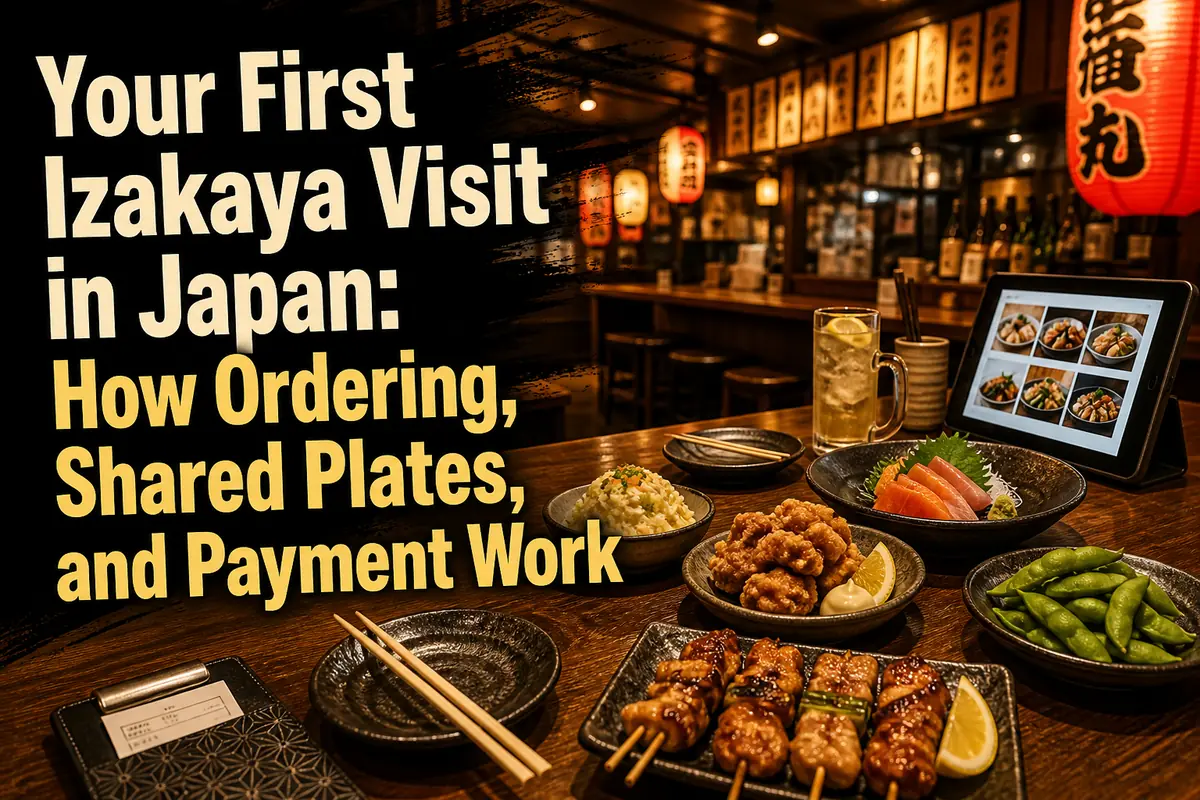
Your First Izakaya Visit in Japan: How Ordering, Shared Plates, and Payment Work
The easiest way to handle an izakaya is to think of it as a casual restaurant where drinks and small dishes are ordered in rounds. The group usually shares the food, one bill commonly covers the table, and a small paid appetizer may arrive before you order.
This guide is for new residents, students, workers, and visitors who want to join an izakaya meal without being surprised by the ordering system or final bill.
The essentials:
- Ask about any table charge before sitting down if the price matters to you.
- Order a few shared dishes first, then add more as the meal continues.
- Use your small plate rather than eating directly from a shared dish.
- Confirm payment methods and separate-payment requests before the bill arrives.
What an izakaya is—and what it is not
An izakaya is a place for both food and drinks, not simply a bar. Menus usually contain many small dishes, making it easy for a group to try several items.
Common choices include:
- Edamame — boiled soybeans
- Karaage — Japanese-style fried chicken
- Yakitori — grilled chicken skewers
- Sashimi — sliced raw seafood
- Hiyayakko — chilled tofu
- Grilled fish, salads, fried foods, rice, and noodles
Alcohol is optional. Most izakaya also offer tea, juice, soft drinks, and alcohol-free beer or cocktails. It is normal to attend with a group and order no alcohol, although some set plans may require every person to select a drink option.
Japan’s legal drinking age remains 20, even though the age of adulthood is 18. A restaurant may ask for identification when age is uncertain.
Why a dish may arrive before you order
The first small dish may be a paid table charge rather than a free sample. It is commonly called otōshi (お通し), while some restaurants use terms such as tsukidashi (突き出し) or sekiryō (席料, seat charge).
The usual sequence is simple:
- You sit down.
- Staff bring drinks, towels, or water.
- A small appetizer arrives automatically.
- A per-person charge appears on the bill.
The dish and price vary by restaurant. Some businesses show the charge on the menu, booking page, or a sign; others explain it only when asked. Not every izakaya has one.
If you do not want an automatic appetizer, ask before accepting the table:
- Otōshi wa arimasu ka? — Is there an otōshi?
- Otōshi wa ikura desu ka? — How much is the otōshi?
- Sekiryō wa kakarimasu ka? — Is there a table charge?
Do not assume that refusing the food will remove the charge. The restaurant may treat it as a fixed seating fee, and its policy can differ from another izakaya’s policy. If the staff’s explanation is unclear, decide whether to stay before ordering anything else.
ここがポイント: The important question is not whether the appetizer was requested. Ask whether the restaurant charges each seated customer and what that charge includes.
How to order without filling the table too quickly
Start small and order additional rounds. This is the clearest way to manage portions, cost, dietary needs, and limited table space.
Check how the restaurant takes orders
Depending on the venue, you may order through:
- A staff member called with sumimasen (“excuse me”)
- A tablet at the table
- A QR code and mobile web menu
- A paper order sheet
- A button that calls a server
Picture menus and multilingual screens are common at large chains, but smaller independent venues may have Japanese-only menus. Translation apps can help with basic words, but they should not be treated as reliable allergen checks.
Useful phrases include:
- Kore o hitotsu kudasai. — One of this, please.
- Onaji mono o mō hitotsu kudasai. — One more of the same, please.
- Osusume wa nan desu ka? — What do you recommend?
- Kore wa nan-nin-mae desu ka? — About how many people is this for?
- Nomimono dake demo ii desu ka? — Is it all right to order only drinks?
Make one person coordinate each round
When several people call out orders independently, duplicate dishes and unwanted drinks are easy to add. Before sending an order, quickly confirm:
- Which dishes will be shared
- Whether anyone wants an individual dish
- Dietary or religious restrictions
- How many additional drinks are needed
- Whether the table is approaching a time limit
A practical first round for a group is one or two quick dishes plus a small number of hot dishes. Order more after seeing the actual portions. Izakaya serving sizes are not standardized.
Watch for timed plans
Some venues offer nomihōdai (飲み放題, all-you-can-drink) for a fixed period, commonly one to two hours. Only drinks on the designated plan menu are included.
Before choosing a plan, check:
- Whether everyone at the table must join
- Whether minors and non-drinkers have a separate price
- The start and finish times
- The last order time, which may be earlier than the finish time
- Whether drinks must be finished before replacements can be ordered
- Whether food orders or a set course are required
On busy evenings, the table itself may also have a time limit. A reservation time, table limit, and all-you-can-drink period are not necessarily the same thing.
Sharing food at the table
Most small dishes are placed in the center and divided among the group. Each person normally receives a torizara (取り皿), a small plate for their own portion.
The basic flow is:
- Place the shared dish where everyone can reach it.
- Use serving utensils when provided.
- Move a reasonable portion to your own plate.
- Ask before taking the final piece.
For skewers, some groups remove the food and divide it; others let each person take a whole skewer. Either approach can work. Check with the group instead of treating one style as a strict national rule.
Keep individual needs separate
A shared-table system becomes risky when someone has an allergy or needs to avoid an ingredient. Sauces, soup stock, marinades, frying oil, and garnishes may contain ingredients that are not obvious from the dish name.
Japan’s Consumer Affairs Agency provides an English Food Allergy Communication Sheet that can be shown to restaurant staff. However, allergen information for restaurant meals is not handled in the same way as mandatory labels on packaged food. Recipes and cross-contact risks can also vary by kitchen.
If an allergy could cause a serious reaction:
- Show written information before ordering.
- Ask whether staff can confirm ingredients and cross-contact.
- Do not rely only on a translation app or menu photograph.
- Keep the affected person’s food and utensils separate.
- Choose another restaurant if the kitchen cannot provide a clear answer.
The same early conversation helps with vegetarian, vegan, halal, and other dietary needs. For example, a vegetable dish may still contain fish-based dashi stock.
How the bill normally works
Expect one table bill unless the restaurant agrees to separate payments. Friends may divide the total among themselves, but that does not mean the cashier will process several cards or exact item-by-item totals.
Requesting the bill
When you are ready, say:
- Okaikei onegaishimasu. — The bill, please.
- Gochisōsama deshita. — Thank you for the meal.
Staff may bring a bill slip to the table, or one may already be in a holder near the edge of the table. At many izakaya, you take that slip to the register near the exit. At others, payment is handled at the table.
Do not leave cash on the table unless staff specifically instruct you to do so.
Splitting the total with your group
Warikan (割り勘) means dividing the total, often equally. Before reaching the register, the group should decide whether to:
- Split the total evenly
- Let non-drinkers pay less
- Have each person calculate their own orders
- Use one card and reimburse the payer afterward
To ask the restaurant about separate payments, say:
- Betsubetsu ni haraemasu ka? — Can we pay separately?
- Kādo wa tsukaemasu ka? — Can I use a card?
- Genkin nomi desu ka? — Is it cash only?
Some registers cannot easily divide a shared order, and a busy venue may request one payment. Agreeing on a backup payer before the meal prevents an awkward delay at closing time.
Check the complete total
The final amount may include more than the visible food and drink prices. Look for:
- Otōshi-dai — appetizer charge
- Sekiryō — seat or table charge
- Set-course or all-you-can-drink fees
- Additional orders made during the meal
- Consumption tax, depending on how prices are displayed
Japan does not have a general tipping custom. Pay the amount on the bill unless the venue clearly lists another charge.
Cashless payment is increasingly available, but acceptance differs by restaurant. An overseas mobile wallet may not work even when contactless payment symbols are displayed. Smaller venues and establishments outside major urban areas may require cash, so check the entrance or ask before ordering.
Common mistakes—and the easy fix for each
Most problems come from assumptions made before the first order or before reaching the register. A ten-second question is usually enough to prevent them.
-
Mistake: Treating the first appetizer as free.
Fix: Ask whether there is a per-person charge before sitting down. -
Mistake: Ordering a full meal at once.
Fix: Begin with a few dishes and add another round after checking portions. -
Mistake: Assuming every dish is an individual serving.
Fix: Ask nan-nin-mae—how many people the dish is intended to serve. -
Mistake: Assuming “all-you-can-drink” covers every beverage.
Fix: Confirm the plan menu, last-order time, and participation rules. -
Mistake: Waiting until checkout to request six separate bills.
Fix: Ask about separate payments before ordering and prepare one-payment backup. -
Mistake: Using a menu translation as an allergy guarantee.
Fix: Show the official communication sheet and speak directly with staff. -
Mistake: Expecting the same system everywhere.
Fix: Check the specific venue’s menu, signs, booking terms, and payment logos.
Differences you may encounter
There is no single izakaya system used by every venue in Japan. Chains, neighborhood taverns, standing bars, and regional businesses can operate differently.
A large chain may have multilingual tablet ordering, clearly stated charges, and several cashless options. A small independent venue may use a handwritten Japanese menu, accept only cash, and explain the evening’s dishes verbally.
Other differences include:
- Smoking policies and designated smoking areas
- Minimum order requirements
- Whether children may enter
- Table or seating time limits
- Shoes-off seating areas
- Takeaway availability
- Rules for set courses and group plans
Check current information with the individual restaurant. A review or old menu photograph may no longer match its prices, hours, or payment policy.
A practical checklist before your next izakaya meal
Confirm the costs and payment arrangement first; the rest becomes much easier.
Before entering:
- Check the menu price range and accepted payment methods.
- Ask about otōshi or a table charge.
- Mention allergies or strict dietary needs.
Before ordering:
- Confirm any table time limit.
- Check the conditions for set plans.
- Decide who will coordinate shared orders.
Before paying:
- Review the table’s final orders.
- Decide how the group will divide the total.
- Ask early if separate transactions are needed.
The most useful habit is simple: settle the money questions before the food starts arriving. Then the group can order in rounds, share comfortably, and leave without discovering at the register that the venue accepts only one payment or cash.
参照リンク
- Japan National Tourism Organization: Izakaya Dining Guide
- Japan National Tourism Organization: Entertainment and Nightlife in Japan
- Japan National Tourism Organization: Japanese Customs and Etiquette
- Japan National Tourism Organization: Cashless Payments in Japan
- Japan National Tourism Organization: FAQ
- Consumer Affairs Agency: Food Labelling
- Consumer Affairs Agency: Food Allergy Communication Sheet
- Government of Japan: What Changed—and Did Not Change—When Adulthood Became 18