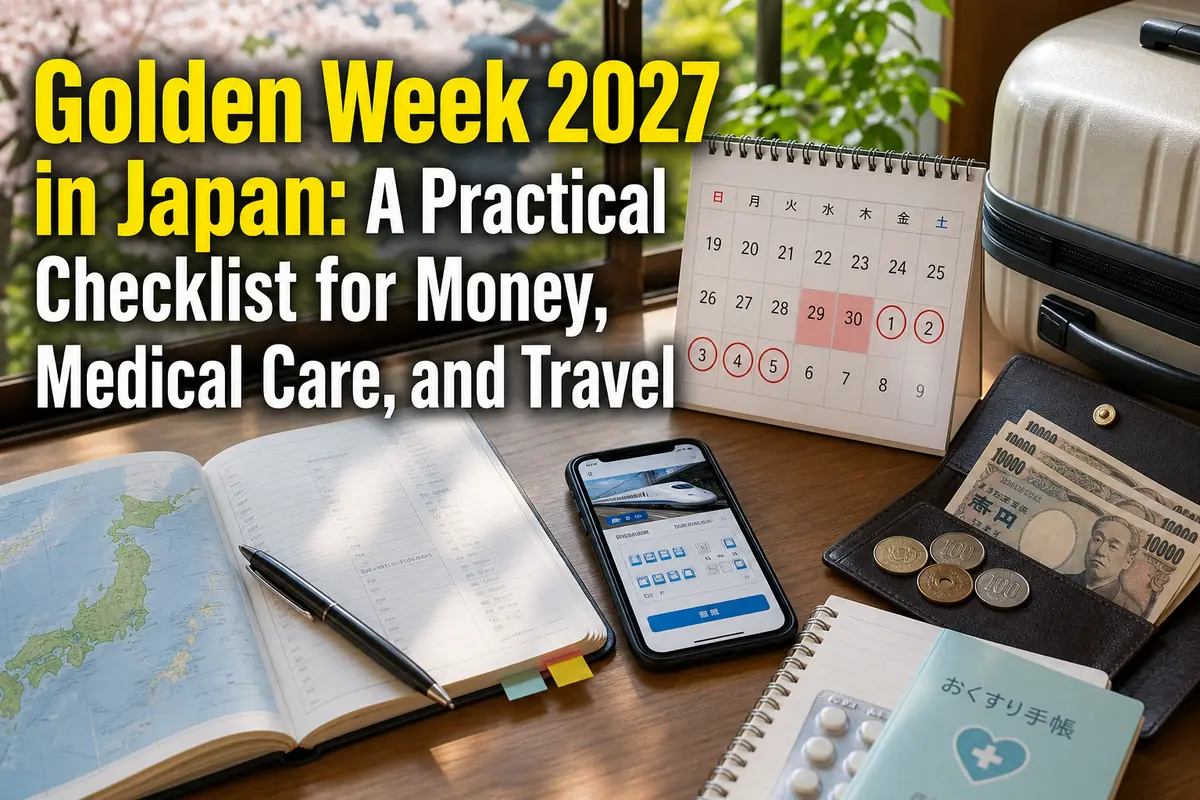
Golden Week 2027 in Japan: A Practical Checklist for Money, Medical Care, and Travel
Golden Week does not mean that everything in Japan closes. Convenience stores, many supermarkets, ATMs, and tourist businesses may remain open. The real problem is that bank counters, ordinary clinics, government offices, and some local services can become unavailable just when you need them.
For Golden Week 2027, plan around two separate blocks: Thursday, April 29, and Monday, May 3 through Wednesday, May 5. Friday, April 30 is not a national holiday, but individual employers and facilities may still close or shorten their hours.
This guide is for foreign residents, students, workers, and newcomers who need to manage payments, medicine, travel, deliveries, or local services during the holiday period.
Quick checklist
- Finish counter-only banking and government procedures before April 29 when possible.
- Refill prescription medicine before your regular clinic closes.
- Reserve long-distance transport early; do not assume every train has non-reserved seating.
- Check your municipality’s garbage calendar and your building’s collection area.
- Keep some cash and an alternative payment method available.
First, understand the 2027 calendar
The important detail is that Golden Week is not one continuous national shutdown. It combines national holidays, a weekend, and ordinary weekdays on which organizations may make their own schedules.
The official 2027 national holidays relevant to Golden Week are:
- April 29, Thursday: Shōwa no Hi (Showa Day)
- May 3, Monday: Kenpō Kinenbi (Constitution Memorial Day)
- May 4, Tuesday: Midori no Hi (Greenery Day)
- May 5, Wednesday: Kodomo no Hi (Children’s Day)
April 30 is an ordinary Friday under the national calendar. May 1 and 2 are Saturday and Sunday. This creates two patterns that matter in daily life:
- A business following only the official calendar may open on April 30 and close again from May 1 to 5.
- A business taking an extended break may close from April 29 through May 5.
The second pattern is a company or facility decision, not a nationwide rule. Look for notices containing Golden Week kyūgyō (Golden Week closure), kyūshin (no medical consultations), or eigyo jikan (business hours).
ここがポイント: A date that is legally an ordinary weekday can still be part of a company’s Golden Week closure. Check the actual schedule of each bank, clinic, employer, school, delivery company, and local office.
Arrange money before the counters close
Complete any task requiring a person, document, seal, or identity check before the holiday period. Digital banking and ATMs reduce the inconvenience, but they do not replace every branch service.
Bank branches and transfer timing
Bank branches normally close on Saturdays, Sundays, and national holidays. This means April 29 and May 3–5 are not suitable days for counter procedures. April 30 is a potential business day, although individual branches may have different arrangements.
Tasks worth completing early include:
- Opening an account or changing registered personal information
- Resolving a frozen card or online-banking problem
- Making a large transfer that exceeds your app limit
- Paying through a form that requires counter handling
- Exchanging cash at a bank branch
- Confirming a rent, tuition, tax, or insurance payment deadline
An online transfer may appear in your account immediately but reach the recipient later, depending on both banks, the transfer system, maintenance, and the receiving account. If a deadline falls near Golden Week, confirm when the recipient considers payment complete. Do not rely only on the time shown in your own banking app.
Useful Japanese terms include:
- furikomi — bank transfer
- nyūkin — deposit or incoming payment
- hikidashi — cash withdrawal
- madoguchi — service counter
- mentenansu — maintenance
- yokujitsu atsukai — processed on the next applicable day
ATMs may work, but access is not guaranteed
Many ATMs remain available during public holidays. Their operating hours and fees can still change according to the bank, card, ATM location, and maintenance schedule.
Japan Post Bank specifically warns that ATM hours during long holidays such as Golden Week may differ because of system work or the hours of the building containing the machine. An ATM inside a post office, station, shopping center, or university can be inaccessible when that building is closed.
For cards issued outside Japan, Japan Post Bank states that certain withdrawals may carry a ¥220 usage fee, with possible additional charges from the card issuer. Its published single-transaction withdrawal limit for overseas-issued cards is ¥50,000. These conditions can change, so check the current page before relying on one card.
A safer money plan is to have:
- Enough cash for several days of food and local transport
- Two payment methods stored separately
- Your bank’s emergency contact information
- Any required rent or bill payment completed early
- A nearby ATM that is accessible independently of branch hours
Avoid withdrawing an unusually large amount merely because a holiday is approaching. The aim is a practical backup, not carrying unnecessary cash.
Prepare for illness before your clinic closes
Regular clinics may close for several consecutive days, while emergency care continues through a separate local system. Knowing the difference can save time and prevent a minor problem from becoming urgent.
Refill medicine and contact your regular clinic first
If you take prescription medicine, check both the remaining quantity and the clinic’s holiday notice. Do this early enough to book an appointment before the last consultation day.
Also prepare:
- Your health insurance card or current eligibility document
- Your okusuri techō (medicine notebook), if you use one
- A list of medicine names, doses, allergies, and existing conditions
- The phone number of your regular clinic
- The location of an open pharmacy
A hospital and the pharmacy supplying its prescriptions may follow different schedules. Receiving a prescription does not guarantee that your usual pharmacy will be open.
Do not try to extend or replace prescription medicine without professional advice. If timing is difficult, ask the prescribing clinic or a pharmacist what can be arranged.
Holiday care depends on the municipality
There is no single Golden Week clinic schedule for all of Japan. Municipalities and local medical associations may publish information under terms such as:
- kyūjitsu shinryō — holiday medical care
- yakan shinryō — nighttime medical care
- tōban-i — doctor or clinic on duty
- kyūbyō sentā — urgent illness center
These services may treat only specified conditions or age groups. Hours, supported languages, departments, and payment methods vary. Call before traveling when your condition allows it.
The Japan National Tourism Organization provides a medical-institution search with filters for location, language, medical department, and emergency availability. It also advises contacting a facility before visiting because listed language support or treatment availability may not be guaranteed at every time.
Know when to call 119
Call 119 for an ambulance when there is a serious or potentially life-threatening emergency. The Fire and Disaster Management Agency explains that the operator will ask for the emergency type, location, symptoms, patient’s age, and the caller’s name and contact details.
Useful phrases include:
- Kyūkyūsha o onegai shimasu — “I need an ambulance.”
- Kyūkyū desu — “It is a medical emergency.”
- Jūsho wa… — “The address is…”
If you do not know the exact address, give a nearby building, station exit, or intersection. For a non-life-threatening concern, check whether your area offers #7119, an emergency consultation service. Availability is regional, so it should not be treated as a nationwide replacement for 119.
Reserve intercity travel instead of improvising
Golden Week transport still operates, but seats, hotel rooms, rental cars, and roads face peak demand. The main risk is not a nationwide suspension. It is arriving without a usable reservation.
The Nozomi rule deserves special attention
During designated peak periods, all seats on Nozomi trains between Tokyo and Hakata on the Tokaido and Sanyo Shinkansen become reserved seats.
For reference, JR Central designated April 24 through May 6 as the all-reserved Nozomi period for Golden Week 2026. Hikari, Kodama, Mizuho, Sakura, and Tsubame continued to offer their normal non-reserved cars under that announcement.
As of August 22, 2026, the official JR Central page cited here lists the 2026 peak periods but does not yet provide a Golden Week 2027 period. Do not copy the 2026 dates into a 2027 plan. Check the operator’s updated announcement before booking.
Ordinary reserved-seat tickets generally go on sale at 10:00 a.m. one month before travel. Smart EX also offers one-year advance reservations for eligible products, but conditions apply: the timetable may still be provisional, seat selection may be unavailable at first, and some products are excluded.
A reservation request and a confirmed seat are not always the same thing. Read the confirmation screen and email carefully.
Build a realistic travel plan
For a long-distance trip, confirm all of the following:
- Whether your exact train requires a reserved seat
- Whether the booking includes both the basic fare and limited-express charge
- Which station and gate you must use
- Whether your IC card is linked correctly for ticketless travel
- Rules for oversized baggage on the Shinkansen
- The cancellation and change conditions
- The final local train or bus after arrival
If your preferred departure is full, compare an earlier or later train, another train category, a different day, or a route with a transfer. Standing near a Nozomi non-reserved car is not a fallback when Nozomi is operating with all seats reserved.
Roads and local destinations can be just as difficult
Expressway congestion, full parking areas, and delayed highway buses can affect short trips as well as cross-country travel. A destination that looks close on a map may take much longer during a peak period.
Allow extra time if you must connect to a flight, ferry, reserved train, event, or final bus. For driving, check the expressway operator’s current congestion forecast shortly before departure rather than relying on a general Golden Week pattern.
Check food, garbage, deliveries, and household services
Daily shopping is usually possible, but the supporting services around it may run on reduced schedules. A small amount of preparation is more useful than panic buying.
Food and essential supplies
Convenience stores and many supermarkets remain open, especially in urban areas. However, independent shops, campus stores, workplace cafeterias, pharmacies, and rural supermarkets may close or shorten their hours.
Before the break, buy only what you are likely to use:
- Regular food for a few days
- Baby, pet, allergy-safe, or medically necessary products
- Prescription items arranged through a professional
- Basic household consumables
Restaurants in tourist districts may open while neighborhood lunch shops close. Reservation rules and holiday surcharges, where used, are business-specific rather than national.
Garbage collection is a local rule
There is no nationwide Golden Week garbage schedule. One municipality may collect normally, another may suspend a category, and an apartment building may lock or manage its garbage room separately.
Check your city or ward calendar for:
- moeru gomi / kanen gomi — burnable waste
- moenai gomi / funen gomi — non-burnable waste
- shigen gomi — recyclable resources
- sodai gomi — oversized waste
- shūshūbi — collection day
Do not leave bags outside merely because the normal collection day has passed. Store them according to building rules until the next confirmed collection.
Deliveries and repairs may take longer
Parcel carriers may continue operating, but congestion, reduced business hours, or closed receiving offices can delay delivery. Redelivery counters and customer-service desks may also use special schedules.
If you are moving, waiting for furniture, or sending time-sensitive documents, check:
- The carrier’s holiday notice
- Whether the destination can receive the parcel
- The last acceptance date for the desired delivery day
- Refrigerated or frozen delivery conditions
For apartment problems, save the emergency number provided by your landlord or kanri gaisha (property management company). A regular repair request may wait until offices reopen; a serious water leak, gas smell, fire, or immediate safety risk needs the appropriate emergency response.
Government, school, and workplace procedures need separate checks
National holidays set the basic calendar, but each organization controls the deadlines surrounding it. This matters when a document, attendance rule, or application cannot simply wait.
Municipal counters generally close on national holidays and weekends. Some cities offer limited weekend counters or automated certificate machines, but available documents and eligibility vary.
Before Golden Week, check any pending matter involving:
- Residence procedures and appointment dates
- City hall notifications or certificates
- Health insurance and pension paperwork
- School enrollment, tuition, or scholarship deadlines
- Employer timesheets, payroll, and leave requests
- Utility activation or cancellation
Do not assume that a deadline automatically moves because an office is closed. Read the notice or contact the responsible organization. For immigration matters, verify requirements with the Immigration Services Agency or an appropriate qualified professional rather than relying on a general holiday guide.
Employees should also confirm whether April 30 is a workday. Golden Week is not a single statutory vacation granted automatically to every worker. Your schedule depends on public holidays, your employment terms, your employer’s calendar, and any approved paid leave.
Common Golden Week mistakes
Most avoidable problems come from treating “open online” as “fully operational.” A website or app may accept an action while the human review, transfer, delivery, or appointment happens later.
Watch for these mistakes:
- Waiting until the final business day: Branches, clinics, and ticket sites may be crowded.
- Assuming every ATM is accessible: The host building may be closed.
- Confusing a transfer request with completed payment: Processing and receipt dates can differ.
- Going to a hospital without calling: The required department or language support may be unavailable.
- Expecting an unreserved Nozomi seat: Peak-period Nozomi services can be all-reserved.
- Following last year’s schedule: Holiday dates and operator service periods change.
- Using Tokyo information elsewhere: Medical duty rosters, garbage collection, and public counters are local.
- Buying too much: Most daily retail does not disappear for the entire holiday.
A seven-day preparation timeline
Finish the tasks with the fewest alternatives first. Counter procedures and prescription care deserve priority over ordinary shopping.
At least one week before
- Check the official holiday calendar and your employer or school schedule.
- Reserve intercity travel and accommodation.
- Review prescription quantities and contact your clinic.
- Identify any bank or government task requiring a counter visit.
- Read your municipality’s garbage and holiday medical-care notices.
Two or three business days before
- Complete important payments and confirm receipt deadlines.
- Withdraw a reasonable amount of cash.
- Collect prescriptions and essential supplies.
- Save emergency, bank, landlord, and transport contact details.
- Confirm ticket, seat, baggage, and connection details.
On the day before departure or closure
- Recheck operator alerts and opening hours.
- Charge your phone and portable battery.
- Carry identification, insurance information, medicine, and booking records.
- Confirm the last local connection at your destination.
What to check for Golden Week 2027
The national holiday dates are already official, but many operating schedules will be announced closer to spring 2027. The practical next step is to make a short list of the organizations you personally depend on.
Recheck these points when their 2027 notices appear:
- Your bank’s branch, ATM, transfer, and maintenance schedule
- Your clinic, pharmacy, and municipal holiday-care roster
- JR and other transport operators’ peak-period reservation rules
- Expressway congestion forecasts
- Municipal garbage collection
- Parcel delivery and customer-service hours
- Employer, school, and government-office deadlines
The safest plan is not to assume that Japan stops for Golden Week. It is to identify the few services that cannot be replaced when their doors close—and finish those tasks first.
参照リンク
- Cabinet Office: National Holidays for 2026 and 2027
- Financial Services Agency: Banking Act and related holiday rules
- Japan Post Bank: International ATM Service
- JNTO: Guide for When You Are Feeling Ill
- Fire and Disaster Management Agency: Guide for Ambulance Services
- Fire and Disaster Management Agency: #7119 Emergency Consultation Service
- JR Central: Nozomi All-Reserved Peak Periods
- JR Central: English Nozomi Reservation Information
- Smart EX: Online Shinkansen Reservation Service