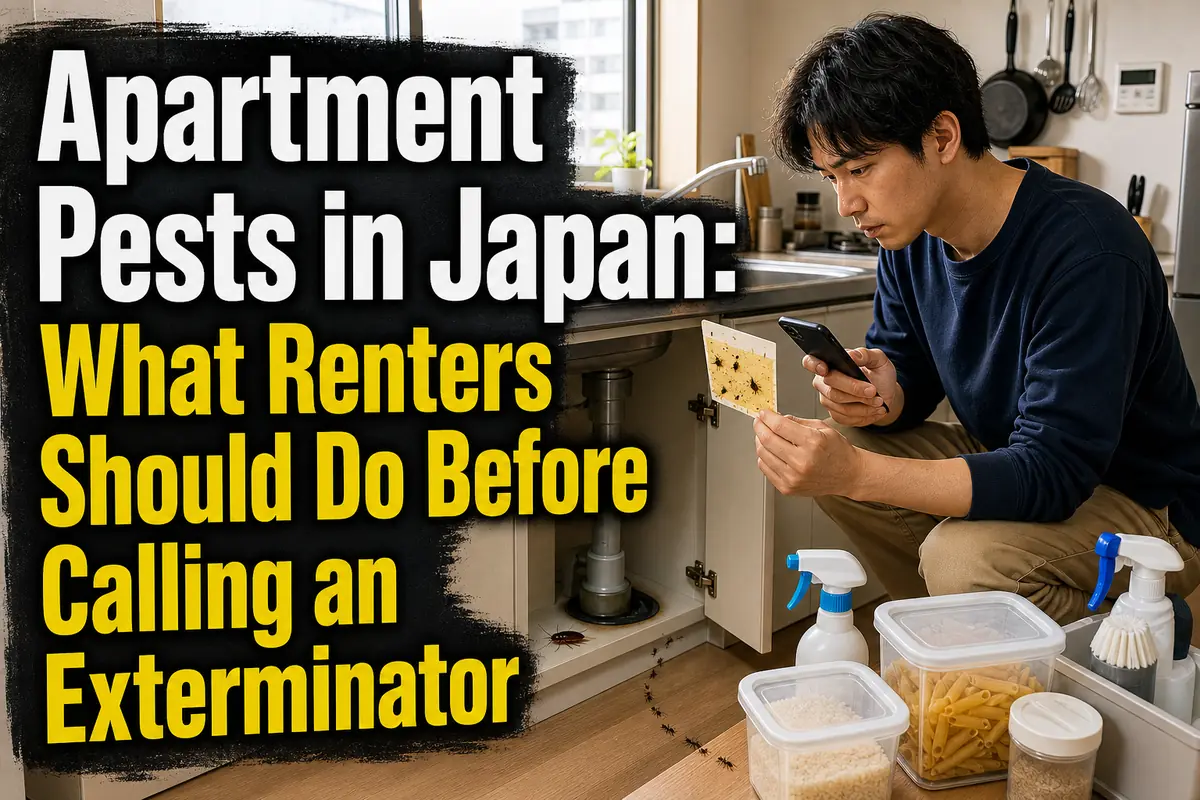
Apartment Pests in Japan: What Renters Should Do Before Calling an Exterminator
If you find one cockroach or a short trail of ants, start with cleaning, food control, traps, and targeted bait. Contact your landlord or property management company before hiring a contractor when insects keep returning, appear in several rooms, seem to enter through the building, or require treatment beyond your own unit.
This guide is for students, workers, and other renters who are new to Japanese apartments. It explains what you can usually handle yourself, when the building manager needs to act, and how to avoid an unexpectedly large extermination bill.
Quick guide
- One isolated insect: remove it, clean the area, and monitor with traps.
- Repeated sightings: photograph the insects and record where and when they appear.
- Cracks, leaks, drains, shared corridors, or neighboring units may be involved: notify management.
- Before using smoke or fog products—or hiring a contractor—check your lease and ask management.
First decide whether this is an isolated visitor or a building problem
The number, location, and timing of sightings matter more than the shock of the first encounter. A single insect near an open door is different from repeated activity around plumbing or insects appearing across several rooms.
Signs you may be able to handle it yourself
A limited response may be reasonable when:
- you have seen only one cockroach;
- ants follow one visible route to exposed food;
- there are no signs of insects in cabinets, appliances, or several rooms;
- the source appears to be an open window, balcony door, package, or grocery bag;
- cleaning and sealing food immediately reduces activity.
Use sticky traps to check whether more insects are present. A trap is not only a killing tool; its location can show where insects are moving.
Signs that management should be involved
Contact the kanri gaisha (管理会社, property management company) or y大家/ōya (大家, landlord) when:
- cockroaches appear repeatedly, especially small ones;
- insects are active in more than one room;
- activity centers on pipe openings, drains, wall gaps, an air-conditioning opening, or a utility shaft;
- ants return after food has been removed and the route has been cleaned;
- insects are also visible in a hallway, garbage area, stairwell, or another shared space;
- a water leak, damaged seal, broken screen, or building crack may be creating an entry point;
- treatment may affect another unit, a shared wall, fire equipment, or common property;
- the lease requires approval before pest-control work.
These signs do not prove that the building owner must pay. They show that treating only your room may fail if the source or route lies elsewhere.
ここがポイント: In a rental, report a repeated infestation before arranging structural work or whole-room chemical treatment. Management needs a chance to inspect the building, identify responsibility, and approve any contractor.
A practical response to cockroaches
Cockroach control works best when food, hiding places, entry routes, and the insects themselves are addressed together. Spraying the insect you can see deals with the immediate problem but may not address the source.
Public-health guidance from Yokohama City and Tokyo materials emphasize sanitation, physical exclusion, monitoring, and correct pesticide use.
Step 1: Remove food and water access
Do this on the same day:
- put rice, flour, snacks, and pet food in closed containers;
- wash dishes and wipe grease from the cooking area;
- remove food residue from under the refrigerator, microwave, and shelves;
- empty or tightly close nama-gomi (生ごみ, food waste);
- rinse cans and bottles before storing them for collection;
- dry the sink area and repair or report leaks;
- remove unnecessary cardboard, especially near warm appliances.
Cardboard boxes are useful during a move, but their layers and gaps also provide hiding places. Unpack promptly and dispose of boxes according to your municipality’s collection rules.
Step 2: Monitor before scattering products everywhere
Place sticky traps along edges rather than in the middle of a room. Useful locations include:
- behind or beside the refrigerator;
- under the sink;
- near pipe openings;
- beside the washing-machine drain;
- close to the suspected entry point.
Write the date on each trap. Check them regularly and keep photographs. This record helps management or a contractor understand whether the activity is concentrated or widespread.
Step 3: Use the right product for the job
Common Japanese labels include:
- bēto-zai (ベイト剤): bait product;
- nenchaku torappu (粘着トラップ): sticky trap;
- sacchū su purei (殺虫スプレー): insecticide spray;
- kun’en-zai (燻煙剤): smoke or fumigating product;
- kunjō-zai (燻蒸剤): fogging or vapor-type product.
Read the complete label even if you recognize the product type. Products differ in ventilation requirements, re-entry times, approved locations, and precautions for children, pets, aquariums, food, and cooking equipment.
Do not spray directly into electrical equipment, flames, or unknown wall spaces. Do not combine products unless the labels expressly permit it.
Step 4: Seal only what belongs to your unit—and report defects
Small removable measures, such as replacing a damaged drain cover or using renter-safe gap material, may help. Permanent caulking, drilling, dismantling equipment, or altering ventilation can create repair and move-out disputes.
Photograph the gap first. Ask management whether it is an approved tenant task or a building repair.
How to respond to ants without making the trail worse
For ants, finding and removing the food source is usually more important than killing the visible line. The workers you see may be only a small part of the colony.
Follow the trail in both directions if you can do so safely. Look for:
- sugar, crumbs, cooking oil, or pet food;
- gaps around a balcony door or window frame;
- openings around pipes;
- plant pots or stored items on a balcony;
- activity coming from a shared wall or corridor.
Clean the food area and store food in sealed containers. Use a product labeled for ants and for the intended location. Avoid spraying over bait: a repellent spray can keep ants away from bait they need to carry back toward the colony.
Notify management if ants emerge from a wall, electrical fitting, fixed cabinet, or shared building area, or if they return after the route and food source have been addressed.
Do not assume every ant is an ordinary household species. If you encounter an unfamiliar ant in large numbers, an aggressive species, or ants associated with imported cargo, do not handle them bare-handed. Photograph them from a safe distance and contact the municipality for identification advice.
Who normally pays in a rental apartment?
There is no universal “tenant always pays” or “landlord always pays” rule for every pest incident. The lease, the source of the problem, the condition of the building, and the tenant’s response all matter.
Japan’s Ministry of Land, Infrastructure, Transport and Tourism explains that ordinary deterioration is generally different from damage caused by a tenant’s intent, negligence, or failure to use reasonable care. Its guidance also stresses reading the contract and documenting the property’s condition. This is general guidance, not a decision about an individual infestation.
Costs more likely to remain with the tenant
Depending on the lease and facts, a renter may be expected to cover:
- ordinary cleaning and food storage;
- basic traps or household pest products;
- a problem linked to food waste left exposed or poor routine cleaning;
- damage caused by unauthorized treatment or alterations;
- a contractor hired privately without required approval.
Situations that may require owner or management action
Management needs to investigate when the likely cause includes:
- cracks, failed seals, or openings that are part of the building;
- plumbing defects or continuing leaks;
- infestation in a common garbage area or shared corridor;
- insects moving between several units;
- a pre-existing problem documented near the start of the tenancy;
- work that requires access to common property or another apartment.
The final cost allocation can still depend on the contract and evidence. Ask for the decision and its reason in writing.
Documents and Japanese terms to check
Look through these items:
- chintai shaku keiyaku-sho (賃貸借契約書): lease agreement;
- nyūkyo no shiori (入居のしおり): resident or move-in guide;
- kanri kisoku (管理規則): building management rules;
- tokuyaku (特約): special contract clause;
- shūzen (修繕): repair;
- genjō kaifuku (原状回復): restoration at move-out.
The MLIT multilingual rental-housing resources can help foreign renters understand common housing procedures. The ministry’s restoration Q&A also recommends photographs and condition records to reduce later disputes.
How to report the problem to management
A short message with evidence is more useful than simply saying that there are bugs. Report enough detail for the manager to decide whether an inspection is needed.
Include:
- your building and room number;
- the type of insect, if known;
- the dates and approximate times of sightings;
- the rooms and exact locations involved;
- the number seen or trapped;
- photographs of insects, traps, gaps, leaks, or damage;
- the cleaning and monitoring steps already taken;
- whether insects also appear in a shared space;
- a request for instructions before hiring a contractor or using a fogger.
A simple message can read:
I have repeatedly found small cockroaches near the kitchen pipe opening since August 18. I cleaned the area and placed two sticky traps, but insects were caught on three nights. Photos are attached. Could you inspect the opening and tell me whether building treatment is needed before I hire anyone or use a smoke product?
For a Japanese subject line, you can use gaichū ni kansuru sōdan (害虫に関する相談, pest-related inquiry).
If you report by phone, send a short email afterward. A written record preserves dates, instructions, and any approval given.
Be careful with smoke, fog, and aerosol products
Whole-room products can affect alarms, neighbors, pets, and shared systems, so they should not be the automatic first step in an apartment. Check the product label, lease, and management rules before use.
Smoke from some insect-control products may activate smoke detectors. Never disable, cover, or alter fire equipment unless the product instructions and building manager specifically explain an approved procedure. Any temporary protective step must be reversed exactly as instructed. Management may instead require notice, schedule coordination, or a different treatment method.
Also check:
- whether ventilation must be stopped or restarted;
- how long people and animals must remain outside;
- how food, dishes, bedding, toys, and aquariums must be protected;
- whether gas appliances or ignition sources require special handling;
- whether neighbors or security staff need advance notice.
For safer pesticide use, Tokyo’s household insecticide guidance advises following the label and gives first-aid information for accidental exposure.
If a product gets into someone’s eyes, is swallowed, or is heavily inhaled, follow the label’s emergency instructions and seek appropriate help. Japan Poison Information Center’s general public lines operate 24 hours a day for actual acute poisoning incidents: Osaka 072-727-2499 and Tsukuba 029-852-9999. The current numbers and scope are listed on the Poison 110 service page. Call 119 for a serious or rapidly worsening emergency.
When a professional exterminator makes sense
Professional help is reasonable when the infestation persists, but a renter should coordinate the visit and price before work starts. Do not let panic turn a manageable problem into a contract dispute.
Consider professional assessment when:
- repeated trapping shows continuing activity;
- small cockroaches appear in several locations;
- the source cannot be reached safely;
- several units or shared spaces appear affected;
- treatment requires structural access;
- household members cannot safely use retail products;
- management requests a licensed or approved contractor.
Before booking, ask management these questions:
- Will you inspect the unit or arrange a contractor?
- Do you have an approved pest-control company?
- Who authorizes the work and who receives the invoice?
- Is treatment limited to my room, or will shared areas and nearby units be checked?
- What preparation and follow-up are required?
How to avoid a high-pressure pest-control bill
The National Consumer Affairs Center of Japan has warned about pest-control advertisements showing extremely low starting prices followed by much larger charges. Its English notice says consultations rose sharply and advises consumers to avoid businesses that deny them time to compare estimates.
Before any private contractor begins work, request a written estimate showing:
- inspection or call-out fee;
- target pest and treatment area;
- product or method to be used;
- preparation and cleaning charges;
- sealing or repair work;
- number of visits;
- guarantee conditions and exclusions;
- tax and total maximum price;
- cancellation charges.
Do not approve vague “complete treatment” or additional work without a price. If the amount changes after inspection, ask for the revised total in writing before work begins.
If you face an unexpected high charge, do not sign or pay simply because you feel pressured. The National Consumer Affairs Center’s March 2025 warning recommends consulting management first in a rental and comparing estimates. Depending on how the contract was formed, cooling-off rules may apply. For individual advice, call Japan’s Consumer Hotline at 188, which connects callers to a local consumer affairs office.
Common mistakes that let the problem return
Most failed responses treat the insect but leave the food, water, hiding place, or entry route unchanged. Avoid these common errors:
- spraying only the insects you can see;
- leaving pet food, grease, cans, or food waste accessible overnight;
- keeping moving boxes stacked for weeks;
- placing traps without checking or dating them;
- spraying insecticide over bait;
- sealing a wet or damaged area without reporting the underlying defect;
- using a smoke product without checking alarms and building rules;
- hiring the first emergency contractor before contacting management;
- throwing away photographs, traps, receipts, or written instructions;
- assuming the cost is automatically the landlord’s—or automatically yours.
Regional and building differences
Pest biology is similar across Japan, but assistance and apartment rules are not. Climate, season, building age, waste storage, and nearby restaurants can change the level of risk.
Municipal services also differ. A city or ward health office may provide identification advice or educational materials but may not enter a private home or pay for extermination. Yokohama, for example, directs residents with sanitary-pest questions to the relevant ward health and welfare center. Check your own municipality rather than assuming that another city’s service is available locally.
Building rules vary even within the same city. A student dormitory, company apartment, public housing unit, and private rental may each have a different reporting route. Start with the contact listed in your resident guide or lease.
A clear action plan for the first 48 hours
The best immediate response is controlled documentation and targeted action, not an unplanned whole-room treatment.
On the first day
- Remove accessible food and food waste.
- Clean grease and crumbs.
- Dry wet areas and note any leak.
- Photograph the insect and suspected entry point.
- Place dated sticky traps.
- Check the lease and resident guide.
By the second day
- Review traps and record new sightings.
- Use correctly labeled bait or another targeted product if appropriate.
- Report repeated activity, building defects, or shared-area sightings to management.
- Ask for written approval before structural work, fogging, or a private contractor.
If activity continues
- Request an inspection and written responsibility decision.
- Confirm whether nearby units or common areas will be checked.
- Compare itemized estimates if you must select a contractor.
- Keep every message, photograph, estimate, and receipt.
One insect does not automatically mean that an apartment is heavily infested. Repeated insects in the same route, however, are useful evidence. Track that route, report building-related signs early, and make management confirm the next step before money or chemicals are committed.
参照リンク
- Yokohama City: Cockroaches
- Ministry of Land, Infrastructure, Transport and Tourism: Support for Foreign Nationals in Rental Housing
- Ministry of Land, Infrastructure, Transport and Tourism: Restoration to Original Condition Q&A
- Tokyo Metropolitan Government: Safe Use of Household Insecticides
- Japan Poison Information Center: Poison 110 Telephone Service
- National Consumer Affairs Center of Japan: Warning About High-Cost Pest-Control Services