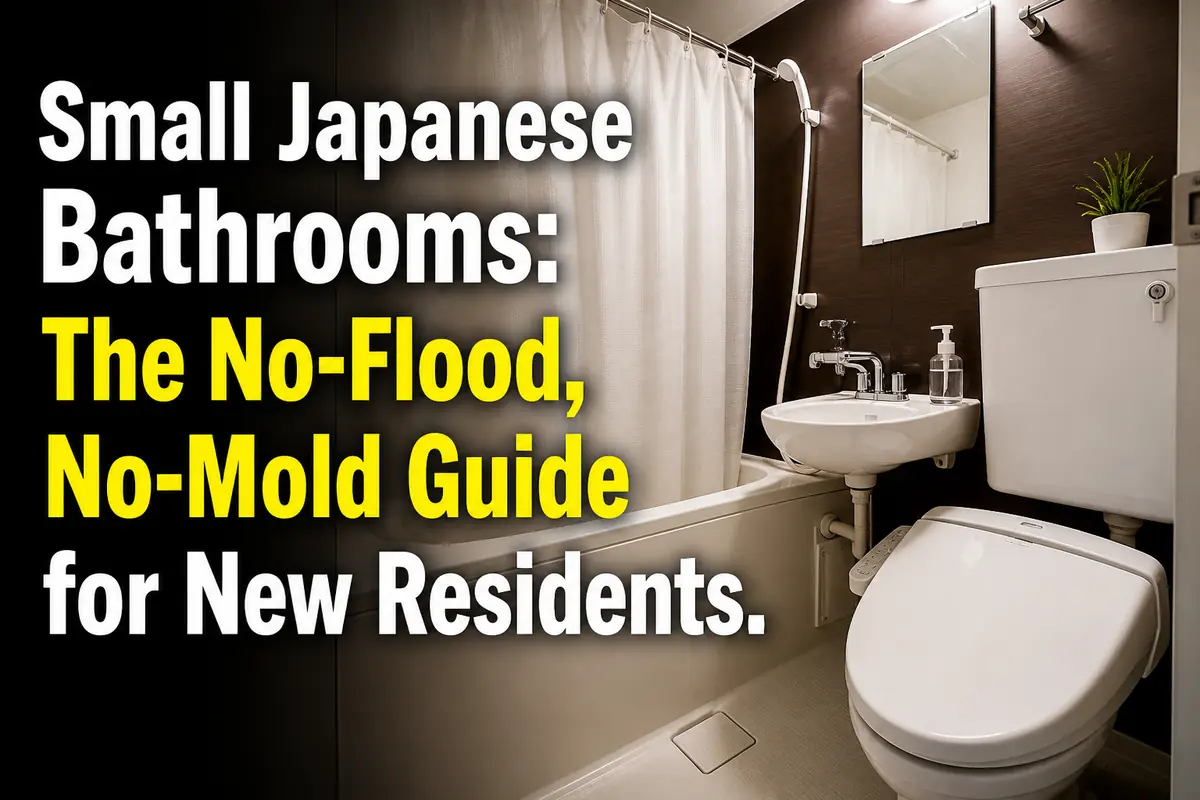
Small Japanese Bathrooms: The No-Flood, No-Mold Guide for New Residents
The safest way to use a compact Japanese bathroom is simple: keep the shower curtain inside the bathtub, keep water away from the toilet and doorway, clear hair from the drain, and ventilate the room after every shower.
This matters most in a san-ten unitto basu (3-point unit bath), where the bathtub, sink, and toilet share one small room. A careless shower can soak the toilet paper, send water into the hallway, or leave enough moisture for mold to grow.
At a glance
- “Unit bath” describes how a bathroom was built; it does not always mean that the toilet is beside the bathtub.
- In a 3-point unit bath, stand inside the tub when showering and place the curtain inside the tub.
- Remove hair before drainage becomes slow. Do not wait for water to pool around your feet.
- After bathing, rinse away soap, remove excess water, and use the ventilation system.
- Report leaks or persistent drainage problems instead of dismantling unfamiliar plumbing.
This guide is for new residents, students, workers, and longer-stay visitors using a small apartment, dormitory, or hotel bathroom in Japan. The information was checked on August 22, 2026, but the equipment manual, accommodation rules, and rental agreement for your room take priority.
First, identify the bathroom you actually have
The important distinction is not the word “unit.” It is whether the toilet, sink, and bathing area share the same wet space.
A unitto basu (ユニットバス, unit bath) is originally a prefabricated bathroom whose major parts are assembled as a unit. The term is also commonly used for a compact room containing a bath, sink, and toilet. The Japan Foundation’s housing material explains this difference and identifies the combined layout as a “3-point unit bath.”
You may encounter three layouts:
- 1-point unit: a bathtub and a separate washing floor; the toilet and sink are elsewhere.
- 2-point unit: a bathtub and sink share the room, while the toilet is separate.
- 3-point unit: the bathtub or shower, sink, and toilet are in one compact room.
In property advertisements, UB may mean only “unit bath.” It does not prove that the toilet is inside. Check the floor plan, photographs, and these Japanese labels:
- basu, toire betsu (バス・トイレ別): bath and toilet are separate
- san-ten unitto basu (3点ユニットバス): three-point unit bath
- dokuritsu senmendai (独立洗面台): separate vanity or washbasin
- yokushitsu kansōki (浴室乾燥機): bathroom drying system
- tsui-daki (追い焚き): reheating function for bathwater
ここがポイント: A bathroom with a toilet beside the tub should be treated as a controlled wet area, not as a room where every surface can automatically be sprayed.
How to take a shower without flooding the room
In a 3-point unit bath, the bathtub is normally both the shower enclosure and the place for soaking. Water control begins before you turn on the tap.
1. Move vulnerable items away from the tub
Remove clothing, towels, electronics, and paper packaging from the splash zone. If the toilet is next to the bath, check that the toilet-paper roll will remain dry.
A floor may look waterproof but still have vulnerable points around the door, toilet base, wall joints, or plumbing openings. Do not assume that water can be sprayed everywhere simply because the surfaces are plastic.
2. Put the shower curtain inside the bathtub
The lower edge of the curtain belongs inside the tub while the shower is running. Water then travels down the curtain into the tub rather than onto the floor.
Tokyo Metropolitan Government guidance for accommodation users also illustrates the curtain falling inside the tub. This small step prevents one of the most common practical problems in a combined bathroom: water reaching the toilet and doorway.
Before showering, check that:
- the curtain covers the full open side of the tub;
- its lower edge is inside the tub;
- it is not blocking the drain;
- the shower head points away from the opening;
- the bathroom door is fully closed unless the equipment instructions say otherwise.
Do not wrap the curtain tightly against your body. Leave enough room for it to hang naturally while still directing water inward.
3. Test the temperature before stepping under the water
Controls differ by building. A simple mixer may have separate hot and cold taps. A samōsutat-to kongō-sen (サーモスタット混合栓, thermostatic mixer) usually has one control for temperature and another for water flow.
Run a small amount of water and test it with your hand. If the temperature changes suddenly or the controls do not behave as expected, stop and ask the hotel, landlord, dormitory manager, or management company for instructions.
Some homes also have a wall controller for the water heater. Common labels include:
- unten (運転): on or operation
- ondō (温度): temperature
- ofuro (おふろ): bath function
- jidō (自動): automatic filling
- oi-daki (追いだき): reheating
Do not press unfamiliar automatic-fill or reheating buttons while the drain plug is open.
4. Keep the shower stream within the tub
Stand inside the bathtub and point the shower toward the wall or downward. Avoid spraying the door, ceiling equipment, toilet controls, ventilation grille, or light fitting.
If water escapes:
- Turn off the shower.
- Wipe the floor and doorway immediately.
- Check the hall or room outside the bathroom.
- Contact the property manager promptly if water has passed under the door, appeared outside the unit, or may have reached the apartment below.
A small towel is useful for ordinary droplets. It is not a substitute for reporting a leak.
Can you fill the bathtub and soak in it?
You can use the tub for soaking if the room rules, water-heating system, tub, and drain are designed for it. The practical difficulty is that a 3-point unit has no separate washing floor.
In a conventional Japanese bathroom, people usually wash outside the tub and use the tub mainly for soaking. A compact combined unit changes that workflow because showering also happens inside the tub.
A workable order for one person is:
- Shower and wash inside the empty tub.
- Rinse soap and hair from the tub and drain.
- Close the drain plug.
- Fill the tub with clean water.
- Soak.
- Drain the water when permitted and rinse the tub afterward.
This takes more water and time than a shower. In a hotel, check whether the room has a hot-water limit or other instructions. In a shared household, ask before keeping or reusing bathwater.
Never activate oi-daki unless the tub has a visible circulation fitting and the equipment instructions confirm that reheating is available. A control panel elsewhere in the building does not guarantee that every function applies to your bathroom.
Drain care prevents both odors and overflows
Slow drainage is an early warning, not a minor inconvenience. In a tiny bathtub, a partial blockage can make water rise around your feet and escape more easily.
Remove hair frequently
Look for the heā kyacchā (ヘアキャッチャー, hair catcher) beneath the drain cover. Remove collected hair and visible debris after bathing or as often as the equipment manual directs.
Manufacturer instructions vary by model. For example, a Cleanup system-bath manual tells users to remove hair from the catcher after each bath, while LIXIL gives model-specific schedules for deeper drain care. The useful lesson is not one universal timetable: inspect the drain often and follow the instructions for the installed unit.
For routine care:
- wear gloves;
- remove only parts designed for ordinary cleaning;
- collect hair and place it in burnable trash according to local sorting rules;
- wash the catcher with a soft brush or sponge;
- return every removable part in the correct position.
Panasonic’s drain-care instructions recommend removing hair and cleaning applicable parts with neutral bathroom detergent. Product designs differ, so use the model manual when available.
Do not pour random chemicals into the drain
Different cleaners can damage materials or create dangerous fumes when mixed. In particular, never mix chlorine-based products with acidic cleaners.
Before using any product:
- read its Japanese safety label;
- check whether it is suitable for the tub and drain material;
- ventilate the room;
- wear the protection stated on the label;
- use only the stated amount and contact time.
If the drain remains slow after accessible hair and debris have been removed, contact the property manager. Do not force tools deep into the pipe or dismantle the trap unless the manual clearly identifies that as user maintenance.
Treat gurgling, backflow, and leaks as warning signs
Stop using the bath and seek help when:
- dirty water comes back through the drain;
- drainage suddenly becomes much slower;
- water appears at the base of the toilet or outside the bathroom;
- the floor stays wet without an obvious splash;
- a strong sewer smell remains after normal cleaning;
- a drain component is cracked or cannot be reinstalled.
Take photographs, note when the problem started, and contact the landlord, hotel desk, dormitory office, or kanri-gaisha (管理会社, management company). This creates a record and allows the correct contractor to inspect the plumbing.
Ventilation is part of using the bathroom
The room is not finished with your shower when the water stops. Moisture left on the curtain, walls, and door can support mold and odors.
Use the installed ventilation mode
Look for these controls:
- kanki (換気): ventilation
- kan-sō (乾燥): drying
- danbō (暖房): heating
- ryōfū (涼風): cool-air or fan mode
- 24-jikan kanki (24時間換気): continuous 24-hour ventilation
- teishi (停止): stop
Ventilation and powered drying are not the same. Kanki mainly exchanges humid air; kansō may use a heater and more electricity. Follow the installed controller’s manual rather than guessing from the button names.
Panasonic explains that bathroom ventilation equipment removes moisture after bathing and helps reduce mold and odor. Its cleaning guidance also notes that efficient ventilation may require the window and bathroom door to remain closed while the fan runs. Air normally enters through a designed gap or grille, but the correct arrangement depends on the unit.
Do not switch off a building’s continuous ventilation simply because the fan makes a low sound. Ask the manager whether it is intended to operate continuously.
A practical after-shower routine
Use this order unless the property or equipment instructions differ:
- Rinse soap and shampoo from the tub, wall, and curtain.
- Remove hair from the catcher.
- Wipe or squeegee large areas of standing water.
- Spread the curtain so both sides can dry.
- Close the bathroom door if required for the ventilation system.
- Run kanki or the specified drying mode.
- Leave towels and clothing outside the wet room unless using an approved laundry-drying mode.
LIXIL’s bathroom care guidance identifies lowering the room temperature and ventilating thoroughly as important parts of mold prevention.
Cleaning without damaging a rental bathroom
Frequent light cleaning is safer than aggressive cleaning after dirt becomes severe. Soap residue, body oils, water scale, and moisture accumulate quickly in a compact space.
After each use
Concentrate on the parts that stay wet:
- rinse the tub and curtain;
- remove visible hair;
- wipe the door edge and floor outside the tub if splashed;
- dry the toilet seat and paper holder if necessary;
- start ventilation.
Regularly
Inspect and clean:
- the drain cover and hair catcher;
- the lower edge of the shower curtain;
- seals around the tub and wall;
- the underside of the sink;
- the toilet base;
- the door track or lower drainage channel;
- the ventilation grille, following its manual.
Some bathroom doors contain a small lower drainage channel that can clog with dust and hair. LIXIL’s guidance for applicable models recommends cleaning that area about once a week, but your unit may have a different design.
Use a soft sponge and a bathroom cleaner approved for the surface. Avoid abrasive pads, hard brushes, boiling water, and unapproved solvents. Never stand on the sink, toilet, or edge of the bathtub to reach the ceiling.
Rental responsibility: normal wear is not the same as neglect
There is no special nationwide “unit bath law” telling residents exactly how long to run a fan or how often to clean a drain. Your duties come from the rental agreement, equipment instructions, building rules, and the general responsibility to use the property with reasonable care.
Japan’s Ministry of Land, Infrastructure, Transport and Tourism states that restoration does not automatically mean returning a rental to its brand-new move-in condition. Ordinary aging and wear from normal use are generally treated differently from damage caused by carelessness.
However, the ministry’s restoration Q&A gives neglected cleaning that causes difficult mold damage as an example that may be attributed to the tenant. It also warns tenants to report equipment problems: failing to report a leak that then spreads damage can create further responsibility.
For renters, the practical record is straightforward:
- photograph existing stains, cracked seals, rust, and slow drainage when moving in;
- send the manager written notice if something is already wrong;
- keep the bathroom reasonably clean and ventilated;
- report leaks, recurring mold, and equipment failure promptly;
- retain messages and repair records.
The ministry provides multilingual move-in and move-out materials for foreign tenants. These are useful when discussing pre-existing damage or restoration charges.
Common mistakes and what to do instead
Most problems begin with a small assumption about how the room works.
-
Mistake: Leaving the curtain outside the bathtub.
Put it inside before turning on the shower. -
Mistake: Spraying the whole combined room.
Keep the shower stream inside the tub unless the manual explicitly identifies other surfaces as washable that way. -
Mistake: Letting hair disappear into the drain.
Use the catcher, remove the hair, and dispose of it as trash. -
Mistake: Opening the bathroom door to “help” the fan.
Check the ventilation instructions. Some systems work better with the door and window closed. -
Mistake: Stopping 24-hour ventilation to save power.
Confirm the building’s instructions first. Continuous ventilation may serve more than the bathroom. -
Mistake: Mixing cleaning products.
Use one compatible product at a time and follow its label. -
Mistake: Ignoring a small leak or recurring mold.
Photograph it and report it before hidden damage grows. -
Mistake: Assuming every “UB” property has a toilet in the bath.
Check the floor plan and ask whether it is a 1-, 2-, or 3-point unit.
What to check before renting or checking into a hotel
A photograph can tell you more than the words “unit bath.” Inspect the usable layout.
For an apartment or dormitory
Check:
- whether the toilet is in the bathing room;
- whether the shower curtain and rail are present;
- where towels and toilet paper can stay dry;
- whether the drain empties normally;
- whether ventilation operates;
- whether mold, cracked seals, or water stains already exist;
- whether the water-heater controls have understandable instructions;
- who handles plumbing and ventilation repairs.
If bathroom comfort matters more than floor space, search for basu, toire betsu. If a lower rent matters more, a clean and well-ventilated 3-point unit may be a reasonable compromise. Compare the actual room, not only the label.
For a hotel
Confirm whether “private bathroom” means a combined bath-and-toilet unit, a shower-only room, or a bathroom with a separate washing area. Ask the front desk if the hot-water control, drain, or ventilation is unclear.
A hotel guest should report a blockage immediately rather than attempting a chemical or mechanical repair. The hotel needs the chance to prevent water damage and may be able to offer another room.
A final no-problem checklist
Before leaving the bathroom, take ten seconds to check:
- Is the tap fully off?
- Is the water draining normally?
- Is the floor near the toilet and door dry?
- Is the toilet paper dry?
- Is hair out of the drain catcher?
- Is the curtain spread so it can dry?
- Is the correct ventilation mode running?
The next watchpoint is not the size of the room. It is any change in how it behaves. Slower drainage, a persistent smell, new discoloration, or unexplained water outside the tub should be cleaned, documented, or reported early—not left until move-out.
参照リンク
- The Japan Foundation: Irodori—Preparing to Move
- Tokyo Metropolitan Government: Accommodation and Bathroom Guidance
- Cleanup: System Bathroom Instruction Manual
- Panasonic: Bathroom Drain Care
- Panasonic: Bathroom Ventilation and Drying Equipment
- Panasonic: Bathroom Cleaning Tips
- LIXIL: Bathroom Cleaning and Mold Prevention
- LIXIL: Bathroom Door Drain Maintenance
- Ministry of Land, Infrastructure, Transport and Tourism: Restoration Q&A
- Ministry of Land, Infrastructure, Transport and Tourism: Rental Housing Support for Foreign Nationals