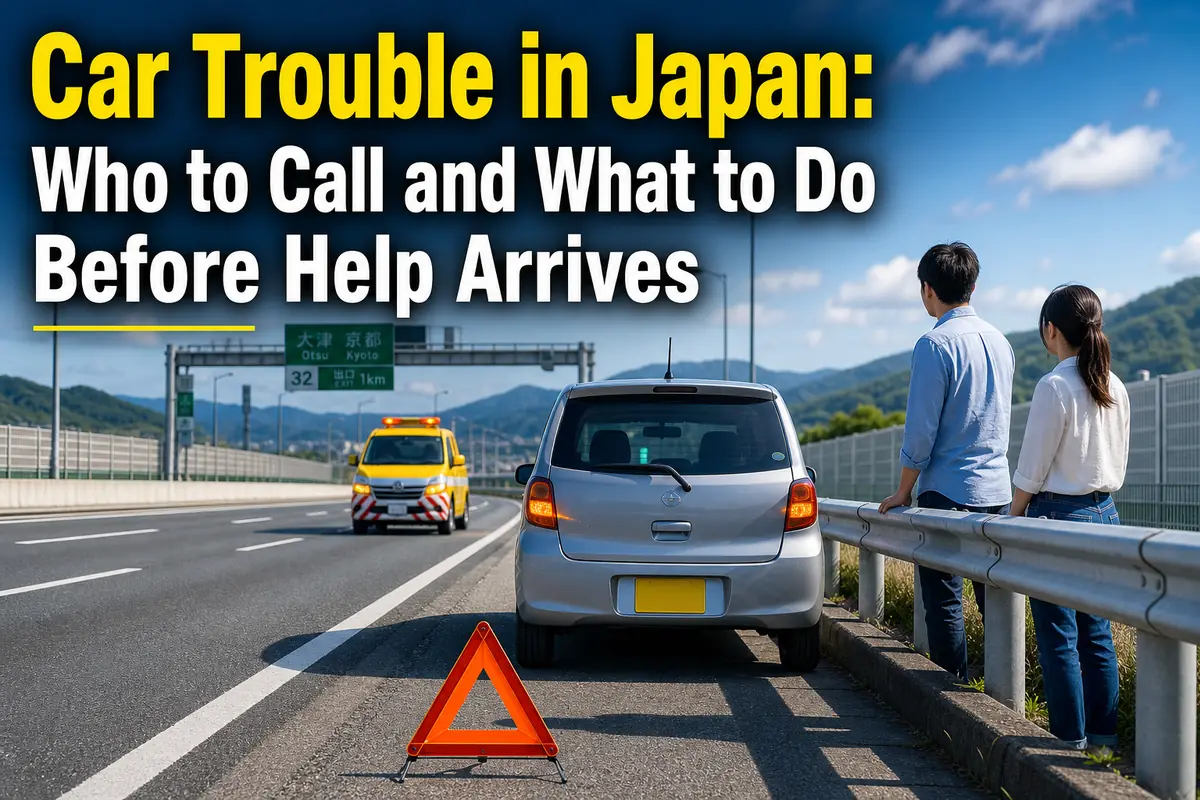
Car Trouble in Japan: Who to Call and What to Do Before Help Arrives
If your car stops in Japan, protect people first and arrange the vehicle later. Turn on the hazard lights, move left if the car can still move, warn approaching traffic, and get everyone to a safe place. On an expressway, do not wait inside the car.
Use the number that matches the problem:
- 119 — ambulance or fire service
- 110 — traffic accident, injuries, or another police emergency
- #9910 — a stopped vehicle, fallen object, road damage, or other road hazard
- #8139 or 0570-00-8139 — JAF roadside assistance
- Your insurer or rental company — assistance included in your contract
This guide is for foreign residents, new drivers, and visitors using a private, company, borrowed, or rental car. The information and published prices below were checked on August 22, 2026, but insurance benefits and operator procedures depend on the individual contract.
The first five minutes matter most
Your first job is to prevent a second collision—not to inspect or repair the car. A stationary vehicle is especially dangerous on an expressway, where another driver may not recognize that it has stopped.
1. Warn other drivers and move left
Switch on the hazard lights immediately. If the car still responds safely, reduce speed gradually and move to the shoulder or an emergency parking bay. Do not brake suddenly merely to reach the side.
After stopping:
- Apply the parking brake and stop the engine when appropriate.
- Use a hatsuentō (発炎筒, emergency flare) and a teishi hyōjiban (停止表示板, warning triangle) if you can place them without exposing yourself to traffic.
- Do not stand directly in front of or behind the vehicle.
- Never try to push a car while traffic is passing close by.
Japanese expressway guidance says a warning triangle must be displayed when a vehicle is stopped because of a breakdown or accident. A flare helps approaching drivers notice the danger, but it does not replace the triangle.
2. Leave the car and get behind a barrier
On an expressway, the passenger compartment is not a safe waiting room. Drivers and passengers should leave from the side away from traffic when possible, watch for approaching vehicles, and move beyond the guardrail.
Wait farther back than the disabled vehicle rather than beside it. If there is no guardrail, move as far from the roadway as the surroundings safely allow. Keep children and pets under direct control.
If leaving the vehicle would put someone in immediate danger—for example, because the car is stuck in a live lane and traffic is passing on both sides—call 110 or 119 and follow the operator’s instructions. No general guide can account for every crash position, tunnel, bridge, fire, or mobility limitation.
3. Report the road hazard before arranging a tow
After reaching safety, report the stopped vehicle. On an expressway, this remains important even if you have already called JAF, your insurer, or a towing company. The road operator can warn other drivers on electronic signs and may send a patrol to control the lane.
ここがポイント: #9910 reports danger on the road; #8139 requests mechanical roadside assistance. Calling one does not always complete the other job.
Which number should you call?
Choose by purpose: rescue people, report danger, or recover the vehicle. One incident may require more than one call.
Call 119 for injury, illness, or fire
Dial 119 when someone needs an ambulance or when there is smoke or fire. State that you are on a road, give the direction of travel, and describe any visible injuries or immediate danger.
Useful words include:
- kyūkyūsha (救急車) — ambulance
- kaji (火事) — fire
- kega (けが) — injury
- ishiki ga nai (意識がない) — unconscious
Do not delay an emergency call while trying to decide who will pay for towing.
Call 110 for a collision or police emergency
Dial 110 after a traffic accident or when police assistance is urgently required. Even a minor collision can create later insurance and liability questions, so do not privately decide that police reporting is unnecessary merely because both cars can move.
The police call does not automatically arrange repairs or transport. You may still need to contact your insurer, rental company, or JAF.
Call #9910 to report a dangerous road condition
The national dōro kinkyū daiyaru (道路緊急ダイヤル, Road Emergency Dial) is #9910. It is available 24 hours a day and is free from fixed, mobile, and public telephones. It covers hazards on expressways and major roads, including:
- A broken-down or crashed vehicle obstructing traffic
- Fallen cargo or another object on the road
- Road surface damage
- Other conditions that threaten road safety
It cannot be reached from some services, including phones using a 050 IP-number range and satellite phones. Do not make the call while driving; stop somewhere safe or ask a passenger to call.
When connected, expect to give the road name, direction, approximate location, and nature of the hazard. On an expressway, signs for nearby interchanges, tunnels, bridges, service areas, or kilometer markers can help identify the location.
Use an expressway emergency telephone when available
An expressway hijō denwa (非常電話, emergency telephone) connects directly to a road control center. On routes managed by NEXCO Central, these phones are generally installed:
- Every 1 kilometer on the main expressway
- Every 200 meters in tunnels
- At interchanges, service areas, parking areas, bus stops, and emergency parking bays
The handset or equipment lets the control center identify the approximate location. Some units also have buttons for breakdown, accident, ambulance, or fire, which can help when spoken Japanese is difficult.
Walk to a phone only if the route is safe. Stay beyond the guardrail where possible and watch your footing as well as traffic.
Call JAF for roadside work
JAF accepts roadside-assistance requests at #8139 or 0570-00-8139 and operates nationwide, 24 hours a day, throughout the year. It can handle common problems such as a flat battery, flat tire, lockout, fuel shortage, and towing.
JAF is not limited to members. Non-members can call, but the work is charged at the published non-member rate.
JAF, insurance, and rental support are not interchangeable
The best first assistance provider is usually the one you already pay for—but only after you confirm what the contract covers. Calling the wrong provider can mean paying a fee that another service would have covered.
JAF follows the member
Individual and family JAF membership generally covers the person rather than one registered car. That matters if you drive more than one vehicle: eligible rental cars, company cars, motorcycles, and a friend’s car may be covered when the member is driving or riding in the vehicle.
Published individual membership fees under rules effective from April 1, 2025 are:
- Joining fee: ¥2,000
- Annual membership fee: ¥4,000
- Family membership: ¥2,000 per year for an eligible family member, with no joining fee
JAF membership does not make every roadside expense free. Parts, fuel, consumables, tolls incurred by the service vehicle, special recovery work, and towing beyond the included distance can still be charged. Members must also be able to confirm valid membership.
Insurance usually follows the insured vehicle and policy
Japanese voluntary motor insurance, nin’i hoken (任意保険), often includes a roadside-support benefit. However, there is no single national package shared by every insurer.
Check the policy, insurer app, or emergency card for:
- Towing distance or maximum benefit amount
- Battery jump-start and flat-tire support
- Fuel delivery and whether the fuel itself is charged
- Lockout support
- Transport or accommodation after a breakdown
- Whether prior approval is required before choosing a tow company
- Exclusions for repeated calls, poor maintenance, off-road recovery, or lost keys
Insurance support may be the better first call when the policy includes a long tow to an approved repair shop or additional travel expenses. JAF may be more flexible when the member is in an eligible vehicle that is not named on the policy.
Some insurers cooperate with JAF and offer additional benefits to customers who have both. Do not assume that the systems combine automatically; tell the operator that you are a JAF member and give the insurer’s name.
A rental company controls the next step for its car
With a rental car, call the number in the rental agreement, key tag, vehicle documents, or operator app. The company may specify the assistance provider and repair destination.
This is important because:
- Roadside work may already be included in the rental plan.
- The operator may prohibit an independently arranged repair.
- A collision may trigger separate accident-reporting and compensation procedures.
- A non-operation charge or damage liability may be separate from the towing bill.
JAF membership can apply to eligible rental cars, but it does not cancel the renter’s duties under the rental agreement. If the car is creating immediate danger, report the hazard first and contact the rental company from safety.
What roadside assistance may cost
Without membership or contractual cover, one ordinary breakdown can cost much more than JAF’s annual fee. The final amount depends on the time, location, work performed, distance, parts, tolls, and whether special recovery is needed.
JAF’s current English cost page says its price schedule was revised in April 2024. Published examples include:
- Daytime battery jump on an ordinary road: ¥21,700 for a non-member; generally no service charge for a member
- Nighttime spare-tire change on an ordinary road: ¥25,630 for a non-member; generally no service charge for a member
- Nighttime lockout on an ordinary road: ¥25,630 for a non-member; generally no service charge for a member
- Daytime fuel delivery on an expressway outside a service or parking area: ¥32,610 for a non-member, plus service-vehicle tolls; members pay for the fuel
- Daytime towing on an ordinary road: from ¥27,700 for a non-member, with towing charged separately
For members, towing of a disabled vehicle is generally included for the first 20 kilometers, followed by ¥830 per kilometer or part of a kilometer. Supplies and fuel are charged at cost. Accident recovery, ditch extraction, four-wheel-drive towing, and other special work can add charges for members as well as non-members.
These are JAF examples, not universal market prices. Ask the dispatcher what is covered and request an estimate when the situation is stable enough to discuss cost.
Information to prepare before calling
A dispatcher can reach you faster when the location and vehicle are clear. You do not need perfect Japanese, but you should collect the details visible around you.
Give or prepare:
- Your name and callback number
- Expressway or road name
- Direction of travel, such as nobori (上り) or kudari (下り)
- Nearest interchange, junction, tunnel, bridge, service area, or kilometer marker
- Vehicle registration number and color
- Car maker and model, if known
- Whether the vehicle is in a traffic lane, shoulder, parking area, or private property
- Number of passengers and whether anyone is injured
- Visible symptoms, such as smoke, leaking fluid, a flat tire, or an engine that will not start
- JAF membership number, insurance policy number, or rental agreement number
A map pin is useful, but do not depend on it alone. Mountain roads, tunnels, and divided expressways can make a phone’s location inaccurate or ambiguous.
Useful Japanese phrases include:
- Kuruma ga ugokimasen. (車が動きません。) — The car will not move.
- Kōsokudōro no rosoku ni imasu. (高速道路の路側にいます。) — I am on the expressway shoulder.
- Jiko desu. (事故です。) — There has been an accident.
- Kega-nin ga imasu. (けが人がいます。) — Someone is injured.
- Rekkāsha ga hitsuyō desu. (レッカー車が必要です。) — A tow truck is needed.
Common mistakes that increase danger or cost
Most avoidable problems come from waiting in the wrong place or ordering help before checking existing cover. Keep the following points in mind.
Waiting inside the car on an expressway
A shoulder does not protect a stopped car from a following vehicle. Move beyond the barrier when it is safe to do so, and wait behind the car’s position rather than next to it.
Calling only a tow company
A tow request does not necessarily notify the road operator. Report a stopped vehicle or other road hazard through #9910, an emergency telephone, or police as appropriate.
Confusing #9910 with #8139
The numbers look similar but have different roles:
- #9910: report a hazard to road authorities
- #8139: request JAF roadside service
Save both in your phone with English labels.
Authorizing an outside tow too quickly
An insurer or rental company may require its own dispatch process. If there is no immediate safety reason to choose independently, call the contract provider before agreeing to paid work.
Attempting a roadside repair in a dangerous position
Changing a tire beside fast traffic is not worth the risk. Even if you know how to make the repair, move everyone to safety and request professional help when the work area is exposed.
Assuming a warning triangle comes with every car
Before a trip, physically check the trunk or storage compartment for a warning triangle and learn how it opens. Also locate the flare, reflective vest, spare tire or repair kit, and wheel-lock key. Equipment differs among private, company, and rental cars.
Ordinary roads, remote areas, and bad weather
The safe sequence stays the same, but access and response conditions change by location. A quiet city street, an icy Hokkaido road, and a mountain expressway cannot be handled identically.
On an ordinary road, move the vehicle out of the traffic flow if possible without creating another risk. Do not block an intersection, railway crossing, or emergency access route. If the car is on private property, tell the assistance provider because entry and recovery conditions may differ.
In snow, flooding, mud, or mountainous terrain:
- Do not walk into an unsafe area merely to find reception.
- Tell the dispatcher about water depth, snow, slope, or an unpaved surface.
- Expect delays when weather causes many simultaneous calls.
- Special extraction may fall outside standard free assistance.
- Follow police, fire service, road operator, or municipal evacuation instructions when they conflict with an ordinary breakdown plan.
Road operators also differ. NEXCO East, Central, and West manage large parts of the national expressway network, while other urban and regional operators have their own control centers and procedures. Road signs and emergency telephones at the scene are therefore more reliable than a memorized regional customer-service number.
A five-minute check before your next drive
Preparation is simplest when it is done before the engine starts. Add this check to any long trip, unfamiliar rental, or drive through a remote area:
- Save 119, 110, #9910, and #8139.
- Save the insurer or rental company’s emergency number.
- Photograph the policy or rental assistance page for offline access.
- Confirm the warning triangle, flare, reflective vest, and tire equipment are present.
- Check fuel or battery range, tire condition, and warning lights.
- Learn the vehicle’s exact model and registration number.
- Tell passengers that an expressway evacuation means leaving the car and going beyond the barrier.
The key decision after a breakdown is not “JAF or insurance?” It is “Where can everyone wait without being hit?” Make that decision first. Once people are protected and the road hazard has been reported, check the insurance or rental contract before authorizing paid recovery.
参照リンク
- JAF: Emergency Measures
- JAF: About Road Service
- JAF: JAF vs Insurance
- JAF: Road Service Costs
- JAF: List of Road Service Charges
- JAF: Membership Regulations and Fees
- JAF: Eligible Vehicles
- NEXCO Central: Expressway Manner Guide
- NEXCO Central: Road Emergency Dial #9910
- NEXCO Central: Emergency Telephone Guide
- NEXCO Central: What to Do After an Accident or Breakdown