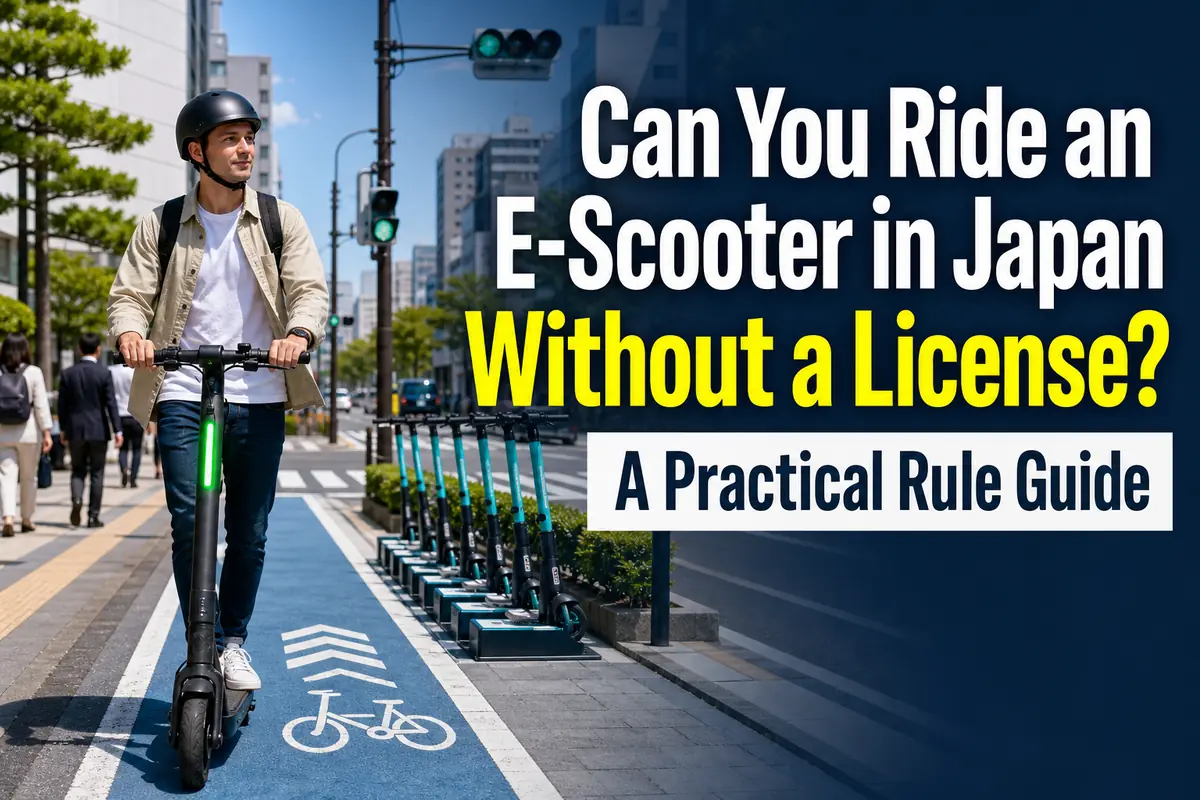
Before You Ride an E-Scooter in Japan: The Rules That Decide Where You Can Go
You can ride some electric kick scooters in Japan without a driver’s license, but only if the vehicle qualifies as a specified small motorized bicycle (tokutei kogata gendōki-tsuki jitensha). You must be at least 16, ride mainly on the left side of the road, and obey traffic rules that are closer to bicycle rules than pedestrian rules.
A helmet is strongly recommended but is not legally mandatory for this vehicle class. Sidewalk riding is allowed only in limited cases, at no more than 6 km/h, using a compatible vehicle mode.
This guide is for visitors, students, workers, and new residents considering a shared or privately owned e-scooter in Japan.
The essentials:
- No license is required only for a qualifying specified small motorized bicycle.
- Riders must be 16 or older, and carrying a passenger is prohibited.
- The normal place to ride is the left edge of the roadway—not the sidewalk.
- Drinking and riding, using a phone while moving, and ignoring traffic signals are illegal.
- Privately owned scooters need compulsory insurance and a municipal number plate.
First check the scooter’s legal class
The scooter’s appearance does not tell you whether it is license-free. Its specifications decide which rules apply.
Japan’s license-free category is called tokutei kogata gendōki-tsuki jitensha, commonly shortened to tokutei gen-tsuki. A qualifying vehicle must meet requirements that include:
- maximum length of 190 cm and width of 60 cm;
- an electric motor rated at no more than 0.60 kW;
- a top speed of no more than 20 km/h;
- no ability to change the top-speed setting while moving;
- an automatic transmission; and
- a compliant maximum-speed indicator light.
The vehicle must also meet national safety standards. A Japanese performance confirmation sticker (seinō-tō kakunin-zumi shīru) is a useful sign that a model has been checked under the government’s confirmation system.
Do not assume that a scooter bought overseas or advertised online as “road legal” meets Japanese requirements. The Ministry of Land, Infrastructure, Transport and Tourism has previously identified models sold online that did not comply with the applicable standards.
What if it does not qualify?
A faster or noncompliant scooter may be treated as a general motorized bicycle or another motor-vehicle class. Depending on the classification, the rider may need:
- an appropriate Japanese-recognized driver’s license;
- a legally required helmet;
- different safety equipment;
- a number plate; and
- compulsory automobile liability insurance.
It cannot use the special sidewalk exception described later in this guide. Riding it as though it were a license-free scooter can result in violations such as unlicensed driving.
For a shared scooter, confirm the vehicle class and complete the operator’s required safety test in the app. For a personal purchase, check the model against the official safety information before paying.
License, age, helmet, and insurance rules
For a qualifying specified small motorized bicycle, age—not nationality or residency status—determines basic eligibility.
No license, but riders must be at least 16
A driver’s license is not required. However, anyone under 16 is prohibited from riding, and another person must not provide such a vehicle to someone under 16.
A foreign driving license or international driving permit does not remove this age restriction. Likewise, being over 16 does not make every electric scooter license-free; the vehicle must still meet the specified-category standards.
Rental operators commonly verify age and identity through their apps. Their registration requirements are service conditions in addition to national law.
Helmets are a duty to make an effort
For this category, wearing a riding helmet is a doryoku gimu, meaning a legal duty to make an effort. It is not the same as an enforceable helmet mandate.
That distinction should not be read as “a helmet is unnecessary.” Small wheels can react sharply to road joints, drainage covers, and uneven surfaces. Wear a properly fitted riding helmet even when a rental operator does not supply one.
If the scooter belongs to a different motor-vehicle class, helmet use may be compulsory rather than recommended.
Insurance and registration depend on ownership
Every specified small motorized bicycle used on public roads must have compulsory automobile liability insurance or mutual aid, known as jibaiseki hoken or jibaiseki kyōsai. It must also display a number plate.
With a shared scooter, the operator normally handles the vehicle’s registration and compulsory coverage. Check the operator’s terms to see what additional protection applies to the rider and to property damage.
If you own the scooter, you must arrange these items yourself:
- Ask your city, ward, town, or village office how to obtain the small number plate.
- Purchase compulsory liability insurance through an insurer, agency, eligible post office, convenience-store service, or other participating channel.
- Attach the plate and insurance sticker correctly.
- Check the insurance expiry date and renew it before it lapses.
Compulsory insurance primarily addresses injury or death suffered by another person. It does not cover property damage, such as damage to a parked car, so voluntary liability coverage is worth considering.
ここがポイント: A license-free scooter is not an unregulated toy. The rider must be 16 or older, while the vehicle still needs legal equipment, compulsory insurance, and a number plate.
Where you may ride
The roadway is the default; sidewalk use is a narrow exception. This is the rule most likely to surprise a first-time rider.
Use the left side of the roadway
Where a roadway and sidewalk are separated, ride on the roadway and keep near its left edge. Riding against traffic on the right is prohibited. Bicycle paths may also be available where signs and road design permit.
While riding, you must follow traffic signals, stop signs, one-way restrictions, and other signs that apply to the vehicle. At a pedestrian crossing, slow down unless it is clear that nobody is crossing. Stop and yield when someone is crossing or about to cross.
Do not enter a road simply because the rental app displays it as part of the service area. An app’s operating zone does not override road signs.
Sidewalks are not generally open to e-scooters
A scooter may use certain sidewalks only when it qualifies as an exceptional specified small motorized bicycle (tokurei tokutei kogata gendōki-tsuki jitensha) while in the relevant mode.
The practical conditions include:
- the vehicle is physically limited to 6 km/h or less in that mode;
- its green maximum-speed indicator light is flashing;
- the sidewalk is marked to allow ordinary bicycles and pedestrians; and
- the rider stays on the roadway-side portion of the sidewalk or in the designated bicycle section.
Simply easing off the throttle and travelling below 6 km/h is not enough. The scooter must be in a compliant mode that cannot exceed 6 km/h.
Pedestrians have priority. If your movement would obstruct them, stop. When you cannot confirm that both the vehicle and sidewalk qualify, get off and walk the scooter.
Right turns use the two-step method
Specified small motorized bicycles make a two-step right turn (nidan-kai usetsu) at intersections.
In left-side traffic, this means:
- continue straight across the intersection on a green signal;
- stop on the far side and turn the scooter to face right; and
- cross when the signal in the new direction turns green.
Do not move into the centre of the roadway and turn like a car. A green right-turn arrow for motor vehicles does not authorize a specified small motorized bicycle to make a direct right turn.
For a left turn, signal in advance, stay near the left edge, slow down, and avoid blocking pedestrians.
Conduct that remains illegal
The lack of a license does not remove criminal and traffic-law responsibilities.
Do not:
- ride after drinking alcohol;
- carry a passenger;
- hold a phone, make a call, or focus on its screen while moving;
- ride on the right side against traffic;
- ignore red lights or stop signs;
- weave through vehicles waiting at an intersection or railway crossing; or
- obstruct pedestrians at crossings or on an eligible sidewalk.
Alcohol rules are especially important for tourists and new residents. There is no “short ride back to the hotel” exception. If you drink, return the scooter through the operator’s permitted process and use public transport, a taxi, or another sober option.
Repeated dangerous violations can lead to a mandatory rider course. Specified small motorized bicycles are also covered by Japan’s traffic-violation notice system and abandoned-vehicle charge system.
Parking: a return zone is not permission to block the street
Park only where both traffic law and the property or operator rules allow it. A convenient empty space is not automatically legal parking.
National stopping and parking restrictions apply. In general, do not leave the scooter:
- at an intersection, pedestrian crossing, bicycle crossing, railway crossing, or in a tunnel;
- within 5 metres of an intersection corner or pedestrian crossing;
- within 10 metres of an operating bus or tram stop;
- within 10 metres of a railway crossing;
- in front of an entrance used by vehicles; or
- where it blocks pedestrians, wheelchair users, tactile paving, doorways, traffic, or emergency equipment.
Where lawful roadside parking is possible, the vehicle must be placed along the left edge without obstructing traffic. Detailed positioning rules can depend on the type and width of the roadside strip.
Shared scooters
A shared-scooter operator may require return to a designated port or parking area shown in its app. You may need to:
- park inside the marked boundary;
- avoid private land outside the contracted area;
- photograph the parked scooter; and
- wait for the app to confirm that the trip has ended.
The operator may reject a return or continue charging if the scooter is outside its permitted zone. Even inside a digital return zone, reposition it if it blocks a real-world walkway or entrance.
Privately owned scooters
Ask the destination whether its bicycle parking area accepts specified small motorized bicycles. Building managers and parking operators may apply their own rules, and some bicycle racks cannot safely hold a scooter.
Municipal enforcement and available parking facilities differ by area. A local rule or facility condition can be stricter than what appears convenient on the street, so check the municipality and parking operator rather than relying only on a map app.
A practical check before every trip
A one-minute check can prevent most first-ride mistakes.
Before unlocking or switching on the scooter, confirm:
- Class: Is it clearly identified as a specified small motorized bicycle?
- Age: Is every rider at least 16?
- Equipment: Do the brakes, tires, lights, indicator light, and turn signals work?
- Helmet: Do you have a correctly fitted helmet?
- Route: Does the route avoid prohibited roads and confusing high-speed traffic?
- Sidewalk mode: If needed, can the vehicle physically limit itself to 6 km/h, and does the sidewalk sign permit it?
- Parking: Is there a legal destination port or accepted parking facility?
- Alcohol: Have you consumed any alcohol? If yes, do not ride.
For a private scooter, also confirm that its number plate and compulsory insurance are current.
Common mistakes and safer alternatives
Most errors come from treating an e-scooter either as a pedestrian device or as a small car. It is neither.
“No license means there are no vehicle rules”
Wrong. Traffic signals, left-side travel, parking restrictions, alcohol laws, and accident duties still apply.
Safer choice: Review the National Police Agency’s English guide before the first trip and complete any operator safety test carefully.
“Any scooter limited to 20 km/h is legal”
Wrong. Speed is only one part of the classification. Size, motor output, transmission, indicator light, equipment, registration, and insurance also matter.
Safer choice: Use an established rental service or buy a model confirmed for the Japanese category.
“I can ride slowly on any sidewalk”
Wrong. The scooter needs a compliant 6 km/h mode, and the sidewalk must have the relevant sign. Pedestrians still have priority.
Safer choice: Stay on the left side of the roadway or dismount and walk when uncertain.
“The app says I can end the ride here”
That does not cancel street restrictions or property rules.
Safer choice: Check the physical surroundings, place the scooter fully inside the marked port, and confirm trip completion in the app.
If there is a crash or breakdown
After a collision, protect people first and report the accident.
If a crash occurs:
- Stop in a safe place and switch off the vehicle if possible.
- Call 119 for an ambulance or fire service when someone is injured or immediate danger exists.
- Give reasonable aid without putting yourself or others in further danger.
- Call 110 and report the location, injuries, and damage to the police.
- Contact the rental operator or your insurer after the urgent steps.
- Record the location, vehicle details, and contact information when it is safe to do so.
Do not leave because the collision seems minor. A rider involved in an accident has duties to assist injured people and report the incident; leaving can turn the case into a hit-and-run matter.
If a shared scooter develops a brake, tire, steering, or light problem, stop using it and report the fault through the operator. For a private vehicle, do not return to public roads until it has been repaired.
Current status and what to check next
As of August 22, 2026, the national category introduced on July 1, 2023 remains the basis for license-free e-scooter use. An early transitional period for some vehicles without a maximum-speed indicator light ended on December 22, 2024, so outdated explanations of that temporary exception should not guide a current purchase or ride.
Before your next trip, check three things that can change independently:
- the National Police Agency’s current traffic guidance;
- municipal information on registration, parking, and local enforcement; and
- the rental operator’s service area, identity checks, fees, insurance terms, and return rules.
The most useful rule to remember is simple: check the vehicle class first. That single detail determines whether “no license,” an optional helmet, and limited 6 km/h sidewalk access apply—or whether you are about to ride a motor vehicle under the wrong rules.
参照リンク
- National Police Agency: Traffic Rules for Specified Small Motorized Bicycles (English PDF)
- National Police Agency: Specified Small Motorized Bicycle Rules
- Ministry of Land, Infrastructure, Transport and Tourism: Warning About Noncompliant Electric Kick Scooters
- Ministry of Land, Infrastructure, Transport and Tourism: Compulsory Insurance for Electric Kick Scooters