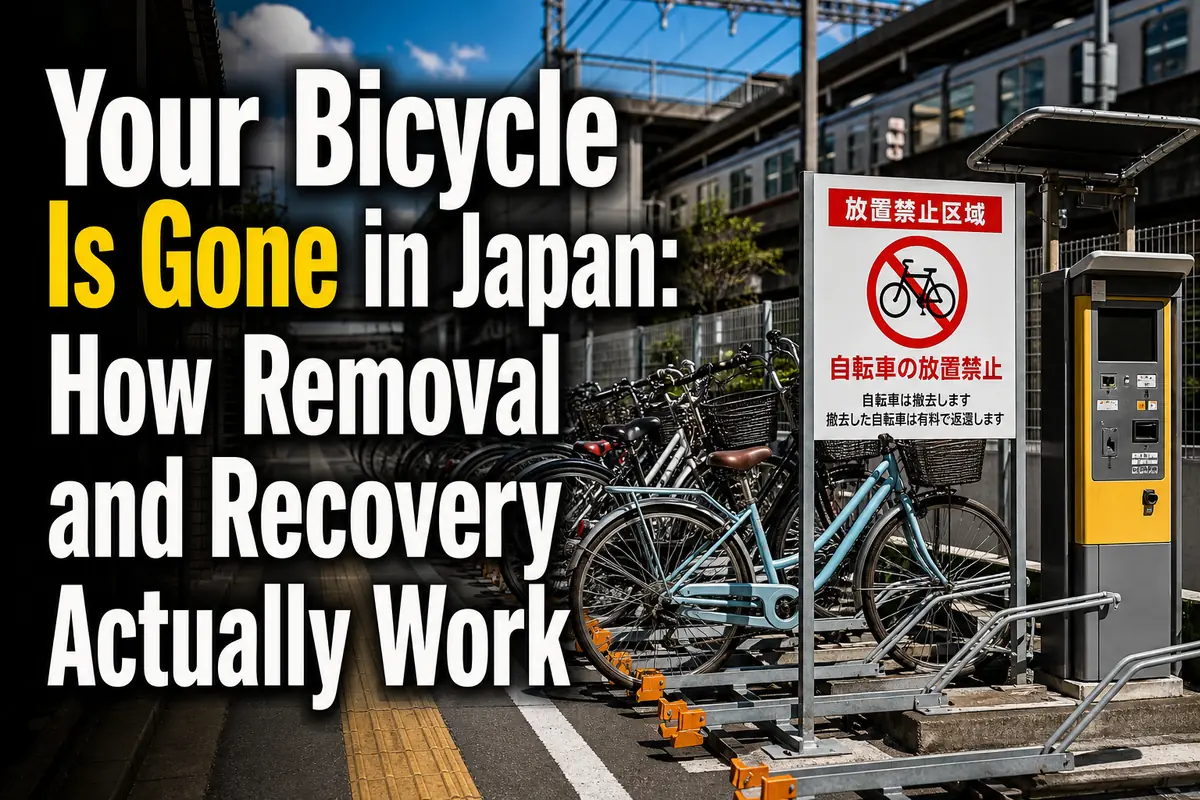
Your Bicycle Is Gone in Japan: How Removal and Recovery Actually Work
If your bicycle disappears from outside a station or shop in Japan, do not assume it was stolen. A city or ward may have removed it as a hōchi jitensha (放置自転車, an unattended bicycle).
Start by checking nearby removal notices and the municipality’s website. If officials removed the bicycle, you will normally need to visit a designated storage facility, prove your identity or connection to the bicycle, and pay a local removal fee.
This guide is for students, workers, and other residents who cycle for commuting, shopping, or daily errands. It is especially useful when you are new to Japan and cannot yet read parking signs easily.
The essentials:
- Use a marked chūrinjō (駐輪場, bicycle parking facility), even for a short stop.
- A bicycle can count as unattended as soon as you walk away from it; there may be no nationwide grace period.
- Removal rules, fees, storage periods, and required documents differ by municipality.
- If the bicycle is missing, confirm removal before filing or updating a theft report.
Where you can leave a bicycle
The safe choice is a designated bicycle parking area, not an apparently empty part of the sidewalk.
Look for the words chūrinjō (駐輪場) or jitensha chūshajō (自転車駐車場). Parking facilities may be operated by a municipality, railway company, shopping center, university, employer, apartment manager, or private business.
Station bicycle parking
Stations commonly have one or more of these options:
- Hourly or one-time parking: Useful for shopping, appointments, and occasional trips. Some facilities offer a short free period before charging.
- Daily parking: You pay for one day or one use.
- Monthly parking: Often called teiki riyō (定期利用, regular use). An application, waiting list, or proof of commuting may be required.
Do not assume that every rack is public. Check the sign for operating hours, fees, maximum parking time, and accepted payment methods before locking the bicycle.
At a mechanical rack, push the wheel fully into the rack and confirm that it has locked. Remember the rack number. At payment time, you may need to enter that number at a machine marked seisanki (精算機, payment machine).
Shops, schools, workplaces, and apartment buildings
A facility’s bicycle area is usually intended for its customers, students, employees, or residents. It is not automatically available for a full day merely because it is free.
Check for restrictions such as:
- customer use only;
- a maximum number of hours;
- registration stickers for residents or employees;
- separate spaces for motorcycles and bicycles;
- limits on large tires, child seats, cargo bicycles, or electrically assisted bicycles.
A convenience-store bicycle area is not a substitute for station parking. Leaving a bicycle there while taking a train may violate the property operator’s rules even if it does not block the street.
Sidewalks and spaces near stations
An open-looking sidewalk is not necessarily a legal parking space. Railings, utility poles, trees, tactile paving, emergency routes, and station entrances are particularly poor places to attach a bicycle.
Municipalities often designate busy areas as jitensha-tō hōchi kinshi kuiki (自転車等放置禁止区域, bicycle no-abandonment zone) or a similarly named removal zone. Signs and pavement markings identify the local boundary.
Parking immediately outside the marked boundary is not automatically permitted. For example, Shinjuku states that unattended bicycles on public roads can be removed throughout the ward, while station areas receive particular attention.
“I was only inside for five minutes” may not protect your bicycle
In local rules, the important question is often whether you can move the bicycle immediately—not how long you have been away.
Shinjuku defines an unattended bicycle as one left in a public place outside a bicycle facility when its user has moved away and cannot immediately relocate it. Kyoto uses the same practical test and says that the purpose of the stop and its length do not determine whether the bicycle is unattended.
That means all of the following can create a removal risk:
- entering a shop while the bicycle remains on the pavement;
- leaving it beside a station entrance while meeting someone;
- locking it to a roadside railing;
- placing it near other bicycles and assuming the group marks an accepted space;
- leaving it outside a full parking facility instead of finding another facility.
A warning tag is not a promise of extra time. In a designated enforcement area, removal may happen promptly under the applicable local ordinance.
ここがポイント: A locked bicycle is not necessarily lawfully parked. Municipal workers may cut a chain or wire lock when removal is necessary, and the municipality may not compensate you for the damaged lock.
National traffic rules and local removal rules are different
Japan does not operate one identical bicycle-removal system for every city.
Bicycles are treated as vehicles under Japan’s Road Traffic Act, and cyclists must follow national traffic rules while riding. Removal of unattended bicycles, however, is commonly managed by cities and wards under local ordinances.
This division matters because the following details can change when you cross a municipal boundary:
- the name and boundary of a removal zone;
- whether and how warnings are attached;
- the office responsible for removal;
- the reclaim fee;
- storage locations and opening hours;
- how long the bicycle is kept;
- accepted identification and payment methods;
- treatment of a bicycle that had already been reported stolen.
Private property is another category. A municipality may lack authority to remove a bicycle from private land, while the landowner or parking operator may act under its own posted terms. Contact the property manager if a bicycle disappears from an apartment, campus, store, or private parking area.
What to do when your bicycle is missing
First identify whether the bicycle was removed, moved by a property operator, or stolen. Acting in that order can save a wasted visit to the police station or storage center.
1. Check the exact location
Look for a notice attached to a railing, signboard, or nearby post. Useful Japanese terms include:
- tekkyo (撤去): removal;
- hōkan basho (保管場所): storage location;
- henkan (返還): return or reclaim procedure;
- tekkyo-bi (撤去日): removal date;
- hōchi jitensha (放置自転車): unattended or abandoned bicycle.
Photograph the notice. It may name the storage facility, removal date, telephone number, and documents you need.
Also check the surrounding area carefully. A store employee or building manager may have moved the bicycle a short distance if it obstructed an entrance.
2. Contact the municipality or property operator
Search the official website of the city or ward where the bicycle was left—not necessarily the municipality where you live. A useful search pattern is:
[municipality name] 撤去 自転車
When calling, prepare as much of this information as possible:
- the place and approximate time you left the bicycle;
- make, model, and color;
- frame number, if known;
- bōhan tōroku bangō (防犯登録番号, crime-prevention registration number);
- basket, child seat, stickers, or other identifying features;
- lock type and key number.
Shinjuku, for example, asks owners to contact its bicycle countermeasures call center first. The ward warns that a mailed return notice may take time because officials must identify the owner, and no notice can be sent when ownership information is unavailable.
3. If there is no removal record, contact the police
If neither the municipality nor the property operator has the bicycle, theft becomes more likely. Contact a police station or kōban (交番, police box) and ask about filing a tōnan todoke (盗難届, theft report).
Bring the bicycle registration details, purchase record, photographs, and frame number if available. The registration sticker alone is not a substitute for keeping your own records.
Do not report a bicycle stolen merely to avoid a removal fee. Municipal exemptions generally depend on a genuine theft report filed before the removal, and the exact condition is local.
How to reclaim a removed bicycle
Confirm the correct storage facility and its opening hours before traveling there. A city may use several facilities, with the destination determined by where the bicycle was removed.
The usual process is:
- Confirm that the municipality has your bicycle.
- Ask which hōkan basho holds it.
- Check the deadline, opening days, payment methods, and required documents.
- Go to the facility and identify the bicycle.
- Complete the return form and pay the fee if required.
- Inspect the bicycle before riding away.
What to bring
Requirements vary, but commonly requested items include:
- photo identification or another document showing your name and address;
- the bicycle key;
- a registration card, warranty, receipt, or other proof connecting you to the bicycle;
- the mailed return notice, if one arrived;
- the removal and storage fee;
- additional paperwork if another person is collecting it for you.
Bring a helmet if you plan to ride home. Check the tires, brakes, lights, basket, and lock first, particularly if the bicycle was transported with other bicycles.
If your residence card or other identification shows an old address, ask the facility in advance what alternative proof it accepts. Do not assume a digital photograph of a document will be sufficient.
How much removal can cost
There is no single national reclaim fee, so use local figures only as examples.
As checked on August 22, 2026:
- Shinjuku, Tokyo: ¥3,000 for a bicycle. The ward says an unclaimed bicycle may be disposed of from 30 days after removal.
- Kyoto City: ¥3,500 for a bicycle. Its official FAQ states a storage period of four weeks from the day after removal.
These examples show why advice from a friend in another city may be wrong for your case. Even within the same prefecture, neighboring municipalities can set different fees and procedures.
The reclaim charge is also separate from several other possible costs:
- transportation to the storage facility;
- a replacement lock if a chain was cut;
- late-night or weekend travel if facility hours are limited;
- repair costs unrelated to the municipality’s handling;
- unpaid parking charges under a private facility’s terms.
Always check the current official page. Fees, facilities, opening hours, and storage periods can change.
What happens if the bicycle was stolen before removal
A prior theft report can matter, but the timing requirement must be checked locally.
Both Shinjuku and Kyoto state that the return fee can be waived when the bicycle was stolen and a theft report had been filed with the police by the day before removal. This is not permission to create a report after discovering the bicycle at a storage facility.
If someone steals your bicycle and later leaves it near a station:
- report the theft promptly;
- keep the report or reference number;
- tell the police if the bicycle is later located by a municipality;
- ask the storage facility which evidence is required for a fee exemption;
- do not retrieve it informally without completing the municipality’s process.
A bicycle may still be removed even when its owner did not leave it there. Kyoto explicitly explains that a bicycle moved onto a road by another person can remain subject to removal. The prior theft report is therefore important evidence when reclaiming it.
Common mistakes that lead to removal or delay recovery
Most problems begin with assuming that a short, convenient stop is harmless.
Avoid these mistakes:
- Following other bicycles: A row of bicycles does not prove that parking is authorized.
- Using only a wheel lock: Locking a bicycle prevents casual theft but does not make the location lawful.
- Ignoring the rack mechanism: If the wheel is not fully inserted, the bicycle may obstruct the aisle or fail to register correctly.
- Forgetting where you parked: Photograph the entrance, rack number, and rate board in a large station facility.
- Waiting for a postcard: Ownership checks take time, and notices go to the address connected with available registration information.
- Going to the nearest storage center: The correct facility may depend on the removal location.
- Delaying collection: Municipalities keep removed bicycles for a limited period and may dispose of or otherwise process unclaimed bicycles.
- Leaving registration details outdated: Update records as required when ownership or address information changes, and keep the frame number separately.
A simple routine that prevents most problems
Build the parking check into every trip, especially before a new commute or class schedule begins.
Before leaving home:
- search the station or destination name plus chūrinjō;
- check whether the facility is hourly, daily, or monthly;
- confirm that your bicycle fits its racks;
- carry a payment method accepted by the operator;
- save a second nearby facility in case the first is full.
After parking:
- read the rate and maximum-use notice;
- place the bicycle fully inside the marked space;
- lock it without attaching it to public railings or another bicycle;
- photograph the rack number and entrance;
- collect it before the posted deadline.
For a regular commute, compare the monthly fee with repeated hourly charges. Students and workers should also ask their school or employer whether bicycle commuting requires advance registration or a parking sticker.
Practical answers to beginner questions
Is free bicycle parking common?
Some commercial and station facilities offer a limited free period, but it is an operator rule, not a general right. Read the sign to learn when charging begins and what happens after the maximum period.
Can I leave a bicycle beside a vending machine or utility pole?
Do not treat street furniture as a bicycle rack. The bicycle can obstruct pedestrians, wheelchair users, tactile paving, maintenance work, or emergency access even when the remaining space looks wide.
Will officials always warn me before removal?
Do not rely on a warning or a fixed waiting period. Procedures differ, and bicycles in designated enforcement areas may be removed promptly.
Can a friend collect my bicycle?
Possibly, but rules differ. Ask the storage facility whether it accepts a representative and what identification, authorization, key, or ownership evidence that person must bring.
Does this guide also apply to mopeds or electric kickboards?
Not automatically. Municipal pages may group bicycles with certain small motorized vehicles, but classifications, fees, storage locations, and traffic rules can differ. Check the vehicle category on the local official page.
What to check before your next ride
The rule that matters most is simple: when you walk away, leave the bicycle only in a space clearly intended for bicycle parking. A short errand, a strong lock, or a line of other bicycles does not turn a sidewalk into a parking facility.
If your bicycle is already missing, act today:
- photograph any removal notice;
- call the municipality responsible for that location;
- confirm the storage deadline and required documents;
- contact the police if there is no removal record;
- reclaim the bicycle before the local storage period ends.
The next watchpoint is always local. Before relying on a fee, deadline, or facility address in this guide, open the current page for the city, ward, or parking operator where the bicycle disappeared.
参照リンク
- Shinjuku City: Removal of Illegally Parked Bicycles and Motorcycles
- Shinjuku City: Measures for Unattended Bicycles
- Shinjuku City: Reclaiming a Removed Bicycle or Moped
- Shinjuku City: Bicycle Parking Facilities
- Kyoto City: Unattended Bicycle Q&A
- Kyoto City: How to Reclaim a Removed Bicycle
- National Police Agency: Traffic Bureau