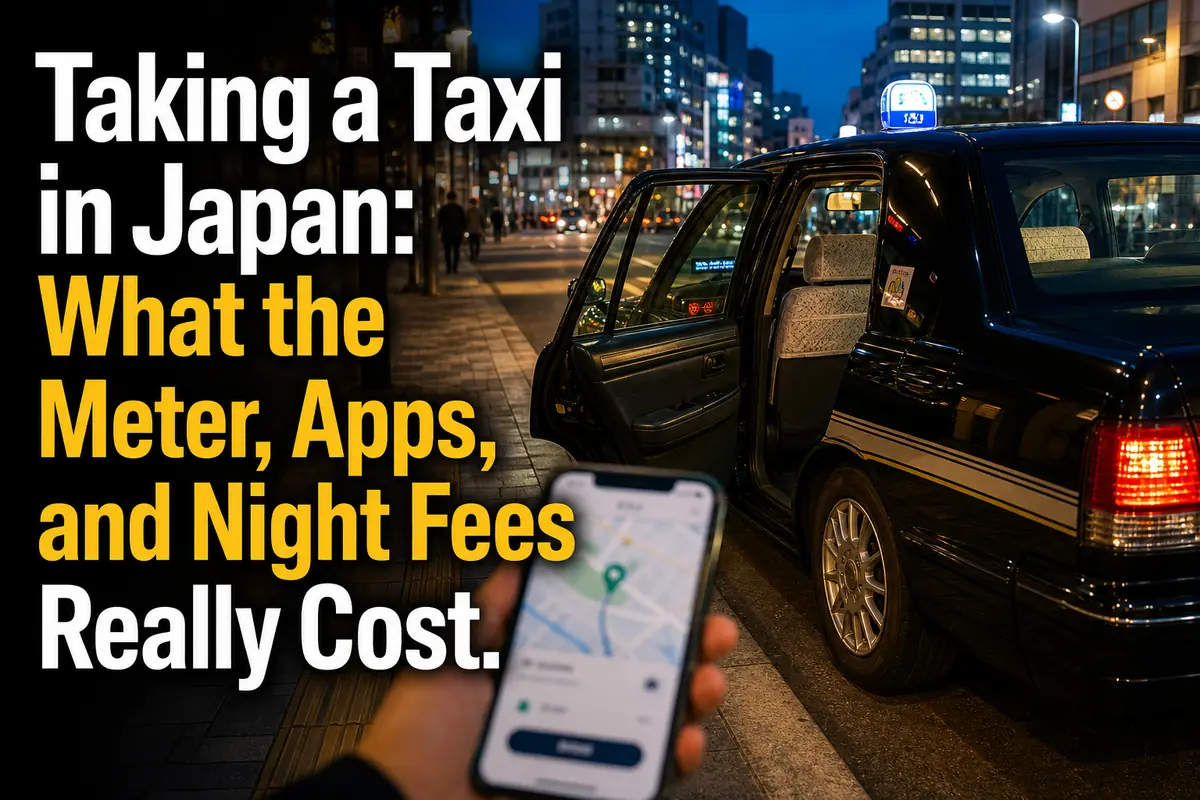
Taking a Taxi in Japan: What the Meter, Apps, and Night Fees Really Cost
A taxi ride in Japan usually costs the metered fare plus any pickup, app, reservation, or expressway fees. Between late evening and early morning—commonly 10:00 p.m. to 5:00 a.m.—the meter runs at a higher rate.
You can hail a taxi, wait at a taxi stand, call a company, or use an app. Cash in Japanese yen remains the safest backup because accepted cards and electronic payments vary by vehicle and area.
This guide is for new residents, students, workers, and visitors who need to understand the price before getting in.
The essentials:
- Street-hailing normally avoids app and dispatch charges.
- The meter combines distance with time spent moving slowly or waiting.
- App prices may include charges that do not appear on the taxi meter.
- Late-night rates, pickup fees, and app coverage differ by region or operator.
How to get a taxi in Japan
The best method depends on where you are and how urgently you need a car. Large cities offer several options, while rural areas may have fewer vehicles and limited app coverage.
Hail an available taxi
Stand somewhere the driver can stop legally and safely, then raise your hand. Near a busy intersection, move away from the corner if stopping there would obstruct traffic.
The illuminated sign inside the windshield shows the taxi’s status. An available taxi commonly displays 空車 (kūsha, “vacant”), often in red. Do not depend on color alone, because displays and status colors can vary.
Other signs you may see include:
- 賃走 (chinsō): carrying a paying passenger
- 迎車 (geisha): going to collect a booked passenger
- 予約 (yoyaku): reserved
- 回送 (kaisō): out of service
A taxi displaying geisha or yoyaku is not available even if it is empty.
Use a taxi stand
Taxi stands are common outside railway stations, airports, hospitals, and shopping centers. Look for タクシー乗り場 (takushī noriba, “taxi stand”).
Join the line and take the first appropriate car when directed. At an airport, staff may send passengers with several large bags to a larger vehicle.
Local restrictions sometimes apply. For example, the Tokyo Taxi Center states that taxis may collect passengers in part of Ginza only at designated stands from 10:00 p.m. to 1:00 a.m. on applicable weekdays. This is a local rule, not a nationwide taxi rule.
Order through an app
The Japan National Tourism Organization lists GO, S.RIDE, Uber, and DiDi among apps offering English-language service. Availability depends on the city, nearby partner vehicles, and the time of day.
Using an app helps when:
- explaining the destination would be difficult;
- there is no taxi stand nearby;
- you need to track the assigned vehicle;
- you want an electronic trip record or receipt;
- you need to confirm the pickup point precisely.
An app request is not necessarily the cheapest option. Check the confirmation screen for pickup, arrangement, reservation, priority, or service charges before ordering.
Call a local taxi company
Calling remains useful in smaller cities and rural areas where apps have few vehicles. A hotel, restaurant, hospital reception desk, or workplace may be able to call on your behalf.
Ask whether a 迎車料金 (geisha ryōkin, pickup fee) applies. The amount is set by the taxi company and may be a fixed charge or calculated under a local system.
What the meter actually charges
The amount is based on both distance and slow-moving time, not distance alone. Traffic congestion can therefore make two trips along the same route cost different amounts.
A normal metered ride can contain several layers:
- Initial fare: covers the first specified distance.
- Additional fare: added in steps as the taxi travels farther.
- Time-distance fare: advances the meter while the car is stopped or moving below a set speed.
- Late-night surcharge: applies during the operator’s defined overnight period.
- Pickup or dispatch fee: may apply when a car is sent to you.
- App or reservation fee: may be charged separately by the booking service.
- Tolls: expressway and other road charges are normally added to the passenger’s bill.
Fares are regulated by regional transport authorities, so there is no single nationwide starting price.
A Tokyo example
As checked on August 22, 2026, the Tokyo Taxi Center lists the following standard-car rates for Tokyo’s 23 wards, Musashino, and Mitaka:
- ¥500 for the first 1.096 kilometers
- ¥100 for each additional 255 meters
- ¥100 for every 1 minute 35 seconds spent at 10 km/h or less
- a 20% late-night or early-morning increase from 10:00 p.m. to 5:00 a.m.
A roughly five-kilometer daytime trip with no slow traffic would therefore reach about ¥2,100 on the distance calculation alone. This is only an illustration. Waiting time, the exact route, pickup charges, app fees, and tolls can change the total.
Do not use Tokyo’s figures as a nationwide price list. Check a local taxi association, transport bureau, operator, or booking app when budgeting for another area.
ここがポイント: The meter is only one part of the possible bill. Before confirming an app booking, check the separate fee details as well as the estimated fare.
Why the late-night fare rises
In many areas, a 20% overnight surcharge makes the meter advance faster during the stated hours. It is not always shown as a simple 20% line added to the final daytime amount.
In Tokyo’s main fare area, the published period is 10:00 p.m. to 5:00 a.m. The Japan National Tourism Organization also describes this as the usual late-night period, but travelers should confirm locally because approved fare rules can differ.
The practical consequences are straightforward:
- A trip beginning after 10:00 p.m. may cost more than the same journey earlier.
- Traffic and waiting time can still increase the metered amount.
- An app’s service or reservation fee may apply in addition to the overnight rate.
- Expressway tolls remain separate.
If price matters, compare the taxi with the last train, a night bus where available, or accommodation near your arrival point. After public transport stops, however, a taxi may be the only practical option.
App estimates and final charges
Treat an app estimate as a planning figure unless the service clearly labels it as a fixed fare. The final amount can change with traffic, tolls, the route, and separate service charges.
GO, for example, states that certain services add charges to the regular fare and pickup fee. The amount can vary by area and time. Its reservation and priority services may also require in-app payment rather than payment inside the taxi.
This explains a common source of confusion: the number on the physical meter may be lower than the amount charged through the app. Some app-related fees are recorded in the app’s usage history instead of appearing on the meter.
Before tapping the final order button, check:
- The pickup pin and destination
- The estimated or fixed fare
- The pickup fee
- Any app, reservation, priority, or vehicle-option fee
- The selected payment method
- The cancellation conditions
- Whether tolls are included
Fixed fares are a separate product
Some airport journeys and other specified routes offer fixed fares. These can make budgeting easier, but the displayed amount may still exclude tolls or optional service charges.
Confirm all three points:
- whether your pickup and destination are inside the eligible zones;
- whether advance booking or a particular payment method is required;
- whether expressway tolls and late-night charges are included.
Do not assume that every airport taxi uses a flat rate. A normal meter may apply if you do not select or request the fixed-fare service.
How to pay
Japanese yen in cash is the most reliable fallback, especially outside major cities. Many urban taxis accept cards, electronic money, QR payments, or in-app payment, but support is not universal.
Before departure, look for payment logos on the window or ask:
- Kādo wa tsukaemasu ka? — Can I use a card?
- Genkin nomi desu ka? — Is it cash only?
- Apuri de shiharai masu. — I will pay through the app.
The Tokyo Taxi Center advises passengers to check before riding because payment support differs by vehicle. Foreign currency is not accepted; pay in Japanese yen or by an approved cashless method.
In-app payment versus payment in the car
These are different payment paths.
With in-app payment, the registered method is charged after the ride according to the service’s process. GO Pay, for example, can also be activated in compatible street-hailed taxis through the rear-seat tablet. GO says that a PDF receipt is then issued through the app rather than inside the taxi.
With in-car payment, you pay the driver or use the vehicle’s terminal at the destination. If you need a receipt, say:
Ryōshūsho o onegai shimasu. — A receipt, please.
Keep some cash available even when planning to pay electronically. A terminal, mobile connection, app account, or registered card can fail.
The normal riding process
A smooth ride mainly depends on giving the driver an exact destination and checking payment early. You do not need advanced Japanese.
- Confirm that the taxi is available or check the app’s license plate and vehicle details.
- Let the driver operate the automatic rear door where fitted.
- Show the destination in Japanese, preferably with a map pin, full address, or building name.
- Fasten your seat belt.
- If necessary, confirm the route before departure.
- At the destination, check the total and chosen payment method.
- Collect your belongings and receipt.
For an apartment or office, a postal address can be more useful than a romanized building name. In a dense area, show the exact entrance rather than only the nearest station.
If the driver asks whether to use the expressway, the key phrase may be kōsoku dōro (expressway). The expressway can save time, but the toll is normally added to your fare.
Regional differences that matter
City habits should not be treated as national guarantees. The greatest differences involve vehicle availability, fares, payment, and dispatch methods.
Major urban areas
Tokyo, Osaka, Nagoya, and other large cities generally have taxi stands, street-hailable vehicles, and several app choices. Cashless payment is common, but it should still be confirmed.
Smaller cities and rural areas
There may be few taxis after the final train or late in the evening. Street-hailing can be unreliable, and an app may show no available vehicles even if the service technically covers the prefecture.
Call or reserve earlier when:
- you have an early flight or train;
- you are leaving a rural hotel;
- you need to reach a hospital outside normal transport hours;
- you need a larger vehicle or wheelchair accommodation;
- heavy rain, snow, or a major event may increase demand.
A reservation improves your chances but may not guarantee an on-time vehicle. Road conditions and shortages can still cause delays or cancellations.
Common mistakes and how to avoid them
Most unexpected costs come from overlooking separate fees or assuming every taxi works like an urban app ride.
Looking only at the meter
An app charge, reservation fee, pickup fee, or toll may be added elsewhere. Review the app’s final trip record and the receipt.
Assuming the app estimate is guaranteed
Check whether the screen says estimated fare or fixed fare. Metered rides can change with traffic and waiting.
Forgetting the overnight period
A ride taken after 10:00 p.m. commonly costs more. Check the local fare schedule if the journey is long.
Expecting every taxi to take the same payment
Payment logos, card support, and electronic-money terminals differ. Ask before departure and carry yen.
Giving only an English place name
The driver may know a major hotel or station, but not a small business or apartment. Save the Japanese address and map pin before leaving Wi-Fi.
Pulling the rear door yourself
Many taxis have a driver-controlled automatic rear door. Wait for it to open and close unless the driver indicates otherwise.
Ordering more than one taxi by accident
Do not hail a street taxi while an app booking remains active. Cancel the booking first and check whether a cancellation fee applies.
What to check before your next ride
You can avoid most confusion with a 30-second check before ordering.
- Is street-hailing or a taxi stand available without a dispatch fee?
- Is the ride during late-night surcharge hours?
- Does the app show separate pickup or service charges?
- Is the price an estimate or a fixed fare?
- Are tolls included?
- Will your preferred payment method work in that vehicle?
- Do you have the destination in Japanese?
Taxi fares and app conditions can change by region, operator, and time. For an expensive trip—especially an airport transfer or late-night rural journey—check the current operator terms before confirming. The most important number is not always the one on the meter; it is the full amount shown after every applicable fee has been added.