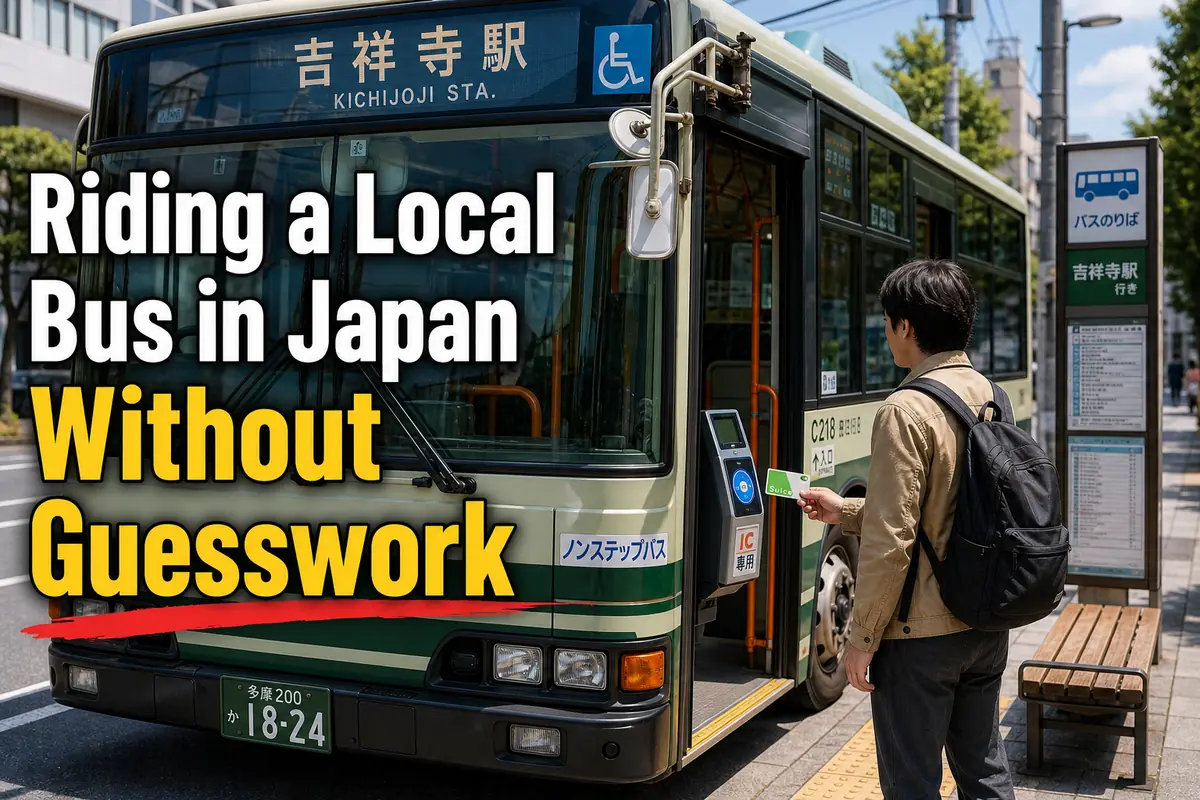
Riding a Local Bus in Japan Without Guesswork
The safest way to ride a local bus in Japan is to check three things before boarding: which door opens, when the fare is paid, and whether you must record your boarding point. These rules are set by each operator and route. There is no single nationwide boarding system.
If passengers enter through the rear door, you will usually pay when leaving through the front. On a distance-based route, tap your IC card or take a numbered ticket when boarding. If passengers enter through the front, the bus often uses a flat fare collected immediately.
This guide is for new residents, students, workers, and visitors using ordinary route buses—not highway or airport buses.
The three questions to answer before you step on
The door and payment system matter more than the city name. Even routes in the same area can follow different procedures.
- Where do passengers enter? Look for
入口(iriguchi, entrance) or watch the people ahead of you. - When do they pay? A reader or farebox beside the boarding door usually means payment or an IC-card tap is required immediately.
- Is the fare flat or distance-based? A numbered-ticket machine or boarding IC reader usually indicates that the bus must record where you boarded.
The most common patterns are:
Rear-door boarding, payment when leaving
This is common on distance-based routes and on many buses outside central Tokyo.
- Enter through the middle or rear door.
- Tap your IC card on the boarding reader, or take a numbered ticket.
- Press a stop button before your stop.
- Pay at the front and leave through the front door.
Kyoto City Bus uses this pattern on most routes. On a non-flat-fare route, an IC-card passenger taps both when boarding and when leaving. A cash passenger takes a numbered ticket.
Front-door boarding, payment immediately
This is common on flat-fare urban services.
- Enter through the front door.
- Tap an accepted IC card or pay the stated fare.
- Press a stop button before your stop.
- Leave through the middle or rear door.
Toei buses in Tokyo’s 23 wards and Yokohama Municipal Buses use this basic pattern. However, Toei services outside the 23 wards can use different procedures.
Rear-door boarding, but no action at the entrance
Some flat-fare systems collect payment when passengers leave, without recording the boarding point.
Osaka City Bus is a useful example: passengers normally enter through the rear, do not take a ticket or tap while boarding, and pay at the front when leaving.
ここがポイント: A rear entrance does not automatically mean “tap twice.” Look for a reader or ticket machine and follow the signs on that specific bus.
How to identify your bus before boarding
Confirm the route number and destination, not only the color of the bus. Several routes and operators may share one stop.
The destination display is called 行先表示 (ikisaki hyōji, destination display). It normally appears on the front and side of the vehicle. Check:
- the route or system number, often shown beside the destination;
- the final destination;
- any
急行(kyūkō, express),快速(kaisoku, rapid), or limited-stop label; - whether the display says the bus terminates before your stop.
A destination board may not list every intermediate stop. Use the operator’s official route search or timetable when possible. If you need to ask the driver, show the stop name on your phone and say:
このバスは ___ に行きますか。
Kono basu wa ___ ni ikimasu ka?
“Does this bus go to ___?”
Ask while the bus is stopped. The driver must concentrate on the road once the bus starts moving.
Paying with an IC card
A transport IC card is usually the simplest option, but acceptance is not universal. Look for the nationwide interoperable IC-card symbol or the names of accepted cards near the entrance or farebox.
Participating services may accept cards such as Suica, PASMO, ICOCA, Kitaca, TOICA, manaca, PiTaPa, SUGOCA, nimoca, and Hayakaken. Some routes accept only particular cards, a regional card, cash, or another payment system.
When to tap once
Tap once when the operator needs only one transaction. Examples include:
- paying while boarding a flat-fare bus;
- paying while leaving a flat-fare bus that requires no boarding record.
Do not assume that every rear-door bus requires an entry tap. Osaka City Bus specifically tells passengers not to tap when boarding its regular flat-fare buses.
When to tap twice
Tap once when boarding and again when leaving when the fare depends on distance. The first tap records your boarding point; the second calculates and deducts the fare.
Hold the card steadily against the marked reader until you hear the confirmation sound or see a successful display. Use the same card or mobile device at both ends of the trip.
Avoid these combinations:
- a physical IC card when boarding and its mobile version when leaving;
- one IC card when boarding and another card when leaving;
- tapping a wallet containing several transport cards;
- tapping a phone whose transport card is not ready for use.
If the reader shows an error, do not keep tapping at random. Tell the driver where you boarded and follow the instructions given.
Check the balance before the trip
A low balance can delay payment when other passengers are waiting behind you. Recharge—チャージ (chāji)—at a station or another supported location before boarding.
On-board recharge rules vary. A bus may accept only cash, only certain banknotes, or fixed recharge amounts. Mobile IC functions can also differ from those of a physical card. Carrying some coins and a 1,000-yen note is a sensible backup.
Paying with cash and a numbered ticket
On a distance-based route, the numbered ticket proves where you boarded. It is called 整理券 (seiriken, numbered boarding ticket).
When boarding
Take one ticket from the machine beside the entrance. Do not fold, lose, or discard it.
The ticket displays a number, not the fare. As the bus travels, look at the fare screen near the front. Find the amount shown under your ticket number. That is normally the fare due at the next stop.
When leaving
Put the numbered ticket and the required cash into the farebox, unless the operator’s instructions say otherwise.
Fareboxes do not all handle cash in the same way:
- some give change automatically;
- some require the exact fare;
- some have a separate exchange function;
- accepted coins and banknotes vary.
For example, Osaka City Bus states that its farebox gives change. Nishi Tokyo Bus, by contrast, instructs cash passengers to exchange money first and pay the exact amount because excess cash placed into the fare slot does not produce change.
That difference is why you should not treat a familiar-looking farebox as proof that the rules are familiar too.
If you forgot the ticket
Tell the driver the name of the stop where you boarded. Useful words include:
-
整理券を取り忘れました。
Seiriken o toriwasuremashita.
“I forgot to take a numbered ticket.” -
___ から乗りました。
___ kara norimashita.
“I boarded at ___.”
Do not guess the fare or silently place money in the box. The driver may need to set the correct fare.
The complete trip, step by step
Once you understand the payment pattern, the rest of the journey is straightforward.
1. Wait at the correct stop
Stand in line without blocking the pavement. One pole may serve several routes, and similarly named stops may have boarding points on opposite sides of a station or road.
Check the route number, direction, and scheduled departure. A timetable labeled 平日 (heijitsu) is for weekdays; 土曜 (doyō) is Saturday; and 休日 (kyūjitsu) usually covers Sundays and public holidays.
2. Let passengers leave first
Even if the door is the designated entrance, give exiting passengers space. A one-door vehicle may use the same door for everyone.
3. Board and complete the required action
Depending on the route:
- pay at the front;
- tap at the rear or middle entrance;
- take a numbered ticket; or
- simply board and pay later.
Move away from the doorway once aboard. Keep large bags out of the aisle and hold a rail or strap if no seat is available.
4. Follow the next-stop display
The next stop is usually announced and shown on a screen near the front. English may be available on major urban or tourist routes, but not everywhere.
Track your location on a map if necessary. Delays caused by traffic are normal, so do not rely only on the scheduled arrival time.
5. Press the stop button
The button is called 降車ボタン (kōsha botan, stop-request button). Press it after your stop is announced or displayed as next.
If nobody presses the button and nobody is waiting at the stop, the driver may continue without stopping. You normally need to press only once; the light and sound confirm that the request has been registered.
6. Wait until the bus stops before moving
Local buses can brake sharply. Official operator guidance commonly asks passengers to remain seated, or keep holding a rail, until the vehicle has stopped.
Have your card, cash, ticket, or pass ready before your stop, but do not walk toward the farebox while the bus is moving.
7. Pay and leave through the correct door
On a pay-on-exit route, settle the fare at the front. If you need a child fare, group payment, a discount, or help after missing an entry tap, tell the driver before touching the reader or inserting money.
After leaving, step away from the bus. Do not cross directly in front of it, where passing vehicles may not see you.
Regional differences that can change the procedure
The operator’s rule overrides any general rule in this guide. The following official examples show how much the system can vary.
Tokyo: Toei buses in the 23 wards
The standard Toei procedure is front-door boarding, immediate payment, and rear-door exit. The published adult fare is ¥210 in cash or ¥206 by IC card, while the child fare is ¥110 in cash or ¥103 by IC card.
Services outside Tokyo’s 23 wards may follow different boarding and payment procedures. Check the vehicle rather than applying the central Tokyo rule automatically.
Yokohama: front entry and a flat fare
Yokohama Municipal Buses use front-door boarding and payment on entry. As of the city’s July 22, 2026 update, the flat fare is ¥220 for adults and ¥110 for children, whether paid by cash or IC card. Passengers normally leave through the rear door.
Osaka: rear entry without an entry tap
Regular Osaka City Bus services use rear-door boarding and front-door exit. Passengers do not take a numbered ticket or tap an IC card when boarding. The operator’s current English guide lists a flat fare of ¥210 for adults and ¥110 for children, paid when leaving.
This is an important exception to the common “rear entry means tap in” shortcut.
Kyoto: route type changes the rule
Most Kyoto City Bus routes use rear-door boarding and front-door payment on exit. Distance-based services require an entry record: tap an IC card when boarding or take a numbered ticket if paying cash.
The city also operates Sightseeing Limited Express routes EX100 and EX101 with front-door boarding and payment on entry. The official guide lists different fares for these services, so the route number matters even when the buses belong to the same municipal operator.
Common mistakes and how to recover
Most bus mistakes can be fixed by speaking to the driver before payment is processed.
- Boarding the correct number in the wrong direction: Check the destination as well as the route number.
- Assuming Suica or another major card works everywhere: Look for an acceptance mark; keep cash available.
- Missing the boarding tap: Tell the driver where you boarded before tapping at the exit.
- Taking a numbered ticket while also tapping: Use one payment method consistently unless the operator instructs otherwise.
- Using one IC card for several adults without asking: Stored-value cards are generally processed for one passenger at a time. Ask the driver before tapping if group payment is permitted.
- Waiting until the bus is moving to exchange money: Prepare cash while stopped or ask the driver at a safe time.
- Expecting a JR Pass to cover an ordinary city bus: Rail passes do not automatically include local buses. Check the pass terms and operator.
- Forgetting to press the stop button: Press it as soon as your stop is shown as next.
If you are unsure, these short phrases help:
ICカードは使えますか。(IC kādo wa tsukaemasu ka?) — “Can I use an IC card?”運賃はいくらですか。(Unchin wa ikura desu ka?) — “How much is the fare?”どこで払いますか。(Doko de haraimasu ka?) — “Where do I pay?”この停留所で降ります。(Kono teiryūjo de orimasu.) — “I am getting off at this stop.”
Children, passes, luggage, and accessibility
Special fares and boarding assistance depend on the operator, so arrange them before the final tap or cash payment.
Child-age definitions and rules for accompanying preschool children are not identical everywhere. If a standard adult IC card is used without telling the driver, the machine may deduct an adult fare. Ask the driver to set a child or group fare first.
For a commuter pass, day pass, disability discount, or local senior pass, confirm:
- whether it is valid on that operator and route;
- whether you must still tap when boarding or leaving;
- whether a certificate or companion card must be shown;
- whether an express or special route requires an additional fare.
Passengers using wheelchairs or strollers may need a particular door or securement area. Signal the driver and wait for instructions. Do not assume that the normal passenger entrance is the accessible entrance.
Large suitcases should not block doors, aisles, priority seating, or the driver’s view. Ordinary local buses may have little luggage space; an airport bus, train, taxi, or luggage-delivery service may be more practical for a very large bag.
What has changed by August 2026
IC-card coverage continues to expand, but a nationwide card still does not guarantee acceptance on every local bus.
JR East reported that regional linked IC-card systems had reached 40 operators and about 3,100 vehicles by the end of May 2026. These systems combine local services, such as regional bus passes or discounts, with Suica functions.
PASMO also introduced updated visitor information for TOURIST PASMO in 2026. Even so, PASMO’s official guidance warns that some lines do not accept all mutually compatible cards.
For a trip tomorrow, the practical checks remain simple:
- open the local operator’s official route page;
- confirm the fare and accepted payment methods;
- look for temporary service changes;
- check whether the route is flat-fare or distance-based;
- carry backup cash, especially outside major urban areas.
Do not rely on an old travel post for a route-specific fare. Operators can revise prices, payment equipment, boarding doors, and passes independently.
Quick checklist for your next bus ride
The reliable habit is to read the bus before copying other passengers.
Before boarding:
- Confirm the route number and destination.
- Look for
入口and the payment equipment. - Check your IC balance and keep small cash as backup.
On the bus:
- Tap or take a numbered ticket only when required.
- Watch the next-stop display.
- Press the stop button early enough.
- Stay seated or hold a rail until the bus stops.
When leaving:
- Use the same IC card you used when boarding.
- Present a numbered ticket with the fare when required.
- Tell the driver about an error before paying.
The one question worth checking every time is: Does this route record where I boarded? If it does, tap or take a ticket at the entrance. If it does not, pay once at the time shown by the operator.
参照リンク
- Tokyo Metropolitan Bureau of Transportation — How to Take the Toei Bus
- Tokyo Metropolitan Bureau of Transportation — Transportation Guide 2026
- Yokohama City — How to Use Municipal Buses
- Osaka Metro — How to Catch a Bus
- Kyoto City Bus & Subway Information Guide — How to Take the Bus
- Kyoto City Bus — IC Card on Non-Flat-Fare Routes
- Nishi Tokyo Bus — How to Ride a Route Bus
- PASMO — Information for Visitors
- JR East — Regional Linked IC Cards