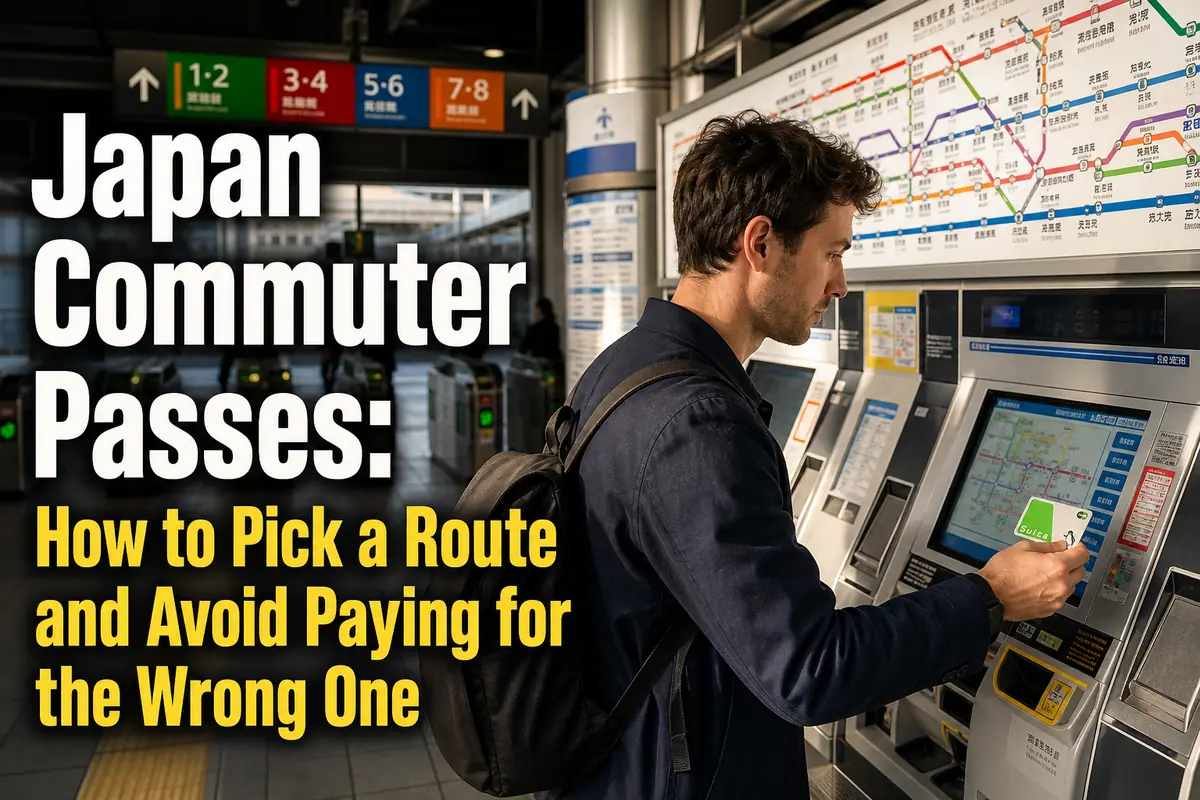
Japan Commuter Passes: How to Pick a Route and Avoid Paying for the Wrong One
A Japanese commuter pass gives one named passenger unlimited ordinary trips over a fixed route between two stations for a fixed period. It is usually sold for one, three, or six months.
The important point is the route—not the IC card brand. Before buying, compare the pass price with your expected trips, confirm every railway operator and transfer station, and check whether your employer or school requires a specific route.
This guide is for workers, students, and new residents who expect to make the same journey regularly. The information was checked against operator guidance available on August 22, 2026, but sales methods and eligible routes vary by operator.
In brief:
- A commuter pass is called a teikiken (定期券).
- It covers only the stations and route recorded on the pass.
- One-, three-, and six-month versions are common.
- A work pass and a discounted student pass have different requirements.
- Longer validity can reduce the monthly cost, but it also increases the risk if you move, change jobs, or change campuses.
What a commuter pass actually covers
A commuter pass covers a defined railway section, not unlimited travel throughout a city.
The registered details normally include:
- the starting station, or jōsha-eki (乗車駅)
- the destination, or kōsha-eki (降車駅)
- the approved route, or keiro (経路)
- the start date, or riyō kaishi-bi (利用開始日)
- the validity period, or yūkō kikan (有効期間)
You may board or leave the train at intermediate stations on the covered route without paying another ordinary fare. This makes the pass useful for errands after work as well as commuting.
If you ride beyond a covered station, the gate generally charges the fare for the uncovered section. A stored-value balance on an IC commuter pass can handle that adjustment automatically in supported areas.
However, a pass does not automatically cover a different line between the same endpoints. Tokyo Metro, for example, generally requires the purchaser to specify a route, although it permits alternative travel within certain listed zones. Other operators may apply different exceptions.
The pass and the IC balance are separate
A Suica, PASMO, or ICOCA can hold two different things:
- commuter-pass information for the registered route
- stored money for travel outside that route and for other supported payments
This distinction prevents a common misunderstanding. A PASMO commuter pass does not make every PASMO-compatible journey free. Outside the registered section, the card works like a normal IC card and deducts the applicable fare.
Also, nationwide IC-card compatibility does not mean that every operator can sell every commuter-pass route onto every card. A route crossing JR and private-railway lines may be available as a renraku teikiken (連絡定期券), or connecting commuter pass, but eligibility depends on agreements between the operators.
Decide whether a pass will save money
Do the calculation before choosing the longest period. A pass is not automatically cheaper for hybrid workers, part-time students, or anyone who travels irregularly.
Use this simple comparison:
Monthly pay-as-you-go cost = one-way IC fare × 2 × expected commuting days
Then compare the result with the official one-month commuter-pass fare for the exact route. Include other journeys on the covered section only when you genuinely expect to make them.
For example, someone commuting five days a week may get substantial use from a pass. Someone working from home three days a week could spend less by paying per ride. Public holidays, business travel, school vacations, and planned leave also change the result.
When a longer pass makes sense
Three- and six-month passes often cost less per month than repeatedly buying one-month passes. They are strongest when all of these are stable:
- your home address
- your workplace or campus
- your required office or class days
- the route accepted by your employer or school
- the operator’s fares
Choose a shorter period if a move, transfer, graduation, job change, or timetable change is likely. Refunds are not simply based on the unused number of days, so buying six months “just in case” can backfire.
Check an employer’s reimbursement rules first
Many employers pay a commuting allowance called tsūkin teate (通勤手当), but the amount and approved route come from workplace policy. An employer may reimburse the cheapest reasonable route rather than the route with the fewest transfers.
Before purchasing, ask payroll or human resources:
- Must I submit a route and fare quotation?
- Is reimbursement monthly or based on a three- or six-month pass?
- Is an off-peak pass accepted?
- What must I do if I move or my work location changes?
- Do remote-work days affect the allowance?
Do not assume that the route you prefer will be fully reimbursed.
Choose the route before choosing the card
The safest route is one that is valid, practical every day, and accepted by whoever pays for it. The cheapest route is not always the best choice if it adds difficult transfers or has poor backup options.
Compare each candidate using these factors:
- total commuter-pass price
- number and ease of transfers
- walking distance inside large stations
- ordinary travel time and rush-hour crowding
- frequency of trains
- last-train times
- accessibility needs
- alternative lines during disruption
- useful intermediate stations
Why identical endpoints can produce different passes
Large Japanese cities often have several ways to travel between the same two places. One option may use only JR lines; another may combine a subway with a private railway. Those are not interchangeable merely because the departure and arrival stations match.
At the machine or counter, inspect every displayed line and transfer station. If your trip crosses operators, ask whether the complete journey can be issued as one connecting commuter pass.
If it cannot, you may need separate products. That affects more than convenience: refunds, lost-card procedures, and customer support may be handled by different companies.
ここがポイント: The route printed or recorded on the pass controls where you can travel without another fare. Check the operator names and transfer stations before paying.
Where to buy a multi-operator pass
A connecting pass is normally purchased from an operator authorized to issue that combination. JR East notes that its stations issue commuter passes onto JR East-issued Suica cards, not onto IC cards issued by another railway company.
When the route is complicated, take a screenshot or written note showing:
- home station
- work or school station
- preferred transfer station or stations
- all railway operators
- desired starting date
- desired validity period
A staffed commuter-pass counter is often easier than guessing through a machine menu.
Work passes and student passes are not the same
A standard work commuter pass is generally available without proof of employment, while a student pass requires school authorization.
Standard commuter pass: tsūkin teikiken
A tsūkin teikiken (通勤定期券) is the regular commuter product. Despite the English label “commuter pass,” it is not limited to employees. An adult can generally buy one for an eligible route without an employer’s certificate.
It may suit:
- employees
- freelancers
- language-school learners whose institution or course is not eligible for a student pass
- people making frequent trips for care or other personal reasons
The operator still decides which routes and combinations it can sell.
Student pass: tsūgaku teikiken
A tsūgaku teikiken (通学定期券) is discounted and more restricted. It is normally limited to travel between the student’s home station and the station designated for an eligible school.
Tokyo Metro states that its student pass cannot be issued for a separate route used only for club activities or cram school. It also requires an appropriate school-issued certificate for qualifying purchases.
Depending on the operator and purchase situation, look for terms such as:
- tsūgaku shōmeisho (通学証明書): certificate of commuting to school
- gakuseishō (学生証): student identification card
- tsūgaku teikiken kōnyū ken’yō shōmeisho (通学定期券購入兼用証明書): certificate that also authorizes a student-pass purchase
A new pass, a changed route, or a pass extending into a new academic year may require fresh verification. Ask your school which station and route it has registered before visiting the railway counter.
How to buy the pass
For a simple adult route, a compatible ticket machine may be enough; student and unusual routes often require extra checks.
1. Confirm the exact fare and route
Use the official fare or route search provided by the railway operator. Search both the ordinary IC fare and commuter-pass fare.
Do not rely only on a general map app. It may recommend a fast route without showing whether the railway can issue it as one pass.
2. Choose the form of the pass
Depending on the region and operator, the pass may be available on:
- a named physical IC card
- a supported mobile IC service
- another operator-specific medium
A named IC card is important because commuter passes are personal. PASMO explains that its commuter version is a personalized card and that stored value can pay fares beyond the covered route.
Tourist products are not necessarily substitutes. For example, the short-term Welcome Suica is designed for visitors, and JR East separately states that a commuter pass cannot be registered on its extended-use Welcome Suica product. Confirm compatibility before buying or importing a card into a phone.
3. Prepare what the operator requires
For a regular adult pass, prepare the route details and payment method. A physical personalized card may also require personal information such as your name, date of birth, and telephone number.
For a student pass, bring the exact certificate requested by the operator. A student ID alone is not always sufficient.
Payment rules differ. Tokyo Metro accepts specified credit cards for pass purchases at its multifunction machines and pass offices, requires a PIN, and processes the payment as a single payment. PASMO’s general card-purchase page, meanwhile, warns that purchase procedures and payment acceptance vary by operator.
4. Check the screen before payment
Confirm all five items:
- start station
- destination station
- route and transfer stations
- starting date
- one-, three-, or six-month period
If anything is wrong, stop and call an attendant. Tokyo Metro advises passengers who notice an incorrect zone or validity period immediately after purchase to use the machine’s call button or consult station staff. Once the pass has been used, normal refund rules may apply instead.
5. Keep the receipt
Keep the receipt and any credit-card record, especially if an employer will reimburse you. They may also matter when requesting a refund. Tokyo Metro requires the card used for the original purchase in certain credit-card refund cases.
How renewal works
Renewal is easiest when the passenger, route, and pass type remain unchanged.
A renewal is called keizoku kōnyū (継続購入). Operators commonly allow it at selected ticket machines, counters, or supported mobile services. Tokyo Metro permits new and renewed adult commuter passes at its multifunction machines, while some student and child transactions have counter or verification requirements.
Tokyo Metro currently allows new and renewed passes to be bought up to 14 days before the new validity starts. Treat that as an operator rule, not a nationwide deadline; check the railway that issued your pass.
Before renewing:
- verify whether your work or class schedule has changed
- check for a planned move or transfer
- recalculate whether pay-as-you-go travel is now cheaper
- confirm the employer-approved route
- look for a fare revision announced by the operator
For a student pass, renewal across an academic-year boundary may trigger another eligibility check. JR West’s mobile student-pass procedure, for example, may require document upload and advance application in specified cases.
Do not renew when you actually need a route change
Changing the start station, destination, transfer station, or operator is usually not a simple renewal. It may require buying a new pass and refunding the old one under the issuing operator’s rules.
Handle the change before traveling on the new route. Otherwise, stored value may be deducted while you believe the pass is covering the trip.
Travel outside the route, express trains, and disruptions
The pass covers ordinary travel on its registered section; extra services and detours require separate attention.
Riding beyond the covered station
If the card has enough stored value and the journey is supported, the gate can usually deduct the uncovered fare automatically. Keep a balance on the card if you often continue beyond your endpoint.
If the gate closes, do not repeatedly tap. Show the card to station staff and say:
- teikiken no kubun-gai made norimashita (定期券の区分外まで乗りました): “I traveled beyond my commuter-pass section.”
- seisan o onegaishimasu (精算をお願いします): “Please adjust the fare.”
Limited express and premium seating
A normal commuter pass does not automatically include every premium service. Limited express trains, Green Cars, reserved seats, or similar services may require an additional ticket. The required product depends on the train and operator.
Check before boarding. Passing through an ordinary gate with the commuter pass does not prove that the premium part of the journey is paid.
Delays and alternative routes
Do not assume the pass always permits a free detour during disruption. Railway companies may arrange furikae yusō (振替輸送), or alternative transportation, under specific conditions. The eligible incident, route, and proof requirements are set by participating operators.
Follow station announcements and ask staff before entering another company’s line. Simply choosing another route on your own can result in an ordinary fare.
Off-peak passes and other regional differences
Commuter-pass products are operator services, so there is no single nationwide menu.
JR East offers an off-peak commuter pass on eligible sections of its Tokyo-area network. It is cheaper than the corresponding regular pass, but weekday-morning entry during the station’s designated peak period is charged separately as a normal IC journey. The decision is based on entry time, and peak periods differ by station.
This option can work for a resident with flexible hours. It is a poor fit if morning meetings regularly force travel during the peak window.
Other differences across Japan may include:
- which IC card can hold the pass
- whether mobile purchase is supported
- which multi-operator routes can be issued as one pass
- machine and counter availability
- student-document procedures
- refund fees and calculations
- bus-pass integration
- special passes for Shinkansen or limited express commuting
JR West, for example, lists ordinary work and student passes in one-, three-, and six-month periods and also offers specialized products on limited sections. That does not mean the same products or conditions apply in Tokyo, Nagoya, Fukuoka, or another region.
Refunds, route changes, and lost cards
Ask the issuing operator promptly; delay can reduce a refund or complicate recovery.
Refunds are not simply prorated by day
Tokyo Metro calculates many commuter-pass refunds by subtracting the fare for treated-as-used months plus a ¥220 handling fee. A special daily calculation can apply when the pass becomes unnecessary within seven days of its start date.
The practical consequence is important: using a three-month pass for one month and one day can be treated as two months used under that operator’s method. Other operators may have their own conditions, so request an official calculation rather than estimating the unused days yourself.
If the pass was purchased by credit card, take:
- identification
- the commuter pass or device
- the original payment card, when required
- the receipt, if available
Route changes should be handled as a new transaction
Tokyo Metro instructs passengers changing a route to purchase the new pass first and then receive the applicable refund for the old one. Ask the operator for the correct sequence before deleting a mobile pass or surrendering a physical card.
A named IC pass is safer if lost
A personalized PASMO commuter pass can be reissued under the applicable procedure, while an unnamed card has fewer protections. Magnetic passes may not be reissued.
If your phone or physical card is lost:
- contact the issuing operator promptly
- bring identification
- follow its suspension and reissue procedure
- expect a possible reissue fee or card cost
Do not buy a replacement blindly. Staff may need to stop the old medium or tell you which pass should be refunded if both are later found.
Common mistakes to avoid
Most costly errors happen before the first trip, when the route or product is selected.
- Buying by endpoint only: Check the lines and transfers, not just the first and last stations.
- Assuming every IC card can hold the route: Issuing agreements and card compatibility vary.
- Choosing six months without checking future plans: A move or job change can make the saving disappear.
- Buying a regular pass before asking the school: Eligible students may need a designated route and school certificate.
- Assuming an employer will reimburse any route: Obtain approval first.
- Treating the pass as an all-city ticket: Travel away from the registered route uses stored value or another ticket.
- Ignoring premium-train charges: Limited express and reserved services may require an additional ticket.
- Waiting to report a wrong purchase: Ask staff immediately, preferably before using the pass.
- Letting the stored-value balance run low: This can stop a journey that continues beyond the covered section.
A practical buying checklist
Spend five minutes checking the route before committing to several months of travel.
Before purchase:
- Calculate your expected commuting days.
- Compare pay-as-you-go and pass prices.
- Confirm the employer- or school-approved route.
- Check every operator and transfer station.
- Decide between one, three, and six months.
- Confirm physical-card or mobile compatibility.
- Prepare student documents if applicable.
- Check the accepted payment method.
At purchase:
- Read the route back from the screen.
- Check the starting date and period.
- Confirm the spelling of your registered name.
- Keep the receipt.
Before renewal:
- Recalculate for your current schedule.
- Check for fare or product changes.
- Confirm that your route has not changed.
- Ask about new student verification if relevant.
The final decision should come from the operator’s official fare search and your employer or school—not from the color of the IC card. If the journey crosses companies or has two plausible routes, take the complete route to a staffed counter before paying.
参照リンク
- Tokyo Metro: Student/Commuter Railway Pass
- Tokyo Metro: Multi-functional Ticket Machine
- PASMO: What is PASMO?
- PASMO: Purchasing a PASMO Card
- PASMO: Using PASMO
- JR East: How to Purchase a Suica Commuter Pass at a Multifunction Ticket Machine
- JR East: Purchasing a Suica Connecting Commuter Pass
- JR East: Rules for the Use of Suica in Mobile Devices
- JR East: Welcome Suica for Extended Use
- JR East: Off-Peak Commuter Pass Overview
- JR West: Types of Commuter Passes
- JR West: Mobile ICOCA Student Commuter Pass