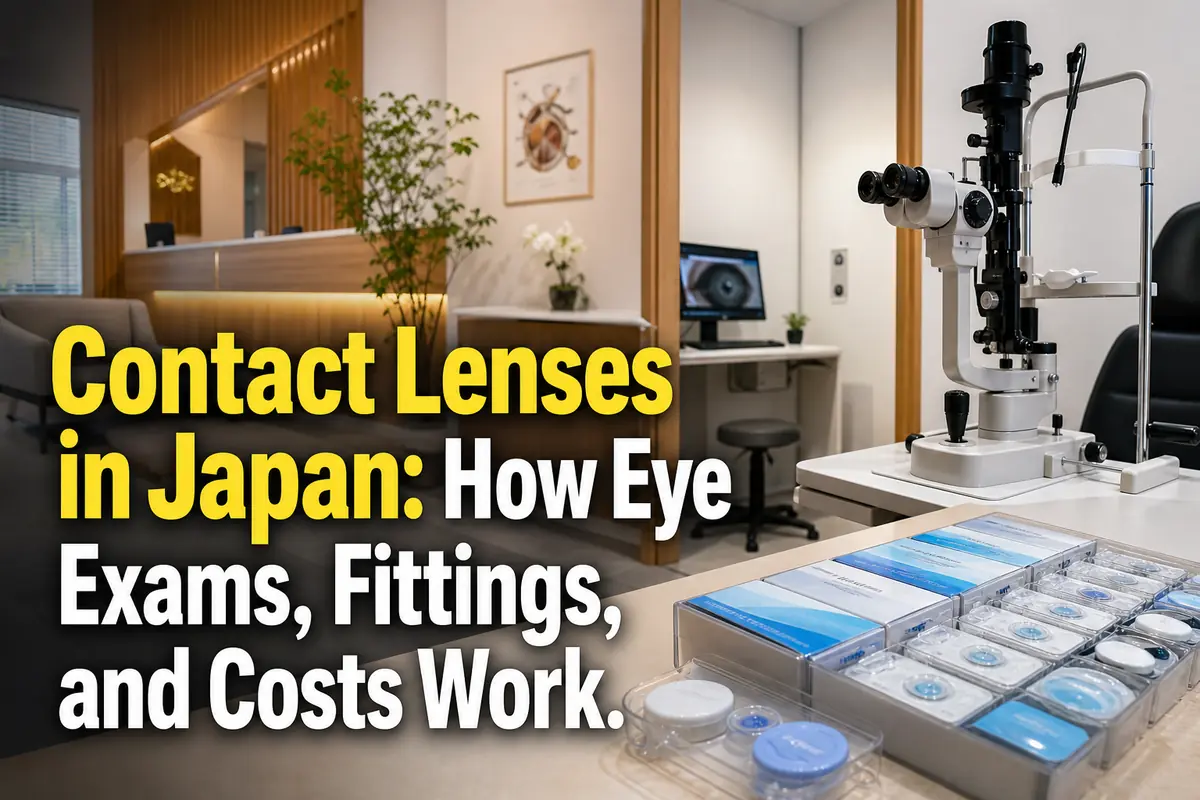
Getting an Eye Exam and Contact Lenses in Japan: A Step-by-Step Guide
For a first contact-lens fitting in Japan, start at an ophthalmology clinic—not only at an eyewear shop. Ask whether the clinic performs contact-lens examinations, whether it accepts new patients, and whether support is available in English or another language.
The examination and the lenses are separate purchases. Public health insurance may apply to medically necessary examination or treatment, but contact lenses themselves are generally paid for out of pocket. Clinic billing and retailer requirements can differ, so confirm both before your visit.
This guide is for new residents, students, workers, and long-term visitors who need a first fitting, a replacement supply, or help with uncomfortable lenses.
Quick orientation:
- Go to ganka (眼科, ophthalmology) when you need an eye-health examination or contact-lens fitting.
- Bring your current lenses, lens package, glasses, medication information, and insurance identification if you have it.
- Expect tests for vision, prescription strength, eye condition, and lens fit.
- Ask separately about the examination fee, lens price, follow-up visits, and collection or delivery time.
Choose the right place first
An ophthalmology clinic examines the eye; an eyewear or contact-lens retailer mainly sells products. Some locations make the process look like one service because a clinic and a retailer operate next to each other, but they remain separate businesses.
Ophthalmology clinic: ganka
Search for ganka (眼科), meaning ophthalmology. This is the appropriate starting point if:
- you have never worn contact lenses;
- you need a different lens type or prescription;
- your eyes are red, painful, dry, or sensitive to light;
- your vision has changed suddenly;
- a lens feels difficult to remove;
- you have an eye condition, allergy, or previous eye surgery; or
- you want an eye-health examination rather than only a vision measurement.
An ophthalmologist can examine the cornea and other parts of the eye, assess whether contact lenses are suitable, and treat a medical problem when necessary.
Eyewear and contact-lens retailers
An megane-ya (眼鏡屋, eyewear shop) can measure vision for glasses and sell frames and lenses. A contact-lens retailer may stock disposable, reusable, toric, multifocal, or colored lenses.
A retailer’s vision check is not necessarily a medical eye examination. It may help select a product, but it does not replace an ophthalmologist’s assessment of redness, corneal damage, infection, or another disease.
Retailer policies also vary. One seller may request recent examination details or direct you to a nearby clinic; another may sell certain products under different conditions. Check the seller’s current requirements rather than assuming that a prescription from another country will be accepted.
How to find a clinic that can help
Confirm the service and language before traveling to the clinic. Not every ophthalmology clinic offers contact-lens fittings, and a clinic listed as English-capable may not have an English-speaking staff member on every shift.
Japan’s nationwide Medical Information Net, or NAVII, lets users search by location, medical department, and foreign-language availability. Visitors can also use the JNTO medical institution search, which includes an ophthalmology filter.
Before visiting, ask:
- Kontakuto renzu no kensa wa dekimasu ka? (コンタクトレンズの検査はできますか?) — Do you perform contact-lens examinations?
- Hajimete desu ga, yoyaku wa hitsuyō desu ka? (初めてですが、予約は必要ですか?) — I am a first-time patient. Do I need an appointment?
- Eigo taiō wa arimasu ka? (英語対応はありますか?) — Is English support available?
- Hoken shō wa tsukaemasu ka? (保険証は使えますか?) — Can I use public health insurance for this visit?
- Jihi no ryōkin wa ikura desu ka? (自費の料金はいくらですか?) — What is the self-pay fee?
Also ask whether the clinic fits your lens category. Toric lenses for astigmatism, multifocal lenses, rigid gas-permeable lenses, and lenses for high prescriptions may require extra time or a specialist service.
What to bring to the appointment
The label from your current lens is often more useful than remembering only the power. Contact lenses are selected using several measurements, not just the minus or plus number.
Bring the following when available:
- My Number Card registered for health-insurance use, called Maina hokenshō (マイナ保険証), or an eligibility certificate, shikaku kakuninsho (資格確認書);
- a residence card or passport if the clinic requests identification;
- your current glasses;
- your contact lenses, case, and care products;
- the box, blister pack, or a clear photograph of its label;
- details of eye drops and other medicines;
- information about allergies, eye surgery, and previous eye problems; and
- a payment method accepted by the clinic and retailer.
The package may show these abbreviations:
- PWR/SPH: lens power;
- BC: base curve;
- DIA: lens diameter;
- CYL and AX/AXIS: astigmatism correction;
- ADD: additional power used for multifocal lenses.
Do not treat matching numbers as proof that two products are interchangeable. Lens material, shape, oxygen transmission, replacement schedule, and fit can differ between brands.
What happens during a Japanese eye examination
A routine fitting usually combines a vision test with an eye-health and lens-fit assessment. The exact order and equipment vary by clinic.
Registration and medical questions
At reception, a new patient may be described as shoshin (初診, first visit). You will usually complete a monshinhyō (問診票, medical questionnaire).
The form may ask about:
- your main concern and symptoms;
- how many hours you wear lenses;
- whether you sleep, swim, or shower in them;
- the replacement schedule;
- allergies and dry-eye symptoms;
- current medicines; and
- pregnancy, chronic illness, or previous eye treatment when relevant.
If the Japanese form is difficult, ask whether a translated version is available. A translation app can help with ordinary registration, but important symptoms and medical instructions should be confirmed with clinic staff.
Vision and refraction tests
Staff commonly measure uncorrected and corrected vision. Shiryoku kensa (視力検査) means visual-acuity test, while kutsusetsu kensa (屈折検査) refers to refraction testing.
The familiar Japanese eye chart may use Landolt rings—circles with a gap. You indicate whether the gap points up, down, left, or right. Some clinics can use letters or other symbols if you explain that you are unfamiliar with the test.
Eye-health examination
The ophthalmologist may examine the front of the eye with a slit lamp. This can reveal irritation, inflammation, corneal damage, or another issue that a simple power measurement cannot identify.
If you already wear lenses, the doctor may ask you to remove them. Bring your case and glasses so that you can travel home comfortably if you are told not to reinsert the lenses.
Trial-lens fitting
For a first fitting or product change, the clinic may place a trial lens on the eye and check:
- whether it centers and moves appropriately;
- whether vision remains stable;
- whether the base curve and diameter suit the eye;
- whether astigmatism correction stays in position; and
- whether the lens causes dryness or discomfort.
Beginners may also receive instruction on insertion, removal, hand hygiene, replacement timing, and cleaning. Do not rush this stage. Being able to remove the lens safely is more important than completing the visit quickly.
Dilating drops are not routine for every fitting
A doctor may recommend additional tests when symptoms or examination findings require them. Some tests use drops that temporarily blur near vision or increase sensitivity to light.
Ask before the test if you must drive, cycle, work on a screen, or sit an examination later that day. The clinic can explain how long the particular drops are expected to affect you.
Costs and public health insurance
Do not assume that the whole visit—or none of it—is covered. The reason for the examination matters, and clinics may separate insured medical care from self-pay services.
Under Japan’s public health-insurance system, many working-age patients pay 30% of the approved cost for covered medical treatment; the percentage differs by age and income. That general rule does not make every contact-lens-related service an insured benefit.
In practice, your bill may contain separate parts:
- an initial or follow-up consultation;
- covered examination or treatment when medically indicated;
- a self-pay fitting or service, depending on the clinic and circumstances;
- eye drops or other treatment; and
- the full retail price of the contact lenses.
Contact lenses and routine lens supplies are normally personal purchases. Public insurance generally should not be expected to pay for the boxes of lenses, cleaning solution, storage case, or ordinary replacement costs.
ここがポイント: Ask the clinic whether the examination will be processed as insurance treatment or jihi (自費, self-pay), then ask the retailer separately for the lens price. A low examination charge does not show the total cost of starting contact lenses.
Prices vary with the clinic, lens type, pack size, replacement schedule, region, and retailer. Toric and multifocal products commonly follow different price structures from standard spherical lenses. A clinic may also require a follow-up before authorizing or recommending a larger supply.
As of August 2026, the old health-insurance card system has ended. At medical institutions, insured patients generally use a My Number Card registered for insurance or a valid eligibility certificate. If your enrollment has just started or your documents are unavailable, contact your insurer and the clinic before the visit; you may otherwise be asked to pay more at the counter and handle reimbursement later.
Tourists and people outside Japanese public insurance should ask for the full self-pay estimate. Travel insurance terms differ, and routine vision correction is often treated differently from unexpected illness or injury.
Buying the lenses after the examination
Confirm the exact product and supply period before paying. A contact-lens recommendation is more specific than a glasses prescription.
Check all of the following:
- brand and product name;
- power for the right and left eye;
- base curve and diameter;
- cylinder and axis for toric lenses;
- addition value for multifocal lenses;
- daily, two-week, monthly, or other replacement schedule;
- quantity per box;
- expiration date;
- collection, shipping, and return rules; and
- timing of the next examination.
The clinic may issue written information, send details to an associated retailer, or explain which trial lens worked. Procedures differ, so ask for a copy of your measurements or product details if you need them for your records. A clinic is not necessarily providing the same document format that your home country calls a “contact-lens prescription.”
If the product is not in stock, it may need to be ordered. Keep your glasses available instead of waiting until your final pair of lenses has expired.
Safety rules that matter in daily life
A lens is a medical device placed directly on the eye, including a colored lens with no corrective power. Japan’s Pharmaceuticals and Medical Devices Agency advises users to receive an ophthalmologist’s examination, follow the replacement schedule and care instructions, and attend regular checks.
Stop wearing lenses when warning signs appear
Remove the lens and contact an ophthalmology clinic if you develop:
- eye pain;
- continuing redness;
- sudden blurred or reduced vision;
- strong sensitivity to light;
- discharge;
- marked swelling;
- a persistent foreign-body sensation; or
- difficulty removing a lens.
Do not put the same lens back in simply to test whether the problem has disappeared. Use glasses until a clinician advises you about restarting lens wear.
Seek urgent help for a chemical splash, serious injury, sudden major vision loss, or severe pain. A routine contact-lens retailer is not the right place for an eye emergency.
Avoid water and unapproved reuse
Follow the instructions supplied with your exact product. Basic precautions include:
- wash and dry your hands before touching lenses;
- do not clean or store lenses in tap water;
- do not swim or shower in lenses unless an eye-care professional has given specific advice and the product instructions allow it;
- never reuse a daily disposable lens after removal;
- replace reusable lenses and cases on schedule;
- use the specified disinfecting solution; and
- do not sleep in lenses unless the lens is approved for that use and an ophthalmologist has instructed you to do so.
Regular examinations still matter when the lenses feel comfortable. Contact-lens-related damage can develop before the wearer notices clear symptoms.
Colored lenses follow the same health logic
Karākon (カラコン) is the common Japanese term for colored contact lenses. Cosmetic lenses without vision correction are not harmless fashion accessories; they still touch the cornea and require correct sizing, handling, and care.
Buy products through legitimate sellers, retain the Japanese instructions and package, and avoid sharing lenses. If the label or seller cannot clearly identify the product, replacement schedule, or care method, do not place the lens on your eye.
Common mistakes and how to avoid them
Most avoidable problems begin with treating power as the only important number. Use this checklist before your visit or purchase.
- Going only to an eyewear store for eye pain: Choose ophthalmology when symptoms or eye health are involved.
- Assuming a foreign prescription will transfer directly: Bring it as useful background, but expect a Japanese clinic or seller to apply its own procedure.
- Buying a familiar power in an unfamiliar brand: Ask about fit, material, base curve, diameter, and replacement schedule.
- Wearing lenses to the clinic without glasses: Bring glasses and a case in case the lenses must stay out.
- Expecting insurance to pay for the lenses: Separate medical examination costs from retail product costs.
- Ordering a long supply before confirming comfort: Complete the trial and any recommended follow-up first.
- Using ordinary eye drops over lenses: Check whether the specific drops are approved for your lens type; ask an ophthalmologist or pharmacist when uncertain.
- Ignoring retailer and clinic hours: Reception may close before the posted medical hours, and contact-lens fittings may be limited to particular times.
Regional and clinic differences
Japan has national medical-device and health-insurance frameworks, but the practical route is set locally by each clinic and seller. Tokyo, Osaka, and other large cities may offer more multilingual options, while smaller communities may require advance booking or travel to a neighboring city.
Differences can include:
- appointment versus walk-in reception;
- languages available on a particular day;
- whether first-time fittings are accepted late in the day;
- brands and trial lenses kept in stock;
- insurance or self-pay billing for the planned service;
- cash, card, or electronic-payment acceptance; and
- how examination details are passed to a retailer.
Call first when language support, a specialist lens, or same-day collection is important. Official search results are a starting point, not a guarantee that the right staff member or product will be available when you arrive.
A practical first-visit plan
Book the clinic before choosing a large lens order. The following sequence avoids most wasted trips:
- Search for ganka with contact-lens services and the language support you need.
- Call to confirm new-patient reception, appointment rules, expected billing, and accepted insurance identification.
- Gather your glasses, lens package, medical information, and payment method.
- Allow time for registration, testing, doctor review, and insertion or removal practice.
- Confirm the exact product, price, quantity, and follow-up date before buying.
- Keep the clinic’s contact details and switch to glasses if warning symptoms appear.
The next point to check is not merely whether a retailer has your power in stock. It is whether the lens was assessed on your eye, whether you can handle it safely, and where you will go if comfort or vision changes.
参照リンク
- PMDA: Contact Lens and Colored Contact Lens Safety FAQ
- PMDA: Proper Use of Contact Lenses and Prevention of Eye Disorders
- Ministry of Health, Labour and Welfare: Colored Contact Lenses
- Medical Information Net (NAVII)
- JNTO: Guide for When You Are Feeling Ill
- Immigration Services Agency: Guidebook on Living and Working
- Ministry of Health, Labour and Welfare: Health-insurance copayment guidance
- Ministry of Health, Labour and Welfare: My Number health-insurance card FAQ