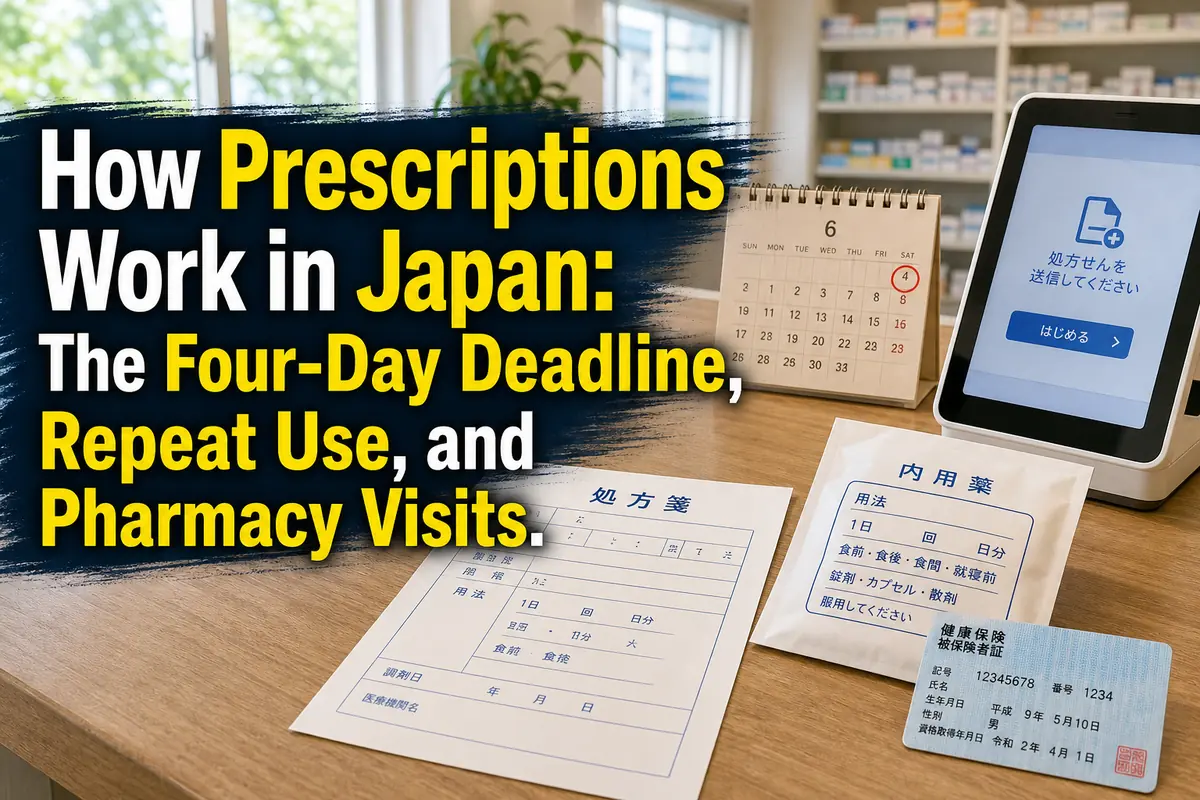
How Prescriptions Work in Japan: The Four-Day Deadline, Repeat Use, and Pharmacy Visits
In Japan, a standard outpatient prescription usually must reach a pharmacy within four calendar days, including the day it was issued. Saturdays, Sundays, and public holidays still count.
Most prescriptions can be used only once. A special rifiru shohōsen (リフィル処方箋, refill prescription) may be used up to three times, but only when the prescriber approves repeat use and marks the prescription accordingly.
For example, a standard prescription issued on Monday is normally valid through Thursday. Waiting until Friday may mean contacting the clinic and possibly having another consultation before the medicine can be dispensed.
This guide is for foreign residents, students, workers, and other patients using outpatient medical services in Japan. It explains the national rules, what to take to the pharmacy, how refills differ from ordinary prescriptions, and a cost change in effect as of August 2026.
The essentials:
- Count the issue date as day one of the four-day validity period.
- Weekends and public holidays do not pause the countdown.
- A normal prescription is not automatically refillable.
- A refill prescription can authorize no more than three dispensings in total.
- From June 2026, choosing certain original-brand medicines when a generic is available can create an additional charge.
The four-day validity rule
The safest approach is to visit a pharmacy on the day of your appointment. The four-day period is a deadline for presenting the prescription, not the number of days for which you may take the medicine.
The Ministry of Health, Labour and Welfare (MHLW) calls this period shiyō kikan (使用期間, period of validity). For prescriptions issued by medical institutions under Japan’s health insurance system, the normal period is four days including the issue date.
Here is how to count it:
- Issued Monday: normally valid through Thursday
- Issued Friday: normally valid through Monday
- Issued before a three-day holiday: the holidays still count
- Issued on the last day before travel: do not assume it will remain valid until you return
The rule applies to both paper prescriptions and electronic prescriptions. MHLW’s public guidance says an electronic prescription must also normally be filled within four days of issue.
An exception must be arranged by the prescriber
A doctor or dentist can write a different validity period when special circumstances, such as extended travel, justify it. This is not an extension that a patient or pharmacy can add later.
If you already know that you cannot visit a pharmacy within four days, tell the prescriber before leaving the clinic. Ask staff to confirm the last valid date on the prescription.
What happens after the deadline
A pharmacist generally cannot dispense medicine from an expired prescription simply because the pharmacy was closed or the patient misunderstood the rule. Contact the issuing clinic and explain what happened.
The clinic will decide what is medically and administratively necessary. Depending on the circumstances, that may involve confirmation by the prescriber, issuance of a new prescription, or another consultation. Extra costs are possible, so do not assume that replacing an expired prescription will be free.
ここがポイント: A prescription for 30 days of tablets does not remain valid for 30 days. The document normally has to be presented within four days, even though the medicine itself is intended to last much longer.
An ordinary prescription is usually single-use
Receiving several weeks of medicine is not the same as receiving permission to refill the prescription. This difference surprises people from countries where a pharmacy can repeatedly dispense medicine from one prescription.
A standard shohōsen (処方箋, prescription) authorizes the pharmacy to dispense the listed medicine once. The number of treatment days—such as 7, 28, or 90 days—describes the prescribed supply. It does not turn the document into a repeat prescription.
When that supply is nearly finished, a patient will normally need another medical assessment and a new prescription unless the original document is specifically marked for refill use.
Check the document before leaving the clinic
Look for the following items or ask clinic staff to point them out:
- Kōfu nengappi (交付年月日): date of issue
- Shiyō kikan (使用期間): validity period, if a special date is written
- Rifiru-ka (リフィル可): refill permitted
- Rifiru kanō kaisū (リフィル可能回数): authorized total number of uses
- Medicine name, strength, dosage, and number of treatment days
If the prescription is electronic, the clinic may give you a printed shohō naiyō (hikae) (処方内容(控え), prescription-details copy). This copy helps you check the order, but it is not itself the prescription original.
How refill prescriptions work
A refill prescription reduces repeat clinic visits only for a condition that the prescriber considers stable. Patients cannot convert an ordinary prescription into a refill prescription at the pharmacy.
Japan introduced the refill-prescription system in April 2022. Under the national framework, the prescriber decides whether it is appropriate and sets the number of uses, with an upper limit of three dispensings in total.
A paper refill prescription should show a check in the rifiru-ka field and the authorized number of uses. If that area is blank, ask the clinic rather than assuming that the pharmacy can refill it.
The first dispensing
The first use follows the ordinary four-day rule. The pharmacy checks the prescription, dispenses the first supply, records the dispensing date and the planned date for the next visit, and returns the paper prescription when another authorized use remains.
Keep that original document safe. A photograph or photocopy is not a substitute for the paper original at the next dispensing.
The second and third dispensings
The timing rule changes after the first use. The second or third dispensing is generally allowed within seven days before or seven days after the expected date when the previous supply ends.
Suppose the first dispensing provides 30 days of medicine. The pharmacy calculates the next planned dispensing date from that supply and records it on the prescription. The usable window for the next dispensing is normally the seven days on either side of that date.
Do not calculate the window only from memory. Confirm the written jikai chōzai yoteibi (次回調剤予定日, next planned dispensing date) with the pharmacist, especially if the dosage changes, doses have been missed, or the remaining quantity does not match the expected amount.
Not every medicine is eligible
Refill prescribing is not available for every medicine. MHLW’s framework excludes medicines subject to statutory prescribing-day limits and medicated patches from refill prescriptions.
The prescriber must also decide that repeat dispensing is medically appropriate for the individual patient. A request may therefore be declined even when another person appears to receive a refill for a similar condition.
Examples of situations that may change the decision include:
- symptoms that are not stable;
- a recent change in medicine or dosage;
- treatment requiring regular examination or laboratory monitoring;
- a medicine excluded from the refill system; or
- new side effects or difficulty taking the medicine correctly.
The pharmacist checks your condition each time
A refill mark does not guarantee automatic dispensing. At every visit, the pharmacist reviews matters such as how the medicine is being taken, remaining doses, adverse effects, and changes in health.
If the pharmacist considers another dispensing inappropriate, the pharmacy may contact the prescriber or advise the patient to return to the clinic. This safety check is part of the system, not a cancellation of the prescription for convenience.
Contact the clinic promptly rather than waiting for the planned refill date if symptoms worsen, a serious reaction is suspected, or the treatment no longer seems to match the instructions.
A practical pharmacy checklist
Bring enough information for the pharmacist to identify both the prescription and your insurance status. Requirements differ slightly between paper and electronic workflows.
For a paper prescription
Take:
- the original paper prescription;
- your My Number Card used as a health-insurance credential, or a valid shikaku kakuninsho (資格確認書, eligibility confirmation certificate), when using insurance;
- any medical subsidy certificate that applies to you; and
- information about other medicines, supplements, allergies, and past adverse reactions.
A community pharmacy displaying hoken yakkyoku (保険薬局, insurance pharmacy) can normally dispense an eligible outpatient prescription. You do not usually have to use a pharmacy inside or beside the clinic, although stock and opening hours vary.
Call ahead when the medicine is uncommon, refrigeration is required, or you need help in a particular language. A pharmacy may need time to obtain an item even while the prescription deadline continues to run.
For an electronic prescription
First confirm that the chosen pharmacy supports denshi shohōsen (電子処方箋, electronic prescriptions).
At the pharmacy:
- A patient using a My Number Card can use it during reception to identify the electronic prescription.
- A patient using an eligibility confirmation certificate needs the six-digit hikikae bangō (引換番号, access code).
- If the clinic issued a paper prescription that happens to show an access code, take the paper original to the pharmacy; the number does not replace it.
MHLW also states that patients can consent to sharing recent prescription and dispensing information through the electronic system. Consent can help doctors and pharmacists check for duplicate medicines and interactions, but staff should still be told about nonprescription products and supplements that may not appear in the record.
If someone else goes to the pharmacy
MHLW’s multilingual guidance says a representative can present an outpatient prescription and collect the medicine for the patient. The pharmacist may still need information about symptoms, allergies, other medicines, or how the medicine will be used.
Ask the pharmacy in advance what identification or additional information it requires. Collection practices can differ according to the medicine and the patient’s situation.
What you may pay at the pharmacy
The final amount is not just the retail price of a box of tablets. It can include the medicine cost and insured pharmacy-service fees, adjusted by the patient’s insurance contribution rate and any applicable public subsidy.
The amount can change with:
- the medicine, strength, and quantity;
- whether an eligible generic is dispensed;
- the pharmacy’s services and timing;
- the patient’s insurance or subsidy status; and
- any charge outside the ordinary insurance contribution.
Keep the receipt and the detailed statement, usually called ryōshūsho (領収書, receipt) and chōzai meisai-sho (調剤明細書, dispensing statement). Ask the pharmacy to explain unfamiliar lines before leaving.
August 2026 status: choosing some original brands costs more
A current cost rule matters when an original-brand medicine has an eligible generic alternative. From June 2026, a patient who chooses certain covered original products—called chōki shūsaihin (長期収載品, long-listed original products)—for a nonmedical preference generally pays a special charge equal to one-half of the price difference between the original and the relevant generic, in addition to the usual insured contribution. Consumption tax applies to the special charge.
MHLW gives a simple example: if the original product’s official price is ¥100 per tablet and the generic price used for the calculation is ¥60, the ¥40 difference produces a ¥20 special charge per tablet, plus consumption tax. The ordinary insured contribution is calculated separately.
The charge does not apply to every original product. It also does not apply when the original is medically necessary or when the pharmacy cannot provide the generic because of supply conditions. Tell the doctor or pharmacist about a previous reaction, a dosage-form problem, or another treatment-related concern instead of merely requesting a brand name.
Ask these questions before dispensing if cost matters:
- Is this medicine covered by the special-charge rule?
- Is a generic available in the required strength and dosage form?
- What will the approximate total be with each option?
- Has the prescriber stated that the original product is medically necessary?
Common mistakes and how to avoid them
Most preventable problems come from treating the prescription like an open-ended pharmacy order. A few checks at the clinic can prevent a missed deadline or an unnecessary return visit.
Mistake 1: Counting from the next day
The issue date is day one. Check the printed date immediately and count calendar days, not business days.
Mistake 2: Assuming a closed pharmacy extends validity
It does not. Search for an open insurance pharmacy or speak to the clinic before the deadline. Holiday and after-hours availability differs by area.
Mistake 3: Confusing a long supply with refills
“Thirty days, three times” and “ninety days once” are different instructions. Look for the refill field and ask how many total dispensings are authorized.
Mistake 4: Losing the refill original
After the first or second dispensing, put the returned paper prescription somewhere secure. Contact the pharmacy and prescriber promptly if it is lost; do not expect a photograph to be accepted as the original.
Mistake 5: Visiting too early or too late for a repeat dispensing
Use the pharmacy’s written next date and the permitted window. If travel, work, or school will interfere, consult the pharmacy before the window rather than arriving outside it without notice.
Mistake 6: Assuming every pharmacy has the medicine
The legal ability to dispense a prescription does not guarantee stock. Contact the pharmacy early, especially before weekends or holidays.
Mistake 7: Requesting an original brand without checking the added cost
From June 2026, the additional charge for certain original products is larger than under the previous rule. Ask whether the charge applies and discuss medically relevant concerns with the pharmacist.
Regional and provider differences
The core prescription-validity and refill rules are national, but the experience at the counter is local. Pharmacy hours, medicine stock, language support, delivery options, and methods for receiving prescription information can differ.
Electronic-prescription participation also varies by facility. A clinic may support the system while the patient’s preferred pharmacy does not, or vice versa. Confirm both locations before relying on an electronic workflow.
Local differences do not normally change these national basics:
- the ordinary four-day validity period;
- the inclusion of weekends and public holidays;
- the maximum of three uses for an authorized refill prescription; and
- the pharmacist’s duty to check whether dispensing remains appropriate.
When clinic or pharmacy instructions appear to conflict with something you have read online, show staff the actual prescription. The written order, medicine involved, insurance status, and individual clinical circumstances can change the correct next step.
Quick FAQ
Can a pharmacy refill my medicine from an empty package?
Not normally. The package can help identify the product, but prescription medicine generally requires a valid prescription unless a separate legal exception applies. Contact a medical institution if the previous supply has run out.
Can I use a foreign prescription at a Japanese pharmacy?
Do not assume that a prescription issued abroad can be filled as a Japanese prescription. Contact a Japanese medical institution or the pharmacy before relying on it, and bring information showing the medicine’s generic name, strength, dosage, and purpose. Import and controlled-substance rules are separate issues.
Must I return to the same pharmacy for each authorized refill?
Using the same pharmacy is practical because its pharmacist can follow the schedule, remaining supply, and previous checks. If you need to change pharmacies, contact both pharmacies in advance and confirm that the new pharmacy can handle the prescription and obtain the medicine. You will still need the valid original refill prescription when it is on paper.
Can the pharmacy change the prescribed medicine?
A pharmacist must dispense within the prescription and applicable substitution rules. An eligible generic may be offered unless the prescription or clinical circumstances prevent the change. Questions requiring alteration of the prescription may need confirmation with the prescriber.
What should I do before a long holiday or trip?
Check the prescription issue date, pharmacy opening hours, refill window, remaining supply, and availability of the medicine. If the ordinary four-day deadline or a future refill window will be impossible, discuss it with the prescriber before the prescription is issued.
What to check before leaving the clinic
The most useful habit is to settle timing questions while the clinic can still speak directly with the prescriber. Before you leave, confirm:
- the last day the prescription can first be presented;
- whether it is ordinary or refillable;
- the total number of authorized dispensings;
- the number of treatment days in each supply;
- whether any prescribed item is excluded from refill use;
- whether a paper original or electronic prescription was issued; and
- what to do if travel overlaps the next dispensing window.
Then choose an open pharmacy and contact it the same day if stock or language support may be an issue. The four-day clock is short, and neither a weekend nor an electronic prescription stops it.
参照リンク
- MHLW: Prescription validity periods
- MHLW: Explanation of the Handling of Prescriptions Outside of the Hospital
- MHLW: FY2022 dispensing-fee revision and refill-prescription framework
- MHLW: Rules for health-insurance medical institutions
- MHLW: Electronic prescriptions—public Q&A
- MHLW: Electronic prescriptions for the public
- MHLW: Additional charge for certain original-brand medicines with generic alternatives
- MHLW: June 2026 patient guide to the original-brand special charge