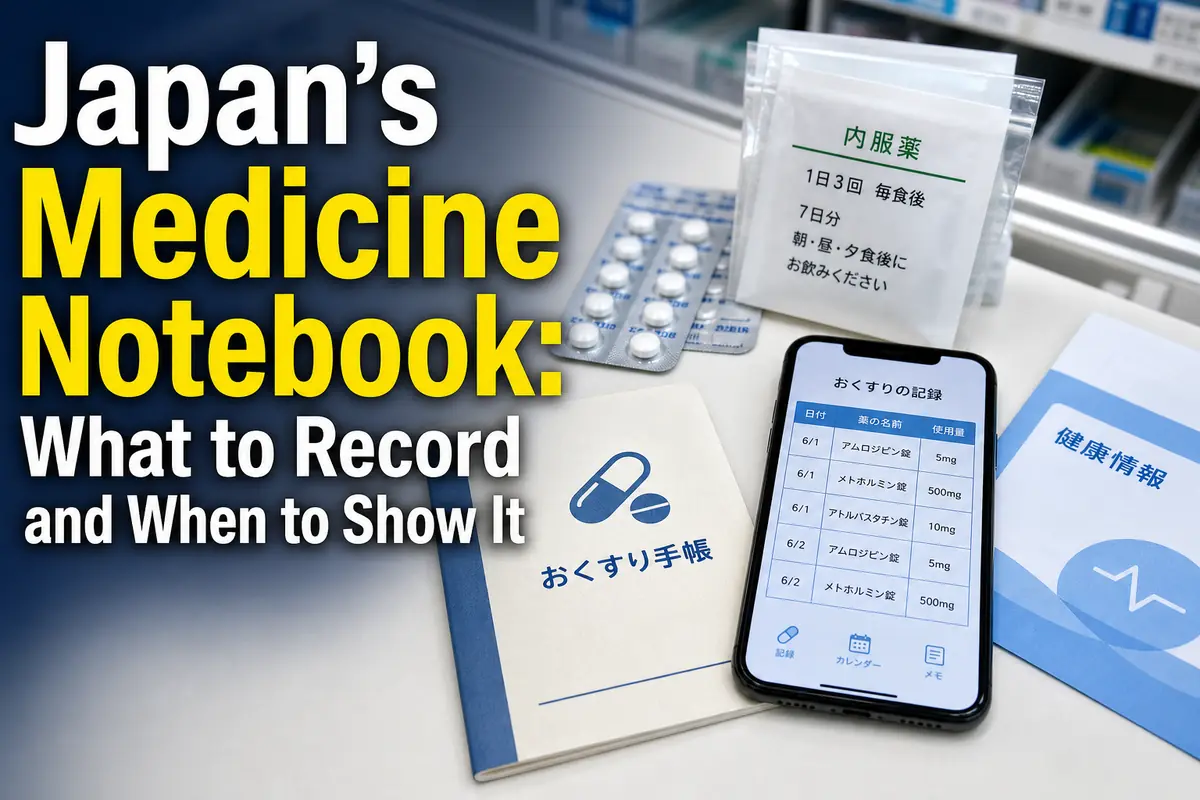
Japan’s Medicine Notebook: What to Record and When to Show It
An okusuri techō (お薬手帳) is a personal record of the medicines you use in Japan. Show it whenever you visit a doctor, dentist, hospital, or pharmacy. Keeping all prescriptions, over-the-counter medicines, supplements, allergies, and past side effects in one record helps medical professionals check for duplicate drugs and unsafe combinations.
This guide is for new residents, students, workers, and longer-term visitors who receive medical care in Japan. The information is current as of August 22, 2026.
The essentials
- Use one complete medicine record, even if you visit several clinics or pharmacies.
- Bring or open it before a consultation and again when collecting medicine.
- Add nonprescription drugs and supplements yourself; they may not appear in government-held prescription data.
- Choose paper or an electronic app according to what you can reliably access.
- Do not use the notebook as a substitute for instructions from a doctor or pharmacist.
What an okusuri techō actually does
The notebook gives each medical professional a clearer view of medicines supplied at different places.
A typical entry may show:
- the medicine’s name and strength;
- the amount supplied;
- when and how it should be used;
- the dispensing date;
- the prescribing medical institution;
- the dispensing pharmacy; and
- notes from a pharmacist.
The Japanese Ministry of Health, Labour and Welfare describes it as a record that patients can use for their own health management and share with doctors and pharmacists. That shared history can help them identify drug interactions, repeated prescriptions, or medicines connected with a previous adverse reaction.
The notebook belongs to the patient. It is not limited to one clinic, pharmacy chain, city, or health insurance plan.
It is more than a prescription list
A prescription label tells you how to use one medicine. An okusuri techō connects several prescriptions over time.
That distinction matters when, for example:
- a dermatologist prescribes one drug and an internal medicine clinic prescribes another;
- you buy a cold remedy while taking a regular prescription;
- a dentist considers prescribing a painkiller or antibiotic;
- you cannot remember the name of a medicine that caused a rash; or
- you need treatment away from your usual city.
Pharmacists do not use the notebook merely to attach new stickers. They can compare the current prescription with earlier entries and ask questions before dispensing it.
ここがポイント: The safest approach is not simply to own a medicine notebook. Keep one complete record and show it before a new medicine is prescribed or supplied.
What you should record
A useful notebook contains information that may change a treatment decision—not only medicines received from a prescription pharmacy.
Prescription medicines
Let the pharmacy add each new dispensing record. If a pharmacy gives you a printed label for the notebook, attach it promptly and keep any related instructions.
Check that the entry belongs to you, especially when collecting medicine for several family members. Each person should have a separate record.
OTC medicines and supplements
Write down or photograph products you buy without a prescription. In Japanese, these may be described as:
- shihanyaku (市販薬): over-the-counter medicine;
- ippan-yō iyakuhin (一般用医薬品): general-use OTC medicine;
- yō-shidō iyakuhin (要指導医薬品): medicine requiring face-to-face guidance; or
- sapuremento (サプリメント): supplement.
Record the product name, ingredients if available, how often you use it, and the date you started. Bring the package or a clear photograph if the Japanese label is difficult to read.
This step remains important in the digital era. The ministry’s electronic prescription Q&A explains that government prescription systems do not record OTC medicine use. Information from facilities that do not support electronic prescriptions can also take about a month to appear in MynaPortal.
Allergies and previous side effects
Record what happened, not only the medicine’s name. Useful details include:
- the suspected product or ingredient;
- the symptom, such as a rash, swelling, breathing difficulty, or severe nausea;
- when the reaction occurred;
- whether a doctor examined it; and
- any instruction to avoid that medicine in the future.
Do not decide by yourself that every uncomfortable symptom is an allergy. Ask a doctor or pharmacist how it should be described in your record.
Medicines brought from another country
Write the active ingredient, strength, dose, and reason for use in English if possible. Brand names can differ between countries, so the active ingredient is particularly helpful.
Keep a photograph of the original box and label. If you have an English prescription copy or a letter from the prescriber, store it with your medical information. Import and possession rules are a separate issue; the notebook itself does not prove that a medicine may legally be brought into Japan.
How to use it during a medical visit
Show the record early enough for it to influence the consultation.
1. At reception or during the medical interview
When staff ask whether you take medicine, say:
“Okusuri techō ga arimasu.” (お薬手帳があります。) — “I have a medicine notebook.”
If using an app, make sure you can unlock it and display the relevant entries. Do not assume every clinic can import information directly from every app.
2. When speaking with the doctor or dentist
Mention any medicine that is missing from the record, including products bought abroad, occasional painkillers, sleep aids, herbal products, and supplements.
Also explain:
- medicines you stopped taking;
- doses you regularly miss;
- possible side effects;
- pregnancy or breastfeeding, when relevant; and
- difficulty swallowing tablets or following the schedule.
The record supports this conversation; it cannot replace it.
3. At the pharmacy
Give the paper notebook to the pharmacist or show the electronic record before the prescription is dispensed. Answer questions about current use honestly, even if you have not followed the instructions exactly. The pharmacist needs your actual use pattern to check the prescription properly.
Before leaving, confirm:
- which medicine is new;
- which medicine has changed or stopped;
- the timing of each dose;
- whether food, alcohol, driving, or other medicines require caution; and
- what to do if you miss a dose or notice a problem.
For individual medical decisions, follow the doctor’s or pharmacist’s advice rather than relying only on a general guide.
One notebook is better than several incomplete ones
The main practical rule is to keep your history together.
Receiving a new paper booklet from every pharmacy may feel convenient, but it separates the information that pharmacists need to compare. If one booklet becomes full, carry the new volume and keep the old one at home where you can retrieve it. Consider photographing the current medicine list as a backup.
If you already have several notebooks:
- Take all of them to your usual pharmacy.
- Ask which entries should be carried into the current record.
- Keep older books instead of immediately discarding them.
- Use only the current book for new entries.
Using one regular pharmacy can also make continuity easier, but you may use another pharmacy when needed. The notebook is what lets the next pharmacist see information from elsewhere.
Paper or electronic: which should you choose?
Both can work. The better choice is the one you will keep current and can show when needed.
Paper notebook
A paper version is simple to hand to staff and does not depend on a charged phone, login, network connection, or app compatibility. It can also hold printed pharmacy labels and handwritten notes.
Its weaknesses are physical: it can be forgotten, damaged, lost, or split into several volumes. Do not place highly sensitive information in it unless it is necessary for medication safety.
Electronic medicine notebook
An denshi-ban okusuri techō (電子版お薬手帳), or electronic medicine notebook, stores the record in a smartphone service. Features differ by provider. Some apps support medication searches, dose reminders, pharmacist communication, health measurements, or links to MynaPortal.
The ministry publishes information and a list of services that follow its electronic medicine notebook guidelines. Before choosing an app, check:
- whether it can combine entries from different pharmacies;
- whether you can add OTC medicines and supplements;
- whether it supports MynaPortal linkage;
- how to transfer data when changing phones or services;
- whether information can be exported, printed, or shown offline;
- the provider’s privacy and account-recovery rules; and
- which languages the interface supports.
An app is not automatically complete just because it is connected to national systems. You may still need to enter OTC products, overseas medicines, supplements, allergies, and side effects yourself.
How MynaPortal and electronic prescriptions fit in
Digital systems improve access to prescription information, but they do not remove the need to maintain and share a complete medicine record.
With your consent, doctors, dentists, and pharmacists using the relevant systems may view past prescription information connected to your My Number health insurance use. MynaPortal can also let you check prescription and dispensing information yourself.
At facilities supporting Japan’s electronic prescription system, newly registered prescription and dispensing information may become viewable promptly. Some compatible medicine notebook apps can retrieve that information through MynaPortal. The ministry updated its public electronic-notebook material in February 2026 and continues to publish current service information.
However, important gaps remain:
- OTC medicines are not automatically included in the electronic prescription record.
- Supplements and many products bought outside Japan require manual entry.
- Data from a facility without electronic prescription support may not appear promptly.
- Access depends on the relevant system, your consent, and successful identity or account procedures.
- A clinic or pharmacy may not support every app or every sharing method.
Think of MynaPortal, electronic prescriptions, and your medicine notebook as connected tools—not interchangeable copies of the same record.
Costs and pharmacy fees
Ask the pharmacy before assuming that carrying a notebook always changes your bill.
Pharmacy charges under Japan’s public health insurance are governed by the national dispensing-fee schedule, which can change. The final amount may depend on factors such as the service provided, the pharmacy, the timing of the visit, your insurance status, and current fee rules—not simply whether you own a paper booklet.
Practical points are more reliable than memorizing an old fee difference:
- Request a paper notebook at the pharmacy if you need one and ask whether there is any separate charge.
- Check an app provider’s terms for subscription or optional-service fees.
- Keep the receipt and itemized statement from the pharmacy.
- Ask the pharmacist to explain an unfamiliar charge before leaving.
The notebook’s central purpose is medication safety and continuity. A possible difference in a pharmacy bill should not be the only reason you use it.
Common mistakes to avoid
Most problems come from incomplete or inaccessible information.
Showing it only at the pharmacy
A doctor or dentist may need the record before selecting a medicine. Mention it during the consultation, then show it again at the pharmacy.
Keeping one notebook for the whole family
Medication histories must not be mixed. Use a separate paper book or app profile for each person and check the name before presenting it.
Recording only regular prescriptions
Occasional medicines can still interact with a new prescription. Include painkillers, cold remedies, sleep products, herbal medicines, supplements, and medicines brought from overseas.
Assuming an app has imported everything
Check the displayed dates and entries. A successful MynaPortal link does not add every health product you use.
Deleting old entries after treatment ends
A previous medicine may explain a past side effect or help a doctor understand what has already been tried. Preserve the history unless a medical professional tells you that a duplicate or incorrect entry should be corrected.
Using the notebook as dosing instructions
Entries are a record, but your prescription label and current professional instructions determine how to use the medicine. Ask before restarting an old medicine or changing the dose.
Special situations
The same record becomes especially useful when normal routines break down.
Emergency treatment and disasters
Keep your current medicine list where you can reach it quickly. A paper notebook, an accessible electronic record, or a recent backup can help responders understand long-term treatment when your usual clinic is unavailable.
The Japan Pharmaceutical Association documented cases in which medicine notebooks helped medical teams supply appropriate medicines after the Great East Japan Earthquake. Japan’s electronic prescription system also allows certain information to be accessed during disasters under specific procedures and with patient consent. Neither option guarantees access in every emergency, so keeping a personal backup remains sensible.
Travel inside Japan
Take the record with you, particularly if you use medicine every day. Carry enough prescribed medicine for the planned trip and ask your prescriber or pharmacist what to do if travel is extended.
Short-term visitors
A visitor may not have a Japanese notebook or MynaPortal account. A current medicine list in English still helps. Include active ingredients, strengths, doses, allergies, and an emergency contact. Show the actual packaging when possible.
Language barriers
The Ministry of Health, Labour and Welfare provides multilingual medical communication materials, including an English form that asks patients to show their medicine or medicine notebook. Translation apps may help with basic words, but confirm medicine names and dosing instructions directly with qualified staff.
Useful terms include:
- shohōsen (処方せん): prescription;
- chōzai yakkyoku (調剤薬局): dispensing pharmacy;
- fukusayō (副作用): side effect;
- arerugī (アレルギー): allergy;
- nomiawase (飲み合わせ): drug combination or interaction; and
- tonpukuyaku (頓服薬): medicine used only when needed.
A practical setup for your first week
A few minutes of preparation can prevent a rushed search during your next appointment.
- Choose one paper notebook or a suitable electronic service.
- Add your name and an emergency contact if you are comfortable doing so.
- List current prescriptions, OTC products, supplements, allergies, and known side effects.
- Photograph overseas medicine packaging and record active ingredients.
- Put the paper book with your health insurance documents, or make the app easy to open.
- Create a secure backup and review it whenever a medicine changes.
- Show the record at every clinic, dental office, hospital, and pharmacy.
The next time you receive a medicine, check one concrete point before leaving: Does your record now show everything you are actually taking? If not, ask the pharmacist to help you complete it while the packaging and instructions are still in front of you.
参照リンク
- Ministry of Health, Labour and Welfare: Electronic Medicine Notebooks
- Ministry of Health, Labour and Welfare: Electronic Prescription Q&A for the Public
- Ministry of Health, Labour and Welfare: English Medical Communication Form
- Japan Pharmaceutical Association: Medicine Notebooks after the Great East Japan Earthquake