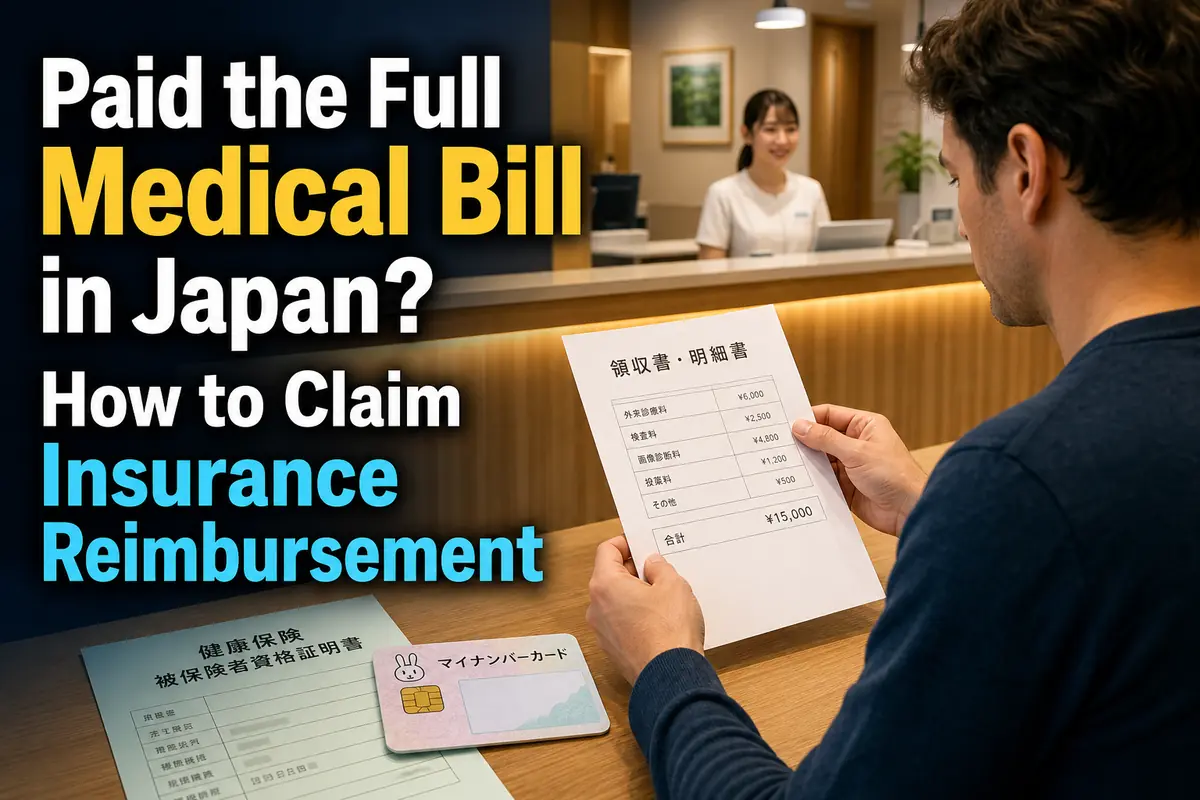
How to Recover Medical Costs After Paying the Full Clinic Bill in Japan
If you paid 100% of a clinic or pharmacy bill because your insurance eligibility could not be confirmed, you may be able to recover the insurer-covered portion. The payment is not automatically lost—but you must either obtain an adjustment from the medical provider or apply to the health insurer that covered you on the treatment date.
For most insured people aged 6 to 69, the normal patient share is 30%. In a straightforward case, that means the recoverable amount is often close to 70% of the insured medical fee. It is not necessarily 70% of everything on the receipt: uninsured services, optional charges, and amounts above Japan’s official fee calculation may remain your responsibility.
This guide is for workers, students, dependents, and other residents enrolled in Japanese public health insurance. It reflects the system as of August 22, 2026.
What to do first:
- Keep the original receipt and the detailed medical statement.
- Ask the clinic or pharmacy whether it can recalculate the bill after you show valid eligibility documents.
- If it cannot, identify the insurer that covered you on the treatment date.
- Request a ryōyōhi reimbursement application from that insurer.
Why you may have been charged 100%
A full charge usually means the provider could not confirm your insurance eligibility at reception; it does not by itself mean the treatment was uninsured.
Common situations include:
- You had just started a job and enrollment processing was not complete.
- You had recently moved, changed jobs, or changed insurers.
- You could not present a valid Maina hokenshō—a My Number Card registered for health insurance.
- You did not have a valid shikaku kakuninsho (Eligibility Confirmation Certificate).
- Your My Number Card or its electronic certificate had expired.
- The clinic’s card reader or online system could not confirm your status.
- You accidentally used details from an insurance plan that had already ended.
A provider may also charge the full amount when it does not participate in public health insurance or when the service itself is outside insurance coverage. Those cases require a different analysis; reimbursement is not guaranteed merely because you were insured.
First check whether the clinic can correct the bill
The fastest route may be a correction at the clinic, but this is an operational option rather than a nationwide right to an immediate counter refund.
Contact the clinic as soon as possible and ask whether it can recalculate the visit after confirming your eligibility. A clinic may set its own deadline, such as before its monthly billing is closed.
Have these items ready:
- The original receipt, or ryōshūsho (receipt)
- The itemized statement, or shinryō meisaisyo (medical fee statement)
- Your My Number health insurance card or valid Eligibility Confirmation Certificate
- Any document showing your insurer, member number, and effective enrollment date
If the clinic agrees, it may replace the 100% payment with the appropriate patient share and return the difference. Ask what documents it needs and whether you must return in person.
If the clinic cannot correct the account, keep every document and move to the insurer application.
ここがポイント: Paying 100% and applying later is not the same as receiving a full refund. The insurer reviews whether the treatment was covered, calculates the recognized fee, and subtracts your normal patient share.
How ryōyōhi reimbursement works
The formal route is a claim for ryōyōhi (medical-care expenses) through the insurer responsible for you when you received treatment.
Public health insurance normally provides an in-kind benefit: the provider bills the insurer directly, while you pay only your share at reception. A ryōyōhi claim is an exception used when that normal process was unavailable for an unavoidable reason.
The amount is based on the recognized insured fee
The insurer does not simply multiply your receipt total by 70%. It first calculates the amount recognized under Japan’s health insurance fee schedule, or uses the amount actually paid if that is lower. It then subtracts your required copayment.
For example, suppose you paid ¥10,000 and all of it is recognized as insured treatment. If your normal share is 30%, the calculation would generally be:
- Recognized medical fee: ¥10,000
- Your normal 30% share: ¥3,000
- Possible reimbursement: ¥7,000
Now suppose the ¥10,000 includes a ¥2,000 service outside public insurance. If the remaining ¥8,000 is recognized and your share is 30%, the possible reimbursement would be ¥5,600. You would ultimately bear the ¥2,000 uninsured charge plus the ¥2,400 insured copayment.
This is an illustration, not a payment guarantee. Your insurer decides the recognized amount after reviewing the claim.
Your copayment rate may not be 30%
The patient share depends on age, income, and the applicable insurance rules. Examples include 20% or 30% for many people aged 70 to 74, while preschool-age children generally have a lower statutory share. Local child or disability subsidies are separate programs and may require another application.
Ask the insurer to confirm the rate that applied on the date of treatment.
The application process, step by step
A successful claim depends on sending the correct form and original evidence to the correct insurer.
1. Identify your insurer on the treatment date
Do not apply based only on where you are enrolled today. Find out which plan covered you when the clinic treated you.
Typical insurers are:
- National Health Insurance, or Kokumin Kenkō Hoken (Kokuho), administered by your municipality
- Japan Health Insurance Association, commonly called Kyōkai Kenpo, for employees of many companies
- An employer’s health insurance society, or kenkō hoken kumiai
- A mutual aid association for eligible public-sector employees
- The medical system for people aged 75 or older
Your employer’s human resources team, municipal insurance counter, MyNa Portal, or shikaku jōhō no oshirase (Notice of Eligibility Information) can help identify the insurer.
2. Ask for the correct application
The usual Japanese name is ryōyōhi shikyū shinseisho—an Application for Payment of Medical-Care Expenses. A dependent’s benefit may be described as kazoku ryōyōhi.
Tell the counter why you paid the full amount. Useful phrases include:
- Hoken shikaku o kakunin dekizu, jūwari shiharaimashita. — “My insurance eligibility could not be confirmed, so I paid 100%.”
- Ryōyōhi no shinsei o shitai desu. — “I would like to apply for reimbursement of medical-care expenses.”
3. Collect the evidence
Requirements differ by insurer, but a standard claim commonly needs:
- The completed reimbursement application
- The original receipt showing the amount paid
- A detailed statement describing the treatment or dispensing
- Your insurance membership information
- Bank account details for the transfer
- Identification or My Number-related documents when requested
- An explanation of why insurance could not be used at reception
Kyōkai Kenpo lists both a receipt and a statement describing the treatment for a full-payment claim. It also warns that submitted attachments are not returned, so make copies before filing.
A card payment slip alone is unlikely to show enough medical information. Ask the clinic for both the official receipt and the detailed statement before leaving.
4. Submit it to the correct office
Where you file depends on your plan:
- For municipal National Health Insurance, apply to the insurance section of the city, ward, town, or village that insured you.
- For Kyōkai Kenpo, submit to the relevant prefectural branch; eligible claims may also be filed through its electronic application service.
- For a health insurance society, follow that society’s form and submission method, sometimes through your employer.
Processing time is not fixed nationally. Municipalities and employee insurers have different review schedules, and the insurer may contact the provider before deciding the claim.
5. Read the decision notice
The payment may be lower than expected if:
- Part of the bill was outside insurance coverage.
- The provider’s self-pay price exceeded the fee recognized under public insurance.
- Your patient-share rate was different from the rate you assumed.
- Required evidence was missing.
- The insurer decided that the conditions for exceptional reimbursement were not met.
If you do not understand the calculation, ask for an explanation of the recognized fee, excluded charges, and applied copayment rate.
Costs that are usually not recovered through this claim
A ryōyōhi claim covers eligible insured care, not every expense connected with a visit.
Items commonly outside the calculation include:
- Routine health checks not covered by insurance
- Preventive vaccinations unless another public program pays for them
- Normal pregnancy and childbirth care, although separate childbirth benefits may apply
- Cosmetic treatment
- Private-room surcharges chosen by the patient
- Medical certificates and other administrative documents
- Unapproved or fully private treatment
- Optional products or services
Emergency treatment does not turn every charge into an insured expense. The insurer still checks each item under public insurance rules.
Special cases that need a different route
Before filing, check whether another insurance system or another payer is responsible.
An injury at work or while commuting
An injury caused by work or an eligible commute normally falls under workers’ compensation insurance, or rōsai hoken, rather than ordinary health insurance. Tell your employer and the medical provider promptly. If ordinary health insurance was used by mistake, repayment and a workers’ compensation claim may be required.
A traffic accident or injury caused by another person
Contact your insurer before settling privately. The insurer may require a daisansha kōi ni yoru shōbyō todoke—a notice of injury caused by a third party. Responsibility for the final cost may involve the other person or their insurer.
You used an old insurance plan
A job change or move can create a difficult sequence. The former insurer may demand repayment of the amount it paid. You may then need to claim from the insurer that actually covered you on the treatment date.
Keep the former insurer’s repayment receipt and any sealed medical claim documents. Do not open a sealed envelope unless the new insurer tells you to do so.
The bill is also very high
Reimbursement for paying 100% and the kōgaku ryōyōhi (High-Cost Medical Expense Benefit) address different problems. First, the insurer determines the eligible insured cost and your normal share. A separate high-cost calculation may then apply if your covered out-of-pocket amount exceeds the monthly limit for your age and income.
Ask whether a second application is necessary. Do not assume the initial ryōyōhi application automatically completes every high-cost procedure.
What changed by August 2026
Old health insurance cards are no longer a reliable fallback at reception.
Japan ended the general validity of conventional health insurance cards by December 1, 2025. A temporary arrangement for people who mistakenly brought an expired card also ended on July 31, 2026, according to the Ministry of Health, Labour and Welfare.
At reception, the main documents are now:
- A My Number Card registered for health insurance—the Maina hokenshō
- A valid shikaku kakuninsho (Eligibility Confirmation Certificate) for people who do not use a My Number health insurance card
If online confirmation fails because of equipment, network, or card problems, paying 100% should not always be the first solution. Depending on the situation, the provider can use alternatives such as:
- Your My Number Card together with the MyNa Portal eligibility screen or downloaded PDF
- Your My Number Card together with the Notice of Eligibility Information
- Information already held by the provider for a returning patient
- A hihokensha shikaku mōshitatesho (Insured Status Declaration Form) for an eligible first-time patient
Ask the receptionist which official fallback it can accept before agreeing to a full self-pay bill.
Deadlines and regional differences
Do not delay simply because reimbursement rights often have a two-year limitation period.
Kyōkai Kenpo states that a full-payment medical claim generally expires two years from the day after payment. Municipal National Health Insurance programs also commonly apply a two-year limit, but the exact starting point and required documents should be confirmed with the municipality.
Local differences can affect:
- The application form
- Whether filing is available by mail, in person, or online
- Which originals must be submitted
- Processing time
- Applications for local medical subsidies
- Translation or interpreter support
If you moved after treatment, begin with the municipality or insurer that covered you on the treatment date—not automatically your current city office.
Common mistakes to avoid
Most preventable problems involve the wrong insurer, missing originals, or an assumption that the whole bill will be returned.
- Do not throw away the receipt or detailed statement.
- Do not send your only copy without making a scan or photocopy.
- Do not apply to your present insurer without checking coverage on the treatment date.
- Do not treat a credit-card slip as the medical receipt.
- Do not assume private or optional charges are reimbursable.
- Do not wait until the two-year limit is close.
- Do not use ordinary health insurance for a work-related injury without checking workers’ compensation rules.
- Do not assume the clinic’s informal adjustment deadline and the insurer’s legal claim period are the same.
A practical checklist before your next visit
Carrying a small set of current eligibility records can prevent a large temporary payment.
Before going to a clinic or pharmacy:
- Check that your My Number Card and electronic certificate have not expired.
- Confirm that the card is registered for health insurance.
- If you do not use it, carry a valid Eligibility Confirmation Certificate.
- Save or print your current eligibility information when appropriate.
- After changing jobs or moving, confirm the effective date of the new plan.
- Keep enough funds available for emergencies because eligibility updates can take time to appear.
If you have already paid 100%, contact the provider first, then the responsible insurer. The key question is not “Can I get 70% of my receipt back?” It is: “Which parts of this bill are recognized as insured care, and which insurer covered me that day?” The answer determines both the amount and the correct application route.
参照リンク
- Japan Health Insurance Association: Reimbursement for medical expenses paid in advance
- Japan Health Insurance Association: Application for payment of medical-care expenses
- Japan Health Insurance Association: Receiving care using a My Number health insurance card or other eligibility document
- Ministry of Health, Labour and Welfare: How health insurance eligibility is confirmed
- Ministry of Health, Labour and Welfare: My Number Card as your Health Insurance Certificate—foreign-language materials
- Ministry of Health, Labour and Welfare: Eligibility Confirmation Certificate
- Ministry of Health, Labour and Welfare: My Number health insurance card FAQ
- Shinjuku City: National Health Insurance reimbursement application
- Ministry of Health, Labour and Welfare: Workers’ compensation FAQ for treatment mistakenly billed to health insurance