Do You Need a Referral to Visit a Hospital in Japan? Fees and Steps Explained
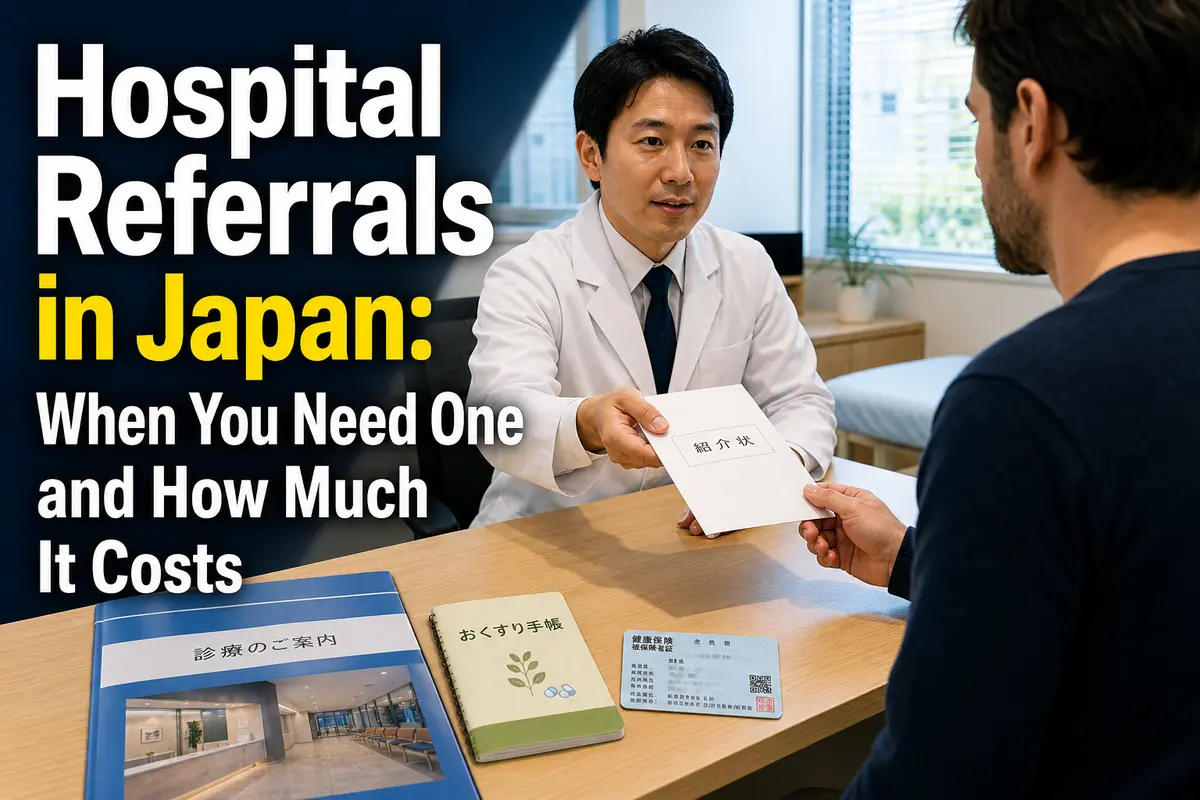
You do not need a referral letter for every hospital visit in Japan. For common symptoms, the usual route is to visit a local clinic first. If you need specialist tests or treatment, the clinic can issue a referral letter—called a shōkaijō (紹介状)—to an appropriate hospital.
Going directly to certain large hospitals without one can add at least ¥7,000 for medical care or ¥5,000 for dental care to your bill. A hospital or department may also limit appointments to referred patients.
The short version
- Start at a local clinic unless the condition is urgent or the hospital tells you otherwise.
- Ask the doctor whether specialist or hospital care is necessary.
- Confirm that the referral names the correct hospital and department.
- Call the hospital before going; a referral does not always create an appointment.
- Check the hospital’s own website because its fees and intake rules may exceed the national minimum.
This guide is for foreign residents, students, workers, and newcomers using medical care in Japan. The information reflects official material available in August 2026, but individual hospitals and departments set their own reception procedures.
What is a shōkaijō?
A referral letter transfers useful medical information from one medical provider to another. Its formal name is shinryō jōhō teikyōsho (診療情報提供書), meaning “medical information document.”
It may include:
- your symptoms and suspected diagnosis;
- previous treatment and current medicines;
- allergies and relevant medical history;
- laboratory or imaging results;
- the reason specialist care is needed; and
- the hospital or department to which you are being referred.
This is more than a note saying that you should see another doctor. It helps the receiving hospital understand what has already been checked and why you were sent there.
A referral can reduce unnecessary repetition, but it does not guarantee that every test will be accepted. The hospital’s doctor may repeat an examination or scan if the existing result is too old, incomplete, incompatible with its system, or medically insufficient.
Japanese terms you may see
- 紹介状 — shōkaijō: referral letter
- 診療情報提供書 — shinryō jōhō teikyōsho: formal medical information document
- 初診 — shoshin: initial consultation or a visit treated as a new case
- 再診 — saishin: follow-up consultation
- 選定療養費 — sentei ryōyōhi: special charge for selected services outside the normal insured copayment
- かかりつけ医 — kakaritsuke-i: your regular or primary doctor
- 逆紹介 — gyaku-shōkai: referral from a large hospital back to a community provider
When is a referral needed?
The answer depends on the hospital, the department, and the type of care—not simply on whether a building is called a hospital.
Japan encourages patients with routine illnesses or minor injuries to use local clinics and smaller hospitals. Large institutions are expected to concentrate on surgery, complex examinations, cancer treatment, acute care, and other specialist services.
A referral is especially important when you plan to visit:
- a tokutei kinō byōin (特定機能病院), or advanced treatment hospital;
- a regional medical care support hospital with at least 200 general beds;
- a referral-focused institution with at least 200 general beds; or
- a specialist department that accepts new patients only through another doctor.
The Ministry of Health, Labour and Welfare describes referral-focused institutions as facilities providing services such as surgery, chemotherapy, radiotherapy, and care requiring expensive equipment. Patients can generally consult these institutions without a referral, but the special fee normally applies. The ministry’s referral-focused institution page links to prefectural lists and advises readers to confirm the latest local list.
However, payment does not always buy access. A hospital may accept walk-in patients in one department while requiring a referral and advance appointment in another. JCHO Tokyo Shinjuku Medical Center, for example, states in its 2026 English patient guide that some departments may refuse patients without a referral.
ここがポイント: A referral and an appointment solve different problems. The referral transfers medical information and may avoid a special fee; the appointment reserves access under the hospital’s own rules.
How much does it cost?
There are two separate amounts to understand: the cost of having a referral prepared and the extra charge for visiting certain hospitals without one. They should not be confused.
Cost of getting the referral
Under the national medical fee schedule effective from June 2026, shinryō jōhō teikyōryō (I) (診療情報提供料(Ⅰ)), the insured fee for providing referral information to another medical institution, is 250 points. One point normally represents ¥10, so the listed insured amount is ¥2,500.
Your share of that item is usually:
- ¥750 at a 30% copayment;
- ¥500 at a 20% copayment; or
- ¥250 at a 10% copayment.
This is not necessarily the total charged at the clinic that day. You may also pay for the consultation, tests, imaging, or other care. Municipal medical subsidies and your insurance status can change your final payment.
The 250-point amount can be checked in the Ministry’s 2026 medical fee information service.
Cost of going without a referral
The national minimum special charges are:
| Situation | Medical care | Dental care |
|---|---|---|
| Initial visit without a referral at a covered large hospital | At least ¥7,000 | At least ¥5,000 |
| Continuing at the large hospital after it refers you to another provider | At least ¥3,000 per applicable visit | At least ¥1,900 per applicable visit |
These amounts are paid in addition to the ordinary consultation and treatment charges. They are minimums, not universal final prices.
For example, many hospitals publish tax-inclusive charges of ¥7,700 for an initial visit and ¥3,300 for an applicable follow-up visit. Tokyo Rosai Hospital lists a ¥7,700 initial-visit charge, while JCHO Tokyo Shinjuku Medical Center publishes ¥7,000 plus tax and ¥3,000 plus tax.
The practical lesson is simple: never assume that the extra charge will be exactly ¥7,000. Search the hospital website for shoshinji sentei ryōyōhi (初診時選定療養費), “initial consultation special fee,” or “patients without a referral.” If the English page is unclear, call the patient support or regional medical liaison desk.
A simple cost comparison
Suppose an insured adult with a 30% copayment visits a clinic, receives a referral, and then attends a covered large hospital.
The referral-information component at the clinic would normally be ¥750. Other clinic services and the later hospital treatment are charged separately, but the patient generally avoids the hospital’s no-referral fee.
If the same person goes directly to a hospital charging ¥7,700, that ¥7,700 is added to the normal medical bill. Even after including the clinic visit, starting locally can be less expensive—and the referral may direct the patient to the correct department before the trip.
This comparison is only illustrative. Tests, subsidy eligibility, insurance coverage, and hospital pricing can change the total.
How to get and use a referral
The safest route has four stages: visit a suitable local provider, discuss the destination, collect the complete referral package, and confirm the hospital’s intake rules.
1. Visit the right local clinic
Choose a clinic related to your symptoms where possible:
- internal medicine for many adult illnesses;
- orthopedics for bone, joint, or certain injury problems;
- dermatology for skin conditions;
- ophthalmology for eye problems;
- ear, nose, and throat care for related symptoms; or
- pediatrics for children.
If you do not know which specialty you need, ask a general internal medicine clinic or a medical consultation service. Do not delay emergency care while searching for a routine referral.
Bring your My Number Card used as a health insurance certificate or other valid eligibility document, a medicine notebook called an okusuri techō (お薬手帳), and any relevant results.
2. Ask whether hospital care is necessary
Explain your symptoms, how long they have lasted, and what treatment you have already received. You can say:
Shōkaijō wa hitsuyō desu ka? (紹介状は必要ですか?) — Do I need a referral letter?
If you already have a preferred hospital, mention it before the document is prepared. The doctor may recommend a different institution because it has the correct specialist, equipment, availability, or regional role.
A doctor issues a medical referral when they judge that another provider’s care is needed. It is not normally a document that reception staff simply sell on request without a consultation.
3. Check what you receive
The clinic may hand the letter to you in a sealed envelope, transmit information to the hospital, or arrange the appointment through a medical liaison office. Ask whether images or other records are provided separately.
Before leaving, confirm:
- hospital name;
- department name;
- whether the clinic booked an appointment;
- whether you must call yourself;
- whether scans are on a CD or other medium;
- whether laboratory results are enclosed; and
- how soon the hospital expects you to attend.
Do not open a sealed envelope unless the clinic tells you that you may. Keep the letter and any image media together.
4. Contact the hospital
Use the hospital’s official new-patient instructions. Tell staff that you have a referral and name the department written on it.
Ask these questions:
- Is advance booking required?
- Does the hospital accept bookings directly from patients?
- Must the referring clinic make the booking?
- What are the reception hours for first-time patients?
- Do I need an interpreter?
- Which original documents and image media should I bring?
Some hospitals give referred patients access to appointment booking that is not available to patients without a letter. Others require the clinic to send the referral first.
What to bring on the hospital day
Bring the referral package even if the clinic has already sent information electronically. Reception may still need to verify the original documents or attached media.
A useful checklist is:
- referral letter or confirmation that it was sent;
- My Number Card used for insurance verification, or another accepted eligibility document;
- hospital patient card, if you have one;
- medicine notebook and a list of current medicines;
- test results, image CD, or other material from the clinic;
- appointment confirmation;
- medical subsidy certificate, if applicable;
- identification and payment method; and
- interpreter arrangements, if needed.
Arrive early. First-visit reception can close before the outpatient department itself closes, and morning-only reception is common.
If your name appears differently across your passport, residence card, insurance record, and referral, contact the hospital in advance. Matching records at the counter may otherwise take longer.
When the special fee may not apply
National rules recognize exceptions, but the hospital must decide whether your case fits one of them. Do not rely on an exception without checking.
Government guidance identifies groups such as:
- emergency patients;
- certain patients covered by national or local public medical expense programs;
- patients eligible for free or low-cost medical services;
- HIV patients at designated AIDS core hospitals; and
- patients admitted immediately after an outpatient consultation.
Other recognized situations can include an internal referral from another department at the same hospital or a visit following instructions for a detailed examination after certain health screenings.
The full list is technical, and local subsidy cards are not treated uniformly. A municipal child medical subsidy, for example, does not automatically prove that a large hospital’s no-referral charge is waived.
Emergency status also means a medical need for urgent care; it does not simply mean that a patient chose an emergency entrance or arrived outside normal hours. If symptoms suggest a serious emergency, seek urgent help first and deal with paperwork afterward.
Why a hospital may send you back to a clinic
A return referral is a normal part of the system, not necessarily a withdrawal of care. Once specialist treatment is complete or your condition is stable, the hospital may issue a gyaku-shōkai so that a local provider handles routine prescriptions and monitoring.
The large hospital may still remain involved for scheduled specialist reviews. Your clinic and hospital can divide the work: everyday management locally, complex treatment at the specialist center.
If the hospital has formally referred you elsewhere but you continue attending it by personal choice, the follow-up special charge can apply. The national minimum is ¥3,000 for medical care or ¥1,900 for dental care on each applicable visit.
Before leaving specialist care, ask:
- which provider will renew each medicine;
- where test results will be sent;
- which symptoms require an earlier hospital return;
- whether the hospital will keep any future appointments; and
- whether a new referral will be needed later.
Common mistakes that cost time or money
Most problems come from treating the referral, appointment, and insurance check as if they were the same procedure. They are separate.
Going straight to a famous hospital for a common symptom
A recognizable hospital name does not mean it is the best first contact. You may pay the special fee, wait longer, or discover that the relevant department requires a referral.
Better approach: call first or visit a suitable local clinic.
Assuming any letter will remove the fee
A medical certificate, health-check report, or note from a non-medical provider may not qualify as a formal referral from an insured medical institution.
Better approach: ask whether the document is a shinryō jōhō teikyōsho addressed to the receiving hospital or department.
Arriving without an appointment
A referral does not always reserve a time. Some hospitals accept referred walk-ins; others require the clinic or patient to book.
Better approach: confirm the procedure before traveling.
Leaving the image disc at home
The written referral may say that scans are enclosed separately. Without the disc, the specialist may lack the images needed for the visit.
Better approach: keep the envelope, results, and media in one folder.
Assuming an old patient card makes every visit a follow-up
A hospital may treat a later visit as a new initial consultation if the previous condition ended, you stopped attending, or you now need a different department. Tokyo Rosai Hospital, for example, warns that some returning patients are treated as new patients under its rules.
Better approach: ask whether your visit will be classified as shoshin and whether a new referral is needed.
Comparing only the referral fee and the ¥7,000 minimum
The clinic appointment can include other insured charges, while the hospital’s special fee can exceed the minimum and is added to treatment costs.
Better approach: request an estimate when cost affects your choice, but understand that final medical charges depend on what care is provided.
Regional and hospital differences
The national framework sets minimum charges for covered large hospitals, but the practical experience is local. Prefectures publish lists of referral-focused institutions, while each hospital controls departments, booking channels, reception times, document handling, and charges above the minimum.
Differences may include:
- whether a specific department accepts patients without referrals;
- whether the clinic must book the appointment;
- whether foreign-language booking support is available;
- the period after which a returning patient is treated as new;
- the tax-inclusive special charge;
- how screening follow-up cases are handled; and
- whether imaging must be submitted before the appointment.
This is why advice from a friend who visited another hospital—or even another department in the same hospital—may not apply to you.
Current position as of August 2026
The large-hospital minimums remain ¥7,000 for an initial medical visit and ¥5,000 for an initial dental visit without a referral. The corresponding follow-up minimums remain ¥3,000 and ¥1,900 when a patient continues at the large hospital after being referred elsewhere.
Japan’s 2026 medical fee schedule took effect in June 2026. The referral-information fee under shinryō jōhō teikyōryō (I) remains 250 points. Meanwhile, the national list of referral-focused institutions was updated in July 2026, and the Ministry advises checking the relevant prefecture for the latest local information.
Future changes can affect either side of the calculation: the national fee schedule or the hospital’s own published charge. Check both when making an appointment.
FAQ
Can I ask for a referral to a hospital of my choice?
You can state your preference, but the doctor may suggest another hospital based on specialty, clinical need, location, or referral arrangements. Discuss the destination before the letter is completed.
Can an online clinic issue a referral?
It may be possible when the doctor can medically assess the case and the service supports referrals, but the provider and receiving hospital set the practical rules. Confirm whether the hospital will accept the document and how it must be delivered.
Does a referral expire?
There is no single simple period that works for every case. Hospitals may apply their own scheduling rules, and medical information can become outdated. Contact the receiving hospital promptly and ask whether the document remains acceptable if your appointment is delayed.
Does a referral guarantee treatment?
No. The hospital still decides whether it can accept the case, which department is appropriate, and what care is medically necessary. A referral also does not guarantee admission, a particular test, or a specific treatment result.
Will travel insurance cover the no-referral fee?
That depends on the policy. Japanese public health insurance does not make this special charge part of the ordinary copayment. Ask the insurer whether selected-service charges and referral-document costs are covered, and keep itemized receipts.
What if I need help in English?
Check the hospital’s international patient or foreign-language support page before booking. Language support varies considerably. A multilingual website does not guarantee that every telephone line or department operates in English.
What to check before your next visit
For non-urgent symptoms, begin with a clinic that handles the relevant problem. If the doctor recommends specialist care, leave with more than an envelope: know the hospital, department, booking method, reception deadline, and documents required.
Before traveling to the hospital, verify these three points on its current official page:
- Will the department accept you with this referral?
- Has an appointment actually been made?
- What will the hospital charge if the referral is missing or rejected?
Those checks can prevent an unnecessary ¥7,000-plus charge—and, more importantly, help you reach the right medical team without losing time at the wrong counter.
参照リンク
- Government of Japan: Visiting large hospitals without a referral and special charges
- Ministry of Health, Labour and Welfare: Referral-focused medical institutions
- Ministry of Health, Labour and Welfare: 2026 medical fee information service
- JCHO Tokyo Shinjuku Medical Center: 2026 English patient guide
- Tokyo Rosai Hospital: Information for new patients