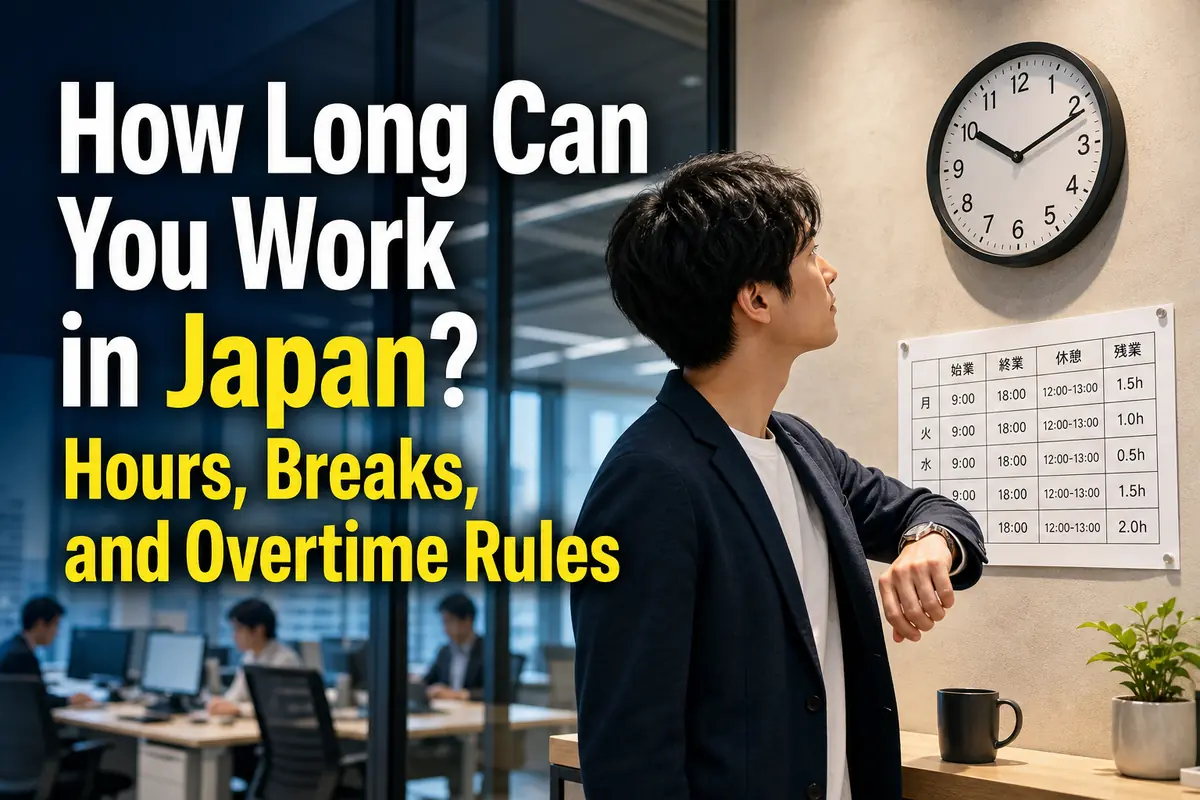
Your Workday in Japan: Legal Hours, Breaks, and Overtime Explained
In most Japanese workplaces, the basic legal limit is 8 working hours per day and 40 hours per week. If you work more than 6 hours, your employer must normally provide at least a 45-minute break. If you work more than 8 hours, the minimum is 60 minutes.
These rules generally apply regardless of nationality and cover full-time, part-time, temporary, and dispatched workers. Your contract may offer better conditions, but it cannot normally replace the minimum protections in Japan’s Labour Standards Act.
The essentials
- Statutory limit: generally 8 hours a day and 40 hours a week
- Break: at least 45 minutes when work exceeds 6 hours
- Longer break: at least 60 minutes when work exceeds 8 hours
- Overtime: usually requires a filed labour-management agreement called a saburōku kyōtei
- Premium pay: generally at least 25% extra for statutory overtime
This guide is for employees, students with part-time jobs, and people preparing to work in Japan. It explains the national baseline current as of August 2026. Special systems and industry-specific exceptions may change how the rules apply to an individual workplace.
The legal limit is not necessarily your scheduled workday
The first distinction to understand is the difference between contractual hours and statutory hours. They are not always the same.
Your employer’s scheduled hours are called shotei rōdō jikan (所定労働時間), or contractual working hours. The general legal limits are called hōtei rōdō jikan (法定労働時間), or statutory working hours.
Suppose your contract says:
- Start: 9:00 a.m.
- Finish: 5:00 p.m.
- Unpaid lunch break: 1 hour
- Actual working time: 7 hours
If you remain until 6:00 p.m., you have worked one hour beyond your scheduled day, but your total is still 8 hours. That hour must be paid, but the Labour Standards Act does not automatically require the statutory overtime premium for it. Your contract, collective agreement, or workplace rules may still promise extra pay.
If you continue until 7:00 p.m., the hour from 6:00 to 7:00 normally exceeds the 8-hour statutory limit. That part is statutory overtime, or hōtei-jikan-gai rōdō (法定時間外労働), and generally attracts an overtime premium.
This difference matters when reading a payslip. A company may use “overtime” for all work after the scheduled finish time while calculating the legal premium only after the statutory threshold is crossed.
How much break time must you receive?
The required break depends on actual working time, not simply the length of time between arrival and departure.
The national rule can be read as follows:
- 6 hours or less: no statutory break is required
- More than 6 hours and up to 8 hours: at least 45 minutes
- More than 8 hours: at least 60 minutes
The word “more than” is important. Exactly 6 working hours does not trigger the statutory 45-minute requirement. Exactly 8 working hours requires at least 45 minutes, not automatically 60 minutes. Once actual work exceeds 8 hours, the minimum rises to one hour.
A workplace may provide longer or more frequent breaks. Check your rōdō jōken tsūchisho (労働条件通知書, notice of working conditions), employment contract, shift schedule, and shūgyō kisoku (就業規則, rules of employment).
A break must come during the work period
The employer cannot normally treat an early arrival or an early departure as the statutory break. The break must be provided during the working period.
For example, a schedule of eight working hours followed by a “break” at the end does not serve the purpose of a statutory rest period. The employee must be released from work while the shift is still in progress.
You must be free from work
A genuine break is time when you are free to use the period yourself. If you must answer calls, serve customers, watch equipment, remain ready for immediate instructions, or cover a reception desk, the period may count as working time rather than a break.
This is especially relevant in restaurants, hotels, care facilities, shops, security work, and small offices where someone is told to “take lunch but keep an eye on things.” The label on the schedule does not decide the issue; the employee’s actual duties and restrictions matter.
A company can impose reasonable workplace rules during a break, including safety or facility rules. However, restrictions that effectively prevent the employee from leaving work duties may call the break’s status into question.
ここがポイント: A lunch period is not automatically a legal break. If you must continue handling work or remain ready to respond immediately, record what happened and ask whether that time is included in your paid working hours.
Breaks are generally given at the same time, but exceptions exist
As a general rule, workers at a workplace receive breaks together. A labour-management agreement can permit staggered breaks, and certain businesses have statutory exceptions to the simultaneous-break rule because continuous service is necessary.
Staggering the time does not remove the employer’s other duties. Each eligible employee must still receive the required length of break during the work period and must be able to use it freely.
What counts as working time?
Working time is broader than the minutes spent on your main task. The key question is whether you are under the employer’s direction or control.
Time may count as work when the employer expressly or implicitly requires you to:
- Change into mandatory work clothing at the workplace
- Prepare tools, machinery, counters, or computer systems
- Clean up or complete required closing procedures
- Attend mandatory training or study work materials
- Wait at the workplace while remaining ready to work
- Travel between work sites as part of an assigned duty
- Answer messages or perform tasks before clocking in or after clocking out
Ordinary travel from home to your usual workplace is generally commuting, not working time. Voluntary social activity or study that is genuinely optional may also fall outside working time.
The facts matter more than the name used by the company. A manager saying “everyone does this before clock-in” does not necessarily make a required preparation task unpaid.
Keep your own practical record
If your recorded hours do not match your actual work, keep a factual log. Useful items include:
- The time you arrived and left
- Clock-in and clock-out records
- Shift schedules
- Work emails and chat timestamps
- Computer login records
- Instructions to attend training or remain on standby
- Payslips showing paid hours and overtime
Do not secretly take protected company information or personal data. Keep only material you are lawfully allowed to retain, and ask an official consultation service what evidence is appropriate for your situation.
Overtime requires more than a manager’s request
An employer generally needs a valid Article 36 agreement before ordering work beyond statutory hours or on a statutory day off. This is commonly called a saburōku kyōtei (36協定), meaning an agreement under Article 36 of the Labour Standards Act.
The agreement is made with either a labour union representing a majority of workers or a properly selected majority representative. It must be submitted to the relevant Labour Standards Inspection Office.
A 36 Agreement does not mean unlimited overtime is lawful. The ordinary upper limits are generally:
- 45 hours in one month
- 360 hours in one year
Under a special-clause agreement for temporary and exceptional circumstances, overtime may exceed the ordinary limits, but further legal ceilings apply. In general, these include:
- No more than 720 hours of overtime in one year
- Less than 100 hours in any single month when overtime and statutory-holiday work are combined
- An average of no more than 80 hours per month across periods of 2 to 6 months when overtime and statutory-holiday work are combined
- Exceeding 45 hours in no more than 6 months of the year
These are ceilings, not recommended targets. A company’s agreement may set lower limits, and employers retain health and safety responsibilities.
Flexible and variable schedules can change the calculation
Some workplaces lawfully use systems such as:
- Henkei rōdō jikan-sei (変形労働時間制): a variable working-hours system
- Furekkusu taimu-sei (フレックスタイム制): a flex-time system
- Discretionary working systems for eligible duties
Under a valid variable-hours system, a scheduled day may exceed 8 hours without every hour above 8 automatically becoming statutory overtime, provided the legal requirements and average-hour limits are satisfied. Flex time may calculate excess hours over a settlement period rather than day by day.
Do not assume that a system is valid merely because its name appears on a schedule. Its introduction, covered workers, calculation period, and workplace documents must meet legal conditions.
How overtime and night premiums work
Statutory overtime usually requires at least 25% extra pay, but the rate depends on when and how much you work.
The main minimum premiums are:
- Work beyond statutory hours: at least 25% extra
- Work on a statutory day off: at least 35% extra
- Work between 10:00 p.m. and 5:00 a.m.: at least 25% extra
- Statutory overtime exceeding 60 hours in one month: at least 50% extra for those excess hours
Premiums can overlap. Statutory overtime performed between 10:00 p.m. and 5:00 a.m. generally means at least 50% extra: 25% for overtime plus 25% for late-night work. Overtime beyond 60 hours in a month that is also late-night work generally produces a minimum combined premium of 75%.
A company may promise higher rates in its employment rules or contract.
“Holiday work” has a specific legal meaning
Not every Sunday or company holiday is necessarily a hōtei kyūjitsu (法定休日), or statutory day off. Employers must generally provide at least one day off per week or four days off over a four-week period, but a workplace may designate which day is statutory.
Work on a non-statutory company holiday may instead be treated as ordinary work or statutory overtime, depending on total hours and the company’s rules. Check which day your employer designates as the statutory day off before trying to calculate the premium.
Common situations that cause confusion
Most mistakes come from relying on the schedule’s labels instead of checking actual duties, actual hours, and the employment rules.
“My salary includes overtime”
Some contracts include a fixed overtime allowance called kotei zangyō-dai (固定残業代) or minashi zangyō-dai (みなし残業代). This does not create a general right to unlimited unpaid overtime.
The contract should make the fixed overtime portion and its basis clear. If the legally required overtime pay for the hours actually worked is higher than the included amount, the employer generally must pay the difference.
“Managers do not receive overtime”
A job title such as “manager,” “leader,” or tenchō (店長, store manager) does not by itself remove working-time protections. The legal exemption for a person in a managerial or supervisory position depends on actual authority, responsibilities, treatment, and working conditions.
Even a worker who falls within that exemption may remain entitled to the late-night premium for work between 10:00 p.m. and 5:00 a.m. Individual cases require careful assessment.
“My lunch was automatically deducted”
An automatic deduction can be reasonable when the employee actually receives the break. It becomes a problem if the system deducts an hour while the employee continues handling calls, customers, monitoring, or other required work.
Compare the time record with what you were actually required to do. Raise discrepancies promptly and in writing when possible.
“I agreed to work extra, so the limits do not matter”
An employee’s personal agreement does not normally cancel the statutory rules. Likewise, a 36 Agreement regulates whether statutory overtime may be required; it does not remove the duty to record hours or pay the correct wages.
Important exceptions and status differences
The basic rules are national, but the calculation can change because of the industry, role, or working-time system—not because a worker is foreign.
Points requiring closer checking include:
- Certain small workplaces in commerce, health and hygiene, hospitality and entertainment, and specified related sectors may use a 44-hour weekly statutory limit if they regularly employ fewer than 10 workers.
- Agriculture, livestock, and fishery work have important exceptions to the ordinary working-hours, break, and day-off provisions.
- Certain transport workers, construction work, and physicians are covered by sector-specific overtime arrangements and limits.
- Genuine managerial or supervisory employees and certain confidential positions are treated differently under the Act.
- Seafarers and some public-sector employees may be governed by different legislation or special rules.
A visa or residence status can separately limit the kind or amount of work a person may perform. For example, a student’s immigration permission and weekly work limit are separate from labour-law rules about breaks and overtime. Meeting one set of rules does not guarantee compliance with the other.
What to check before accepting a job or shift
A five-minute document check can prevent months of uncertainty about unpaid time.
Look for these items in your written conditions:
- Start and finish times
- Length and timing of breaks
- Scheduled days off and the statutory day off
- Whether a variable-hours or flex-time system applies
- Overtime rates and the method used to calculate them
- Any fixed overtime allowance and the number of hours it covers
- The wage-closing date and payday
- The procedure for approving and recording overtime
Ask for the rōdō jōken tsūchisho and workplace rules if they have not been provided or explained. Keep copies of documents you sign.
For a changing shift, calculate working time by subtracting genuine breaks from the period between starting and finishing. Then compare the result with your scheduled hours, the statutory thresholds, and the hours shown on your payslip.
What to do if your hours or breaks appear wrong
Start with records and a specific question, then move to an official consultation service if the explanation does not resolve the issue.
A practical sequence is:
- Write down the dates, actual hours, missed or interrupted breaks, and duties performed.
- Compare your records with the contract, workplace rules, attendance record, and payslip.
- Ask payroll, human resources, or your manager how the time was classified and calculated.
- If relevant, speak with your labour union or employee representative.
- Contact an official labour consultation service for an individual assessment.
Japan’s Ministry of Health, Labour and Welfare provides a Telephone Consultation Service for Foreign Workers in multiple languages. The ministry’s Labour Standards Advice Hotline also offers free, anonymous consultation outside ordinary government-office hours, with foreign-language services available on specified schedules.
For possible legal violations or unpaid wages, the local Rōdō Kijun Kantokusho (労働基準監督署, Labour Standards Inspection Office) is the relevant enforcement office. Consultation schedules, languages, and telephone charges can change, so confirm the current details on the official page before calling.
Current position as of August 2026
The core thresholds remain 8 hours per day, 40 hours per week, 45 minutes after more than 6 hours, and 60 minutes after more than 8 hours in current Ministry guidance.
Recent official materials also reflect the overtime ceilings that now cover sectors whose transitional treatment ended in April 2024, including construction and driving work, although special rules remain for some sectors. Monthly overtime above 60 hours carries a minimum 50% premium for both large companies and small and medium-sized companies; the extension to smaller companies took effect in April 2023.
Employment-law changes can affect particular industries before they change the basic rule for most workers. If you work in transport, construction, medicine, agriculture, seasonal operations, or under an unusual schedule, check the current sector guidance rather than relying only on a general summary.
Practical takeaways
Use these questions to review your next shift or payslip:
- Did my actual work exceed 6 or 8 hours, and did I receive the required break?
- Was I genuinely free from duties during the recorded break?
- Are required preparation, cleanup, training, and standby time included?
- Did I cross my contractual hours, statutory hours, or both?
- Does the payslip apply the correct overtime, holiday, and late-night premiums?
- Is a variable schedule, fixed overtime allowance, or sector exception clearly documented?
The most important watchpoint is unrecorded work around the edges of a shift. Required preparation before clock-in, interrupted lunches, and closing tasks after clock-out can change both the break calculation and the amount of wages due. Record the facts while they are fresh, then ask an official service to assess any unresolved case.
This article provides general information, not individual legal or immigration advice.
参照リンク
- Ministry of Health, Labour and Welfare: Working Hours and Days Off
- Ministry of Health, Labour and Welfare: Rules on Working Conditions and Workplace Environment
- Ministry of Health, Labour and Welfare: Working Conditions Handbook
- Ministry of Health, Labour and Welfare: Guidelines for Proper Understanding of Working Hours
- Ministry of Health, Labour and Welfare: Information on Labour Standards for Foreign Workers
- Ministry of Health, Labour and Welfare: Telephone Consultation Service for Foreign Workers
- Ministry of Health, Labour and Welfare: Labour Standards Advice Hotline
- Japanese Law Translation: Labour Standards Act