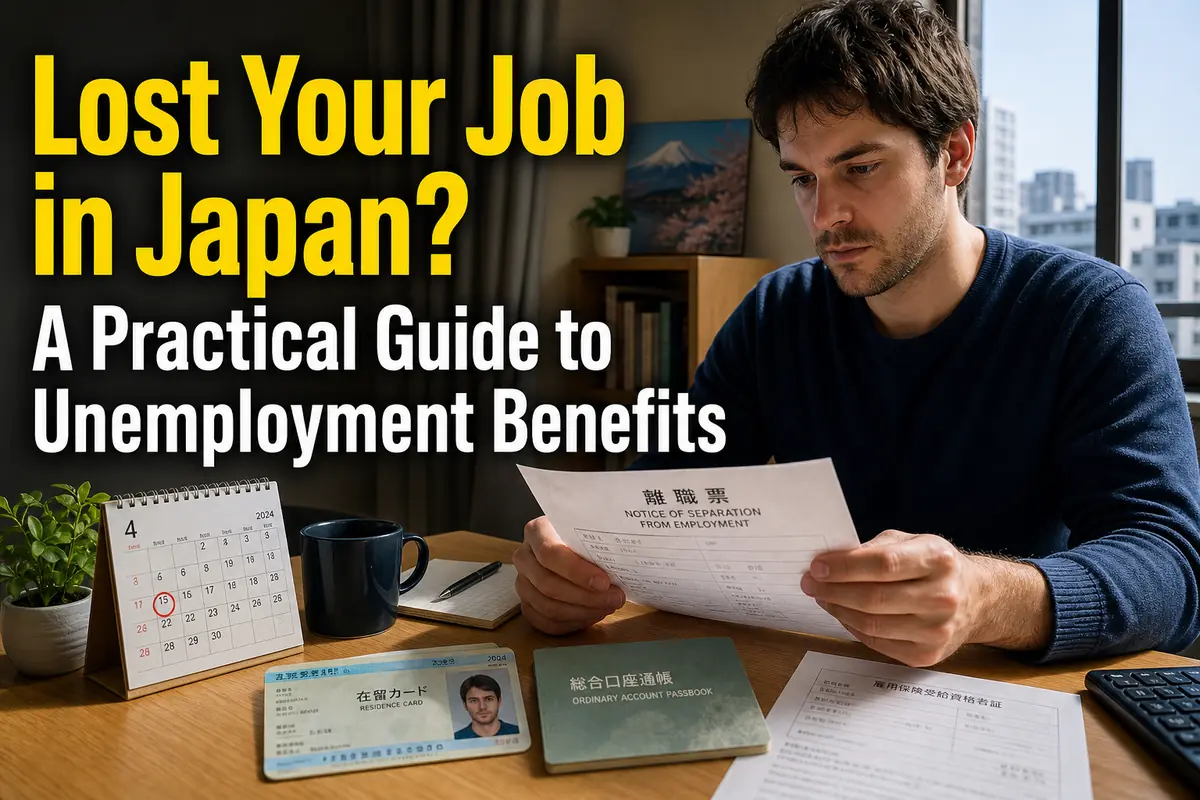
Lost Your Job in Japan? A Practical Guide to Unemployment Benefits
If you lose your job in Japan, you may qualify for the employment insurance basic allowance. In most cases, you need at least 12 insured months during the two years before leaving work. Some people who were dismissed, affected by bankruptcy, or unable to continue working for an unavoidable reason may qualify with six insured months during the previous year.
Applying does not produce an immediate payment. Everyone first completes a seven-day waiting period after registering as a job seeker. People who resigned without an accepted reason usually face an additional one-month benefit restriction if they left their job on or after April 1, 2025.
This guide is for foreign workers in Japan who are ready and legally able to take another job.
The essentials:
- Apply at the Hello Work office responsible for your home address.
- The process starts when you submit your separation documents and register as a job seeker—not automatically on your final working day.
- Your daily allowance is generally about 50% to 80% of your previous wage-based daily amount, subject to age-based limits.
- Your reason for leaving affects the waiting time and may affect the number of payable days.
- Unemployment benefits do not replace immigration procedures connected with losing or changing a job.
What Japan’s unemployment benefit actually covers
The basic allowance supports an active job search; it is not a general payment for everyone who stops working.
Japan’s unemployment insurance is called koyō hoken (雇用保険, employment insurance). Its main unemployment payment is kihon teate (基本手当, basic allowance), often informally called shitsugyō teate (失業手当, unemployment benefit).
To be treated as unemployed for this purpose, you must:
- want to find work;
- be physically and practically available to start work;
- actively look for a job; and
- remain without employment despite those efforts.
You normally cannot receive the basic allowance while you are taking a break with no intention of job hunting, studying full-time, running a business, or unable to work immediately because of illness, injury, pregnancy, childbirth, or childcare.
That does not always mean losing the benefit permanently. If you cannot work for 30 consecutive days or more for an accepted reason, you may be able to extend the period in which you can claim. Discuss this with Hello Work before the ordinary claim period expires.
Foreign nationality is not the deciding factor
A foreign worker covered by employment insurance can apply under the same core benefit rules as other insured workers. The important questions are whether you accumulated enough insured months and whether you can legally and practically accept suitable work.
Your residence status is a separate issue. Some work-based status holders must notify the Immigration Services Agency when their contract with an employer ends. For several common work statuses, the deadline is within 14 days of the change.
Check the rules for your exact status of residence. Receiving unemployment benefits does not extend your period of stay or authorize work outside the activities permitted by your status.
Check your eligibility before calculating the payment
Insurance history and the reason recorded for your departure are the two facts to check first.
The standard 12-month rule
The usual requirement is at least 12 months as an insured worker during the two years before separation.
For this calculation, an insured month generally counts when it contains either:
- at least 11 days used as the basis for wage payment; or
- at least 80 hours used as the basis for wage payment.
Periods from different employers may sometimes be combined. If you changed jobs without claiming a benefit and joined employment insurance again within one year, earlier insured service may continue to count.
Do not estimate eligibility only from the number of calendar months you worked. Part-time schedules, unpaid absences, a long gap between jobs, and a previous benefit claim can change the calculation.
The six-month route for certain departures
A shorter test may apply to a tokutei jukyū shikakusha (特定受給資格者, specially qualified recipient) or a tokutei riyū rishokusha (特定理由離職者, person leaving for a specified reason).
These classifications may cover cases such as:
- dismissal or business failure;
- some non-renewals of fixed-term contracts; or
- certain unavoidable personal or workplace circumstances.
Eligible people in these groups may qualify with six insured months during the year before leaving. Some also receive more payable days than ordinary voluntary leavers.
The label is not determined only by what the employer writes. Hello Work makes the final decision after considering the employer’s information, your explanation, and supporting evidence.
ここがポイント: A separation recorded as “voluntary” can mean a longer delay and fewer payable days. Read your rishokuhyō carefully and raise any factual disagreement when you apply.
If the stated reason is wrong
Your employer provides rishokuhyō-1 and rishokuhyō-2 (離職票-1・2, separation notices). The second form includes wage and separation information.
If it says you resigned voluntarily but you were dismissed, pressured to leave, subjected to serious harassment, or unable to continue for another documented reason, tell Hello Work immediately. Bring relevant material, such as:
- a dismissal notice or resignation-related correspondence;
- your employment contract and work rules;
- pay records or shift records;
- medical documents where relevant; or
- messages and other records that explain the circumstances.
Hello Work will seek information from both sides before deciding. A disagreement does not guarantee a different classification, but staying silent allows inaccurate information to shape the decision.
Waiting period and benefit restriction are different
Every claimant has a seven-day waiting period, but only some claimants face an additional restriction.
These two periods are often confused.
Seven-day waiting period: taiki
The taiki kikan (待期期間, waiting period) is seven days in total. It starts from the day on which Hello Work accepts your separation documents, confirms your benefit application, and registers your job search.
It does not normally start on your resignation date or final payday. Delaying your visit can therefore delay the entire schedule.
The seven-day rule applies regardless of whether you resigned or were dismissed. Work performed during this period can affect when the seven qualifying unemployed days are completed, so report every paid activity.
Additional restriction: kyūfu seigen
The kyūfu seigen (給付制限, benefit restriction) comes after the seven-day waiting period in certain cases.
For a resignation without a reason accepted under the system:
- separation on or after April 1, 2025: normally one month;
- separation on or before March 31, 2025: normally two months; and
- two or more previous qualifying voluntary separations within the preceding five years: three months.
A three-month restriction can also apply to dismissal for a serious reason attributable to the worker.
People dismissed because of bankruptcy, redundancy, or another qualifying employer-side reason generally do not face the ordinary voluntary-resignation restriction. They must still complete the universal seven-day waiting period.
Training can remove the restriction
Since April 2025, eligible education or training connected with improving employment prospects can remove the voluntary-resignation restriction. The rules cover specified training started on or after April 1, 2025, including some courses begun within one year before leaving work or during unemployment.
This is not automatic for every private course. Ask Hello Work whether the course qualifies and what proof of its content and start date is required.
How much can you receive?
The allowance is wage-based, but it is not a fixed percentage of your monthly salary.
Hello Work first calculates your chingin nichigaku (賃金日額, wage daily amount). As a general rule, this is the total regular wages paid during the final six months before separation divided by 180. Bonuses are normally excluded.
The kihon teate nichigaku (基本手当日額, basic allowance daily amount) is then generally about:
- 50% to 80% of the wage daily amount; or
- 45% to 80% for people aged 60 to 64.
Lower wage levels receive a higher replacement percentage. This formula produces a daily amount, not a promised monthly salary replacement.
Current daily maximums
The following maximum daily amounts apply from August 1, 2026:
- Under 30: ¥7,450
- Age 30 to 44: ¥8,270
- Age 45 to 59: ¥9,110
- Age 60 to 64: ¥7,830
The Ministry of Health, Labour and Welfare normally revises calculation thresholds each August. Use these figures only for claims covering the current period, and confirm the amount shown on your benefit certificate.
A simple estimate
Suppose your regular wages during the final six months totaled ¥1,800,000.
- Wage daily amount: ¥1,800,000 ÷ 180 = ¥10,000
- Basic allowance daily amount: determined from the official sliding formula
- Amount for one recognition period: daily allowance multiplied by the number of recognized payable days
You cannot safely calculate the second line by applying one percentage to every wage level. Age, the statutory formula, annual thresholds, unpaid days, and the wage information on your separation notice all matter.
The basic allowance itself is tax-exempt. However, receiving it may affect whether you can remain a dependent under another person’s employee health insurance. Ask that insurer or the employed family member’s benefits office before assuming that dependent coverage will continue.
How many days are payable?
The number of payable days depends on your insurance history, age, and separation classification.
An ordinary worker who voluntarily leaves a job commonly receives 90, 120, or 150 payable days, depending mainly on the length of insured service. Some people dismissed by an employer, affected by bankruptcy, or leaving for a specified reason may receive a longer entitlement based on age and insured years.
The number of payable days is not the same as the claim deadline. In principle, the benefit period ends one year after the day following separation. If you apply late, the deadline does not simply move forward; you may run out of time before using all your payable days.
Possible extensions exist when you cannot work for an extended period because of circumstances such as illness, injury, pregnancy, childbirth, or childcare. Separate special rules also apply to certain people who begin a business after leaving employment.
How to apply at Hello Work
Apply promptly after receiving your separation notices, even if the first payment will be delayed.
1. Check which office covers your address
Benefits are handled by the Hello Work office responsible for where you live, not necessarily the office nearest your old workplace. Office services, interpretation availability, and appointment practices can differ.
The Ministry’s office directory lists locations nationwide. Call in advance if you need language assistance.
2. Gather the documents
The standard application list includes:
- rishokuhyō-1 and rishokuhyō-2;
- My Number evidence, such as a My Number Card, notification card where accepted, or a certificate of residence showing the number;
- valid identity evidence;
- two recent photographs, 3.0 cm by 2.4 cm, unless the applicable My Number Card presentation procedure allows them to be omitted; and
- a bankbook or cash card for an account in your own name.
A residence card is useful identity and status evidence for foreign residents, but confirm the complete combination of documents with the office. Name order, spacing, and Roman-letter differences between your bank account and official records can cause practical delays.
Bring every separation notice if you received forms from more than one recent employer.
3. Register as a job seeker
Submitting the forms and making a kyūshoku mōshikomi (求職申込み, job-seeker registration) begin the claim. Hello Work reviews your insured record, departure reason, ability to work, and job-search intention.
You will receive instructions about an orientation, your recognition schedule, and required job-search activities. Keep every document and note the next reporting date before leaving the office.
4. Complete unemployment recognition
Hello Work usually schedules a shitsugyō ninteibi (失業認定日, unemployment recognition date) about once every four weeks. You report your job-search activities and any work or income during the relevant period.
Attend on the assigned date. If an interview, examination, illness, or another accepted reason prevents attendance, contact the office in advance and ask whether the date can be changed. Proof may be required.
5. Wait for the transfer
After a payable period is recognized, the transfer is generally made about seven days after the recognition date. Weekends, holidays, document problems, or individual review can affect the timing.
Working part-time while claiming
Part-time work must be reported even when the income is small or the work occurred during a benefit restriction.
Depending on the hours, contract, and income:
- a worked day may not be payable;
- the allowance may be reduced;
- payment may move to a later day; or
- the arrangement may be treated as employment rather than unemployment.
A contract can be treated as employment when it meets relevant hours and duration conditions, even if you describe it as casual work. Freelance assignments, trial shifts, paid training, family-business help, and online work should also be disclosed and assessed by Hello Work.
Failure to report work can lead to suspension, repayment, and an additional payment order. Keep contracts, timesheets, invoices, and payment records so that you can report accurately.
Immigration tasks to handle separately
Hello Work decides the benefit claim; the Immigration Services Agency decides residence-status matters.
For many work-based statuses, ending a contract with an employer must be reported within 14 days. Starting with a new qualifying employer can also trigger a notification requirement.
Check all three points after losing a job:
- whether your status requires an affiliation notification;
- whether the type of work you are seeking fits your current status; and
- whether your period of stay will remain valid throughout the job search.
Rules differ for work statuses, students with work permission, dependents, permanent residents, spouses, and other categories. Contact the Immigration Information Center for an individual status question rather than relying on the outcome of the unemployment-benefit claim.
Common mistakes that delay or reduce a claim
Most avoidable problems begin with late action or incomplete reporting.
- Waiting for the employer indefinitely: If requested separation notices have not arrived after the employer’s processing period, contact the employer. If the problem continues, take identity evidence and proof that employment ended to Hello Work.
- Assuming the waiting period began on the last working day: It generally begins after the benefit application and job-seeker registration.
- Ignoring an incorrect departure reason: Raise the issue during the application and bring evidence.
- Missing a recognition date: Contact Hello Work before the appointment whenever possible.
- Treating small jobs as unimportant: Report every work activity and income.
- Stopping the job search during a restriction: You remain in the benefit process and must follow the instructions given by Hello Work.
- Confusing insurance and immigration rules: Complete both processes separately.
- Planning a long rest before applying: The claim normally remains limited by the one-year benefit period after separation.
What changed and what to check in 2026
The most important recent changes are the shorter standard restriction and updated daily limits.
For a job ending in 2026, the practical points are:
- The usual restriction for an unqualified voluntary resignation is one month after the seven-day waiting period.
- Eligible employment-related education or training can remove that restriction under rules effective from April 2025.
- New age-based maximum daily allowances took effect on August 1, 2026.
- Individual payment amounts and benefit days still depend on the claimant’s wages, age, insured history, and officially determined reason for leaving.
National eligibility rules apply throughout Japan, but the office you visit, interpretation support, seminar schedule, and local job-search services vary. Confirm procedural details with the Hello Work office responsible for your address.
Practical checklist after your job ends
Act in this order:
- Ask your employer to issue both separation notices.
- Check the wages and departure reason recorded on them.
- Find the Hello Work office responsible for your home address.
- Prepare My Number evidence, identity documents, photographs if needed, and your own bank-account details.
- Apply and register as a job seeker without unnecessary delay.
- Record every job application, interview, workday, and payment.
- Check your residence-status notification and expiry date separately.
- Ask Hello Work about an extension if you cannot work now, or about the training exception if you are taking an eligible course.
The first date to protect is not the expected payment date. It is the day you apply. That visit starts the seven-day waiting period, gives you a recognition schedule, and creates an opportunity to correct the departure reason before it changes your benefit timeline.
参照リンク
- Ministry of Health, Labour and Welfare: Q&A on the basic allowance and re-employment allowance
- Hello Work Internet Service: Basic allowance
- Hello Work Internet Service: Employment insurance FAQ
- Ministry of Health, Labour and Welfare: Removal of the benefit restriction for eligible training from April 2025
- Ministry of Health, Labour and Welfare: Hello Work office directory
- Immigration Services Agency: Notification concerning an affiliated contracting organization
- Immigration Services Agency: Status of residence information