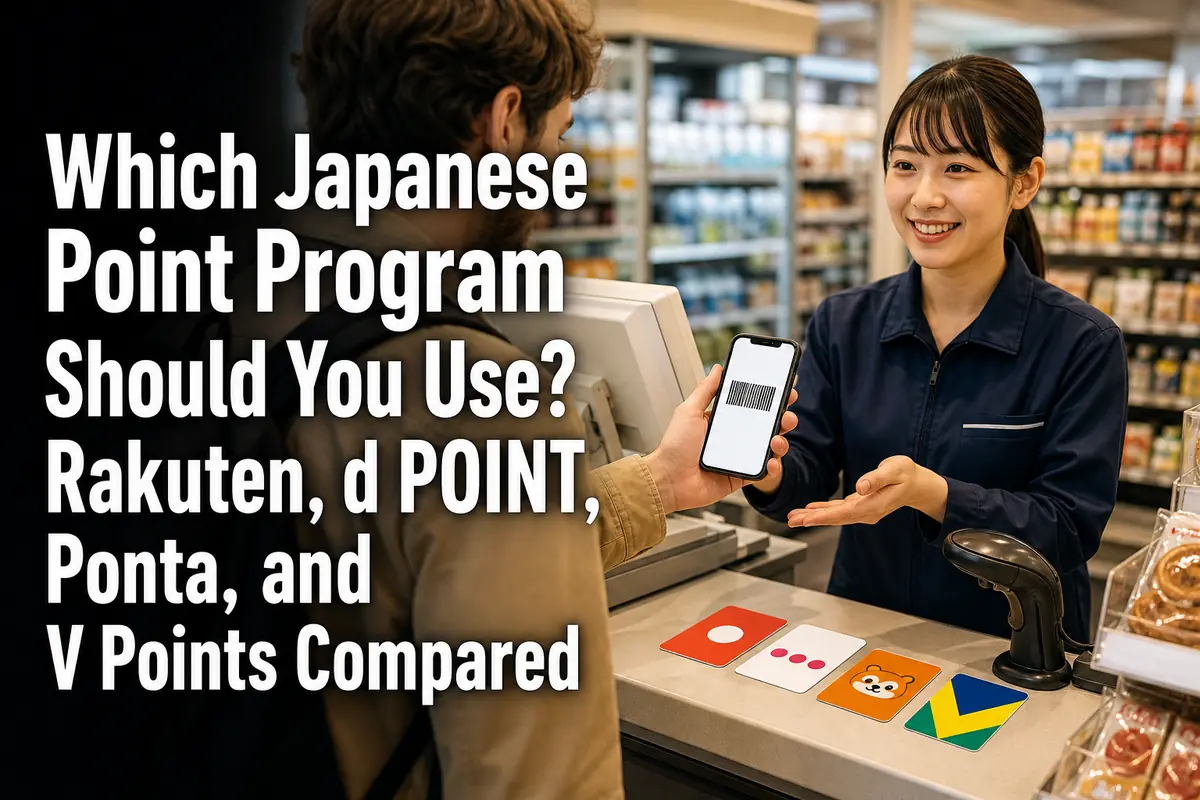
Which Japanese Point Program Should You Use? A Practical Comparison of Four Major Options
In Japan, the best point program is usually the one connected to shops and services you already use. Rakuten Points suit people in the Rakuten ecosystem, d POINT works well across participating stores without requiring a Docomo phone contract, Ponta is useful around Lawson, au, and Recruit services, and V Points connect participating stores with the wider Visa network through a separate app.
You do not need all four. For most newcomers, choosing one main program—and perhaps one secondary program tied to a frequent shop—is easier than managing four balances and four expiration schedules.
This guide is for students, workers, and other residents who are new to Japan. The information and links were checked on August 22, 2026.
Quick comparison:
- Rakuten Points: strongest when you use Rakuten shopping, mobile, travel, or payment services.
- d POINT: useful at participating shops even if you are not a Docomo mobile customer.
- Ponta: a practical match for Lawson, au-related services, and participating Recruit services.
- V Points: useful at participating stores and, after charging them to V Point Pay, eligible Visa merchants.
First, understand what a Japanese point program is
The key fact is simple: these programs give you points that can usually be used at a stated value of 1 point = ¥1 at participating services. However, a point is not automatically accepted everywhere that accepts yen.
At a shop, there may be two separate actions:
- Show a membership barcode or card to earn points.
- Pay with cash, a card, an app, or another accepted payment method.
The membership card is called a pointo kādo (ポイントカード, point card). Showing it does not necessarily pay the bill. If you want to spend your balance, say:
- Pointo o tsukaimasu (ポイントを使います): “I would like to use points.”
- Zenbu tsukaimasu (全部使います): “I would like to use all of them.”
- Hyaku pointo tsukaimasu (100ポイント使います): “I would like to use 100 points.”
Some stores allow both earning and payment in the same transaction. Others impose minimum amounts, usage limits, or exclusions. Confirm the current conditions in the program’s app or on the store’s official page.
The four programs compared
There is no universal winner. Your normal supermarket, convenience store, mobile provider, online marketplace, and credit card determine which balance will grow fast enough to be useful.
Rakuten Points: best for a connected Rakuten routine
Rakuten Points are a natural choice if several parts of your routine already involve Rakuten. The official program lists shopping, travel, mobile, utility, financial, and payment services among the places where points may be used.
Regular Rakuten Points are generally valid for one year from the month in which you last earned regular points. Earning another eligible regular point within that period extends the expiration date. Limited-time points do not extend the life of regular points, and each limited-time award has its own deadline.
Important details include:
- Points are generally worth ¥1 each when used through eligible Rakuten services.
- Limited-time points are used before regular points when both are available.
- The minimum and maximum number of points you can spend varies by service.
- A cancelled purchase may not restore expired limited-time points.
- Campaign participation may require a separate entry before shopping.
Rakuten therefore rewards active users, but it can feel complicated if you join many campaigns. Check kikan gentei pointo (期間限定ポイント, limited-time points) separately from your regular balance.
d POINT: broad access without a Docomo phone contract
d POINT is not limited to Docomo mobile subscribers. The official English FAQ states that anyone who joins d POINT CLUB can use the program, subject to its registration and service conditions.
At participating stores, show a physical or mobile d POINT card. To spend points, tell the cashier how many you want to use. The standard value is ¥1 per point, although a store may set its own transaction limit or other conditions.
A major expiration rule changed on December 1, 2025. Regular d POINTs are now generally valid until 12 months after the most recent qualifying activity—earning or using points—and the expiration can extend with further qualifying activity. Older physical cards may still display the previous rule of 48 months from award, so check the current online guide rather than relying on text printed on an old card.
d POINT also has kikan・yōto gentei points (期間・用途限定, limited-period and limited-use points). These can expire sooner and cannot be used for every d POINT service. When eligible limited and regular points are combined, limited points are used first.
Ponta: useful around Lawson, au, and Recruit services
Ponta connects physical stores with online services. Its official partner list includes retail, travel, dining, beauty, utilities, and other categories, although availability and earning conditions differ by partner.
Regular Ponta Points are generally valid for one year from your most recent point activity—either earning or spending. This makes the program manageable if you use it regularly, but an inactive account can still lose its balance.
PontaWeb also distinguishes regular Ponta Points from Recruit Points and limited-time points. That distinction matters because:
- Some Recruit Points can be exchanged for Ponta Points after linking the required accounts.
- Campaign or site-limited points may not be transferable.
- Limited-time points can have narrower uses and shorter deadlines.
- A partner may apply its own earning rate, eligible purchase amount, or excluded products.
For newcomers, the practical test is whether your usual Lawson, fuel station, travel booking service, or other regular destination participates. Do not choose Ponta only because you saw its logo once.
V Points: store points with an optional Visa route
V Points replaced the former T Point name. Existing T Cards and balances continued under the V Point system, so you may still see older cards carrying the letter “T.”
At participating stores, you can show a Mobile V Card or eligible physical card and use points at a standard value of ¥1 each. The official guide says regular V Points expire one year after your most recent qualifying use, including earning, spending, or exchanging points.
V Points have an extra route that can be useful: you can charge eligible points to the V Point Pay app and spend through participating Visa merchants. This is not the same as showing a V Point membership barcode. It involves a separate app and its own setup, device, merchant, and service conditions.
That distinction prevents a common checkout mistake:
- Mobile V Card: identifies your point membership at participating V Point partners.
- V Point Pay: provides a payment route after eligible points are charged to the app.
Confirm which screen the cashier or payment terminal requires before presenting a barcode.
Here is the key point: a point logo tells you that a program is involved, but it does not tell you the earning rate, whether points can be spent, or whether your chosen payment method qualifies. Check the conditions for that specific store and transaction.
How to choose without carrying four programs
Start with your spending pattern, not the advertised reward rate. A high campaign rate has little value if it applies only once or requires services you would not otherwise buy.
Step 1: list your repeated monthly spending
Look at the places you expect to use every month:
- supermarket and convenience store;
- mobile phone and internet provider;
- online shopping site;
- fuel station or car service;
- restaurant or café chain;
- travel and hotel booking service;
- credit card or QR payment app.
Choose the program appearing most often across that list. A second program may make sense for one major expense, but collecting small amounts in four systems increases the risk of expiration.
Step 2: separate the membership card from payment
Before checkout, identify three different things:
- the point membership you will show;
- the payment method you will use;
- any coupon or campaign entry required in advance.
These can be connected, but they are not interchangeable. For example, showing a point barcode may earn points while you pay with a completely different card. A campaign may also require payment through the operator’s own app.
Step 3: compare the real return
Earning rates vary by store, service, membership level, campaign, tax treatment, and payment method. Use this simple calculation:
points received ÷ eligible spending × 100 = effective point rate
If you receive 50 usable points from ¥5,000 of eligible spending, the effective rate is 1%. But check whether those 50 points are regular or limited-time points. A short expiration date reduces their practical value.
Step 4: test with a normal purchase
Register the account through the official app or website, then try it on a purchase you already planned to make. Confirm that:
- the barcode displays correctly;
- the points appear in your history;
- the app shows an expiration date;
- you understand how to spend a small amount.
Do not change your shopping habits until you know the program works with your account, phone, and preferred stores.
Registration issues foreign residents may face
The difficult part is often account setup, not using points at the register. Requirements vary by operator and linked service.
You may encounter fields for:
- shi-mei (氏名, full name);
- furigana (フリガナ, phonetic name in katakana);
- Japanese postal address;
- domestic telephone number;
- email verification;
- linked mobile, credit card, or payment-service accounts.
Enter your name consistently with the identity or account records required by that particular service. If a form rejects a long name, spaces, hyphens, or Latin letters, consult the operator’s official support instead of creating a different identity merely to pass the form.
Tourists and short-term visitors should also check whether registration requires a Japanese phone number, address, compatible app-store region, or linked domestic service. A plastic card may be easy to obtain, but account registration may be necessary to protect, combine, transfer, or fully use the balance.
Expiration rules deserve more attention than earning rates
A point you cannot use before its deadline is worth nothing. Each program distinguishes regular points from at least some form of limited or campaign points.
Use this monthly routine:
- Open each active program’s official app or account page.
- Look for yūkō kigen (有効期限, expiration date).
- Check whether the balance includes kikan gentei (期間限定, limited-time) points.
- Spend the earliest-expiring eligible points on an ordinary purchase.
- Review inactive programs and stop collecting points you are unlikely to use.
Do not assume that every transaction extends every point. Rakuten limited-time points, d POINT limited-period and limited-use points, and Ponta campaign or site-limited points follow their own conditions. Partner-specific V Point awards may also have separate rules.
Common mistakes and how to avoid them
Most lost value comes from missed conditions, scattered balances, or confusing membership with payment.
Showing the barcode after payment
Many stores need to scan the membership barcode before completing the sale. Have the correct screen open before reaching the cashier.
Assuming every branch has the same arrangement
Participation can differ by operator, franchise, store, online service, or transaction type. Look for the logo and ask before paying. Regional differences matter because the chains and partner stores near you may not match those in another prefecture.
Joining a campaign without completing its conditions
A campaign may require advance entry, a minimum spend, a specified payment method, or purchases during a fixed period. Read the conditions before buying. A large headline percentage is not a guarantee for every customer.
Creating duplicate accounts
Using different email addresses, cards, or linked IDs can divide one program into separate balances. Check the official linking or consolidation procedure before registering again.
Treating points as savings
Points can expire, lose eligible uses, or be affected by program changes. Redeem them for planned everyday spending instead of building a large balance without a clear use.
Following an old expiration rule
The d POINT rule changed in December 2025, and physical or translated materials may not always reflect the newest terms. Use the current Japanese official guide for time-sensitive details, even when an English overview is available.
When each program is the practical choice
Choose based on a repeatable use case. These are starting points, not universal rankings.
- Choose Rakuten Points if you already use several Rakuten services and are willing to monitor limited-time awards.
- Choose d POINT if nearby participating stores fit your routine; a Docomo mobile subscription is not required.
- Choose Ponta if Lawson, au-linked services, Recruit booking services, or other Ponta partners are regular parts of your spending.
- Choose V Points if its retail partners fit your area, or if the separate V Point Pay route is useful and available to you.
A student living near a Lawson may reach a usable Ponta balance faster than someone who rarely shops there. A worker who orders through Rakuten and uses other Rakuten services may find Rakuten Points easier to spend. Your address and routine matter more than national popularity.
Final checklist for newcomers
Before committing to a program, check these points on its official site:
- Which shops near your home, school, or workplace participate?
- Is the card used for earning, spending, or both?
- What is the normal point value at that partner?
- Are taxes, fees, discounted goods, tobacco, stamps, gift cards, or other items excluded?
- When do regular and limited points expire?
- Does activity extend the expiration date?
- Do you need a Japanese phone number, address, or linked account?
- What happens to points after cancellation or return?
Start with one program and use it for a month. If the balance grows slowly or the points are difficult to spend, stop collecting them and choose the program that matches your real purchases. The next date to watch is the earliest expiration shown in your account—not the next advertised campaign.
参照リンク
- Rakuten Point Club: Regular Points vs. Limited-Time Points
- Rakuten Point Club: How to Use Rakuten Points
- Rakuten Point Club: Official earning rules
- d POINT CLUB: English FAQ
- d POINT CLUB: Current point types and expiration rules
- PontaWeb: Point types and expiration rules
- PontaWeb: Participating stores and services
- V Point: Beginner’s guide to using points
- V Point: Official usage guide
- V Point: Transition from T Points