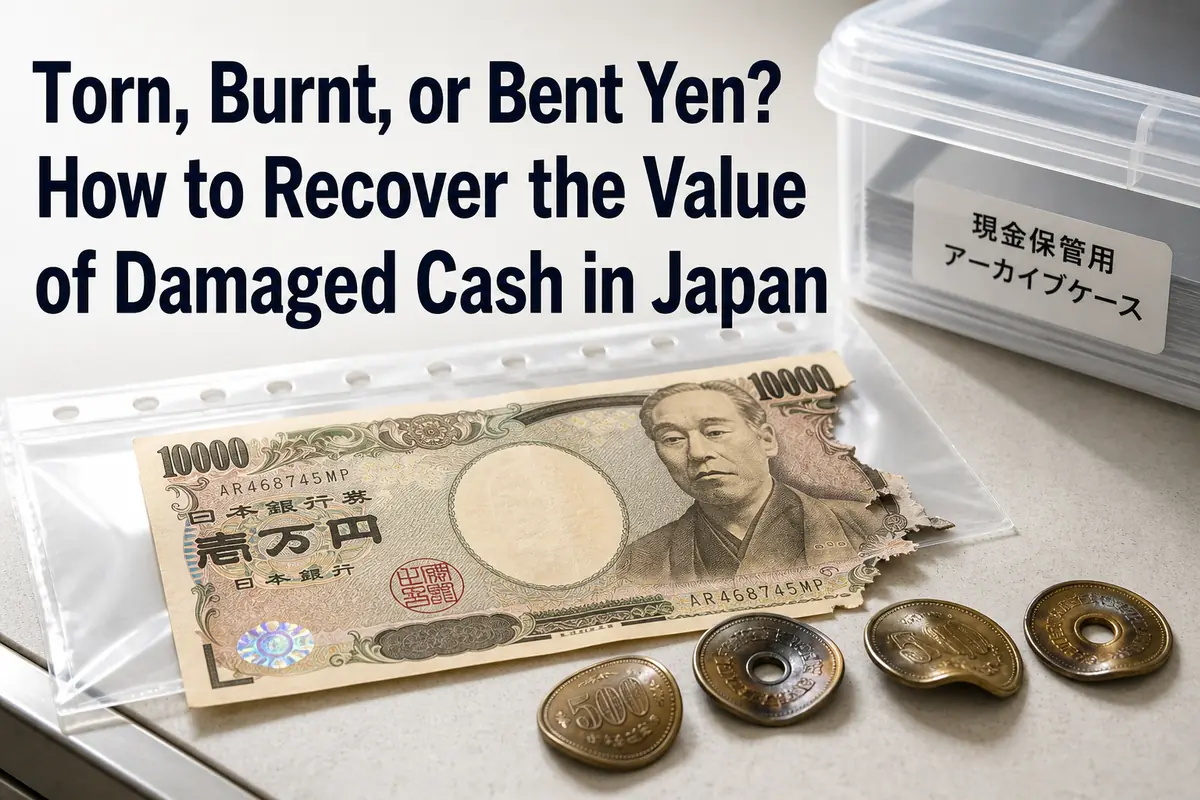
Torn, Burnt, or Bent Yen? How to Recover the Value of Damaged Cash in Japan
A damaged yen note or coin is not automatically worthless. The Bank of Japan (BOJ) can exchange eligible damaged cash free of charge, but the amount you receive depends on how much of the note remains or whether a coin can still be identified.
Do not throw the cash away, clean it aggressively, or keep testing it in payment machines. Preserve every piece, make an appointment with the BOJ, and take it to an eligible counter in person.
This guide is useful for residents, students, workers, and visitors dealing with cash damaged by tearing, water, fire, heat, corrosion, or an accident.
The essentials
- A banknote with at least two-thirds remaining can qualify for its full face value.
- A banknote with at least two-fifths but less than two-thirds remaining can qualify for half its face value.
- Most damaged coins need recognizable inscriptions and more than half their original weight.
- The official service is available at the BOJ Head Office and branches, not every BOJ facility.
- You should book in advance and visit in person; damaged cash cannot be mailed or sent by courier.
- The exchange itself has no service charge.
First, protect the damaged cash
Your first task is to prevent further loss. The BOJ must be able to identify the cash and measure or weigh what remains.
If a note is torn
Keep every piece, including small fragments. When the matching pieces are clear, place them together carefully with weak adhesive tape so that staff can see both the front and back.
Before attaching anything, compare:
- the serial numbers;
- printed lines and patterns;
- colors;
- the position of the tear;
- the front and reverse designs.
Do not combine fragments from different notes. The BOJ totals the area of pieces only when it can identify them as parts of the same banknote.
If there are many tiny fragments, preserve all of them. A loose pile may be difficult to identify, so reconstruct as much of the note as reasonably possible without trimming or altering the pieces.
If a note is wet
Separate the notes and dry them as much as possible. Avoid actions that could remove ink, tear soft paper, or cause several notes to stick together.
Do not discard detached corners or fragments found nearby. Even a small piece may affect whether the remaining area crosses the two-thirds or two-fifths threshold.
If cash is burnt or brittle
Do not flatten, scrape, or brush burnt cash. Place it—with any fragments or ashes—in a firm container that protects it from movement.
This matters because material that disintegrates before examination may no longer be identifiable as a banknote. The remaining ashes can also help establish that the material came from genuine notes.
If coins are dirty, corroded, or melted
Keep all affected coins together. The BOJ asks customers to wash and dry heavily soiled coins and, where possible, remove unrelated metal, plastic, or other material mixed with them.
Use a gentle approach. Do not grind, polish, drill, reshape, or file a coin in an attempt to reveal its design. Such work can remove more weight or make the inscription harder to recognize.
ここがポイント: Preserve evidence, not appearance. The BOJ needs identifiable features and the remaining material; it does not need the cash to look ready for a shop or vending machine.
How much money can you recover?
For banknotes, the decisive measurement is the remaining area—not whether a cashier would accept the note. Both the front and reverse sides must remain identifiable.
Banknote exchange thresholds
| Condition | Exchange value | Example for a ¥10,000 note |
|---|---|---|
| Two-thirds or more remains | Full face value | ¥10,000 |
| At least two-fifths but less than two-thirds remains | Half the face value | ¥5,000 |
| Less than two-fifths remains | No exchange value | ¥0 |
For example, a note that has lost one small corner may still exceed the two-thirds threshold and qualify for full value. A badly burnt note may receive half value if the BOJ can identify it and confirms that at least two-fifths remains.
Do not make the final measurement yourself. Irregular edges, ash, overlapping fragments, and uncertainty about whether pieces belong to one note can change the assessment.
If half the face value would create a fraction smaller than one yen, that fraction is discarded. In practice, current yen banknote denominations divide evenly when halved.
Coin exchange thresholds
A damaged coin must have recognizable inscriptions. The remaining-weight rules are:
- Gold coins: at least 98% of the original weight for full face value.
- Other coins: more than half of the original weight for full face value.
- Unavoidable disasters: when weight was lost because of a disaster or another unavoidable event, the BOJ may exchange an identifiable coin at full face value even if the normal weight condition is not met.
The exception is important after a fire or natural disaster, but it is not a promise that every lump of metal will qualify. BOJ staff still need to recognize the coin’s inscriptions and determine that the exception applies.
Where to take damaged yen
The official destination is the Bank of Japan’s Head Office or one of its branches. This is a national service, so the valuation criteria do not change by municipality.
The service is not available at:
- the BOJ Computer Center in Fuchu, Tokyo;
- the Banknote Operations Center in Toda, Saitama;
- BOJ local offices;
- overseas representative offices.
The BOJ does not accept damaged cash by post or courier. The owner or an agent must bring it to an eligible counter.
A commercial bank may sometimes help with a lightly damaged note, but branch policies and account requirements can differ. Contact the bank before visiting. For burnt, fragmented, severely contaminated, or melted cash, the BOJ is the clear official route.
Find the right branch before traveling
BOJ branches are not located in every prefecture. Check the official Head Office and branch list rather than relying on a map result with a similar name.
This is especially important if you live far from a branch. A telephone call can confirm:
- whether you have selected an eligible location;
- the available appointment date;
- how staff want unusually fragile cash packaged;
- what to do if you cannot follow the standard procedure;
- whether a large quantity must be divided across visits.
Make an appointment before you go
Do not treat the exchange counter like a walk-in currency booth. The BOJ recommends making an online appointment or contacting the relevant office in advance.
Applications are accepted on BOJ business days from 9:00 a.m. to 3:00 p.m. Japan Standard Time. Check the current calendar and branch instructions before traveling, particularly around national holidays and the year-end period.
An appointment matters because staff must assess the cash under legal criteria. Processing time depends on:
- the number of notes or coins;
- the type and severity of damage;
- whether pieces must be matched;
- whether authenticity needs further examination;
- the time the application is submitted.
Arriving without an appointment may mean the BOJ cannot handle the request that day. For a large quantity, it may propose another date or limit how much can be examined in one visit.
The BOJ generally does not keep damaged cash overnight. If the work cannot be completed, staff may return some or all of it and ask you to come back on another business day.
What happens at the counter?
The process is an examination and claim, not an ordinary cash swap. Allow enough time and be ready to explain how the damage happened.
The usual steps are:
- Fill in the Damaged Cash Claim Form at the counter. In Japanese, an exchange request may be described as hiki-kae (引換え, exchange), and damaged cash as sonshō genkin (損傷現金, damaged cash).
- Submit the form with all the damaged notes, coins, and fragments.
- Explain how the cash was damaged and whether any missing pieces may still exist.
- Receive a numbered tag and keep it safe.
- Wait while the BOJ identifies the cash and determines its exchange value.
- Return the numbered tag and state your name when collecting the payment.
- Check the amount before leaving the counter.
The BOJ pays the approved value in cash, using the minimum number of notes or coins. There is no exchange fee.
The official English guideline does not list a standard set of supporting documents for every damaged-cash claim. Entry arrangements and individual circumstances can differ, so ask the chosen location in advance whether you or an agent should bring identification or other documents.
What if the cash may be counterfeit?
Do not knowingly spend or pass on cash that you suspect is counterfeit or altered. A damaged note and a suspicious note require different handling.
The BOJ can examine questionable cash. At the counter, you may be asked to complete an Examination Application Form and explain how you obtained it. Authentication can take considerable time.
After examination:
- genuine cash that is damaged or inconvenient to use can be processed under the damaged-cash exchange procedure;
- genuine cash that does not need that procedure can be returned;
- cash judged counterfeit or altered is returned, and the BOJ instructs the holder to report it to a local police station.
If you notice a suspicious note before visiting, keep it separate from other cash and contact the BOJ or police for instructions.
Common mistakes that can reduce your chance of recovery
Most avoidable problems happen before the cash reaches the counter. Handle it as evidence that must be examined.
Avoid these mistakes:
- throwing away a detached corner, ash, or small fragments;
- taping together pieces from different banknotes;
- using strong glue, lamination, or a repair that hides both sides;
- scrubbing wet notes or pulling apart paper while it is soft;
- opening a container repeatedly when burnt notes are crumbling;
- polishing or filing a damaged coin;
- mailing the cash to the BOJ;
- visiting a local BOJ office that does not provide the service;
- arriving without an appointment and expecting immediate completion;
- assuming an old design is invalid merely because a shop or machine rejects it.
A shop, ticket machine, or vending machine may reject cash that remains legally valid. Machine acceptance is an operator issue; BOJ exchange value is decided under separate national criteria.
Damaged cash, old designs, and the new banknotes are different issues
An old banknote is not the same as a damaged banknote. Japan began issuing its current series of ¥10,000, ¥5,000, and ¥1,000 notes in July 2024, but the introduction of new designs did not automatically invalidate earlier valid series.
This distinction matters because foreign residents may hear false claims that older notes must be exchanged urgently. The BOJ warns about misleading information and related fraud involving previously issued notes.
Use these checks:
- If the note is intact but has an older portrait, confirm its validity on the BOJ website.
- If it is valid but inconvenient to use, the BOJ can exchange eligible old-series notes at its Head Office or branches.
- If it is physically damaged, the remaining-area rules apply.
- If someone demands a fee, bank transfer, PIN, or home visit to “upgrade” old cash, do not proceed. Contact your bank, the BOJ, or police through an independently verified number.
No private person needs to collect your old notes simply because a newer design exists.
Practical scenarios
A ¥1,000 note tears in half
Keep both matching halves. Confirm the serial number and design line up, then join them carefully with weak tape. Because the combined pieces may represent the complete note, it may qualify for full value after BOJ examination.
Notes go through a washing machine
Separate and dry them without tearing the softened paper. Keep all fragments. If the notes remain identifiable and at least two-thirds of each note survives, each may qualify for full face value.
A ¥10,000 note is partly burnt
Place it and all ash in a protective container. Do not estimate the area by removing charred edges. If the BOJ confirms that at least two-fifths but less than two-thirds remains, the exchange value is ¥5,000; at two-thirds or more, it is ¥10,000.
Coins are damaged in a house fire
Keep the coins and remove unrelated debris only when this can be done safely without further damage. Tell the BOJ that the loss resulted from a fire. The disaster or unavoidable-event exception may matter if the inscriptions remain recognizable but the coins have lost too much weight.
Final checklist before leaving home
A careful ten-minute check can protect both the remaining cash and your trip.
- Preserve every identifiable piece and any relevant ash.
- Dry wet notes and coins gently.
- Protect brittle material in a firm container.
- Confirm that your destination is the BOJ Head Office or a branch offering the service.
- Book ahead and verify the date, time, and local entry instructions.
- Ask about identification if another person will act for you.
- Leave enough time before the 3:00 p.m. closing time.
- Expect examination rather than an instant over-the-counter swap.
The most important next step is simple: stop the damage from getting worse, then contact the BOJ before traveling. Whether you recover all, half, or none of a note’s face value can depend on the fragments you preserve today.
Information checked against Bank of Japan pages available on August 22, 2026. Counter hours and procedures can change, so confirm them with the destination office before visiting.
参照リンク
- Bank of Japan: Guideline for Exchange of Damaged Cash
- Bank of Japan: Exchange of Damaged Cash
- Bank of Japan: Criteria for Exchange of Damaged Banknotes
- Bank of Japan: FAQ on Burnt Banknotes and Melted Coins
- Bank of Japan: Validity of Old-Design Banknotes
- Bank of Japan: Head Office, Branches, and Overseas Offices