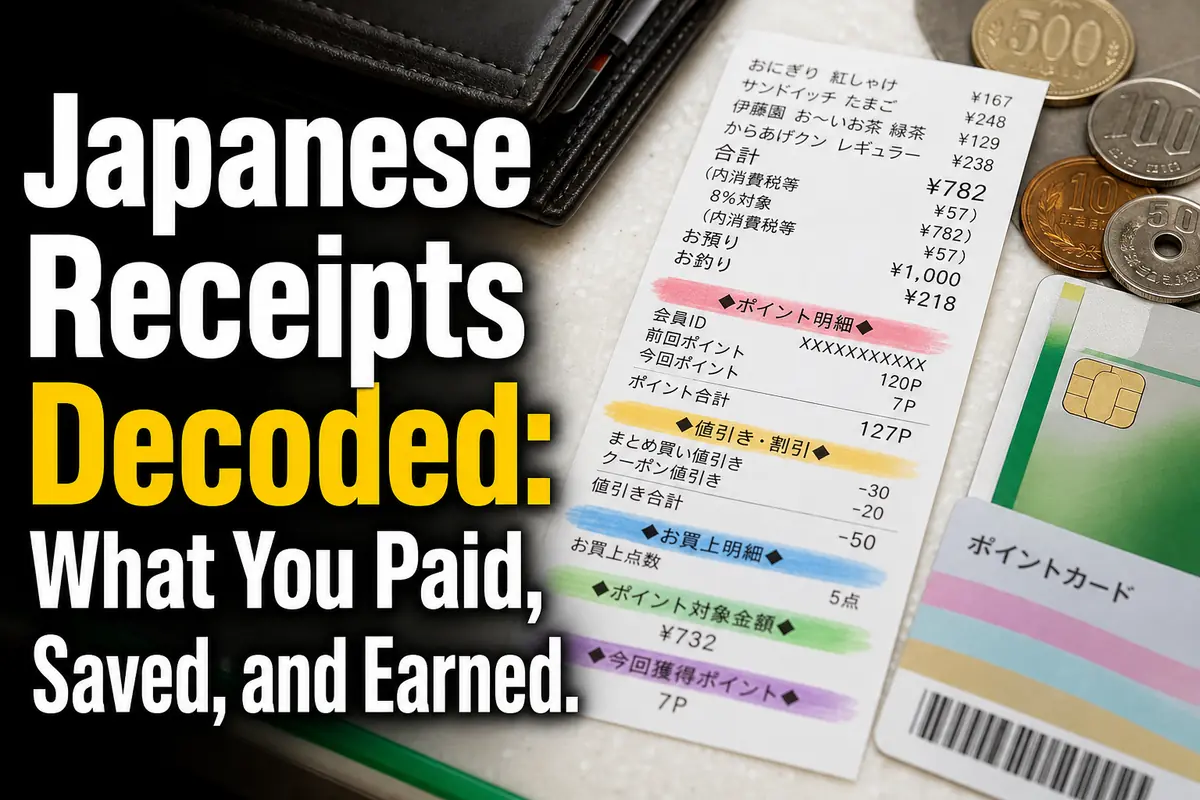
Japanese Receipts Decoded: What You Paid, Saved, and Earned
A Japanese receipt becomes much easier to read once you separate four figures: the price before adjustments, discounts, the final amount due, and the amount actually paid by each method. Tax and loyalty points are usually shown in their own sections.
This guide is for new residents, students, workers, and visitors who need to check supermarket, convenience-store, restaurant, pharmacy, or retail receipts in Japan.
The quick reading order
- Find
合計(gōkei, total) orお買上合計(okaage gōkei, purchase total). - Check
値引(nebiki, price reduction),割引(waribiki, discount), and coupon lines. - Confirm the final payment under
お支払(oshiharai, payment) orお会計(okaikei, amount due). - Look below the total for the tax breakdown, payment method, points, cash received, and change.
The layout and wording vary by store and register system. The arithmetic matters more than the exact position of each line.
Start with the final amount—not the tax line
The number beside 合計, お支払, or お会計 is usually the amount that leaves your wallet or payment account. Do not assume the largest number on the receipt is the final charge: it may be a subtotal before a coupon, points, or another adjustment.
A typical calculation may look like this:
小計                 ¥2,180
値引                   -¥180
合計                 ¥2,000
ポイント利用           -¥300
お支払               ¥1,700
クレジット           ¥1,700
In this example:
小計(shōkei) is the subtotal.値引reduces the purchase by ¥180.合計is ¥2,000 after that discount.- ¥300 in points is then used toward payment.
- The card is charged ¥1,700.
Some stores treat points as a reduction in the price itself; others treat them as a way of settling part of an unchanged purchase price. That difference can affect how the tax base appears, especially when the purchase is a business expense. For ordinary household budgeting, the practical questions are simpler: What was the purchase total, how many points were used, and how much reached the card, cash, or e-money account?
Common total-related words
小計(shōkei): subtotal合計(gōkei): total総合計(sōgōkei): grand totalお買上合計(okaage gōkei): purchase totalお会計(okaikei): amount due or checkout totalお支払額(oshiharai-gaku): amount paid or payable点数(tensū): number of items or units
If two totals appear, follow the calculation downward. The later figure normally includes more adjustments.
How consumption tax appears
Retail prices shown to consumers in Japan must generally make the tax-inclusive total visible, but receipts may still show both tax-exclusive and tax-inclusive figures. The total-price display requirement applies to consumer-facing price displays such as shelf labels, menus, advertisements, and online shops. It does not mean every register must print an identical receipt format.
Look for these terms:
税込(zeikomi): tax included税抜(zeinuki): tax excluded内税(uchizei): tax included within the displayed amount外税(sotozei): tax added to a tax-exclusive amount消費税(shōhizei): consumption tax税額(zeigaku): tax amount課税(kazei): taxable非課税(hikazei): non-taxable
For example, 内消費税 ¥182 means that ¥182 of the displayed tax-inclusive total is consumption tax. It is not another ¥182 to add.
Why both 8% and 10% may appear
Japan has a standard 10% consumption-tax rate and an 8% reduced rate for qualifying items. A supermarket receipt can therefore divide one purchase into separate groups.
You may see:
8%対象             ¥1,080
(内消費税              ¥80)
10%対象            ¥1,100
(内消費税             ¥100)
対象 (taishō) means “subject to” or “covered by.” These lines show how much of the purchase falls under each rate and how much tax is included.
Qualifying food and non-alcoholic drinks are commonly taxed at 8%. Alcohol and many non-food products use 10%. Restaurant dining is generally treated differently from qualifying takeaway food, so the same type of meal may not always carry the same rate.
A mark such as ※, *, 軽, or 軽減 may identify reduced-rate products. Check the receipt’s footnote because the symbol is chosen by the store.
ここがポイント: The 8% and 10% sections normally explain the tax already contained in the total. They are not separate charges to pay again.
Small differences caused by rounding
Tax may be calculated by rate group or transaction rather than by simply calculating each printed product line and adding the results. Rounding can therefore create a difference of one or a few yen between your own line-by-line estimate and the printed tax total.
A small rounding difference is not automatically an error. First check whether:
- individual prices are tax-inclusive;
- the receipt contains both 8% and 10% items;
- a discount was applied before the tax summary;
- the store calculated tax on grouped totals.
Discounts, coupons, and price adjustments
A minus sign or a discount term tells you where the advertised price changed. Read these lines before deciding that the register charged the wrong amount.
Common labels include:
値引(nebiki): a fixed price reduction割引(waribiki): a discount, often percentage-based○割引: a percentage-style discount; for example,2割引means 20% offクーポン: coupon会員値引(kaiin nebiki): member discount特売(tokubai): sale or special offer返品(henpin): return取消(torikeshi): cancellation or void訂正(teisei): correction
A discount may appear immediately below the affected item or as one adjustment near the bottom. When it appears under a product, keep the two lines together while checking the calculation.
“20% off” does not always equal a neat number
Suppose a tax-inclusive item costs ¥298 and receives a 20% discount. The mathematical reduction is ¥59.60. The register must handle the fraction according to its programmed rounding method, so the printed reduction may be ¥59 or ¥60.
Also check the promotion’s conditions. A coupon may apply only to:
- one eligible item rather than the entire basket;
- products above a minimum price;
- purchases made during a stated period;
- members who scanned an app or card before payment;
- products outside an exclusion list.
If the expected discount is absent, keep the receipt and the coupon or app screen, then ask the store before leaving when possible.
How to read loyalty points
Points earned and points used are different transactions. The first affects a future balance; the second can reduce what you pay now.
Look for:
ポイント利用(pointo riyō): points usedポイント充当(pointo jūtō): points applied to payment今回ポイント(konkai pointo): points from this transaction獲得ポイント(kakutoku pointo): points earned付与ポイント(fuyo pointo): points awarded通常ポイント(tsūjō pointo): regular points期間限定ポイント(kikan gentei pointo): limited-time pointsポイント残高(pointo zandaka): point balance利用可能ポイント(riyō kanō pointo): points available to use有効期限(yūkō kigen): expiry date
Do not subtract 獲得ポイント from today’s payment. If the receipt says you earned 20 points, those points usually become available under the program’s rules after the purchase.
Why points can make the tax section look unusual
National Tax Agency guidance distinguishes between points used as a reduction in the price of goods and points used to settle part of the amount payable. A receipt may therefore show either:
- a lower purchase amount after a points-based discount; or
- the full purchase amount, followed by points as one payment component.
This distinction matters most to businesses recording deductible purchases. Employees and sole proprietors should not reconstruct the tax treatment from memory. Keep the receipt, follow the printed classification, and ask the employer or a qualified tax professional how to record it under the organization’s accounting policy.
Payment details: cash, cards, and e-money
The payment section should add up to the final amount due. It may show one method or several if the store permits split payment.
Cash payments
Typical labels are:
現金(genkin): cash現計(genkei): cash total or cash transactionお預り(oazukari): cash received from the customerお釣り(otsuri): change釣銭(tsurisen): change
For a ¥1,700 purchase paid with ¥2,000, the receipt may show:
お預り               ¥2,000
お釣り                 ¥300
お預り is not an additional charge. It is the amount handed to the cashier.
Credit and debit cards
Possible labels include クレジット, カード, or a card brand. The receipt may also include masked digits, an approval result, or a transaction reference.
A store can issue both:
- an itemized register receipt showing products, discounts, and tax; and
- a payment slip showing the card transaction.
The payment slip alone may not show what you bought. Keep the itemized receipt when you may need a return, reimbursement, warranty claim, or business-expense record.
Compare the merchant receipt with your card statement. If the amount differs or you do not recognize the transaction, contact the card issuer promptly using the contact details in its official app, website, or the back of the card—not a link in an unexpected message.
IC cards, QR payments, and store e-money
You may see 電子マネー (denshi manē, electronic money), 残高 (zandaka, balance), or the service name. A stored-value payment can show:
- balance before payment;
- amount deducted;
- balance after payment;
- points or a separate reward earned.
Do not confuse the remaining balance with the purchase total. If a transaction fails, the terminal may print a cancellation or error slip; verify the result in the payment provider’s official app or transaction history before paying again.
A practical receipt-reading example
Consider this simplified supermarket receipt:
牛乳 ※                 ¥216
洗剤                    ¥438
弁当 ※                  ¥540
会員値引                -¥54

小計                  ¥1,140
8%対象                  ¥702
(内消費税                ¥52)
10%対象                 ¥438
(内消費税                ¥39)

ポイント利用            -¥100
お支払                ¥1,040
電子マネー            ¥1,040
今回ポイント              10P
Read it in this order:
- The final purchase total after the member discount is ¥1,140.
- The receipt divides that amount between the 8% and 10% tax groups.
- The tax figures in parentheses are already included.
- The shopper uses 100 points.
- The e-money account is charged ¥1,040.
- Ten new points are recorded separately for future use.
The ※ mark identifies the store’s special category—likely reduced-rate items in this example—but the receipt’s own footnote is the final guide.
Is your receipt a qualified invoice?
Most personal shoppers do not need to check invoice-system details, but business buyers may need to. Japan’s qualified invoice system began on October 1, 2023. A receipt can serve as a qualified invoice if it contains the required information; the document does not have to be titled “invoice.”
Retailers, restaurants, and taxi operators that serve many unspecified customers may issue a simplified qualified invoice. It may omit the customer’s name and has somewhat simpler display requirements.
A business buyer may need to look for:
- the seller’s name;
- a registration number beginning with
Tfollowed by 13 digits; - the transaction date;
- transaction details and an indication of reduced-rate items;
- totals divided by tax rate;
- the applicable tax rate or tax amount, as required for the document type.
This is an accounting and tax-record issue, not a test of whether an ordinary consumer purchase is valid. If you are claiming a work expense, follow your employer’s document rules. If you operate a business, confirm current recordkeeping requirements with the National Tax Agency or a qualified tax professional.
Common mistakes and how to avoid them
Adding tax twice
When a receipt says 内税 or 税込, the tax is already included. Use the printed payment total rather than adding the tax line again.
Treating earned points as an immediate discount
獲得, 付与, and 今回ポイント usually describe points earned. Look for 利用 or 充当 to find points actually used on this purchase.
Comparing the wrong figures
A card statement should normally be compared with the card-payment line, not an earlier subtotal. Coupons, points, gift certificates, or cash can create a difference.
Throwing away one of two slips
The itemized receipt explains the purchase. The card slip confirms the payment transaction. Keep both when you may need proof of the item and proof of payment.
Assuming every store uses the same symbols
※ may mean a reduced-rate item at one store and something else at another. Read the legend printed near the bottom.
Posting the full receipt online
Receipts can contain membership numbers, partial payment identifiers, store and time details, barcodes, or transaction references. Redact these before sharing an image.
What to do when something looks wrong
Check the receipt while you are still near the store. Corrections are generally easier when staff can confirm the purchase and promotion immediately.
Use this sequence:
- Circle the product, discount, or payment line you do not understand.
- Compare it with the shelf label, coupon conditions, or official app history.
- Ask staff:
Kono kingaku o kakunin shite moraemasu ka?—“Could you check this amount?” - Keep the original receipt and any correction or cancellation slip.
- For an unrecognized card charge, contact the card issuer promptly.
Useful phrases include:
Reishīto o kudasai.— “Please give me a receipt.”Ryōshūsho o onegai shimasu.— “May I have a formal receipt?”Nebiki sarete imasu ka?— “Has the discount been applied?”Pointo wa tsukimashita ka?— “Were the points added?”Kono shiharai wa torikeshi ni natte imasu ka?— “Has this payment been cancelled?”
レシート usually means the itemized register receipt. 領収書 (ryōshūsho) is a receipt requested as formal proof of payment and may contain a recipient name or purpose. Store procedures differ, and some businesses will not issue a second document after the original has been lost.
Current status as of August 2026
The practical framework remains:
- consumer-facing prices generally show the tax-inclusive total;
- standard and reduced consumption-tax categories may appear separately;
- the qualified invoice system has applied since October 1, 2023;
- receipt layouts, loyalty-point rules, discount order, and payment labels still vary by retailer and service provider.
For day-to-day shopping, focus on the final amount, adjustments, payment method, and change. For reimbursement or tax records, preserve the original document and check the specific requirements of your employer, school, or business.
The best habit takes only a few seconds: read from the final total downward, then compare the payment line with your cash, app history, or card statement before discarding the receipt.
参照リンク
- Government of Japan: Total-price display requirement
- National Tax Agency: Japan Invoice System instructions and English guides
- National Tax Agency: Overview of the qualified invoice system
- National Tax Agency: Consumption-tax treatment when points are used
- Japan Consumer Credit Association: Checking card statements
- Consumer Affairs Agency: Warning about unauthorized credit-card use