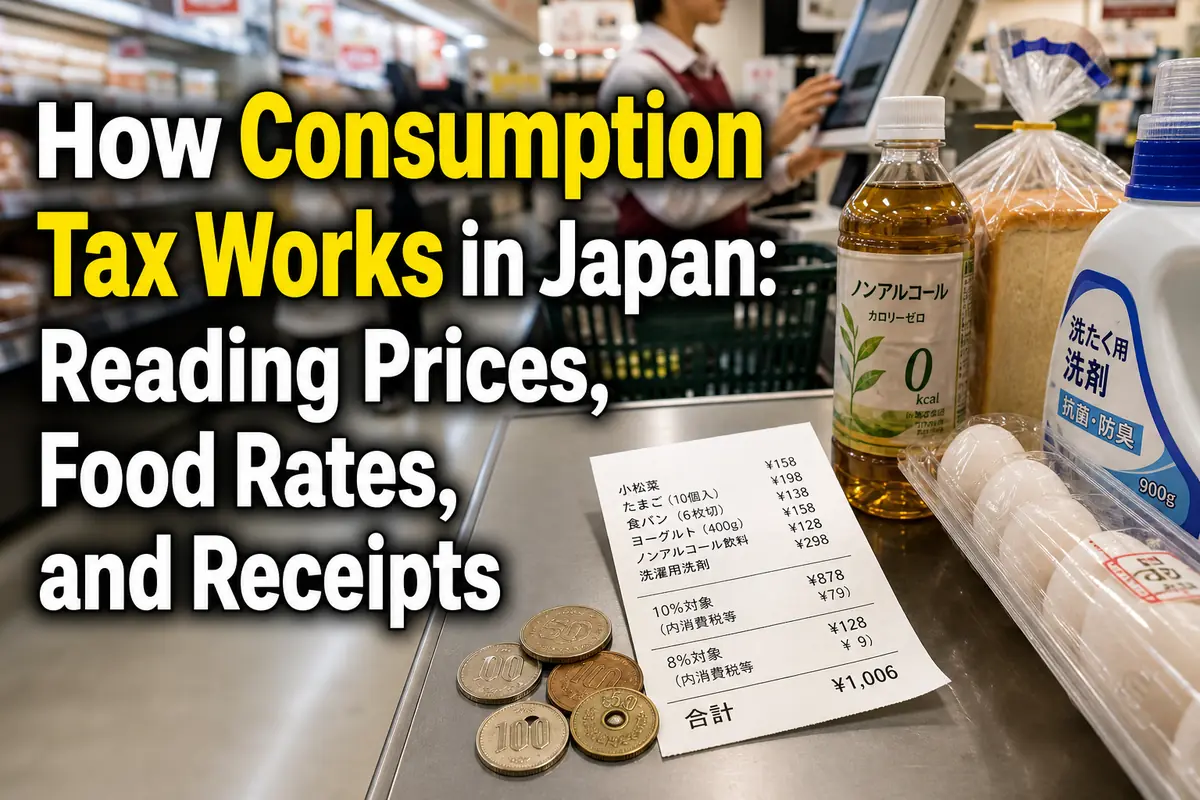
Reading Prices and Receipts in Japan: A Practical Guide to Consumption Tax
The price shown to ordinary shoppers in Japan should normally already include consumption tax. At the register, most goods and services are taxed at 10%, while eligible food and non-alcoholic drinks are currently taxed at 8% when sold for takeout. Food eaten on the premises is generally taxed at 10%.
This guide is for new residents, students, workers, and visitors who need to understand shelf labels, restaurant prices, and Japanese receipts.
Quick answer
- Look for 税込 (zeikomi) or 税込価格 (zeikomi kakaku): tax included.
- 税抜 (zeinuki) means tax excluded, but a tax-included total should also be visible when a business advertises a price to consumers.
- The standard consumption tax rate is currently 10%.
- Eligible food and non-alcoholic drinks are generally 8% for takeout but 10% when treated as dining on the premises.
- A government policy announced in August 2026 proposes a temporary change for eligible food from April 2027, but it does not change today’s checkout rate.
The displayed price is usually the amount you pay
For everyday shopping, the most important rule is simple: businesses displaying prices in advance to consumers generally have to show the total price including consumption tax. This is called sōgaku hyōji (総額表示), or total-price display.
A store may show several numbers. For example:
1,100円(税込)— ¥1,100 including tax1,000円(税抜) 1,100円(税込)— ¥1,000 before tax and ¥1,100 including tax1,100円(うち消費税100円)— ¥1,100, of which ¥100 is consumption tax
If one price is large and another is printed below it in smaller type, find the words around each number before comparing products.
Useful terms include:
- 税込 (zeikomi): tax included
- 税抜 (zeinuki): tax excluded
- 本体価格 (hontai kakaku): base price before tax
- 消費税 (shōhizei): consumption tax
- 合計 (gōkei): total
- お会計 (okaikei): bill or checkout amount
Total-price display does not mean that every possible charge is included. An online order may still have separately disclosed shipping, handling, or cash-on-delivery charges. Hotels, ticket services, and restaurants may also disclose separate service or facility charges. Check the final order screen or menu notes.
Japan currently uses two main consumption tax rates
The practical split is 10% for most taxable purchases and 8% for a limited reduced-rate category.
Standard rate: 10%
The 10% rate generally covers taxable goods and services that do not qualify for the reduced rate. Everyday examples include:
- clothing and household goods
- toiletries and cosmetics
- restaurant meals eaten on the premises
- alcoholic drinks
- delivery and other service charges
- most repairs and personal services
Some transactions are exempt or otherwise treated differently under tax law. Residential rent, for example, is generally exempt from consumption tax, although separate services, parking, or short-term accommodation may be treated differently. A tax-free or exempt transaction is not the same as an 8% reduced-rate purchase.
Reduced rate: 8%
The 8% rate currently applies mainly to:
- food and drinks sold for human consumption, excluding alcohol
- qualifying newspaper subscriptions issued at least twice a week
The food rule covers ordinary groceries, prepared food sold for takeout, bottled water, and non-alcoholic drinks. It does not automatically cover every product sold in a supermarket or convenience store. Household supplies remain at 10%, even when purchased with groceries.
ここがポイント: The product alone does not always determine the rate. For prepared food, how the seller provides it—takeout or dining service—can change the rate from 8% to 10%.
Takeout and eat-in prices can differ
Food sold as takeout is generally an 8% transaction. Food served as a restaurant service in a place with tables, chairs, counters, or similar dining facilities is generally taxed at 10%.
This matters at cafés, fast-food restaurants, bakeries, food courts, supermarkets, and convenience stores with seating.
What staff may ask
You may hear:
- 店内でお召し上がりですか? (Tennai de omeshiagari desu ka?) — Will you eat here?
- お持ち帰りですか? (Omochikaeri desu ka?) — Is it takeout?
Useful replies are:
- 店内で食べます。 (Tennai de tabemasu.) — I will eat here.
- 持ち帰りです。 (Mochikaeri desu.) — It is takeout.
The seller determines the applicable rate based on the transaction at the time of sale. Answer according to your actual plan. Do not select takeout simply to obtain the lower rate and then use the shop’s dining area.
Why two menu prices may appear
A menu might show one amount for takeout and another for eating inside. Another business may set its base prices so that both final amounts happen to be the same despite the different tax treatment.
Therefore, do not assume that the difference will always equal exactly two percentage points on the displayed price. The business sets the selling price; the tax rate is only one part of that price.
How to read a Japanese receipt
A receipt is useful when a basket contains both 8% and 10% items. Shops commonly mark reduced-rate products with a symbol such as ※ or *, then explain the symbol near the bottom.
Look for these items:
- 小計 (shōkei): subtotal
- 合計 (gōkei): total
- 内税 (uchizei): tax included in the listed amount
- 外税 (sotozei): tax added separately
- 消費税等 (shōhizei-tō): consumption and related local consumption tax
- 8%対象 (hachi-pāsento taishō): amount subject to 8%
- 10%対象 (jippāsento taishō): amount subject to 10%
- 軽減税率対象 (keigen zeiritsu taishō): subject to the reduced rate
A simplified example might look like this:
Bottled tea       ¥108 ※
Notebook          ¥330
合計              ¥438
8%対象            ¥108
10%対象           ¥330
※軽減税率対象
Here, the bottled tea qualifies for the reduced rate, while the notebook does not. The receipt separates the totals so the two rates can be checked.
Why your own calculation may be off by one yen
Stores may calculate and round tax at the transaction level rather than treating every displayed item as a separate calculation. Discounts can also be allocated across items taxed at different rates.
As a result, adding estimated tax to each product individually may differ from the register total by one yen. Use the final receipt total and its tax-rate breakdown when checking what was charged.
A normal receipt and a qualified invoice are not the same question
For a private shopper, the receipt mainly proves the purchase, shows the total, and helps identify which rate was applied. You usually do not need to check whether it satisfies business tax-accounting requirements.
The rules become more important when an employer or your own business will claim the purchase as an expense. Japan’s tekikaku seikyūsho-tō hozon hōshiki (適格請求書等保存方式), commonly called the Invoice System, began on October 1, 2023.
A qualified invoice or simplified qualified invoice generally includes information such as:
- the registered issuer’s name and registration number
- the transaction date
- a description of the purchase, including identification of reduced-rate items
- totals separated by tax rate
- the applicable rates and consumption tax amounts
Restaurants, retailers, and certain other businesses serving many customers may issue a simplified qualified invoice. In everyday practice, this can be a register receipt containing the required details.
If you need reimbursement, ask your employer what document and payment details it requires. A receipt acceptable for returning an item is not automatically sufficient for every company’s expense policy.
Common mistakes to avoid
Reading a before-tax figure as the final price
A business may display a base price alongside the required tax-included total. Look for 税込 before assuming which number will be charged.
Assuming all supermarket purchases are taxed at 8%
Only qualifying food and drink items receive the reduced rate. Detergent, kitchen tools, cosmetics, and other non-food products are normally taxed at 10%.
Assuming all food is taxed at 8%
Alcohol and dining services are generally outside the reduced-rate category. A packaged meal can be 8% as takeout but 10% when supplied as an eat-in meal.
Confusing tourist tax-free shopping with the reduced rate
The reduced rate is part of the domestic consumption tax system and applies according to the item and transaction. Tourist tax-free shopping is a separate scheme with its own eligibility, identity, export, and purchase procedures. Seeing “8%” on food does not mean that a shop processed a tax-free purchase.
Throwing away a receipt needed for work
Keep the original or permitted electronic record if your employer will reimburse the expense. Check the receipt before leaving, especially when the purchase mixes personal and business items.
What may change from April 2027
As of August 22, 2026, shoppers should still use the current 10% and 8% rules described above.
On August 5, 2026, the government announced a basic policy that includes reducing the consumption tax rate on food currently covered by the reduced-rate system to 1% for two years from April 1, 2027. The policy was presented as a bridge before a planned income-linked tax credit and benefit system.
For shoppers, three cautions matter:
- The announcement concerns a future start date; it does not make eligible food 1% today.
- The proposal refers to food already within the reduced-rate category, so alcohol and restaurant dining should not be assumed to qualify.
- A lower tax rate does not by itself guarantee that every shelf price will fall by the full difference. Retailers and restaurants still set their selling prices.
Implementation details, enacted rules, receipt formats, and transitional treatment should be checked again before April 2027. Businesses will also need official guidance on cash registers, accounting, and invoices.
Practical checks at the shelf and register
Before paying, follow this short routine:
- Find the price marked 税込 or the clearly displayed total price.
- For prepared food, tell staff whether you will take it away or eat on the premises.
- Check separately disclosed delivery, service, or facility charges.
- On the receipt, look for 8%, 10%, and the symbol marking reduced-rate items.
- Keep the receipt if you may return the item, request reimbursement, or record a business expense.
The main watchpoint is the planned April 2027 food-tax change. Until official implementation guidance takes effect, continue reading Japanese prices and receipts under the present 10% standard rate and 8% reduced rate.
参照リンク
- Ministry of Finance — Material on Consumption Taxation
- Ministry of Finance — Reduced Tax Rate System Q&A
- National Tax Agency — Basic Knowledge of Consumption Tax
- National Tax Agency — Reduced Consumption Tax Rate System
- National Tax Agency — Total-Price Display Requirement
- National Tax Agency — Invoice System Information
- Ministry of Finance — Minister’s Press Conference, August 5, 2026