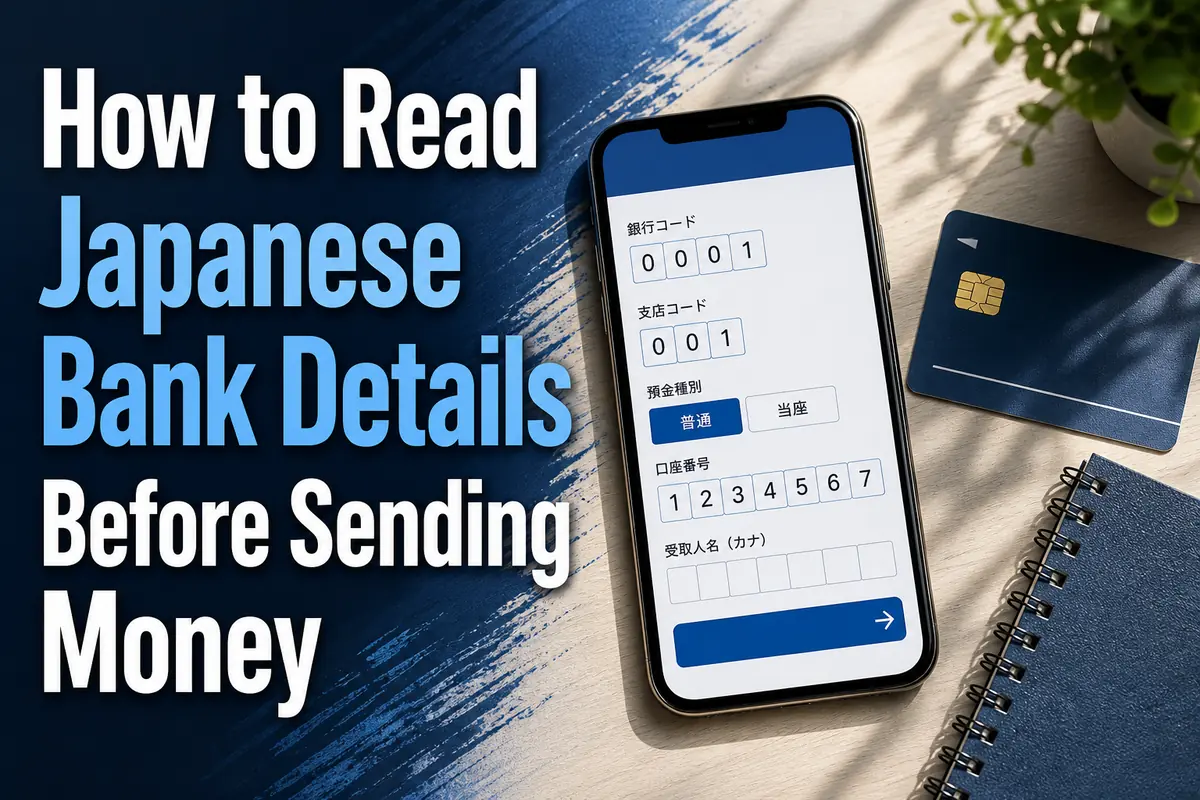
How to Read Japanese Bank Details Before Sending Money
To send money to a bank account in Japan, you normally need five matching details: the bank name, branch name or code, account type, account number, and account-holder name. A bank code may also appear on forms, especially payroll and business forms.
Do not combine these numbers unless the form specifically tells you to. A branch code is not part of the ordinary account number, and a SWIFT code is for a different kind of transfer.
This guide is for new residents, students, workers, and anyone entering Japanese account details for salary payments, rent, refunds, or a domestic bank transfer.
The essentials
- Financial institution code: usually a four-digit code identifying the bank
- Branch code: usually three digits identifying the branch
- Account type: most personal accounts use futsū yokin (ordinary deposit)
- Account number: commonly seven digits; keep any leading zeros
- Account-holder name: use the registered name, often displayed or entered in katakana for domestic transfers
Information and bank screens can change. The details below were checked against official sources available on August 22, 2026.
The five details that identify a Japanese account
A domestic transfer succeeds only when the receiving account is identified correctly. Each field has a separate job.
1. Bank name and financial institution code
The bank name may be written as kinyū kikan-mei (金融機関名, financial institution name). On some forms, you will instead see kinyū kikan kōdo (金融機関コード, financial institution code) or ginkō kōdo (銀行コード, bank code).
The financial institution code is a four-digit number. For example, the Japanese Bankers Association identifies the four-digit numbers in its member list as common financial institution codes.
You may select the bank by name in an app and never type this code yourself. It still matters on:
- salary deposit forms
- pension or benefit forms
- business payment records
- systems that import transfer data
- forms where similarly named institutions must be distinguished
Use an official bank search or ask the account holder when the name is unclear. Do not guess from a logo, card color, or abbreviated name.
2. Branch name and branch code
A Japanese account belongs to a particular branch, even when the bank mainly operates online. The branch name is shiten-mei (支店名) or sometimes tenmei (店名). The branch code may appear as shiten kōdo (支店コード), shiten bangō (支店番号), or tenban (店番).
A branch code is commonly three digits. For example, MUFG’s official transfer guidance shows a three-digit branch code followed by a seven-digit account number.
Digital banks may assign branch names that do not refer to a physical location. Japan Post Bank also uses transfer branch names derived from its account-number system. Therefore, the branch printed or displayed for transfers may not be the post office or counter you usually visit.
Keep leading zeros. Branch code 001 is not the same entry as 1 on a form that requires three digits.
3. Account type
The account type is yokin shumoku (預金種目, deposit type), kōza shumoku (口座種目), or simply kamoku (科目). The most common choices are:
- 普通預金 — futsū yokin: ordinary deposit; the usual choice for an individual’s everyday account
- 当座預金 — tōza yokin: current account; commonly associated with businesses and settlement needs
- 貯蓄預金 — chochiku yokin: savings deposit; available at some institutions
Choose the type supplied by the recipient. Do not select tōza merely because an English form uses the word “current account.” Japanese account categories do not always map neatly onto banking terms used in other countries.
If a transfer screen offers only futsū and tōza, and the recipient has not stated the type, stop and ask. The cash card or bank app may show the correct category.
4. Account number
The account number is kōza bangō (口座番号). Seven digits are common for ordinary domestic bank transfers, but you should copy the number exactly as the bank provides it.
Watch for three problems:
- dropping a zero at the beginning
- entering the branch code in the account-number field
- copying a customer number, card number, or login ID instead
A cash card can display several numbers. The longest number is not automatically the account number. Check the labels tenban and kōza bangō, or confirm the details in the bank’s official app.
5. Account-holder name
The account-holder name is kōza meigi (口座名義) or uk取nin-mei—more commonly written 受取人名 (uketori-nin mei, recipient name) on a transfer screen.
For domestic transfers, the registered name is often handled in katakana. A foreign resident’s bank record may use katakana, Roman letters, or a bank-specific format. Spaces, middle names, long vowels, and name order can differ from a passport.
Use the name registered at the receiving bank, not your preferred spelling. Ask the recipient to copy it from the bank app or account information screen. Do not convert it yourself if you are uncertain.
A practical example
Read each element separately before typing anything. Suppose a recipient gives you the following sample details:
- Bank: Example Bank
- Financial institution code:
1234 - Branch: Central Branch
- Branch code:
005 - Account type: futsū (ordinary)
- Account number:
0123456 - Account-holder name:
ヤマダ アレックス
On a typical domestic transfer screen, you would select the bank and branch, choose futsū, and enter 0123456 in the account-number field. The first zero remains part of the number.
The screen may then display a recipient name retrieved through the banking network. Check it carefully. If it does not match the person or organization you expect, cancel the transfer and verify the details independently.
ここがポイント: A four-digit bank code, three-digit branch code, and account number identify different parts of the destination. Never merge them unless the particular form gives an explicit format such as “branch code + account number.”
Where to find your own transfer details
The safest source is your bank’s official account-information screen. Depending on the institution, the necessary details may be available in several places.
Check:
- the home or account-details page in the official banking app
- online banking after signing in through the official site
- your cash card, if the fields are clearly labeled
- a passbook, if your account uses one
- an account-opening notice or official account-information document
- the bank’s customer service or branch counter
When giving details to an employer, school, landlord, or refund provider, copy all fields into one clear block. Include the account type and registered account name instead of sending only a number.
Do not send your PIN, online banking password, one-time password, card security code, or authentication code. None of these is required for someone to deposit money into your account.
Japan Post Bank is the important exception
A Japan Post Bank account can have two representations, so use the format required for the transfer. This is one of the most common sources of confusion.
Japan Post Bank accounts may be shown with kigō-bangō (記号・番号, symbol and number). A transfer from another Japanese bank instead requires the transfer-format details:
- branch name (tenmei)
- deposit type (yokin shumoku)
- account number (kōza bangō)
Japan Post Bank provides an official tool that converts the symbol-and-number format into the branch name, deposit type, and account number used for transfers from other banks. Its guidance also says that an extra digit located between the symbol and number, when present, is not used in the converted transfer details.
Do not calculate the conversion from memory. Use the official lookup and confirm the result against your passbook or the bank’s account-information notice.
Transfers within Japan Post Bank
A Japan Post Bank service may request the original symbol and number rather than the converted details. Read the field label before entering anything.
Transfers from another Japanese bank
Use the converted branch name, deposit type, and account number. Giving only the original symbol and number may not be enough for another bank’s domestic transfer screen.
Transfers from overseas
International remittance instructions are different again. Japan Post Bank’s official guidance requires its designated international details and, for certain incoming overseas transfers, the full symbol-and-number account format. It also explains that the bank converts the funds into yen and may check the purpose and source of the payment.
This is why a set of details that works for a domestic transfer should not automatically be reused for an overseas remittance.
Domestic transfers and overseas remittances are different
Japanese domestic account details are not a replacement for international routing information. Ask whether the money is being sent through Japan’s domestic banking system or from a bank outside Japan.
For a domestic transfer
The sender generally needs:
- bank name
- branch name or code
- account type
- account number
- account-holder name
A domestic transfer is called furikomi (振込). The sending bank may charge a fee, and the amount can vary by bank, channel, destination, and account plan. Check the fee shown before confirmation.
For an overseas remittance
The sender may also need:
- the bank’s English name
- branch name and address
- SWIFT/BIC code
- beneficiary name and registered address in Roman letters
- purpose of payment
- intermediary-bank details
Japan does not use IBAN. MUFG’s official incoming-remittance guidance states this directly and warns that the final XXX in an 11-character SWIFT code is not a three-digit branch code.
Requirements differ by bank, currency, country, and the recipient’s residence status. Ask the receiving bank for its current incoming-remittance instructions before the sender initiates the payment. Intermediary and receiving fees may reduce the credited amount.
Common mistakes and how to avoid them
Most errors come from mixing fields or copying an unofficial version of the details. A one-minute check before confirmation is easier than trying to recover a misdirected transfer.
Mistake: treating every number on a cash card as transferable account data
A card may show a branch number, account number, membership number, or card-related identifier. Match each number to its printed label or verify it in the official app.
Mistake: removing leading zeros
Spreadsheet software and online forms sometimes turn 005 into 5. Store branch and account identifiers as text, especially when preparing payroll or reimbursement forms.
Mistake: choosing the wrong account type
Most personal accounts are futsū, but “most” is not confirmation. Use the type supplied by the recipient or shown by the bank.
Mistake: romanizing the recipient’s name yourself
The domestic system may expect the registered katakana form. Ask for the exact account-holder name and check the name returned on the confirmation screen.
Mistake: using Japan Post Bank’s symbol and number in another bank’s form
Convert the details with Japan Post Bank’s official tool when the sender is transferring from a different Japanese bank.
Mistake: using domestic details for an international payment
An overseas sender may need a SWIFT/BIC code, English address, purpose of payment, and other compliance information. Obtain a dedicated incoming-remittance instruction sheet from the receiving bank.
Mistake: continuing after the displayed name looks wrong
Do not assume the bank will correct your entry. Cancel before confirmation and contact the recipient through a trusted channel. Be especially careful when payment instructions arrive in a changed email or message.
What can differ by bank or situation
The numbering structure is broadly familiar across Japan, but the user experience is not identical. Banks decide how details appear on cards and apps, which characters a name field accepts, what fees apply, and when extra checks are required.
Differences can include:
- whether the branch is physical or virtual
- whether the account holder’s name appears automatically
- available account types
- accepted name characters and abbreviations
- transfer limits and authentication steps
- same-bank and other-bank fees
- processing outside service hours
- handling of non-resident accounts or overseas remittances
These are operator rules, not municipal rules. Moving from Tokyo to another prefecture does not by itself change the structure of your bank details, but changing banks or account products can change the relevant fields, fees, and transfer procedure.
A final check before you send or share details
Confirm the destination as a complete set, not number by number in isolation. Before sending money, verify:
- the bank and branch are correct
- leading zeros remain in place
- the account type matches
- the account number has not been combined with another code
- the displayed recipient name is the expected person or organization
- the amount and fee are correct
- a domestic transfer is not being confused with an overseas remittance
If you are sharing your own details, provide only the information needed to receive the payment. Never provide authentication secrets.
For Japan Post Bank, first identify whether the sender needs the original symbol-and-number format, the converted domestic-transfer format, or international remittance instructions. That single distinction prevents the most avoidable account-number error.
参照リンク
- Japanese Bankers Association — Bank Search
- Japanese Bankers Association — List of Members
- MUFG Bank — Branch Code and Account Number for Payments to Accounts in Japan
- MUFG Bank — Receiving an Overseas Remittance
- Japan Post Bank — Convert a Symbol and Number into Transfer Details
- Japan Post Bank — International Remittances
- Seven Bank — Registering and Using Direct Banking