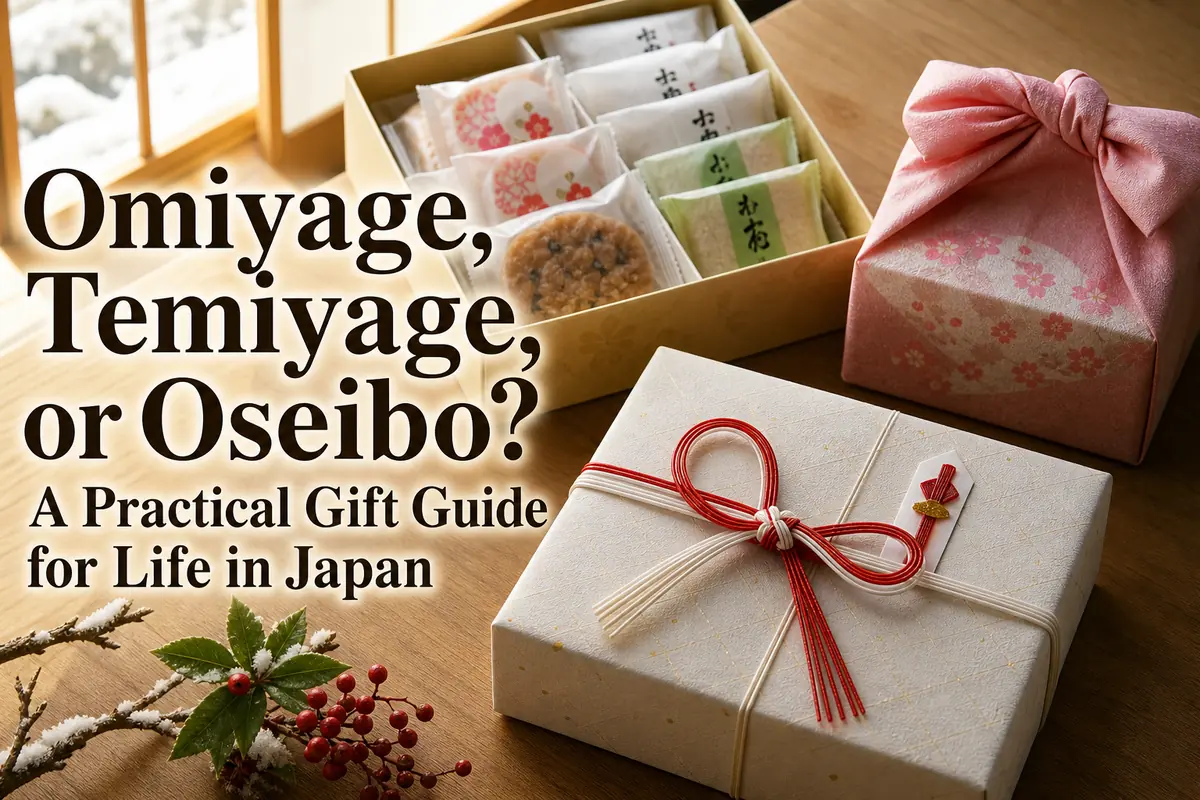
Omiyage, Temiyage, or Oseibo? A Practical Gift Guide for Life in Japan
You do not need to give gifts constantly to live politely in Japan. For most new residents, three distinctions are enough: omiyage is usually brought back from a trip, temiyage is taken to a visit, and oseibo is a more formal year-end expression of thanks.
None of these is a national rule. Whether a gift is appropriate depends on the relationship, workplace policy, occasion, and local custom. A modest, shareable item is usually safer than an expensive or highly personal present.
This guide is for foreign residents and their families who are visiting a home, returning to work after a trip, or wondering whether they should send a year-end gift.
Quick guide:
- Returning from a trip: consider small, individually wrapped omiyage for people who supported or covered for you.
- Visiting someone’s home: take a modest temiyage that the household can easily serve or store.
- Thanking someone at year-end: check whether oseibo fits the relationship before buying anything.
- Giving at work: confirm company rules first, especially when clients, suppliers, or public-sector employees are involved.
The three customs solve different social situations
The occasion—not the product—usually determines what the gift is called. The same box of sweets could function as omiyage after a journey or temiyage when carried to a host’s home.
Omiyage: something brought back from a trip
Omiyage is commonly translated as “souvenir,” but its social purpose is often different from buying a keepsake for yourself. It is something brought back for other people, frequently a regional food or local specialty.
Stations and airports make this easy: many products are boxed for sharing, clearly show the number of pieces, and contain individually wrapped portions. Regional food is especially common because it connects the gift to the place visited. Japan’s Ministry of Agriculture, Forestry and Fisheries notes that Japanese food culture developed around regional ingredients and local dishes, which helps explain why place-specific food works so naturally as omiyage.
You might consider omiyage when:
- coworkers handled your duties during a vacation or business trip;
- friends or relatives looked after your home, plants, or pet;
- you stayed with someone while traveling;
- you want to share a specialty from your home country or region.
However, taking any trip does not automatically create a debt to everyone you know. Customs vary between workplaces, and many offices do not expect employees to bring something after ordinary leave.
Temiyage: a small gift carried to a visit
Temiyage literally suggests a gift carried in the hand. In everyday life, it usually means something taken when visiting a home, office, teacher, or other host.
This is the useful term when you are invited to dinner, staying overnight, or attending a small gathering at someone’s home. The gift acknowledges the host’s preparation; it is not payment for the meal.
Good choices include:
- a box of sweets that can be divided easily;
- fruit, tea, coffee, or another nonperishable specialty;
- something from your home country with a simple explanation;
- a drink, but only when you know the household’s preferences.
A host may not open or serve the gift immediately. That does not signal dislike. The host may already have planned the meal, or the item may be intended for later.
Oseibo: formal thanks near the end of the year
Oseibo is a seasonal gift expressing thanks to someone who has provided continuing help during the year. Traditional recipients can include relatives, professional contacts, or others with an established relationship.
Japan House Los Angeles describes oseibo as a gift custom associated with the first half of December, while the exact delivery window varies by region and retailer. Major department stores open their winter-gift services well before December, so people ordering formal deliveries often make arrangements early.
Oseibo differs from a one-time thank-you gift in an important way: it can suggest an ongoing annual custom. Takashimaya’s 2025 guidance therefore recommends thinking about whether you intend to continue sending it in future years. If you only want to thank someone for one specific favor, a plainly labeled thank-you gift is often clearer.
ここがポイント: Omiyage follows a trip, temiyage accompanies a visit, and oseibo marks an established year-end relationship. They are customs, not compulsory payments.
How much should you spend?
Spend enough to be thoughtful, but not enough to create pressure. The recipient should not feel that an equal return is required.
These are practical starting points rather than official rates:
- Everyday omiyage for a small team: choose by the number of portions and ease of sharing, not by a price per person.
- Temiyage for a home visit: about ¥1,000–¥3,000 is a workable range for many casual situations.
- More formal temiyage or an overnight stay: around ¥2,000–¥5,000 may fit, depending on the relationship.
- Oseibo: Takashimaya’s November 2025 guide gives a typical range of ¥3,000–¥5,000.
Higher is not automatically better. An expensive present can embarrass a friend, appear excessive in a professional relationship, or conflict with an organization’s gift policy.
Consider the recipient’s situation before the price tag:
- Can the household consume the item before it expires?
- Does it require refrigerator or freezer space?
- Are allergies, religious restrictions, or alcohol preferences relevant?
- Can coworkers divide it without cutting or preparing it?
- Will the recipient need to carry a heavy package home?
For a large office, one box containing enough individually wrapped pieces is usually more practical than separate gifts. Count the visible team members and add a few extra portions if possible.
A simple buying checklist
The safest gift is easy to accept, easy to explain, and easy to use. You rarely need specialist knowledge or perfect ceremonial wrapping.
1. Identify the real occasion
Ask yourself what prompted the gift:
- “I came back from Hokkaido” points to omiyage.
- “Thank you for inviting us to dinner” points to temiyage.
- “Thank you for your continued help this year” may point to oseibo.
- “Thank you for helping with my move” is an ordinary thank-you gift.
Using the correct occasion prevents a small gesture from sounding like a promise to repeat it every year.
2. Check whether the recipient can accept it
Before buying for a workplace contact, ask your employer or the recipient’s organization about its policy. Some companies restrict gifts between employees or from suppliers. Government bodies, schools, hospitals, and regulated professions may apply stricter rules.
When unsure, ask directly: “Is it all right to bring a small gift?” A refusal may reflect policy rather than personal feeling.
3. Choose something low-burden
Food is common, but it is not universally safe. Check for:
- nuts, dairy, eggs, wheat, or other allergens;
- halal, kosher, vegetarian, or other dietary needs;
- alcohol content, including in sweets;
- a short expiration date;
- storage requirements.
If you bring food from overseas, make sure it can legally enter Japan. Animal products, plants, fruit, and seeds may be subject to quarantine restrictions even when intended as gifts. Check the current customs, animal-quarantine, and plant-quarantine rules before packing them.
4. Let the shop handle formal presentation
Department stores and many specialty shops can provide gift wrapping, a paper bag, and formal noshi decoration. Explain the occasion to the sales assistant:
- “Oseibo yō desu” means “This is for oseibo.”
- “Temiyage desu” means “This is a gift for a visit.”
- “Purezento-yō ni onegai shimasu” asks for gift wrapping.
Formal oseibo commonly uses red-and-white decorative cords with a bow that can be retied, symbolizing an occasion that may be repeated. You do not need to assemble this yourself; tell the shop what the gift is for.
How to give the gift without making the moment awkward
A short sentence and respectful handling matter more than a perfect ritual. Present the package after greetings rather than thrusting it forward at the doorway.
For a home visit, take the gift out of the transport bag before presenting it. The paper shopping bag protects the package during travel; it is not normally part of the gift. If removing it would be impractical or the setting is very casual, do not turn the bag into a source of stress.
Offer the item with both hands when possible, with the front facing the recipient. Useful phrases include:
- Tsumaranai mono desu ga — a traditional humble phrase meaning roughly, “It is only a small thing, but…”
- Kore, omiyage desu — “This is a small gift from my trip.”
- Minasan de dōzo — “Please share it with everyone.”
- Itsumo arigatō gozaimasu — “Thank you for your continued help.”
Plain English is also fine. “Thank you for inviting us—this is a little something for everyone” communicates the purpose clearly.
If someone politely declines once, do not assume the answer is ceremonial. You may clarify once that the item is small and meant for sharing, but accept a clear refusal. Policies and personal boundaries take priority over traditional scripts.
Situations where no gift may be the better choice
Courtesy does not require giving something in every relationship. Sometimes a message, verbal thanks, or practical help is more appropriate.
Your manager or teacher
Giving upward in a hierarchy can create discomfort, particularly if only one employee or student participates. Check the group’s normal practice. A shared card or collective gift may be more suitable, but only if participation is voluntary.
Doctors, care workers, and public employees
A sincere thank-you note is safer than assuming a gift is permitted. Hospitals, care facilities, local-government offices, and individual professionals may prohibit or limit gifts.
A new neighbor
A small greeting item can be friendly after moving, but it is not a nationwide requirement. Apartment culture, detached-house neighborhoods, student housing, and company dormitories operate differently. Introduce yourself briefly and follow the building’s security and privacy practices; do not feel obliged to visit every door.
Someone who has declined gifts
Do not repeatedly insist. Dietary restrictions, storage problems, workplace rules, or a desire to avoid reciprocal obligations are all valid reasons.
Common mistakes new residents can avoid
Most problems come from creating work or obligation for the recipient, not from choosing the “wrong” Japanese symbol. Focus first on practicality.
- Calling every souvenir omiyage: Something bought for yourself is simply a souvenir or personal purchase. Omiyage normally has another recipient in mind.
- Using oseibo for a one-off favor: The seasonal label can imply an established relationship. Use an ordinary thank-you message when that is what you mean.
- Buying too much: A large refrigerated item may become a storage problem.
- Ignoring office headcount: A box with eight pieces for a 12-person team creates an avoidable awkward moment.
- Assuming alcohol is universally welcome: Ask first or choose a nonalcoholic option.
- Pressuring colleagues to contribute: Group gifts should not become an unofficial workplace fee.
- Bringing restricted food from abroad: Attractive packaging does not exempt meat, fruit, plants, or seeds from Japan’s import controls.
- Treating etiquette guides as law: Gift customs differ across families, regions, generations, and organizations.
Seasonal and regional differences
Timing and terminology can change, especially for formal seasonal gifts. Retailer deadlines are useful for shopping, but they do not create a legal or universal social rule.
Oseibo is generally associated with December. The preferred delivery period may begin earlier in eastern Japan and later elsewhere, and department stores may describe regional windows differently. If the recipient follows formal customs, ask the retailer serving that destination.
A late gift may use another seasonal label, such as onenga for a New Year greeting or kanchū mimai for a midwinter greeting. The correct label depends on the date, region, and whether the recipient is observing a mourning period. A department-store gift counter can advise based on the delivery date.
Omiyage also changes by place. A locally made sweet, tea, seasoning, or craft tells the recipient where you went. This regional connection matters more than finding an item that supposedly represents all of Japan.
Current guidance for 2026
As of August 2026, these remain social customs rather than mandatory procedures. There is no application, eligibility test, fixed fee, or national deadline for giving omiyage, temiyage, or oseibo.
What can change are the practical details:
- company and public-sector gift-acceptance policies;
- department-store ordering and delivery periods;
- food-allergen labeling and product availability;
- customs and quarantine restrictions for gifts brought from abroad;
- expectations within a particular family, school, neighborhood, or office.
For formal or professional gifts, confirm the recipient organization’s current policy. For goods entering Japan, use the latest information from Japan Customs, the Animal Quarantine Service, and the Plant Protection Station.
A practical rule to remember
When you are unsure, start small and make the purpose clear:
- Match the gift to the occasion.
- Check whether it can be accepted.
- Choose something shareable and easy to store.
- Keep the price modest.
- Give it with a short, sincere message.
You do not need to master every term before accepting an invitation or taking leave from work. The next useful action is simpler: ask about workplace policy, check dietary needs, and buy for the number of people who will actually receive the gift.
参照リンク
- Japan House Los Angeles: ’Tis Better to Give than to Receive
- Takashimaya: Appropriate Amounts and Etiquette for Oseibo
- Japan National Tourism Organization: Traveling Mindfully
- Japan National Tourism Organization: Customs and Manners
- Ministry of Agriculture, Forestry and Fisheries: What Is Washoku?
- Japan Customs
- Animal Quarantine Service: Bringing Animal Products into Japan
- Plant Protection Station: Bringing Plants into Japan