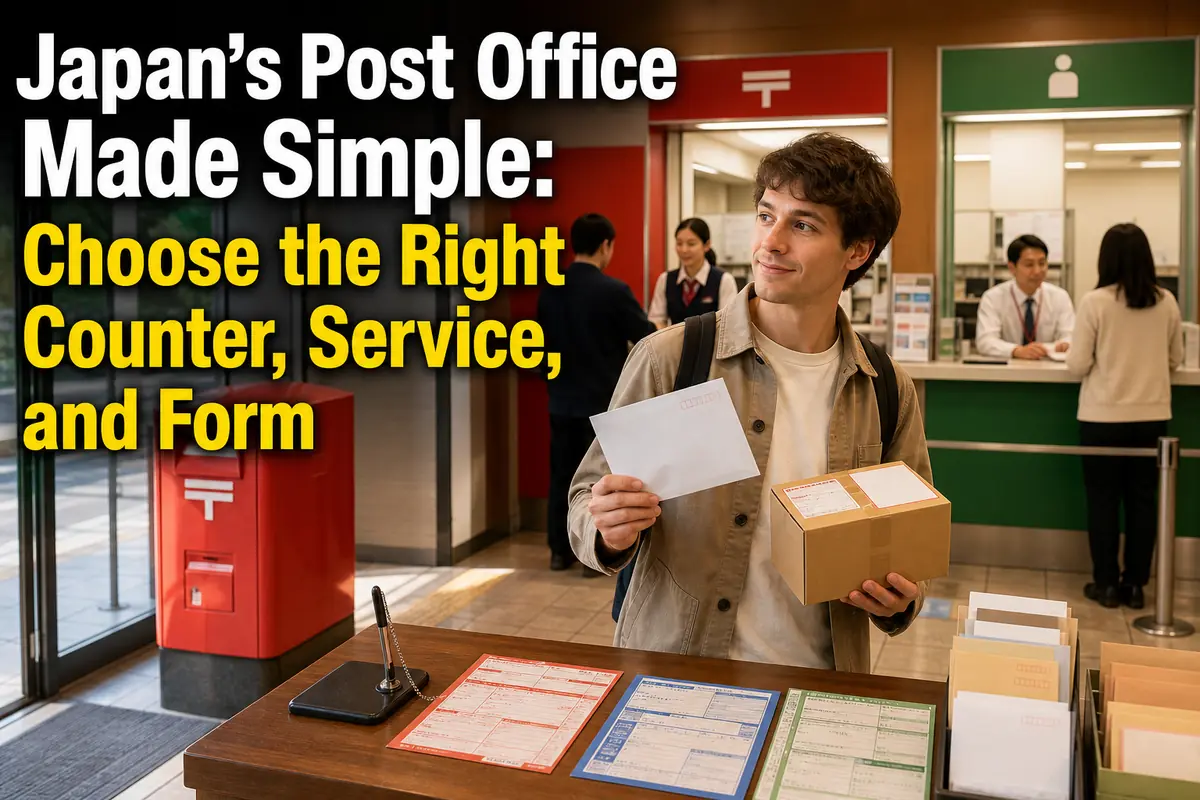
Japan’s Post Office Made Simple: Choose the Right Counter, Service, and Form
A Japanese post office can handle letters, domestic parcels, international shipping, missed deliveries, and some banking procedures. The important first step is to identify the service you need: postal services and Japan Post Bank use separate counters, forms, and business hours—even when they are inside the same building.
This guide is for foreign residents and their families who need to send documents, ship belongings, receive a missed parcel, or use Japan Post Bank. Rates and services below were checked against official information available on August 1, 2026.
Quick orientation
- Use the postal counter for stamps, letters, Letter Pack, Yu-Pack, EMS, and other shipping services.
- Use the savings counter for Japan Post Bank procedures. Its hours may be shorter than the postal counter’s hours.
- Bring the full address, postal code, recipient’s name, and a specific description of parcel contents.
- For international goods, create the shipping label electronically before or during your visit.
Before You Go: Check the Office and Counter Hours
Do not assume that every service is available whenever the post office building is open.
A large post office may have several service areas:
- 郵便 (yūbin): letters, stamps, parcels, and international mail
- 貯金 (chokin): Japan Post Bank deposits and account procedures
- 保険 (hoken): insurance services
- ATM: cash withdrawals and other supported banking transactions
- ゆうゆう窓口 (Yū-Yū counter): selected postal services outside ordinary counter hours
The counters can close at different times. A building may still have an operating ATM after its savings counter has closed, while a smaller post office may not offer extended postal hours at all.
Use Japan Post’s post office, ATM, and postbox search before leaving home. The search page is mainly in Japanese, but it shows addresses, counter hours, ATM hours, postbox collection times, and whether a Yū-Yū counter is available.
What to prepare
For an ordinary domestic letter, you normally need only the addressed envelope and enough postage. For other tasks, prepare the following as applicable:
- Recipient’s name, postal code, complete address, and telephone number
- Your return address and telephone number
- The exact weight and dimensions, if you want to compare prices in advance
- A clear list of parcel contents
- A smartphone for an international shipping label or redelivery request
- The missed-delivery notice if collecting an item
- Identification documents for banking or identity-checked delivery
- Your residence card for Japan Post Bank procedures involving foreign residents
Sending Letters and Documents Within Japan
Ordinary mail is cheapest for light documents, while Letter Pack is easier when you want tracking or do not know the exact postage.
As of August 1, 2026, a standard domestic letter weighing up to 50 grams costs ¥110. A standard postcard costs ¥85. A standard-size letter must meet Japan Post’s size requirements; thicker, heavier, square, or irregular items may be charged as nonstandard mail.
A practical rule is simple: if you are uncertain about the size or weight, take the sealed item to the postal counter and ask staff to measure it. This avoids insufficient postage and a possible return to the sender.
How to address an envelope
Japanese addresses may be written horizontally or vertically. Roman letters are acceptable for domestic mail, but a complete seven-digit postal code makes sorting easier.
For horizontal writing, use this order:
- Write the recipient’s postal code and address in the center.
- Write the recipient’s full name clearly and make it larger than the address.
- Put your name, address, and postal code in a smaller area on the back or upper-left part of the front.
- Place stamps at the upper right of a horizontally addressed envelope. For a vertically addressed item, stamps normally go at the upper left.
Include the building name and apartment number. Omitting either is a common cause of delayed or failed delivery, particularly in large apartment complexes.
When to use Letter Pack
Letter Pack is a prepaid A4-size envelope sold at post offices and participating stamp retailers, including some convenience stores. No extra stamp is needed if you use a current envelope at the correct value.
- Letter Pack Light — ¥430: up to 4 kilograms and 3 centimeters thick; delivered to the recipient’s mailbox
- Letter Pack Plus — ¥600: up to 4 kilograms; handed to the recipient face-to-face in exchange for a signature or seal
Both include tracking and can carry correspondence as well as permitted articles. However, neither includes compensation for loss or damage. Cash, precious metals, dangerous goods, and other prohibited valuables cannot be sent this way.
Keep the tracking-number sticker before posting the envelope. Without that number, checking the delivery status becomes much harder.
When registered mail is worth the extra cost
Use registered mail when you need a formal acceptance record, compensation, or proof connected to an important document. Japan Post lists several options, including simplified registration and ordinary registration, with an additional fee on top of basic postage.
Ordinary unregistered letters and Letter Packs generally do not provide compensation. A tracking number shows movement through the delivery network, but tracking alone is not insurance.
Sending a Domestic Parcel with Yu-Pack
Yu-Pack is the main choice for a box containing permitted goods, especially when you need tracking, delivery-time selection, or compensation.
A standard Yu-Pack parcel can measure up to 170 centimeters when length, width, and height are added together, and it can weigh up to 25 kilograms. A separate weighted service covers parcels over 25 kilograms and up to 30 kilograms.
The price depends on:
- The size category, from size 60 through size 170
- The prefecture where the parcel is accepted
- The destination prefecture
- Any optional service
- Whether a discount applies
Because rates vary by route, check the official Yu-Pack rate calculator and regional lists rather than relying on a single nationwide estimate.
How to send a Yu-Pack parcel
- Pack the item securely. Use enough cushioning to stop movement inside the box.
- Complete a Yu-Pack label. Write the recipient’s and sender’s postal codes, addresses, names, and telephone numbers.
- Describe the contents precisely. Write “clothes,” “books,” or “ceramic plate,” not only “daily goods” or “gift.”
- Choose a delivery date or time band if needed. Availability depends on the route and acceptance time.
- Keep your receipt and inquiry number. You will need the number for tracking or an investigation.
Yu-Pack is accepted at post offices and participating convenience stores. Payment methods are not identical everywhere: for example, convenience stores may have their own restrictions, and postage stamps cannot be used to pay Yu-Pack charges there.
Standard Yu-Pack generally compensates actual loss or damage up to ¥300,000. Keep the damaged item, packaging, and receipt if you need to make a claim; Japan Post states that damage claims should be made within two weeks of receipt.
ここがポイント: A Yu-Pack label’s “contents” field is a safety declaration, not a casual description. Specific wording helps Japan Post decide whether the parcel can travel by air and reduces avoidable delays.
Items that cause trouble
Cash cannot be placed in Yu-Pack. Hazardous, explosive, toxic, or legally restricted items are also prohibited.
Some articles are not completely prohibited but face air-transport restrictions. These can include certain batteries, aerosols, high-alcohol liquids, and other flammable materials. A parcel going to an island or another route normally served by air may travel by surface transport instead, adding roughly one to four days in applicable cases.
There is another easily missed rule: ordinary personal correspondence cannot be enclosed in Yu-Pack. An unsealed note about the contents, an invoice, or a billing statement may be allowed, but a private sealed letter should be sent through a postal service that accepts correspondence, such as Letter Pack.
Sending Mail and Parcels Overseas
For international goods, prepare the electronic label and customs information—not just the recipient’s address.
International rates, weight limits, available services, and restrictions depend on the destination. Service may also be suspended or limited for a country even when another nearby destination remains available. Check the current destination conditions before buying packaging or promising a delivery date.
Documents and goods are treated differently
A document-only shipment is not the same as a shipment containing merchandise or a gift. Clothes, food, stationery, and similar physical articles are goods even when they are not being sold.
For goods that may undergo customs inspection, Japan Post requires customs information and electronic advance data. Use the free International Mail My Page Service to create the shipping label and necessary documents for services such as EMS and eligible international letter-post options.
The smartphone version can create shipping data without an account. At a post office equipped with a Yu-pri Touch terminal, scan the displayed code to print the label. If the office has no terminal, show the item or printing number to the clerk. The PC version lets you print documents on A4 paper yourself.
Complete the customs information accurately
Before creating the label, prepare:
- The recipient’s full address in Roman letters
- A reachable telephone number
- A separate, specific description for each item
- Quantity, weight, and value of each item
- The purpose, such as gift, sale, sample, or personal effects
- The correct HS code when required or useful
- Any invoice, permit, or certificate required by the destination
Do not write only “gift,” “food,” “clothes,” or “miscellaneous goods.” Customs officials need to know what each article actually is. A better entry would be “cotton T-shirt, 2” or “commercially packaged green tea, 3 boxes.”
Japan Post’s My Page Service added content-entry assistance in September 2025, including English-name and HS-code suggestions. These suggestions make entry easier, but the sender remains responsible for accurate information and for checking the destination country’s import restrictions.
Shipments with goods valued above ¥200,000 require formal export customs procedures. Some destinations may also require an invoice or additional documentation below that amount. Taxes or import duties can still be assessed by the destination country regardless of the shipping price paid in Japan.
What to confirm immediately before sending
International conditions can change faster than domestic rules. Check all of the following on the day you prepare the shipment:
- Whether EMS, parcel post, or the selected letter-post service is operating for the destination
- Current rates and expected delivery times
- Maximum size and weight
- Prohibited and restricted items in both Japan and the destination country
- Whether tracking, compensation, or an inquiry service is included
- Whether the recipient may have to pay tax, duty, or a handling fee
Keep the sender’s copy, receipt, and tracking number until the recipient confirms delivery.
Receiving a Parcel After a Missed Delivery
A missed-delivery notice is an instruction sheet, not a sign that the parcel has been returned immediately.
Japan Post generally keeps an undelivered item at the delivery post office for seven days. If no successful delivery or collection occurs during that period, the item is normally returned to the sender.
Use the notification number or tracking number from the notice to request redelivery. Japan Post’s English redelivery form supports redelivery to the address shown on the notice. For another destination or collection at a post office counter, follow the notice or contact Japan Post for the available method.
If collecting an item, bring:
- The missed-delivery notice
- Identification matching the addressee when required
- Any additional item named on the notice
Identity-confirmation deliveries and parcels addressed to another household member may have stricter requirements. Do not assume that knowing the tracking number is enough.
Using Japan Post Bank at a Post Office
Japan Post Bank is a bank, not an extension of the parcel counter. Postal forms and banking forms are not interchangeable.
Many post offices contain a Japan Post Bank savings counter or an ATM, but banking availability differs by location. The ATM may support a routine transaction that the postal clerk cannot process, while an account or identity procedure may require the savings counter or the Yucho Tetsuzuki App.
Opening an account as a foreign resident
Foreign nationals are generally asked to present a valid residence card so the bank can confirm nationality, status of residence, and period of stay. The bank may also request documents showing employment or student enrollment. Eligibility and the required checks depend on the applicant’s residence status, period of stay, circumstances, and the product requested.
The Yucho Tetsuzuki App supports an application for a bankbook-free general account for eligible residents aged 16 or older who do not already hold a general account. Japan Post Bank’s English guide says review may take approximately two weeks; opening is not immediate or guaranteed.
Prepare to provide:
- Your name exactly as shown on your residence card
- Your current address in Japan
- Residence status and expiration date
- Japanese telephone and contact information requested by the bank
- Employment or school information when applicable
- Tax-residency and transaction-purpose information requested during screening
If your legal name is long or uses several scripts, ask the bank how it will appear on the account. An inconsistency between the registered account name and a salary, transfer, or online-service form can cause rejected transactions later.
Keep residence information current
Foreign residents should update Japan Post Bank when their address, residence status, or period of stay changes. Since July 2025, the Yucho Tetsuzuki App has supported additional procedures including updating residence-card information and changing an address, although language availability and eligibility differ by procedure.
Do not wait until a transfer fails. Complete the residence-card update after renewal and keep the confirmation or application record.
International remittances changed in 2025
Japan Post Bank ended international remittance service at its branches and post office counters on August 29, 2025. International remittance options may still exist through designated online services, but a customer should not arrive at a savings counter expecting staff to process the former counter-based transfer.
Receiving money from overseas into an eligible Japan Post Bank account also requires exact beneficiary and bank information. Intermediary-bank fees, currency restrictions, compliance checks, and supporting-document requests may apply. Confirm the current instructions directly with Japan Post Bank before arranging a transfer.
Using a card issued outside Japan
Japan Post Bank ATMs accept many overseas-issued cards displaying supported network marks, including Visa/PLUS, Mastercard/Maestro/Cirrus, JCB, UnionPay, and Discover. Actual acceptance depends on the issuing institution, card settings, ATM, and operating hours.
Certain overseas cards may incur a ¥220 ATM usage fee per withdrawal, in addition to fees or exchange-rate charges imposed by the card issuer. The ATM may also offer settlement in the card’s home currency; compare the displayed conversion carefully before accepting it.
Forms and Japanese Terms You May See
You do not need to memorize every form, but recognizing a few labels helps you reach the correct counter.
- 送り状 (okurijō): shipping label or waybill, commonly used for parcels
- 差出人 (sashidashinin): sender
- お届け先 / 受取人 (otodokesaki / uketorinin): destination or recipient
- 品名 (hinmei): description of contents
- ご不在連絡票 (gofuzai renrakuhyō): missed-delivery notice
- 再配達 (saihaitatsu): redelivery
- 書留 (kakitome): registered mail
- 速達 (sokutatsu): express mail
- 通帳 (tsūchō): bankbook
- 口座 (kōza): bank account
- 払込取扱票 (haraikomi toriatsukaihyō): payment slip used for certain payments
A red or blue payment slip does not automatically mean that every post office, ATM, or payment method can accept it. Follow the instructions printed on the form and check the handling fee before paying.
Common Mistakes and How to Avoid Them
Most avoidable problems come from choosing the wrong service or providing incomplete information.
- Going to the wrong counter: Say “yūbin” for mail or “chokin” for banking and show the document or parcel.
- Missing the counter’s closing time: Check the exact office and service hours online before traveling.
- Forgetting the apartment number: Write the building name and room number on both mail and bank-related address forms.
- Using vague parcel descriptions: List the real item, material, and quantity where relevant.
- Dropping tracked mail without saving the number: Photograph or remove the tracking sticker first.
- Sending cash in an ordinary envelope, Letter Pack, or Yu-Pack: Ask the postal counter about registered currency mail instead.
- Treating tracking as compensation: Confirm the compensation limit before sending valuable or irreplaceable items.
- Handwriting an international goods label: Use International Mail My Page so the required electronic data can be transmitted.
- Assuming overseas services are always available: Recheck destination restrictions and operating status on the day of mailing.
- Expecting an international bank transfer at the counter: Counter-based international remittance ended in August 2025.
A Practical Decision Checklist
Choose the service by asking what is inside, where it is going, and what proof you need.
- Light domestic document with no tracking needed: ordinary letter
- Domestic A4 document or small permitted item with tracking: Letter Pack
- Domestic box with goods and compensation needs: Yu-Pack
- Important domestic document requiring a formal record: ask about registered mail
- Overseas documents: compare the available international document services
- Overseas gift or merchandise: use International Mail My Page and complete customs data
- Missed delivery: apply within the holding period shown on the notice
- Account or transfer procedure: check Japan Post Bank requirements and savings-counter hours
Before sending anything valuable, restricted, urgent, or difficult to replace, show the item and its contents to postal staff rather than selecting a service only by price. For banking, confirm document requirements before visiting. Those two checks prevent the most expensive kind of post-office mistake: discovering after the deadline that the parcel, form, or transaction used the wrong channel.
参照リンク
- Japan Post: Post office, ATM, and postbox search
- Japan Post: Domestic letters and postcards rates
- Japan Post: Standard Mail Services
- Japan Post: Optional domestic postal services and charges
- Japan Post: Letter Pack
- Japan Post: Letter Pack conditions of use
- Japan Post: Yu-Pack
- Japan Post: Yu-Pack rates
- Japan Post: Postal FAQs and prohibited items
- Japan Post: International Mail My Page Service
- Japan Post: International mail rates
- Japan Post: International letters and customs-data requirements
- Japan Post: Customs clearance guide
- Japan Post: English redelivery request
- Japan Post Bank: Information for foreign customers
- Japan Post Bank: Yucho Tetsuzuki App guide for foreign nationals
- Japan Post Bank: Customer-oriented financial services and app updates
- Japan Post Bank: International remittances
- Japan Post Bank: International ATM Service