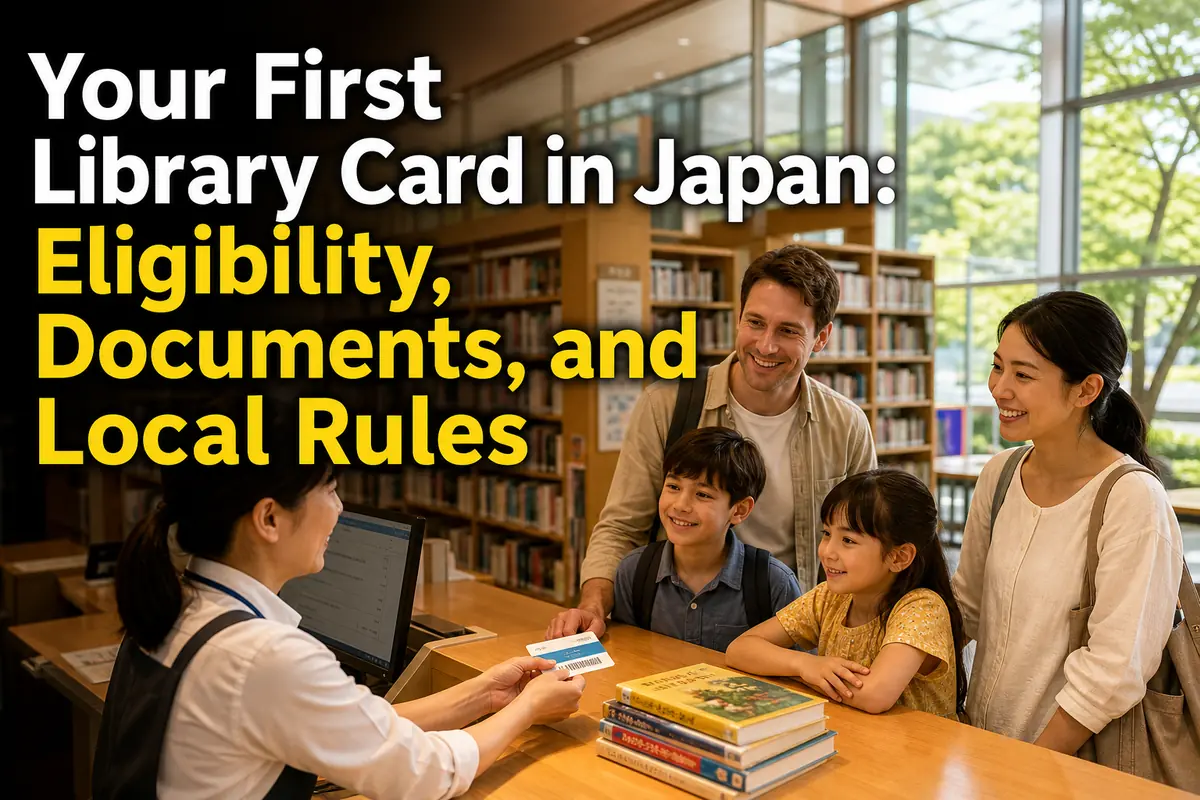
Your First Library Card in Japan: A Step-by-Step Guide for Foreign Residents
In most Japanese cities, a foreign resident can get a public library card free of charge by showing identification with a current address. You do not normally need Japanese citizenship, permanent residence, or advanced Japanese.
The important catch is that Japan does not have one nationwide public-library card. Each municipality sets its own eligibility rules, accepted documents, borrowing limits, and renewal periods.
Quick answer:
- Start with the library operated by the city, ward, town, or village where you live.
- Take identification showing your name and current address, such as a residence card.
- If you work or study in the area but live elsewhere, take proof of employment or enrollment too.
- Check the library’s official website before visiting because neighboring municipalities can have different rules.
This guide is for foreign residents, international students, workers, and families who want to borrow books or use local library services in Japan. Information was checked against official library pages available in August 2026, but local rules can change.
The basic rule: eligibility is local
Your address usually determines where you can register. Municipal libraries are local services, so one city’s card does not automatically work in another city.
A typical library accepts people who:
- live in the municipality;
- work there;
- attend a school there; or
- live in a neighboring municipality covered by a reciprocal agreement.
These are common patterns, not a national rule. Yokohama City, for example, offers free cards to people who live, work, or study in Yokohama. It also accepts residents of several nearby cities, including Kawasaki, Kamakura, and Machida.
Fuchu City in Tokyo similarly accepts city residents, local workers and students, and residents of municipalities with reciprocal arrangements. Narita Public Library serves eligible people in Narita and specified surrounding areas.
Tokyo can be especially confusing
“Tokyo” is not a single public-library membership system. Its wards and cities operate separate systems, and their eligibility areas are not identical.
For example, Minato City states that people who live, work, or study in any of Tokyo’s 23 wards may receive its library card. That should not be treated as a rule for every ward.
The Tokyo Metropolitan Library is different again. It is a reference-focused metropolitan institution rather than a normal ward library: visitors can consult materials, but it does not lend its own books directly to individual users. It supports borrowing through local public libraries instead.
ここがポイント: Do not search only for “Tokyo library card.” Search for the official library system of your ward or city and read its own registration conditions.
What to take to the registration counter
The safest document is an original ID that displays both your name and current residential address. A residence card often meets this requirement after its address has been updated.
Commonly accepted documents include:
- residence card;
- special permanent resident certificate;
- My Number card, showing only the appropriate front side when a copy is requested;
- Japanese driver’s license;
- another government-issued document showing the required information;
- student ID, if it contains the details required by that library.
A passport may prove your identity but usually does not show your current Japanese address. Do not assume it will be enough on its own.
If you recently moved
Check whether the address printed on your ID is current before going to the library. An old address may make it impossible for staff to confirm that you are eligible.
Some institutions accept supplementary proof, but the permitted documents differ. A recent utility bill or addressed mail may help at certain libraries; it is not universally accepted.
If you work or study in another municipality
Take two kinds of evidence:
- identification showing your home address; and
- documentation connecting you to the municipality, such as an employee ID, certificate of employment, or student ID.
Fuchu City’s official guide, for example, asks workers and students who live elsewhere to show proof of their workplace or school as well as identification proving their residence.
If your employee or student card does not show the institution’s address, ask the library whether another certificate is necessary. Confirm this before making a special trip.
Registering a child
Children can often receive their own cards, but the age rules, application form, and required identification vary. A parent may need to apply or accompany a younger child.
Ask these questions in advance:
- Does the child need to be present?
- Is a health insurance eligibility document, residence record, or other ID accepted?
- Must a parent or guardian sign the form?
- Can the child’s card access e-books or audiovisual materials?
Do not use a parent’s card as a substitute unless the library expressly permits it. Library cards are normally personal.
How to apply at the library
Counter registration is usually a short process if your documents are complete. The Japanese phrase for a library card is toshokan card (図書館カード), although some systems use names such as riyōken (利用券), meaning user card.
Step 1: Find the correct official website
Search for the municipality name followed by “city library English” or “図書館.” Confirm:
- who is eligible;
- which documents are accepted;
- where new registrations are handled;
- whether registration closes before the building does;
- whether an appointment is required;
- whether online registration is available.
English pages are useful, but the Japanese page may have been updated more recently. Compare the update dates where possible.
Step 2: Visit a branch that handles registration
Go during counter-service hours, ideally well before closing. Not every reading room, bookmobile, or small service point necessarily issues new cards.
You can say:
- Toshokan card o tsukuritai desu. — I would like to make a library card.
- Gaikokujin demo tsukuremasu ka? — Can a foreign national get one?
- Hitsuyō na shorui wa nan desu ka? — What documents are required?
Citizenship is normally not the key question. Staff need to determine whether you meet that library system’s local eligibility conditions.
Step 3: Complete the application
The form commonly asks for your:
- name;
- date of birth;
- address;
- telephone number;
- email address; and
- workplace or school details, when relevant.
Write your name consistently with your identification. If the form requests phonetic reading, staff may ask for your name in katakana.
Step 4: Receive and activate the card
Many libraries issue a physical card at the counter. Some also provide a digital card or online account.
Yokohama currently allows online registration and use of a digital card displayed on a smartphone. People registering this way do not receive a physical card. This is a local option, not a nationwide service.
Before leaving, ask how to:
- set or change the online password;
- reserve materials;
- renew loans;
- receive due-date notices; and
- display a digital card, if offered.
Cost, time, and expiration
A standard municipal library card is commonly free, but related services and replacement cards may cost money. Check the fee page of the library you plan to use.
Possible charges include:
- photocopying or printing;
- replacement of a lost card;
- postage or home-delivery services;
- replacement of lost or damaged materials; and
- certain interlibrary-loan expenses.
At Yokohama City Library, registration is free. Its published copying charges include ¥10 per black-and-white sheet, while color prices depend on paper size. These figures illustrate why “free library” does not mean every service is free.
How long registration takes
A complete counter application may result in a card being issued immediately, as Yokohama’s official guide states. Delays are possible when:
- the address on your ID is outdated;
- proof of work or study is missing;
- the branch cannot process registrations;
- staff need to confirm a reciprocal-use area; or
- the application is made close to closing time.
Cards may need renewal or address confirmation
Validity periods differ. Yokohama reviews registered information every five years. Another municipality may use a shorter period or ask you to update the account after moving.
Treat the following events as reasons to contact the library:
- moving to a new address;
- changing your name;
- leaving your school or employer;
- losing the card; or
- moving out of the eligibility area.
What the card usually lets you do
Borrowing books is only one benefit. Depending on the municipality, a card may also unlock reservations, branch transfers, online account management, databases, e-books, or audiovisual materials.
Borrowing and returning
Limits and deadlines are local. Yokohama currently allows each user to borrow up to 10 books for 14 library opening days. It permits one renewal when the material is not seriously overdue and another reader has not reserved it.
Do not apply those numbers elsewhere. When receiving your card, confirm:
- the maximum number of items;
- whether magazines, CDs, DVDs, and children’s materials have separate limits;
- whether the loan period counts calendar days or library opening days;
- how many renewals are allowed;
- where items can be returned; and
- what happens when another user has placed a hold.
Libraries often have book-return boxes for use outside opening hours. Some items, however, must be returned at a staffed counter because they are fragile, oversized, or borrowed from another institution.
Reservations and branch delivery
A municipal system may let you reserve an item online and collect it at another branch in the same network. This can be valuable when your nearest branch has few books in English.
Check the online catalog by title, author, subject, and language. If the catalog interface is difficult, ask a librarian for help rather than limiting your search to the shelves in front of you.
E-books and online databases
Digital access varies widely. A physical library card does not guarantee that you can use every e-book platform or database from home.
Possible restrictions include:
- access limited to residents, even when workers and students may borrow physical books;
- a separate application or password;
- use permitted only inside the library;
- device or application requirements; and
- lending limits different from printed books.
Ask specifically about denshi toshokan (電子図書館), meaning electronic library. Also confirm whether English-language titles are included; a service can exist while offering only a small collection in English.
Research help and materials from other libraries
Public librarians can help identify reliable materials, locate information, and explain catalog searches. This service is often called a reference service.
If the local collection does not contain what you need, ask about interlibrary loans. Participating public and university libraries can sometimes obtain eligible materials from other institutions, including the National Diet Library. Restrictions and possible costs depend on the requesting library and the material.
Important exceptions
Not every place called a library follows municipal-library rules. Identify the institution before assuming that your local card will work there.
The National Diet Library
The National Diet Library is Japan’s national library, with a preservation and research role. It is not a larger version of a neighborhood lending library.
People aged 18 or older may use its Tokyo Main Library and Kansai-kan regardless of nationality. Official registration is free, but it requires identification confirming the user’s name, address, and date of birth. A one-day card offers limited on-site access without full registration.
Most importantly, the National Diet Library does not lend its holdings directly to individuals for home use. Many materials are kept in closed stacks and requested for use inside the building.
Prefectural and metropolitan libraries
A prefectural library may focus on research, specialist collections, and support for municipal libraries. Direct lending rules can differ from those of the city library near your home.
The Tokyo Metropolitan Library, for example, does not directly lend its materials to individual visitors. A local public library may be able to arrange access through its network.
University libraries
University libraries primarily serve their own students and staff. Some admit local residents or outside researchers, but they may impose:
- age or research-purpose requirements;
- registration fees;
- annual renewal;
- restricted borrowing periods;
- limits during examinations; or
- no borrowing for outside users.
Tokyo Metropolitan University Library, for example, has a separate program for qualifying Tokyo residents and workers. Its published conditions include a ¥300 first-registration fee, one-year validity, and specific limits. This should not be confused with an ordinary municipal library card.
Tourists and short-term visitors
Tourists can often enter a public library, read open-shelf materials, or use permitted spaces without borrowing. Receiving a card is less certain because many systems require residence, work, study, or a qualifying neighboring address.
A hotel address is unlikely to establish municipal eligibility unless the library has a specific visitor scheme. Ask what can be used without registration instead of submitting an ineligible application.
Regional differences that affect your decision
The nearest library is not always the only library for which you qualify. Your home, workplace, school, and reciprocal agreements may connect you to different systems.
Compare these possibilities:
- Home municipality: usually the simplest option because your address proves eligibility.
- Workplace municipality: useful for lunchtime or after-work pickup, but additional evidence may be required.
- School municipality: practical for international students, especially when the school library has limited general-interest materials.
- Neighboring municipality: possible only when a reciprocal agreement or special eligibility rule covers your address.
- University or specialist library: useful for research, but often governed by separate fees and restrictions.
A second eligible card may improve access to foreign-language collections, but it also creates separate due dates, passwords, and rules. Check whether the added convenience is worth managing two accounts.
Common mistakes and how to avoid them
Most registration problems come from assuming that familiar rules apply everywhere. A quick check of the official local page prevents unnecessary return visits.
Bringing ID with an old address
Update the address on the relevant identification before applying, or ask which supplementary evidence the library accepts.
Assuming a passport is enough
A passport identifies you but may not prove your current Japanese address. Bring an accepted address-bearing document.
Forgetting workplace or school evidence
If you live outside the municipality, your residence card alone may prove where you live but not why you qualify there.
Treating one Tokyo card as universal
A ward card, city card, metropolitan-library reader card, and university-library card belong to different systems. Confirm the card issuer and service area.
Sharing a card with family members
Cards are generally issued to individuals. Register each eligible family member separately and keep track of which account borrowed each item.
Assuming all returns can go anywhere
Items may be returnable at any branch within one municipal system, but not at a library operated by another municipality. Interlibrary-loan and audiovisual items may have special return instructions.
Ignoring overdue materials
Japan does not have one national overdue policy. A library may suspend borrowing or renewal privileges. Contact staff promptly if an item is late, lost, or damaged; do not wait for the next visit.
Expecting a large English collection at every branch
A small neighborhood branch may have few foreign-language books even when the central library has many. Search the full catalog and use reservation or branch-transfer services where available.
A practical checklist before you go
Five minutes of preparation is usually enough to avoid a failed application. Use this checklist:
- [ ] I found the official website for my city, ward, town, or village library.
- [ ] I confirmed that my residence, workplace, school, or neighboring city makes me eligible.
- [ ] My identification shows my current name and address.
- [ ] I have additional proof of employment or enrollment if required.
- [ ] I checked registration hours and the correct branch.
- [ ] I know whether the card is free and whether replacement fees apply.
- [ ] I will ask about borrowing limits, renewals, reservations, and digital services.
- [ ] I will register children separately under the library’s family rules.
Final takeaway
For most foreign residents, getting a municipal library card is straightforward: use the library system connected to your address and take current proof of that address. Workers and students may have additional options if they can document their connection to another municipality.
The next thing to check is not whether foreigners are accepted in general. It is the exact eligibility boundary of the library you want to use. Open its official registration page, confirm the document list and counter hours, and take any extra proof before you leave home.
参照リンク
- Yokohama City Library General Information
- Fuchu City Library — General Information
- Narita Public Library — Service
- Minato City Living Guide — City Libraries
- Tokyo Metropolitan Library — How to Use
- Tokyo Metropolitan University Library — Information for Tokyo Residents
- National Diet Library — User Registration
- National Diet Library — Official Registration for Individuals
- National Diet Library — Help: Services
- National Diet Library — Using via Libraries