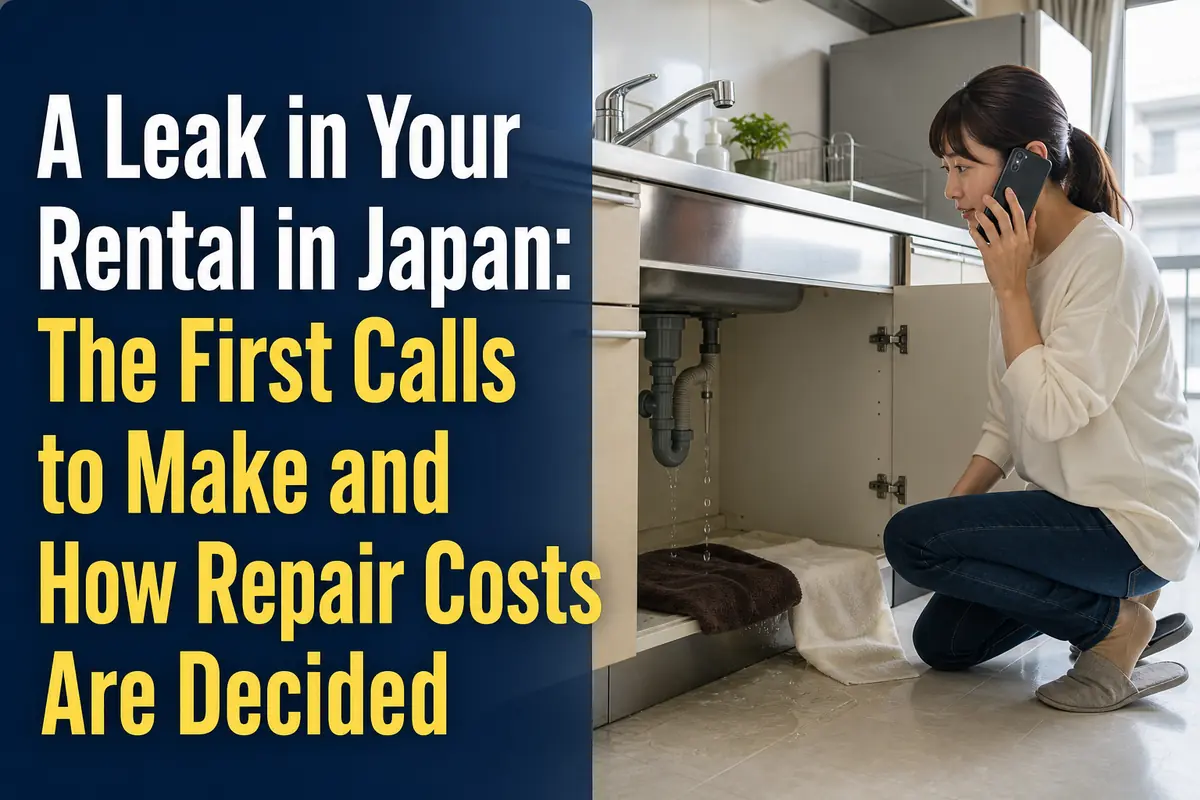
A Leak in Your Rental in Japan: The First Calls to Make and How Repair Costs Are Decided
If water is spreading inside your rental, stop the water if you can do so safely, protect yourself from electrical danger, and contact the property manager or landlord immediately. Do not wait until the next day simply because the leak looks small.
Who pays depends mainly on the cause—not on whose room first became wet. The owner commonly handles failures caused by aging pipes or supplied equipment. A tenant may be responsible when misuse, negligence, an unauthorized repair, or a delayed report makes the damage worse. Your lease and insurance terms also matter.
This guide is for foreign residents and families renting apartments, condominiums, company housing, or student accommodation in Japan.
Quick action plan
- Stop using the leaking fixture and close the nearest shutoff valve if it is safe.
- Keep away from wet outlets, appliances, lights, and breaker panels.
- Call the emergency contact listed in your lease or move-in documents.
- Take photos and videos before cleaning up, then record every call and message.
- Contact your insurer promptly if your room, the building, or another unit may be damaged.
In the first few minutes, contain the leak and make the call
Your immediate task is to limit further damage without putting yourself at risk. Repairs and responsibility can be discussed after the flow is controlled and the manager has been notified.
1. Stop using the source
Turn off the faucet, washing machine, toilet, bath, or other fixture involved. If you know which valve controls it, close that valve gently.
Common locations include:
- Beneath a kitchen or washbasin sink
- Beside or behind a toilet
- At the washing-machine tap
- Inside or near the water-meter box
Do not force a stuck valve. A broken valve can turn a small leak into a much larger one.
If the water is coming through a ceiling or wall, the source may be another unit, a shared pipe, the roof, or concealed plumbing. You may not be able to stop it from inside your room.
2. Treat electricity as a separate emergency
Do not touch wet electrical equipment, outlets, switches, or a breaker panel while standing in water. Move away from the area and tell the manager that electricity may be involved.
Call Japan’s emergency services at 119 if there is smoke, fire, a burning smell, sparking, an immediate threat to life, or another situation requiring firefighters or an ambulance. A routine plumbing leak by itself normally goes through the building’s emergency contact rather than 119.
3. Contact the management side first
For a rental in a multi-unit building, the normal first contact is one of the following:
- The property management company, called kanri gaisha
- The landlord, called ooya or kashinu shi
- The building manager or caretaker
- A housing provider, employer, school, or university office responsible for the accommodation
- The 24-hour support service named in the lease or move-in guide
Give them your name, building, room number, callback number, where the water appears, whether it is still flowing, and whether another unit may be affected.
A simple message is enough:
“There is an active water leak in room 305. Water is coming from under the kitchen sink, and I have closed the valve. The floor is wet, but I do not see water near an outlet. Please tell me the approved emergency procedure and repair company.”
If you cannot reach anyone, leave a timestamped voicemail or email and keep screenshots of your attempts. Follow any emergency procedure written in the lease.
ここがポイント: Reporting the leak is not the same as accepting liability. Notify the responsible contact quickly, describe only what you know, and keep evidence while the cause is investigated.
Who should arrange the plumber?
In a managed rental, let the landlord or management company arrange or approve the repair whenever time allows. They may have a designated contractor, a building-wide maintenance agreement, or information about shared pipes that an outside plumber cannot access.
The Tokyo Metropolitan Government’s water bureau likewise tells residents of multi-unit buildings to consult the building owner or management company. Procedures differ among water utilities and properties, so Tokyo’s instructions should not be treated as a nationwide service rule.
When an emergency plumber may be necessary
You may need outside help when water is actively causing serious damage, the designated contacts cannot be reached, and the lease provides no workable emergency route. Even then:
- First take reasonable temporary steps to stop or contain the water.
- Check the lease for approved companies and emergency-support numbers.
- Ask for the callout fee, diagnosis fee, labor rate, parts cost, and night surcharge.
- Request a written estimate before permanent work begins where possible.
- Approve only the work needed to stop the immediate damage.
- Keep the invoice, receipt, damaged parts if available, and before-and-after photos.
Do not assume that the landlord must reimburse every contractor you hire. Whether emergency expenses can be recovered depends on the urgency, necessity, contract, cause, and surrounding facts.
The National Consumer Affairs Center of Japan has warned about emergency repair advertisements displaying very low starting prices followed by much larger bills. If a contractor pressures you into extra work, will not explain the price, or demands an immediate cash payment, pause the work when it is safe to do so. Consumer Hotline 188 connects callers to a local consumer affairs consultation service, although language availability varies.
Who normally pays for the repair and damage?
The practical dividing line is whether the problem arose from the property itself or from someone’s action or failure to act. The final allocation may involve several separate bills: repairing the pipe, restoring your room, replacing your belongings, and compensating a downstairs resident are not necessarily paid by the same party.
Aging pipes or supplied equipment
The landlord commonly bears the cost when a leak results from deterioration or failure of the building or equipment supplied with the rental, such as:
- A concealed pipe that fails through age
- A fixed water heater or supplied air conditioner that breaks during normal use
- A roof, exterior wall, or shared pipe that allows water into the unit
- Plumbing that was already defective when the tenancy began
Japan’s Ministry of Land, Infrastructure, Transport and Tourism explains that necessary repairs to a rental are generally the landlord’s responsibility. However, the lease may allocate certain minor tasks—such as replacing a simple faucet packing—to the tenant. Check the repair clause and any special provisions rather than relying on a general rule alone.
Tenant action, neglect, or delayed reporting
A tenant may be charged when the evidence shows that the tenant caused the leak or allowed avoidable damage to spread. Examples can include:
- Leaving water running
- Incorrectly connecting a washing-machine hose
- Damaging a pipe or fixture
- Continuing to use equipment after an obvious leak appears
- Ignoring water long enough for flooring, walls, or the unit below to suffer additional damage
- Performing an unauthorized repair that causes further harm
The MLIT guidance specifically warns that failing to notify the landlord about a leak may expose the tenant to a claim if the delay expands the damage—for example, when water reaches the unit below.
This distinction matters. A worn pipe may begin as the owner’s repair responsibility, but a tenant could still face a claim for the additional damage caused by not reporting it promptly.
Water from another unit or a shared area
If water enters from upstairs, do not negotiate responsibility directly in the hallway before the source is known. Contact management so it can inspect both units and determine whether the cause is:
- An upstairs resident’s appliance or conduct
- A pipe serving only one unit
- A shared vertical pipe or another common building component
- Rain intrusion or an exterior defect
- Work performed by a contractor
The person or organization responsible for the source—and its insurer—may ultimately handle some losses. Until the investigation is complete, avoid stating that a particular neighbor caused the incident.
Your belongings are a separate question
Even when an owner pays to repair the building, that does not automatically mean the owner pays for your damaged computer, bedding, furniture, or other belongings. Compensation depends on legal responsibility and the available insurance cover.
Notify your insurer before discarding damaged items unless sanitation or safety makes immediate disposal necessary. Photograph each item, its condition, and any model or serial number. Keep purchase records where available.
Understand the insurance terms before making a claim
“Fire insurance” for a Japanese rental often contains several different forms of cover, and each answers a different question. The name alone does not confirm that a particular leak is covered.
Common components include:
- Contents cover: may protect your own belongings against specified water damage.
- Tenant liability cover (shakunin baishō sekinin): may respond when you are legally liable for damage to the rented premises.
- Personal liability cover (kojin baishō sekinin): may respond when you are legally liable for damage to another person or their property, such as belongings in the unit below.
The General Insurance Association of Japan explains that tenant liability and personal liability serve different purposes. A policy may include both, one, or neither, and exclusions, deductibles, limits, and notification deadlines vary.
When calling the insurer, prepare:
- Your policy number
- The date and approximate time of discovery
- Photos or videos of the source and damage
- The manager’s contact details
- Names of affected units, if known
- Contractor reports, estimates, and receipts
- A factual timeline of what you did
Ask whether the insurer wants an inspection before repairs or disposal. Do not promise payment to a neighbor or sign a settlement before checking whether doing so could affect the claim.
Evidence determines more than a verbal explanation
A short, factual incident file can prevent a later disagreement about cause, timing, and added damage. Start it while events are still fresh.
Record:
- When you first noticed the leak
- When you stopped the fixture or closed a valve
- When and how you contacted management
- The names of people who responded
- What emergency instructions they gave
- Which rooms and objects became wet
- Whether water reached a corridor or another unit
- What was cleaned, moved, repaired, or discarded
Photograph wide views and close-ups. Include the source, the route the water followed, flooring, walls, ceilings, appliances, and damaged property. If a contractor identifies the cause, ask for it in writing rather than relying only on a spoken explanation.
Do not sign a document saying you caused the leak merely to speed up the repair. You can confirm access, work completion, or receipt of an estimate without agreeing to responsibility if the cause remains uncertain.
Common mistakes that make a leak more expensive
Most avoidable problems come from delay, unauthorized work, or weak documentation. These mistakes can complicate both the repair and the insurance claim.
- Waiting to see whether the leak stops: Water can travel under flooring or into the unit below before damage becomes visible.
- Calling the first sponsored search result: A low advertised starting price may not include travel, diagnosis, labor, parts, or after-hours service.
- Making a permanent repair without approval: The owner may dispute the method, price, or need for the work.
- Throwing everything away immediately: The manager or insurer may need photographs, receipts, or an inspection.
- Blaming a neighbor before inspection: Water often travels away from its true source.
- Assuming the security deposit settles the matter: Deposit deductions, repair liability, insurance, and third-party damage are separate issues.
- Stopping after a phone call: Follow up in writing so there is a clear timestamp and summary.
Regional and housing differences to check
The basic need to contain and report a leak applies broadly, but the actual contact route changes by property and location. Your municipality is usually not the first repair contact for plumbing inside a private rental.
Check the rules for your specific housing type:
Private rental apartment
Use the management company or landlord’s emergency route. The local water utility may deal with public mains or provide approved-contractor information, but it does not automatically manage repairs inside the building.
Condominium rented from an individual owner
You may need both the unit owner’s agent and the condominium management office. The boundary between private-unit equipment and common building pipes is important.
Company or university housing
The employer, school, dormitory office, or contracted operator may control access and contractor selection. Report through its designated channel unless immediate danger requires emergency action.
Public housing
Municipal, prefectural, or other public housing operators have their own repair desks, after-hours numbers, and cost rules. Use the contact information provided by that operator.
A practical decision checklist
Before the incident is closed, make sure the cause, scope, payer, and next steps are written down. A repaired faucet does not necessarily resolve damage behind a wall or in another unit.
Ask the manager or contractor:
- What was the confirmed or suspected source?
- Is the affected pipe or fixture part of the rental, a private unit, or a common area?
- Is temporary drying or later restoration required?
- Who authorized the work?
- Who will receive each invoice?
- Has another unit been inspected?
- Should rent, access, or temporary accommodation be discussed if the room cannot be used?
- What documents should be sent to the insurer?
If responsibility or charges remain disputed, request an itemized explanation and compare the lease with MLIT’s rental and restoration guidance. For consumer-contract problems, contact the Consumer Hotline at 188. Significant liability, an uninhabitable room, or a large uninsured loss may justify advice from a qualified legal professional or an appropriate local consultation service.
The most useful preparation takes only a few minutes: save the building’s emergency number, find the main shutoff valve, photograph your insurance policy details, and check whether your cover includes both tenant liability and personal liability. During a leak, those four facts can matter more than finding a plumber through a hurried web search.
参照リンク
- Ministry of Land, Infrastructure, Transport and Tourism: Private Rental Housing
- MLIT: Restoration Guidelines Q&A
- MLIT: Support for Foreign Nationals in Rental Housing
- Tokyo Metropolitan Government: Rental Housing Trouble Prevention Guidelines
- Tokyo Metropolitan Waterworks Bureau: Requesting Leak Repairs
- National Consumer Affairs Center of Japan: Warning About High-Priced Emergency Repair Services
- General Insurance Association of Japan: Insurance Q&A for Rental Homes