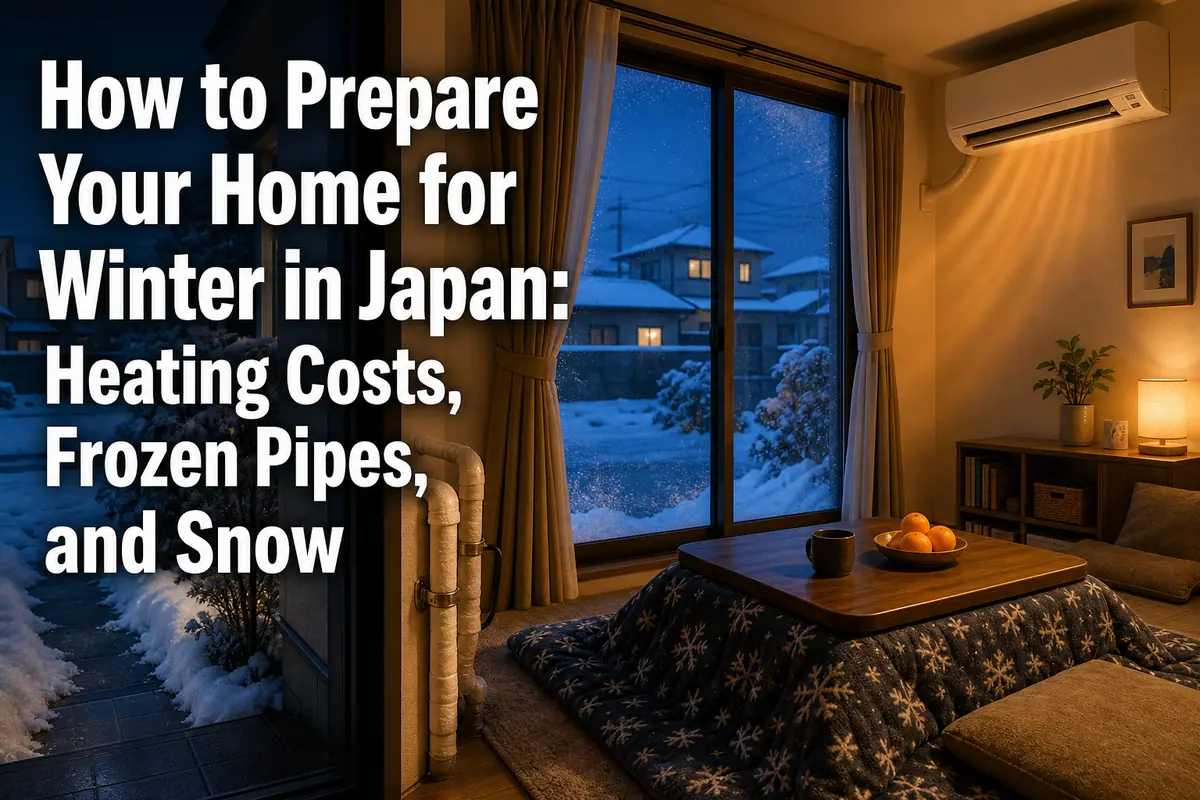
How to Prepare Your Home for Winter in Japan Without Letting Costs or Cold-Weather Damage Get Out of Control
Winter living in Japan depends heavily on where you live, how well your home is insulated, and which heating system the property supports. A Tokyo apartment may need only occasional heating, while a detached home in Hokkaido can require continuous cold-weather planning.
The safest approach is simple: learn how your heater works, estimate its running cost before winter, locate the water shutoff or drain valve, and check who removes snow around your building.
This guide is for foreign residents and families preparing for their first winter in Japan, especially renters who may not know the equipment or local responsibilities.
In brief:
- Check the heater type, fuel, controls, and ventilation requirements before the first cold night.
- Estimate electricity costs from the appliance’s wattage and your own electricity rate.
- Ask your landlord how to prevent frozen pipes; procedures differ by building and region.
- Confirm whether snow removal belongs to the tenant, landlord, management company, or municipality.
- Follow official weather warnings rather than judging risk only from conditions outside your window.
Start with the home, not the weather forecast
The same outdoor temperature can produce very different indoor conditions. Building age, insulation, window type, floor level, sunlight, and air leakage can matter as much as the city shown in your weather app.
A concrete apartment between occupied units often retains heat better than a detached wooden house. Corner rooms and top-floor units can lose more heat because more walls or roof surfaces face outdoors. Older single-pane windows may become cold enough for condensation to form even while the room feels warm.
Before winter, check:
- Which rooms have installed heating or air-conditioning units
- Whether the air conditioner has a heating mode marked
暖房 - Whether the home uses electricity, city gas, LP gas, kerosene, or a combination
- Where the breaker panel and water shutoff are located
- Whether exposed pipes have insulation or heater cables
- Who to contact if the heater, boiler, or water supply fails
- Whether the lease contains rules about portable kerosene or gas heaters
Renters should not install fuel-burning equipment, change piping, or attach a heater to a gas outlet without permission. The building may prohibit certain appliances for fire-safety or insurance reasons.
Understand the main heating options
There is no single cheapest heater for every Japanese home. Purchase price, room size, insulation, local climate, energy contract, and how long you heat the room all change the result.
Reverse-cycle air conditioner
Most Japanese air conditioners are heat pumps: they move heat rather than producing all of it with an electric heating element. This can make them efficient for regular room heating.
Their performance still depends on the unit and conditions. A machine that is too small for the room may run hard without making the space comfortable. Snow, leaves, luggage, or other objects around the outdoor unit can also reduce performance; keep its intake and outlet clear without carrying out unsafe exterior work.
Useful settings and habits include:
- Select
暖房for heating and自動for automatic fan control if appropriate. - Direct warm air downward, then use a circulator or fan gently to mix the room air.
- Clean the filter according to the manufacturer’s instructions.
- Close doors to rooms you are not heating.
- Use curtains that reach close to the floor, but keep fabric away from heaters.
Japan’s Agency for Natural Resources and Energy uses 20°C as a winter room-temperature reference for energy-saving examples. This is not a rule that every household must follow. Children, older people, people with medical needs, and poorly insulated homes may require a different setting.
Electric resistance heaters, carpets, and kotatsu
Portable electric fan heaters and radiant heaters are easy to use, but high-wattage models can become expensive when operated for many hours. They also place a large load on a circuit.
A kotatsu—a low table with a heater underneath and a quilt around it—warms people rather than the whole room. An electric carpet does the same for a limited floor area. These can reduce the need to heat every cubic metre of air, but they do not protect distant pipes or unheated rooms from freezing.
Do not cover a portable heater, dry laundry over it, or connect a high-power appliance through a damaged extension cable. Check the appliance manual and keep the required clearance from bedding, curtains, and furniture.
Gas and kerosene heaters
Gas and kerosene heaters can warm a room quickly, but the installation and ventilation requirements are critical. Some systems exhaust combustion gases outdoors; other unvented models use room air and require regular ventilation.
Follow the exact appliance instructions. Do not assume that a small gap under a door provides enough fresh air. Stop using an appliance that produces unusual smells, soot, repeated shutdowns, abnormal flames, or error indications, and contact the landlord, manufacturer, or fuel supplier.
ここがポイント: A lower energy bill is never worth bypassing ventilation, disabling a safety device, using outdoor combustion equipment indoors, or operating a heater that the lease prohibits.
If you smell gas, do not create a flame or operate electrical switches. Leave the area and follow the emergency instructions from the relevant gas supplier.
Calculate heating costs before the bill arrives
The most useful estimate comes from your appliance and tariff, not a nationwide average. Electricity prices vary by retailer, plan, region, fuel adjustment, and other billing components.
For an appliance that draws power at a roughly constant rate, use:
Power in kW × hours used × your electricity price per kWh = estimated energy charge
For example, a 1,200-watt heater is 1.2 kW. If it operates for five hours, it uses up to about 6 kWh during that period:
1.2 kW × 5 hours = 6 kWh
Multiply 6 kWh by the applicable per-kWh figure from your electricity plan. This is only an estimate because thermostats may cycle, and a bill can contain fixed charges, fuel-cost adjustments, renewable-energy surcharges, taxes, or time-based rates.
Why an air conditioner is harder to estimate
An inverter air conditioner changes its power draw as it warms the room and maintains the temperature. The rated or maximum input on the label therefore does not mean it consumes that amount every hour.
For a better estimate:
- Find the model number and energy label.
- Check the manufacturer’s listed heating consumption and seasonal consumption figures.
- Compare the figure with the size and climate assumptions used in the specification.
- Read the unit’s actual consumption through a compatible monitor or retailer service if available.
- Compare similar periods, correcting for colder or warmer weather where possible.
Gas and kerosene costs require the same discipline. Use the current unit price on your contract or delivery statement rather than assuming that city gas and LP gas cost the same. They are different services with different pricing structures.
Reduce heat loss before reducing safe heating
Turning the heater down is not the only way to save. In a drafty home, slowing heat loss may improve comfort without creating dangerously cold rooms.
Try low-risk, reversible measures first:
- Close curtains after sunset and open them for useful sunlight during the day.
- Apply removable window-insulation products only if the lease and window manufacturer permit them.
- Use a rug or approved insulating layer on a cold floor.
- Seal obvious drafts with removable products that do not block required ventilation.
- Heat occupied zones rather than leaving every room at the same temperature.
- Clean filters and keep air paths clear.
Do not block air vents, combustion-air openings, fire equipment, or emergency exits. Condensation also needs attention: wipe wet windows, ventilate as needed, and report persistent dampness or mould to the property manager.
Prevent frozen pipes before a cold absence
The time to learn the pipe-freezing procedure is before the temperature falls. Frozen water can stop the supply, and expansion may crack a pipe or fitting and cause leakage after thawing.
Risk is higher when:
- A strong cold spell is forecast
- Outdoor or poorly insulated pipes are exposed to wind
- The property will be empty for several days
- Heating will be turned off
- Pipes run through an unheated space
- The building is in a colder region where water-draining systems are standard
Sapporo’s water bureau recommends draining water with the property’s 水抜き栓 water-drain valve as an effective preventive measure. Guidance commonly highlights particular concern around −4°C or below, during prolonged sub-zero conditions, or when water will not be used for a long period. That threshold is a practical warning used by cold-region authorities, not a guarantee that every pipe is safe above it.
Ask for the building-specific procedure
Do not copy a generic sequence from another apartment. Valve designs vary, and some properties have electric pipe heaters or remotely controlled systems.
Ask the landlord or management company to show you:
- The main shutoff and the water-drain valve
- Which direction or setting closes and drains the system
- Which taps, toilet components, boiler lines, and washing-machine connections need attention
- Whether the water heater has a separate freeze-protection procedure
- How to restore the water without causing a leak
- Who pays if a pipe freezes after the tenant ignores the required procedure
- Which emergency contractor is approved by the building
Take labelled photos for your own reference, but do not post security-sensitive utility details publicly.
If a pipe has frozen
First, check whether the problem affects one tap, the entire home, or neighbouring units. Then contact the management company or water provider according to local guidance.
Never apply an open flame. Avoid pouring boiling water directly onto a pipe, which can damage it or cause burns. Some water authorities describe gradual warming with a towel and lukewarm water for accessible sections, but this is not suitable for every pipe or appliance. If the location is hidden, cracked, leaking, or connected to a boiler, use an authorised professional.
If water begins leaking:
- Close the main water valve if it is safe and you know the correct valve.
- Move electrical devices and valuables away without touching wet electrical equipment.
- Contact the landlord or building emergency number immediately.
- Notify the downstairs resident or management desk if water may spread to another unit.
- Record the damage for the property manager and insurer.
Know who removes the snow
Public road clearing does not mean every entrance, private path, parking space, or pile beside a building will be cleared by the municipality. Responsibility changes by property and city.
In an apartment building, common-area snow removal may be included in management services. A tenant in a detached rental may be expected to clear the entrance, steps, parking area, or another private section. Ask before the first snowfall, not after access is blocked.
Confirm these points in writing:
- Which areas the municipality clears
- Which areas the building contractor clears
- Whether residents must shovel any shared area
- Where removed snow may be placed
- Whether snow may be moved into a road, drainage channel, neighbouring property, or parking space
- Who clears emergency exits, fire equipment, outdoor utility equipment, and rubbish collection points
- How roof snow and icicles are inspected
Never climb onto a roof or work below unstable roof snow without appropriate professional controls. Falling snow and ice can injure people even when the roof itself looks accessible.
Municipal service levels can change
Local snow operations depend on road category, snowfall, staffing, machinery, and budget. They may prioritise major roads and emergency access over small residential streets.
This is a current issue in Sapporo. City information updated in 2026 describes workforce and cost pressures and says the city is developing a sustainable snow-policy direction during fiscal 2026. Residents should therefore check current city notices rather than rely on what happened in a previous winter.
Prepare for snow days without treating them as ordinary days
Heavy snow affects more than the morning commute. Deliveries, rubbish collection, home-care visits, schools, buses, trains, and access for emergency vehicles may all be disrupted.
Before a forecast cold spell or snowfall:
- Charge phones and power banks.
- Keep essential medication and several days of necessary household supplies.
- Check batteries in flashlights and approved alarms.
- Avoid allowing fuel or groceries to fall to zero before a storm.
- Move bicycles and personal items away from designated snow-clearing areas.
- Learn the safest route to the nearest station, bus stop, shop, and emergency facility.
- Check whether outdoor water taps or washing-machine hoses need protection.
Use the Japan Meteorological Agency’s forecasts, warnings, and advisories for your area. Its English services include heavy-snow and snowstorm information. The agency also issues early information when unusually heavy five-day snowfall may occur 6 to 14 days ahead under its stated probability criteria.
A warning is a signal to change plans. Do not drive merely because your vehicle has winter tyres, and do not assume that the final train or bus will run normally. Check the transport operator directly.
Common first-winter mistakes
Most avoidable problems begin with an assumption about equipment or responsibility. These are the errors worth preventing:
- Waiting for the first freeze to test the heater: Repairs and replacement parts may take longer during peak demand.
- Comparing heaters by purchase price alone: Running cost and suitability for the room matter over an entire winter.
- Using the air-conditioner’s maximum wattage as its constant consumption: Inverter operation varies over time.
- Turning off all heat during a trip without checking pipes: The correct action depends on the building’s drain and freeze-protection systems.
- Leaving an unvented combustion heater running while asleep: Follow the manufacturer’s restrictions and ventilation instructions.
- Blocking vents to stop cold air: Some openings are needed for safe ventilation or combustion.
- Assuming the city clears private property: Entrances and parking spaces may remain the resident’s or manager’s responsibility.
- Pouring very hot water on ice or frozen plumbing: This can damage surfaces or pipes and create a new slip hazard.
- Ignoring condensation: Repeated moisture can lead to mould and damage around windows, walls, or furniture.
What is changing after the 2026–27 winter
A national efficiency change affects manufacturers and future purchases, not the continued use of an existing air conditioner. Japan’s revised 2027 fiscal-year energy-efficiency standards for household air conditioners are due to take effect from April 2027.
The Agency for Natural Resources and Energy states that households will not be required to replace existing machines simply because of the new standard. Its April 2026 explanation estimates that qualifying new units could reduce annual electricity costs compared with the older 2010 standard by about ¥2,760 for a 2.2 kW, six-tatami-class model and about ¥12,600 for a 4.0 kW, 14-tatami-class model under the agency’s assumptions.
Those figures are comparisons, not guaranteed household savings. Actual results depend on climate, insulation, room size, usage, installation, electricity price, and the models compared.
If you expect to replace an air conditioner, compare:
- Heating capacity for your region and room
- Low-temperature heating performance
- Annual energy consumption and APF, the seasonal efficiency indicator
- Installation and removal charges
- Outdoor-unit placement
- Warranty and local repair support
- Expected running cost, not only the shop price
There is no need to rush a working unit out of the home solely because April 2027 is approaching.
A practical two-stage winter checklist
Finish the safety work early, then use bills and weather data to adjust your routine.
Before the cold season
- Test every installed heater.
- Clean approved filters and inspect outdoor-unit clearance.
- Learn the water-draining and restoration procedure.
- Save landlord, utility, repair, and emergency contact details.
- Confirm snow-removal responsibilities.
- Review appliance ventilation and clearance instructions.
- Prepare warm bedding, curtains, safe floor insulation, and basic storm supplies.
- Record the electricity, gas, or fuel price used by your contract.
After the first full bill
- Compare usage, not only the total yen amount.
- Note the billing period and weather conditions.
- Identify which rooms and hours account for most heating.
- Reduce drafts and unnecessary heated space before sacrificing essential warmth.
- Ask the retailer to explain unfamiliar charges.
- Report equipment faults, persistent condensation, or suspected pipe risk early.
Your most important next action is property-specific: ask the landlord or management company to demonstrate the water-drain system and confirm the permitted heating equipment in writing. That short conversation can prevent a winter repair bill that no generic national guide can calculate for you.
参照リンク
- Agency for Natural Resources and Energy: Practical household energy-saving measures
- Agency for Natural Resources and Energy: Winter energy-saving measures for fiscal 2025
- Agency for Natural Resources and Energy: New air-conditioner efficiency standards from April 2027
- Sapporo Waterworks Bureau: Frozen water pipes
- Tokyo Metropolitan Government Bureau of Waterworks: Preventing frozen water pipes
- Sapporo City: Winter living and snow removal
- Sapporo City: Sustainable snow-policy overview
- Japan Meteorological Agency: Weather forecasts, warnings, and advisories
- Japan Meteorological Agency: Early Warning Information on Extreme Weather
- Fire and Disaster Management Agency research centre: Safe use of heating equipment
- Tokyo Gas Network: Emergency instructions