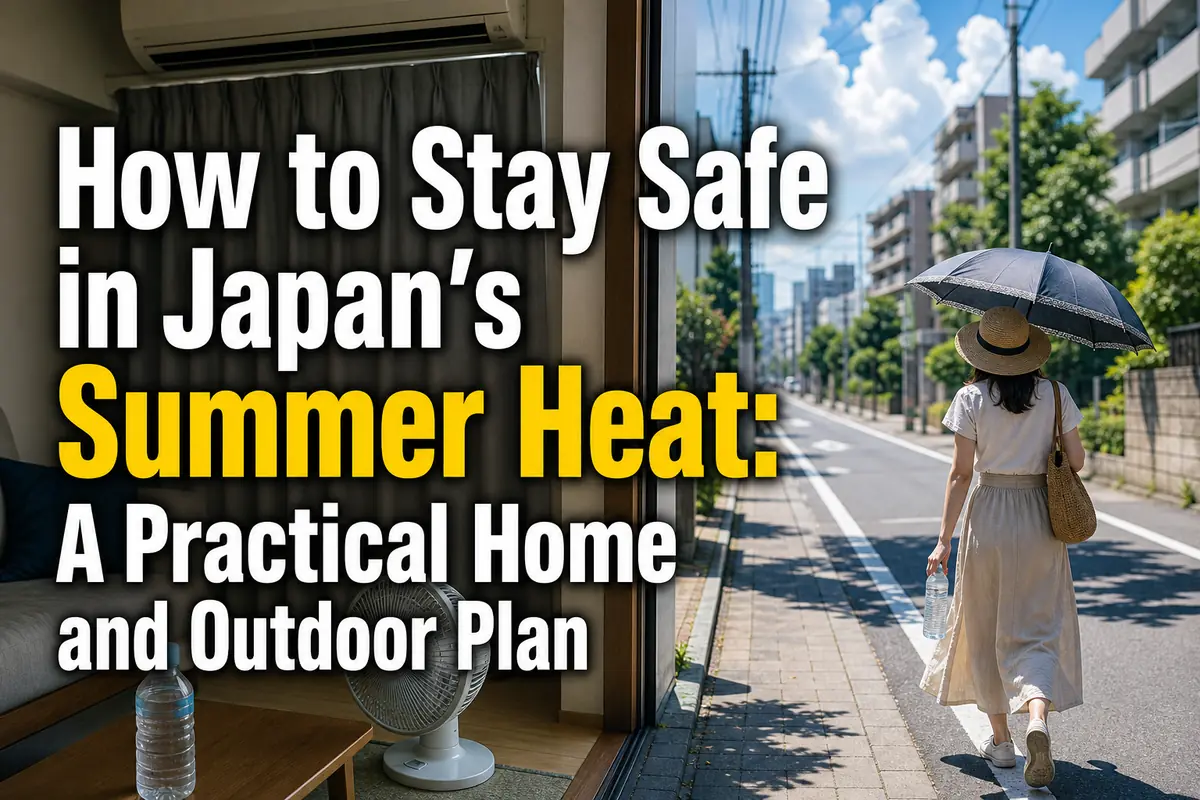
How to Stay Safe in Japan’s Summer Heat: A Practical Home and Outdoor Plan
Japan’s humid summer can cause heat illness indoors as well as outdoors. The safest approach is to cool your living space, drink regularly before you feel thirsty, and change or cancel outdoor plans when the local heat-risk level is high.
This guide is for foreign residents, students, workers, and families—especially anyone experiencing a Japanese summer for the first time.
Quick action plan
- Check your area’s WBGT heat-risk forecast, not only the air temperature.
- Use air conditioning before your room becomes dangerously hot.
- Carry water and plan shaded or air-conditioned breaks when going out.
- Call 119 if a person is not responding normally or cannot drink without help.
Check WBGT before deciding what to do
Japan’s Wet Bulb Globe Temperature, or WBGT, is a more useful activity guide than temperature alone. It reflects temperature, humidity, and radiant heat from sources such as sunlight, roads, and buildings.
A forecast of 32°C does not describe the full risk. High humidity slows the evaporation of sweat, while direct sun and heat radiating from pavement add to the strain on the body. WBGT combines these factors into one heat-stress index.
The Ministry of the Environment publishes current readings and forecasts by area on its English heat-illness prevention website. Its general activity guidance uses these bands:
- Below 21: Risk is lower, but water is still recommended.
- 21 to under 25: Use caution and replace water regularly.
- 25 to under 28: Take frequent breaks.
- 28 to under 31: Heavy exercise should be stopped.
- 31 or higher: Exercise should be stopped.
These are activity guidelines, not a guarantee that everyone below a threshold is safe. A person’s health, age, medication, clothing, workload, and exposure to sun can change the risk.
Heat Stroke Alert and Special Heat Stroke Alert
Japan uses two related alert levels:
- A Heat Stroke Alert indicates that extremely dangerous heat conditions are forecast in the relevant forecast area. Treat it as a reason to reduce exposure and reconsider outdoor activity.
- A Special Heat Stroke Alert is reserved for unusually severe, widespread heat that could cause serious harm. Municipalities may open designated cooling shelters during the periods stated for these facilities.
Alert areas do not always match municipal boundaries. Hokkaido, Kagoshima, and Okinawa are also divided into smaller forecast areas. Check the place where you will actually spend the day rather than assuming one alert covers an entire prefecture in the same way.
ここがポイント: A heat alert is not simply a notice to carry an extra bottle. It is a signal to change the plan—move an activity, shorten it, use an air-conditioned location, or cancel it.
Keep your home cool before heat builds up
Do not wait until you feel sick to switch on the air conditioner. Heat illness can develop in a bedroom, kitchen, or other indoor space, including at night.
Use air conditioning as a safety tool
Set the air conditioner to maintain a comfortable indoor environment, then check how the room actually feels. The number on the remote control is a target setting, not necessarily the measured room temperature.
Several factors can make the room warmer than expected:
- strong afternoon sun through a window;
- a top-floor or poorly insulated apartment;
- heat from cooking and appliances;
- an air conditioner with dirty filters or insufficient capacity;
- warm air entering from an open door or window.
Closing curtains or blinds before direct sunlight reaches the room can reduce heat gain. A fan can circulate cooled air, but a fan alone may not make a dangerously hot room safe.
There is no single air-conditioner setting that suits every home or person. Older adults, babies, people with disabilities, pregnant people, and those with certain health conditions may need more careful monitoring. Follow personal medical instructions where applicable.
Make one room your cool base
If cooling the whole home is expensive or difficult, concentrate daily activity in one air-conditioned room where possible. Keep these items within reach:
- drinking water;
- a thermometer, ideally with a humidity display;
- a phone and charger;
- prescribed medicines;
- a fan for air circulation;
- a cool towel or wrapped cold pack.
This is particularly useful for someone living alone. Arrange a regular call or message with a relative, friend, or neighbor during very hot periods.
If your air conditioner is unavailable
Open windows only when the outdoor conditions make ventilation helpful. Opening them during the hottest part of the day can bring more heat indoors.
If the room remains hot:
- Move to an air-conditioned public place such as a library, shopping center, or other facility where you are allowed to stay.
- Check your municipality’s website for a designated cooling shelter, sometimes listed in Japanese as cooling shelter or shitei shonetsu hinan shisetsu (指定暑熱避難施設).
- Confirm the facility’s opening hours and access conditions before traveling.
- Call the building manager or landlord if the installed air conditioner is not working and the repair responsibility is unclear.
Cooling-shelter locations and operating arrangements are set locally. They therefore differ between cities and wards.
Drink regularly—but use salt and sports drinks sensibly
The basic rule is frequent fluid intake, including when you do not yet feel thirsty. Waiting for strong thirst can leave you trying to catch up after dehydration has begun.
Keep water beside your bed and desk, and carry a drink whenever you leave home. Drink at regular stops rather than saving the entire bottle for the end of a journey.
When plain water is usually enough
For ordinary indoor life or a short outing without heavy sweating, water is generally the practical first choice. Normal meals also provide salt.
After prolonged activity or heavy sweating, a sports drink or oral rehydration solution may help replace fluid and electrolytes. These products are not identical:
- Sports drinks are designed for fluid and energy replacement around activity and often contain sugar.
- Oral rehydration solutions have a specific balance of water, salts, and glucose and are intended for dehydration management, not as an unlimited everyday soft drink.
People who have been told to limit fluid, salt, sugar, or potassium because of a medical condition should follow advice from a qualified medical professional. Do not make a major change based only on general summer guidance.
Alcohol is not hydration
Beer and other alcoholic drinks should not count toward a hydration plan. Drink water separately, especially after an outdoor event or before sleeping.
Plan outdoor trips around heat exposure
The best protection outdoors is often changing the time, route, or duration—not adding more equipment to the same risky plan.
Before leaving:
- check the hourly WBGT and weather forecast for your destination;
- move exercise and errands to a cooler part of the day where possible;
- identify air-conditioned stops along the route;
- carry enough water for delays;
- wear light, breathable clothing and a hat;
- use a parasol or umbrella for shade if practical;
- tell someone your route when working or exercising alone.
Treat the journey as part of the exposure
A ten-minute walk can become much longer after a missed bus or train disruption. Stations may have air-conditioned shops or waiting areas, but platforms and bus stops are not always cooled.
Build a margin into the plan. For example, choose a route with an indoor transfer, stop before symptoms begin, and avoid running for a train in direct sun.
Children, older adults, and pets need a different plan
Children are closer to heat radiating from the ground and may not explain their symptoms clearly. Older adults may notice heat or thirst less readily. Check on them directly rather than relying on “I am fine.”
Never leave a child, dependent adult, or pet in a parked vehicle, even for a short errand. A slightly open window does not make a hot vehicle safe.
Pet owners should also test pavement before a walk and consult a veterinarian about breed- and health-specific risks. The human WBGT guidance does not replace veterinary advice.
Recognize heat illness early
Dizziness or unusual weakness after heat exposure is a reason to stop immediately. Do not encourage the person to “push through” to finish work, exercise, or sightseeing.
Possible signs listed in Japan’s official heat-illness materials include:
- dizziness or fainting;
- muscle pain, cramps, or stiffness;
- heavy sweating;
- headache;
- nausea or vomiting;
- unusual tiredness or weakness;
- difficulty moving normally;
- impaired consciousness;
- high body temperature.
Symptoms vary, and severe illness may develop quickly. The absence of one symptom does not rule it out.
First aid: cool first and assess the response
If you suspect heat illness:
- Move the person to shade or an air-conditioned place.
- Loosen unnecessary clothing.
- Cool the body with water, wet towels, airflow, or wrapped cold packs. Cooling the neck, armpits, and groin can help.
- If the person is fully alert and can drink independently, offer water and an appropriate electrolyte drink.
- Stay with the person and check whether the symptoms improve.
Do not force a drink into someone who is confused, unconscious, vomiting repeatedly, or unable to swallow safely. This can cause choking.
When to call 119
Call Japan’s emergency number, 119, if the person is not responding normally. Official first-aid guidance also directs people to urgent medical care when the person cannot drink independently or when symptoms do not improve after cooling and fluids.
While waiting for the ambulance:
- keep the person in a cool place;
- continue active cooling;
- follow the dispatcher’s instructions;
- prepare the address and an accessible entrance for responders;
- gather information about medicines, medical conditions, and the events before the illness if available.
If you are unsure whether an ambulance is needed, some areas operate emergency medical advice services, but the telephone number, supported languages, and hours vary. Do not delay a 119 call when the person has altered consciousness or another severe sign.
Heat at work requires an employer response
Workers should not be expected to manage serious heat risk only through personal hydration. Employers control schedules, workloads, rest areas, staffing, and emergency procedures.
Japan strengthened workplace heat-illness prevention requirements in June 2025. Workplaces performing covered tasks under hot conditions must establish and communicate systems for reporting suspected heat illness, emergency response steps, and measures to prevent the condition from becoming severe.
The exact duties depend on the work conditions and applicable occupational-safety rules. Workers in construction, warehouses, factories, kitchens, delivery services, agriculture, and outdoor events should know:
- who receives a report of symptoms;
- where the cool rest area is;
- how often breaks and drinks are available;
- who calls emergency services;
- whether anyone is working alone;
- what procedure applies when a worker cannot continue safely.
Foreign workers should ask for instructions in a language they understand. If workplace heat controls appear inadequate, raise the issue promptly with a supervisor, safety officer, union, or an appropriate labor consultation service.
Common mistakes that increase the risk
Most preventable problems begin with waiting too long or relying on one measure. Watch for these errors:
- Checking only the maximum temperature and ignoring humidity, sun, and WBGT.
- Keeping the air conditioner off until the room is already extremely hot.
- Assuming a fan always provides enough protection.
- Drinking only after strong thirst begins.
- Treating beer, coffee, or an energy drink as the complete hydration plan.
- Continuing an activity after dizziness, cramps, headache, or nausea starts.
- Forcing fluids on someone who is not fully alert.
- Assuming every municipality has the same cooling-shelter locations or hours.
- Believing young or physically fit people cannot develop heat illness.
Current information for summer 2026
Heat risk must be checked locally and repeatedly because conditions change by hour and region. As of summer 2026, the Ministry of the Environment’s Japanese heat-illness portal states that its 2026 WBGT and alert information service runs from April 22 through October 21.
That operating period is not a definition of Japan’s entire hot season. Warm conditions can occur outside it, particularly in southern regions or during unusual weather. Continue to use weather forecasts and indoor measurements whenever conditions feel hot.
Japan also has large regional differences. Hokkaido may be cooler than central Honshu on many days, while Okinawa’s season is longer; individual days can still break the usual pattern. Buildings differ just as much. A shaded modern apartment and a sun-facing top-floor room in the same city may require different cooling plans.
A practical routine for the next hot day
Use this checklist the evening before or early in the morning:
- Check the local WBGT forecast and alerts.
- Move nonessential outdoor activity away from the hottest hours.
- Prepare water and identify cooling stops.
- Close curtains before strong sunlight reaches the room.
- Test the air conditioner rather than waiting for peak heat.
- Check on family members or neighbors who may need help.
- Save 119 in the family’s emergency notes and make sure everyone knows the home address.
The most important decision may be made before anyone feels unwell: when WBGT is dangerous, change the day’s plan early. The next watchpoint is not merely tomorrow’s maximum temperature, but the hourly heat risk in the places where you will sleep, work, wait, and travel.
参照リンク
- Ministry of the Environment: Heat Illness Prevention Information
- Ministry of the Environment: All About WBGT
- Ministry of the Environment: Heat Illness Guideline Cards and First Aid
- Ministry of Health, Labour and Welfare: Preventing Heatstroke
- Ministry of the Environment: 2026 Heat-Illness Prevention Portal
- Ministry of Health, Labour and Welfare: 2026 STOP! Heatstroke Cool Work Campaign
- Fire and Disaster Management Agency: Guide for Ambulance Services