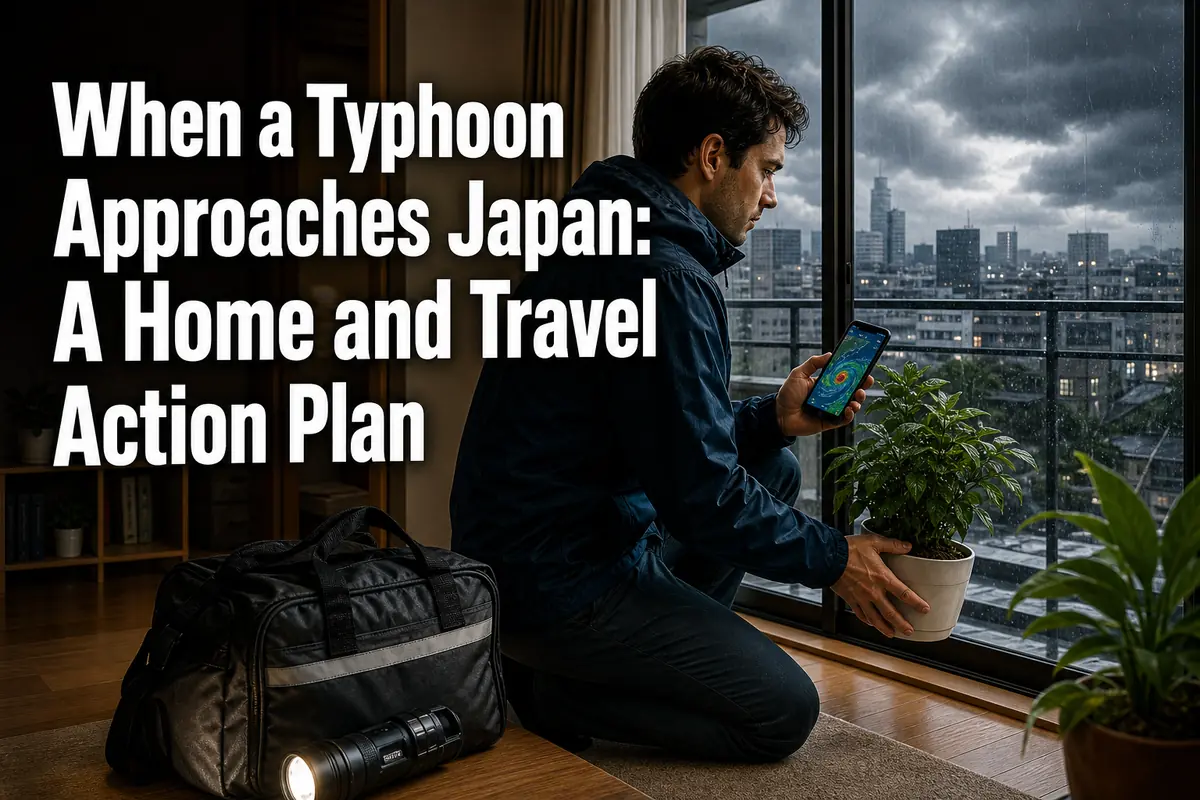
When a Typhoon Approaches Japan: A Home and Travel Action Plan
When a typhoon may affect your area, prepare your home before strong wind begins and change travel plans before services stop. Check both Japan Meteorological Agency (JMA) information and notices from your municipality or transport operator. They answer different questions: JMA describes the weather risk, local authorities issue evacuation information, and operators decide whether trains, flights, buses, and ferries will run.
This guide is for foreign residents and families in Japan, especially anyone living near a river, coast, steep slope, or transport route that may close during severe weather.
Quick action plan:
- Check your address on a local flood and landslide hazard map now.
- Bring balcony items indoors and charge essential devices before conditions worsen.
- Move or cancel nonessential trips early; do not rely on the last scheduled train or flight.
- If your municipality issues an evacuation instruction for your area, act before roads become dangerous.
Information in this guide was checked against official sources available on August 1, 2026. Conditions and local instructions can change quickly during an active storm.
Start with your address, not the typhoon’s name
Your home’s flood, landslide, and storm-surge risk matters more than the storm’s national headline. A typhoon can affect places far from its center through heavy rain, swollen rivers, high waves, and strong wind.
Use the MLIT Disaster Prevention Portal to reach hazard-map information, then check your municipality’s own map. Search for your exact address and identify:
- Expected flood depth, if shown
- Landslide warning zones near slopes or cliffs
- Storm-surge or coastal flood zones
- Designated emergency evacuation sites
- A route that does not cross a river, low underpass, or steep slope
A hazard map is a planning tool, not a live prediction. During a storm, combine it with current JMA warnings, risk maps, river information, and municipal notices.
Decide where you would go
“Evacuation” in Japan does not always mean entering a public shelter. Depending on your risk and local guidance, a safer destination may be:
- A designated emergency evacuation site
- A relative’s or friend’s home outside the risk area
- A hotel in a safer location
- An upper floor of a structurally suitable building, when local guidance says indoor safety is appropriate
Do not assume that the nearest school is open for every emergency. Municipalities decide which facilities open, and capacity can change. Check the current shelter list before leaving.
Read Japan’s warnings in the right order
Weather warnings describe danger, while municipal alert levels tell residents when to take evacuation action. Checking only one source can leave out an important part of the decision.
JMA information
The Japan Meteorological Agency provides typhoon forecasts for up to five days and issues Advisories, Warnings, and Emergency Warnings. Its English pages show whether these are active in a particular area.
During an approaching storm, check:
- Tropical Cyclone Information for the projected track and intensity
- Weather Warnings and Advisories for your area
- Real-time Risk Maps for flooding and landslides
- Precipitation forecasts and nowcasts
- Local weather information, which may contain more detail in Japanese
Forecasts are updated as the storm develops. A track shown several days in advance is not a fixed route, so make decisions using the latest update rather than a screenshot saved earlier.
Municipal alert levels
Municipalities issue evacuation information for specified districts. Under the current five-level system:
- Level 1: Increase your awareness and monitor information.
- Level 2: Review your hazard map, destination, route, and timing.
- Level 3 — Evacuation of the Elderly, etc.: People who need extra time should evacuate. This can include older adults, people with disabilities, families with small children, and anyone who cannot travel quickly. Other residents should prepare to leave.
- Level 4 — Evacuation Instruction: Everyone in the affected risk area should evacuate.
- Level 5 — Emergency Safety Measures: Danger to life is already extreme. Take the safest action still available; going outside may be more dangerous than moving upstairs or away from a cliff.
ここがポイント: Do not wait for Level 5. If your address is in the affected risk area, complete evacuation by Level 4—and earlier if anyone in your household needs more time.
A Level 4 instruction does not mean every person in the entire city must leave. It applies to the areas identified by the municipality. Conversely, you may need to act before a municipal instruction if water is already rising or your route is becoming unsafe.
Prepare your home before the wind arrives
The safest time to secure a home is while trains are still running and going outdoors is still safe. Once strong wind or intense rain starts, do not go onto a balcony or roof to make last-minute repairs.
Outside and around the building
Bring loose items indoors. Common examples include:
- Laundry poles and hangers
- Plant pots and gardening tools
- Bicycles or covers that can blow away
- Outdoor storage boxes
- Trash containers and cleaning equipment
Close windows, shutters, and storm doors if your home has them. Clear accessible balcony drains only while conditions are calm. Never climb onto a roof, lean outside a high window, or attempt structural repairs during the storm.
Apartment residents should follow building-management instructions. Do not block shared corridors, emergency stairs, or fire doors when moving outdoor items inside.
Inside the home
Move important items away from windows and low floors when flooding is possible. Keep curtains closed, but do not depend on tape or curtains to make glass safe.
Prepare for a power or water interruption:
- Charge phones, rechargeable lights, and power banks.
- Put flashlights where everyone can find them.
- Prepare drinking water, food that requires little preparation, regular medicines, and basic hygiene supplies.
- Keep cash, identification, residence cards, health information, and insurance details together in a waterproof pouch.
- Download or print essential phone numbers, maps, and booking details.
- Fill necessary water containers before service is interrupted, while following local advice.
Households with infants, older adults, pets, or medical equipment need a longer lead time. Confirm whether a public shelter accepts pets and whether it can support specific medical or accessibility needs. Requirements vary by municipality and facility.
If you rent your home
Contact the landlord or property manager about damaged shutters, leaking windows, blocked building drains, or shared-area hazards before the storm arrives. Photograph the condition safely if damage occurs, but do not put yourself at risk to document it.
Tenants should not make permanent exterior changes without checking the lease and obtaining any required permission. For insurance questions, ask the insurer what records it needs and what the policy covers; coverage is not automatic for every type of water or wind damage.
Change travel plans before cancellations trap you
A service shown as running now may still be suspended later, and the final decision belongs to each operator. Railways, airlines, ferry companies, and highway-bus operators assess different routes and hazards, so one service operating does not prove that another is safe.
Use a decision deadline
Set a personal deadline several hours before your planned departure. Move or cancel the trip if:
- The operator announces a planned suspension or warns of major disruption.
- Your destination, transfer station, or route is under a severe warning.
- The return journey may fall within the period of strongest wind or rain.
- You would depend on a last connection, mountain road, ferry, or airport access train.
- Your home is in a risk area and may require preparation or evacuation.
Leaving early can be safer than waiting for a formal cancellation. It can also reduce the chance of being stranded after an outbound service runs but the return service stops.
Check the operator, not only a route-planning app
Route apps are useful, but they may not show the full reason, expected duration, or ticket handling. Check the official pages or apps for every part of the journey:
- Local railway and Shinkansen operator
- Airline and departure airport
- Ferry or highway-bus company
- Hotel or package-tour provider
- Local roads and airport access services
A ticket and a travel package can have different change or refund conditions. For example, JR Central Tours tells customers affected by severe weather to check both train operations and their EX account because handling depends on the booked product. Contact the actual seller before cancelling on your own if the refund conditions are unclear.
If you are already away from home
Do not rush through dangerous weather simply to reach the original destination. Ask your hotel whether you can extend your stay, locate a safe indoor place, and keep enough battery power to receive alerts.
The Japan Tourism Agency’s disaster-information page lists multilingual tools for foreign visitors and residents. Its supervised Safety tips app provides push notifications for selected emergency information in 15 languages. The Japan Visitor Hotline also offers 24-hour assistance in English, Chinese, Korean, and Japanese at 050-3816-2787.
Know when staying home is not the safe option
Sheltering at home is reasonable only when the building and location are safe for the expected hazards. A sturdy apartment away from mapped flood and landslide zones may be safer than walking through severe weather, but a ground-floor home in a deep flood zone requires a different plan.
Leave early when:
- Your municipality instructs your district to evacuate.
- The hazard map shows serious flooding, storm surge, or landslide exposure.
- A household member needs more time or assistance.
- The safe route could close before the worst weather arrives.
- Building management or emergency personnel direct residents to leave.
If outdoor evacuation has already become dangerous, move to the safest available part of a suitable building and continue following official instructions. For flood risk, that may mean a higher floor. For landslide risk, it may mean a room on the side away from the slope. This is an emergency fallback, not a substitute for leaving early.
Regional differences that change the plan
Japan has a national warning framework, but practical action is local. Typhoon risk and available services differ sharply by location.
- Coastal areas: Watch storm-surge and high-wave information as well as rainfall. Stay away from beaches, breakwaters, and river mouths.
- River basins and low ground: Check flood depth and nearby river information. Underpasses may become unusable before the wider area floods.
- Mountain and hillside communities: Landslides can block roads and railways, leaving limited routes out.
- Small islands: Flights and ferries may stop well before the closest approach, and supplies may not resume immediately.
- Large cities: Underground spaces and crowded transport hubs create different risks. A train may stop far from home even when your own neighborhood is not under evacuation instructions.
Your municipality may use disaster emails, an app, outdoor speakers, television, or social-media accounts. Register in advance where possible. Outdoor announcements can be difficult to hear during wind and rain, so do not depend on speakers alone.
Common mistakes—and the safer alternative
Most avoidable problems begin with waiting too long or checking the wrong source. Replace these habits before the next storm:
-
Mistake: Watching only the typhoon center.
Safer approach: Check local rain, flood, landslide, storm-surge, and wind information. -
Mistake: Waiting for Level 5.
Safer approach: Leave by Level 4, or at Level 3 if someone needs extra time. -
Mistake: Assuming every shelter opens automatically.
Safer approach: Confirm the municipality’s current shelter announcement and capacity information. -
Mistake: Going outside to secure an object after strong wind begins.
Safer approach: Finish outdoor work early and stay inside once conditions deteriorate. -
Mistake: Trusting a single transport app.
Safer approach: Check each operator and the company that sold the ticket or package. -
Mistake: Taking a car onto a flooded road.
Safer approach: Avoid driving through water and evacuate before roads become unsafe. -
Mistake: Treating a quieter period as the end of the storm.
Safer approach: Continue monitoring official information until warnings and local restrictions are lifted.
A practical timeline
Divide the work into early preparation, final checks, and shelter or evacuation. This keeps important tasks from piling up when the weather is already dangerous.
Several days before a possible impact
- Follow JMA’s forecast, while remembering that the path can change.
- Check the hazard map for home, school, workplace, and planned destination.
- Identify two possible safe places and routes.
- Refill medicines and essential household supplies.
- Review transport, hotel, and ticket-change conditions.
- Agree on a family contact method and meeting plan.
About one day before, or earlier if advised locally
- Bring loose outdoor items inside.
- Charge devices and prepare lights.
- Pack identification, medicine, water, food, clothing, and hygiene items.
- Move vehicles and valuables from flood-prone locations if it is still safe and permitted.
- Change nonessential travel plans.
- Confirm which shelters are open.
When warnings intensify
- Follow municipal instructions for your specific district.
- Help children, older relatives, and anyone needing assistance act early.
- Stop outdoor preparation.
- Avoid rivers, coasts, slopes, underpasses, and unnecessary driving.
- Keep monitoring official information even if conditions temporarily seem calmer.
What to check next
A useful typhoon plan is not “stay home and wait.” It is a set of decisions made early:
- Is this address exposed to flood, landslide, or storm-surge risk?
- Where can every household member go safely?
- At what alert or time will you leave?
- Which operator controls each part of a planned journey?
- Can you complete home preparation without going outside after the wind starts?
Save the official links below, register for local alerts, and check the hazard map before a storm appears. When a typhoon is already close, the most valuable resource is often the time you preserved by preparing earlier.
参照リンク
- Japan Meteorological Agency — Forecast Services
- Japan Meteorological Agency — Real-time Risk Map
- Cabinet Office — Evacuation Information Guidelines and Alert Levels
- MLIT Disaster Prevention Portal — Hazard Maps and Conceivable Damage
- Japan Tourism Agency — Disaster Tools for Foreign Visitors
- JNTO — Japan Safe Travel Information
- JR Central Tours — Guidance for Delays and Suspensions