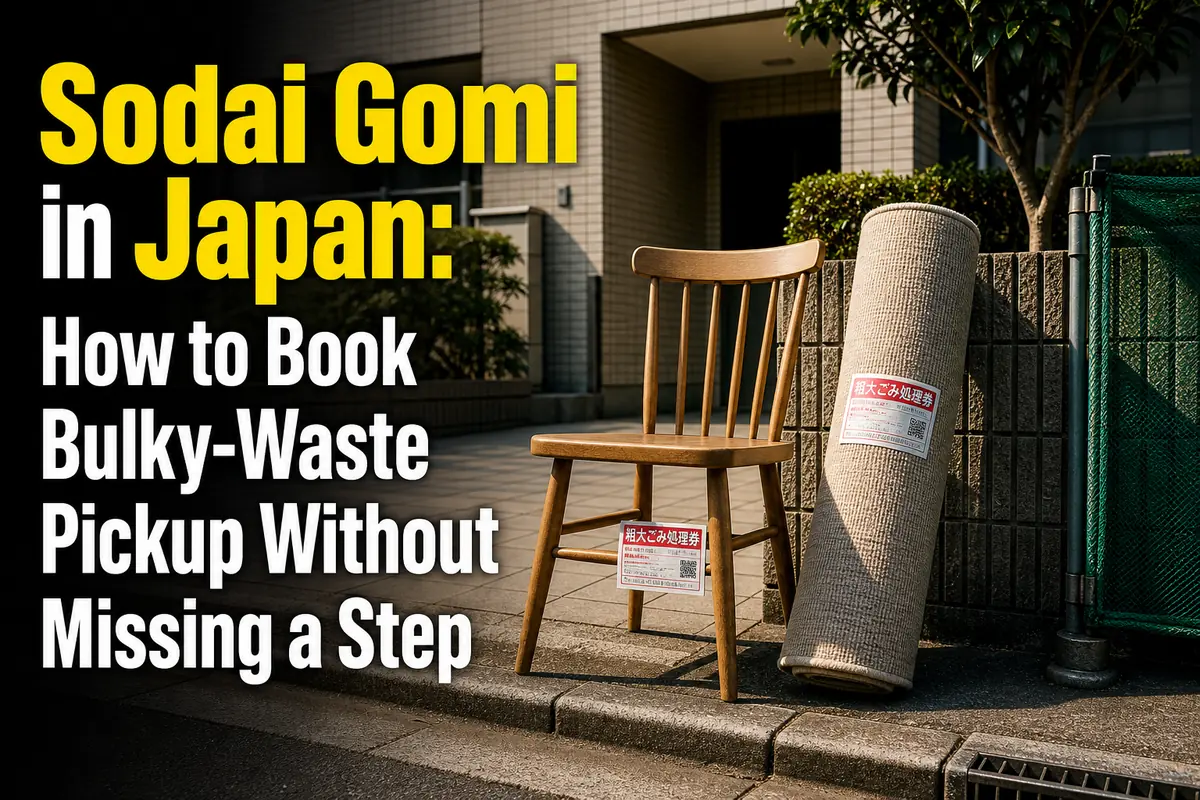
Sodai Gomi in Japan: How to Book Bulky-Waste Pickup Without Missing a Step
In Japan, you usually cannot leave large furniture or other bulky household items at the regular garbage station. You must first check your municipality’s definition of sodai gomi (oversized or bulky waste), reserve collection, pay the stated fee, and place the item at the assigned location on the collection day.
The exact size limit, price, payment method, and collection time depend on the city or ward. Check the rules for the municipality where the item is located—not the rules for a neighboring area or your previous address.
Quick checklist:
- Measure the item and identify its material.
- Confirm that your municipality accepts it as sodai gomi.
- Apply online or through another official booking channel.
- Record the collection date, fee,受付番号 (reception number), and drop-off location.
- Pay exactly as instructed.
- Attach the required sticker or payment information to each item.
- Put everything outside by the stated deadline.
This guide is for foreign residents and families disposing of furniture, bedding, bicycles, and similar household belongings, especially before moving out of an apartment.
First, Check Whether the Item Is Really Sodai Gomi
Size alone does not produce the same answer everywhere in Japan. Municipal governments run household waste collection, so they set their own definitions and procedures.
For example:
- Yokohama classifies a household item as oversized garbage when its longest side is at least 30 cm if it is metal, or at least 50 cm if it is made from another material such as wood or plastic.
- Osaka City generally treats household waste as bulky when its longest side or diameter exceeds 30 cm, or when a rod-shaped item exceeds 1 meter.
- Setagaya City’s English guide describes large-sized garbage as items measuring more than 30 cm on any side.
These differences matter. A small shelf might qualify in one municipality but remain ordinary waste in another.
Before booking, search your city or ward website for:
粗大ごみ— sodai gomi or oversized garbage粗大ごみ 申し込み— oversized-garbage application粗大ごみ 手数料— oversized-garbage feeごみ 分別— garbage sorting
Include your municipality’s name in the search. If the official item list is only in Japanese, use the measurements and materials you recorded when contacting the reception center.
Information to prepare
Have the following ready before opening the booking form or making a call:
- Your address, including the apartment or building name
- A phone number or email address
- The item name and quantity
- The item’s width, depth, and height
- Its main material, such as metal, wood, or plastic
- Whether it can be dismantled
- Your preferred collection date, if the system offers a choice
- Details about the collection point used by your building
Measure first. Charges and acceptance categories can change according to size, and a booking made under the wrong item description may not match what collection staff find outside.
Items That Need a Different Disposal Route
Do not assume every large object belongs in the municipal sodai-gomi system. Some products are excluded by national recycling rules or by local collection limits.
Four regulated appliance groups
Under Japan’s Home Appliance Recycling Law, the regular municipal bulky-waste route generally does not cover:
- Air conditioners
- Televisions
- Refrigerators and freezers
- Washing machines and clothes dryers
Consumers pay recycling costs, while retailers collect covered products and manufacturers recycle them. Ask the store supplying a replacement, the original retailer, or your municipality about the correct route.
This distinction prevents a common mistake: paying for an ordinary sodai-gomi sticker and attaching it to an appliance that the city cannot collect.
Other common exclusions
Rules vary, but municipal services may also exclude or separately handle:
- Household computers
- Motorcycles and certain vehicle parts
- Fire extinguishers
- Gas cylinders, fuel, paint, and chemicals
- Pianos, heavy safes, and other difficult-to-process objects
- Construction materials
- Commercial waste from an office, shop, or short-term rental business
Yokohama, for example, directs residents to separate routes for several difficult items and does not collect televisions, air conditioners, refrigerators, washing machines, clothes dryers, or personal computers as municipal oversized garbage.
ここがポイント: Confirm the disposal category before paying. A sodai-gomi sticker is not a universal disposal ticket, and an incorrect sticker does not make an excluded item eligible for collection.
How to Book Sodai Gomi Step by Step
The safest order is classify, book, pay, label, and then put the item outside. Do not reverse these steps.
Step 1: Find the official reception channel
Many municipalities accept online applications. Depending on the area, alternatives may include phone, chatbot, fax, or postcard.
Use a link from the municipality’s official website rather than an advertisement or an unsolicited collection-company page. The official page should explain:
- Accepted items
- Available collection dates
- The exact fee
- Payment options
- Where and when to leave the item
- What must be written on the sticker or label
Online forms may only list common items. Yokohama tells residents to call its reception center when an item is not available in the online list. Do not select a vaguely similar object simply to complete the form.
Step 2: Enter each item accurately
Book every object separately unless the municipality explicitly treats a set as one unit. A bed frame and mattress, for example, may be separate chargeable items.
Use the official item category and enter the correct dimensions. If you dismantle furniture, confirm whether the municipality still counts the parts as one item. Cutting or dismantling something does not automatically turn it into ordinary garbage.
Step 3: Save the booking result
Before closing the confirmation screen, record:
- Collection date
- Collection location
- Fee for each item
- Total fee
- Reception or confirmation number
- Instructions for labeling cashless payments
- Cancellation or amendment procedure
Take a screenshot or save the confirmation email. You may need the number when writing a label or asking about a missed collection.
Step 4: Pay by the approved method
Municipalities commonly use paid disposal stickers, often called 粗大ごみ処理券 or 有料粗大ごみ処理券. Participating convenience stores, supermarkets, or other designated outlets may sell them. Some online systems also support cashless payment.
Buy the sticker only after the booking system confirms the amount. Sticker designs and values are local; a ticket issued by one city or ward should not be assumed valid in another.
As one current example, Osaka City uses four fee levels—¥200, ¥400, ¥700, and ¥1,000 per item—and allows cashless payment for online applications. That is an Osaka City example, not a nationwide price list. Your fee may differ even for the same type of furniture.
Keep any receipt until collection is complete. Yokohama specifically advises residents to retain the receipt and warns that damaged or lost stickers are not reissued.
Step 5: Label every item
If you bought a physical ticket, fill in the information requested by the municipality and attach it where collection staff can see it easily.
If you paid online, follow the local instructions. You may need to write the reception number and collection date on paper and attach that paper securely instead of using a purchased sticker.
Do not expose more personal information than the official instructions require. Some municipalities permit initials or a reception code in place of a full name; confirm this during the application.
Step 6: Put the item at the assigned location on time
Collection crews normally take items from an outdoor collection point. They generally do not enter your home as part of standard pickup.
The booking result should identify the correct place, which may be:
- In front of your house
- Beside the building entrance
- At a designated point within the property
- At another location arranged with the municipality
Check with your landlord or building manager when the location is unclear. Do not block sidewalks, emergency routes, doors, bicycle parking, or vehicle access.
Deadlines differ. Yokohama requires items to be placed at the designated location by 8:00 a.m. Osaka City’s English guidance says by 8:30 a.m. Follow the time on your own confirmation, not a general rule found elsewhere.
How Long Booking and Collection Can Take
Book early when you have a fixed moving date. Same-day municipal pickup should not be expected.
Yokohama advises that collection takes around two weeks from application. Other municipalities may have different waiting periods, and available dates can become limited during busy moving seasons.
A practical schedule is:
- List unwanted items several weeks before moving.
- Decide what can be sold, donated, or reused.
- Measure and classify the remaining items.
- Book municipal collection before cancelling utilities or returning keys.
- Leave time to correct a rejected online category or unavailable date.
If the only collection date is after your lease ends, contact the municipality, landlord, or property manager immediately. Do not leave the item in a garbage room, hallway, or outside the building without permission.
Pickup, Self-Delivery, and Reuse Are Different Options
Municipal collection is convenient, but it is not always the only route. Your location, deadline, ability to carry the item, and the item’s condition affect the best choice.
Municipal pickup
This is the usual choice when you can carry the item to the assigned point and wait for the available date. The fee is confirmed during booking.
Direct delivery to a facility
Some municipalities let residents take bulky waste to a designated facility, usually with advance arrangements and proof of residency. Do not drive to a waste facility without checking its rules.
Yokohama normally requires advance application for its drop-off yards and charges the same fee as collection. Its Sakae Stockyard also has a specific no-prior-application option that requires proof of Yokohama residence and electronic payment; cash is not accepted for that option.
Osaka City uses a different system: residents bringing waste to the assigned processing facility must make a telephone reservation, and the published disposal charge is ¥90 per 10 kilograms as of June 2026.
These examples show why “self-delivery is cheaper” is not a universal rule. Check the assigned facility, vehicle rules, payment method, and unloading requirements first.
Reuse or resale
A usable desk, chair, shelf, or bicycle may be suitable for a reuse shop, municipal reuse program, or person-to-person transfer. Arrange this before the final day of your tenancy; acceptance and pickup are never guaranteed.
Be careful with informal pickup offers. Confirm the total charge, the operator’s identity, and where the item will go. An advertised “free” collection can involve later charges or unclear disposal practices.
Special Situations to Check
Standard curbside pickup assumes that the resident can move the item outside. If that is not possible, ask about assistance before booking an ordinary slot.
You cannot carry the item out
Some municipalities provide limited carry-out assistance for eligible older residents, people with disabilities, or people requiring long-term care. This is not a general moving service and may require an assessment or separate application.
Yokohama, for example, describes an in-home removal service for certain eligible residents who live alone and cannot take oversized waste outside themselves. Eligibility and availability are local, so contact the responsible waste office early.
You live in company or student housing
The municipality’s classification still matters, but the building may control where and when items can be staged. Ask the dormitory manager, employer, school, landlord, or management company about:
- The approved collection point
- Elevator or protective-flooring arrangements
- Hours for moving large objects through common areas
- Whether advance notice is required
Building permission does not replace the municipal booking.
You are disposing of many items
A normal online reservation may limit quantities. A large move-out load may require multiple bookings, direct delivery, or another approved service.
Start with the municipal waste office. If you use a private collector, check that the operator is legally authorized for the type of household waste involved. A moving company’s ability to transport furniture does not automatically mean it can dispose of household waste.
Severe weather affects collection
Rain alone may not cancel service—Yokohama states that oversized garbage is collected on rainy days—but dangerous conditions can change operations. Osaka City, for example, publishes separate procedures for suspending waste collection during severe typhoon conditions.
Check the municipality’s current notices when a typhoon, heavy snow, flood warning, or other disruption is expected.
Common Mistakes and How to Avoid Them
Most failed collections result from a mismatch between the reservation and the object outside. A two-minute check the night before can prevent another booking and another wait.
Avoid these mistakes:
- Putting the item out without booking: Regular garbage crews do not treat an unregistered object as paid bulky waste.
- Using another municipality’s sticker: Tickets and payment systems are local.
- Buying the wrong fee value: Pay the amount assigned to the exact item and size.
- Booking one item but leaving several: Each object or set must match the reservation.
- Choosing the wrong online category: Call or use the official inquiry channel if the item is missing.
- Leaving an excluded product: Regulated appliances and difficult materials need another route.
- Missing information on the label: Write the required number, date, or name exactly as instructed.
- Using the wrong collection point: Confirm the location with building management when necessary.
- Putting it out late: The crew may arrive soon after the stated morning deadline.
- Waiting until move-out day: Available collection dates may be weeks away.
Also remove fuel, batteries, or other detachable hazardous components when the municipality instructs you to do so. Yokohama specifically tells residents to remove kerosene and batteries from items such as heaters and gas ranges because collection-truck fires have occurred.
Current Status as of August 2026
Digital booking and cashless payment are expanding, but Japan still has no single national sodai-gomi system. Local instructions remain decisive.
Recent official information illustrates the variation:
- Yokohama’s Japanese guide, updated in June 2026, covers both collection stickers and electronic payment.
- Osaka City’s June 2026 instructions accept applications through the internet, chatbot, phone, fax, or postcard; online applicants can use cashless payment.
- English-language support and online item lists vary by municipality. A phone inquiry may still be necessary for an unlisted object.
The practical result is simple: check the official page again even if you have used sodai gomi before. Payment methods, reception links, fee lists, and collection arrangements can change.
FAQ
Can I leave a sofa at the regular garbage station?
Usually not. Check whether its size and material place it in your municipality’s sodai-gomi category, then book and pay before putting it outside.
Can I buy the sticker before making a reservation?
Do not do so unless your municipality explicitly instructs you to. The booking determines the correct item category and fee.
Does dismantling furniture make it ordinary garbage?
Not necessarily. Municipalities may still classify the dismantled parts as oversized waste or count them under specific bundling rules. Confirm before cutting anything.
Will collection staff carry an item down from my apartment?
Standard pickup usually requires you to move it to the assigned outdoor point. Ask your municipality about restricted assistance programs if disability, age, or care needs make that impossible.
Can a landlord dispose of it after I move out?
Only if this has been clearly arranged. Leaving property behind can lead to disposal charges or other problems under your lease. Complete the booking before returning the keys whenever possible.
Is the sodai-gomi fee the same across Japan?
No. Definitions, prices, ticket values, payment methods, and deadlines are set locally. Osaka City’s ¥200–¥1,000 fee bands, for example, should not be applied to another municipality.
Final Checklist Before Collection Morning
Match the physical item to the booking one last time. Confirm:
- The municipality accepts the item.
- The description, measurements, and quantity are correct.
- Payment is complete.
- The sticker or cashless-payment label is visible and secure.
- The reception number and collection date are written correctly.
- Prohibited contents, fuel, and removable batteries have been handled as directed.
- The item is at the exact approved point before the deadline.
- It does not obstruct residents, pedestrians, or emergency access.
If any detail does not match, contact the official reception center before putting the item outside. The most important next step is not buying a sticker—it is finding your municipality’s current item list and booking instructions while you still have time to choose an available date.
参照リンク
- City of Yokohama: Oversized Garbage
- City of Yokohama: Garbage the City Does Not Collect and Recycling
- City of Yokohama: Oversized Garbage Guide, updated June 2026 (Japanese)
- City of Osaka: Bulky-Waste Collection, updated June 2026 (Japanese)
- City of Osaka: Bulky-Waste Fee List (Japanese)
- City of Osaka: Taking Waste Directly to a Processing Facility (Japanese)
- City of Osaka: For Comfortable Living—Bulky Waste
- City of Osaka: Waste Collection During Typhoons and Severe Winds (Japanese)
- Setagaya City: How to Separate and Dispose of Recyclables and Waste (English PDF)
- Ministry of Economy, Trade and Industry: Home Appliance Recycling Law