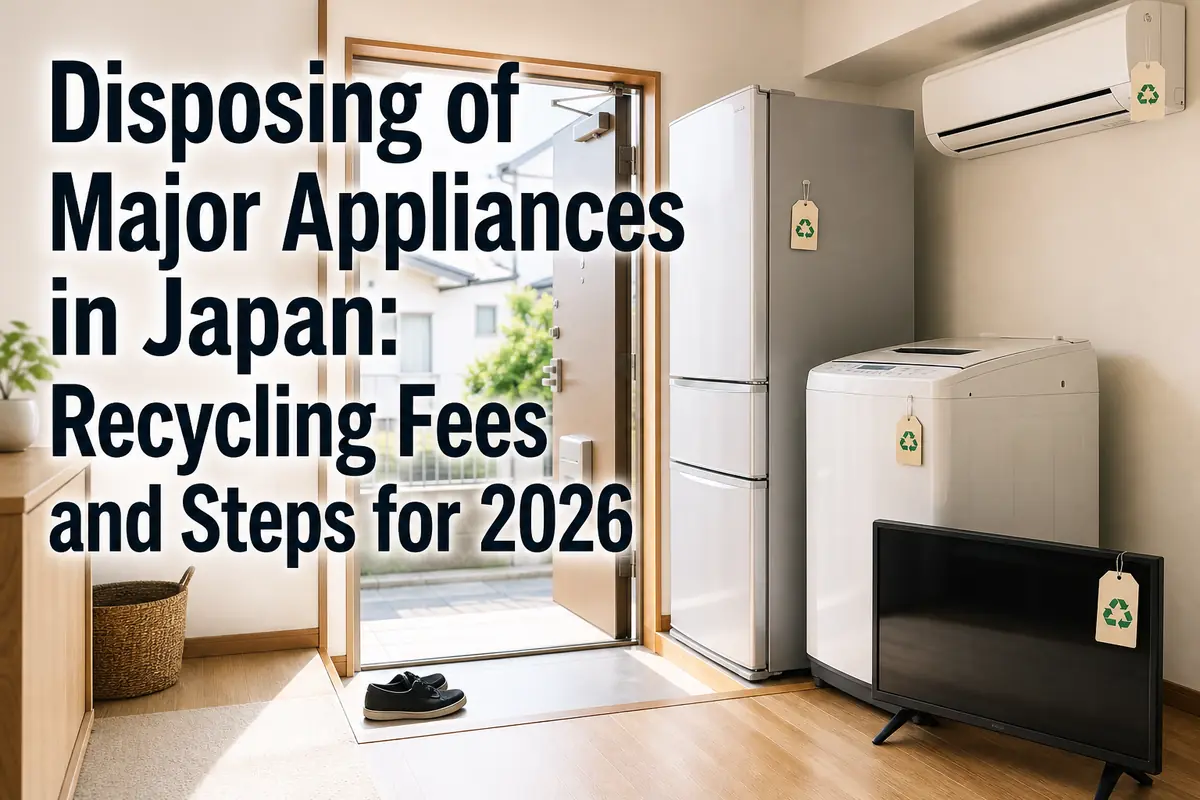
Disposing of a TV, Fridge, Air Conditioner, or Washer in Japan: Fees and Steps for 2026
You usually cannot leave a television, refrigerator, freezer, air conditioner, washing machine, or clothes dryer at the local oversized-waste collection point in Japan. These appliances follow a national recycling system, and the person disposing of one normally pays both a recycling fee and a collection or transport fee.
For most foreign residents, the simplest option is to ask the store delivering a replacement appliance to take the old one away. If you are not buying a replacement, contact the original retailer or follow your municipality’s instructions.
What you need to know first
- The system covers four groups: air conditioners, televisions, refrigerators/freezers, and washing machines/clothes dryers.
- Recycling fees depend on the manufacturer, appliance type, and sometimes size.
- A retailer or collector may add a separate transport fee. Removal work can cost extra.
- Ordinary bulky-waste stickers do not replace the required appliance recycling process.
- OLED televisions have been included in the system since April 1, 2024.
This guide is for tenants, homeowners, students, workers, and families disposing of household appliances in Japan. It is especially useful before a move, a replacement purchase, or the end of a rental contract.
Which appliances are covered?
The law covers four appliance groups, not every electrical product in your home. Japan calls them the kaden yon hinmoku (家電4品目), meaning the four designated home-appliance categories.
They are:
- Air conditioners: household wall-mounted and certain other domestic units, generally including the indoor and outdoor units
- Televisions: CRT, LCD, plasma, and OLED televisions
- Refrigerators and freezers: including many household wine coolers and similar cooling appliances when classified within the covered category
- Washing machines and clothes dryers: including household tumble dryers
The equipment must be a type intended for household use. A commercial refrigerator, commercial air conditioner, or coin-laundry machine may look similar but can fall outside this system.
Items that use different disposal routes
Microwave ovens, rice cookers, vacuum cleaners, electric fans, printers, and many other electrical products are not part of the four-category scheme. Municipalities may collect them as non-burnable waste, oversized waste, or small electronics.
Computers also have a separate manufacturer-led recycling system, although some municipalities offer collection under the Small Home Appliance Recycling Act. Ask your municipality before buying a bulky-waste sticker or taking an item to a collection box.
How much does appliance recycling cost in 2026?
Your total is normally the recycling fee plus transport, with removal work added when necessary. There is no single nationwide total price because manufacturers set recycling fees and retailers set their own collection and transport charges.
The Home Appliance Recycling Ticket Center’s April 2026 fee list shows the following common fees for many major manufacturers. These are useful planning figures, not universal prices.
- Air conditioner: commonly ¥990
- CRT television: commonly ¥1,320 for 15-inch or smaller; ¥2,420 for 16-inch or larger
- LCD, OLED, or plasma television: commonly ¥1,870 for 15V-inch or smaller; ¥2,970 for 16V-inch or larger
- Refrigerator or freezer: commonly ¥3,740 for 170 liters or less; ¥4,730 for 171 liters or more
- Washing machine or clothes dryer: commonly ¥2,530
Some manufacturers and designated organizations charge different amounts. The official list includes, for example, fees above or below these common figures for certain brands and categories. Confirm the maker’s name and the appliance size before calculating the cost.
Charges that the recycling fee does not cover
The amount above does not necessarily include:
- collection from your home;
- transport to a designated intake site;
- disconnecting or removing an air conditioner;
- carrying a heavy appliance down stairs;
- work requiring special access, parking, or additional staff; or
- delivery and installation of a replacement.
Ask for an itemized quote. A low advertised recycling fee can be only one part of the final bill.
ここがポイント: The recycling fee is linked to the appliance and manufacturer. The collection fee is linked to the retailer, collector, distance, and work required. Always confirm both.
Choose the correct disposal route
The right route depends mainly on whether you are replacing the appliance and whether you know where it was purchased. Start with the first option that matches your situation.
Option 1: Ask the store delivering a replacement
When buying a new appliance of the same category, ask the new retailer to collect the old one. Retailers have a take-back duty when they sell a replacement covered appliance, subject to the law’s conditions.
Before ordering, tell the store:
- the type and approximate size of the old appliance;
- its manufacturer;
- your floor number and whether there is an elevator;
- whether an air conditioner must be disconnected;
- whether the collection and delivery addresses are different; and
- whether you need collection on a specific moving date.
This is usually the easiest route because delivery and collection can be arranged together. Online retailers may have their own booking rules, service areas, and deadlines, so do not assume collection is automatically included at checkout.
Option 2: Contact the retailer that sold the appliance
If you are disposing of an appliance without buying a new one, contact the store that originally sold it. A retailer generally has a take-back duty for covered appliances it previously sold.
A receipt helps, but first ask the store what information it needs. If the store has closed, you bought the appliance from another resident, or you cannot identify the seller, move to the municipal route.
Option 3: Follow your municipality’s instructions
When no retailer has a take-back obligation, check the waste and recycling page for your city, ward, town, or village. The national system is the same, but local collection arrangements differ.
A municipality may:
- name retailers that accept old appliances;
- provide details for licensed collection companies;
- arrange collection through a local service;
- direct residents to a designated intake site; or
- explain how to buy and use a recycling ticket.
Tokyo’s wards, Yokohama, Osaka, and smaller municipalities do not necessarily use identical booking systems or fees. Search the official municipal website for “家電リサイクル” together with your city or ward name. If the information is only in Japanese, ask the municipal waste office or an international residents’ desk for help.
Option 4: Pay at a post office and deliver it yourself
If you can safely transport the appliance, you may be able to take it to a manufacturer-designated intake site. This can avoid a retailer’s collection charge, but it does not remove the recycling fee or the practical difficulty of moving the item.
The usual process is:
- Identify the appliance category.
- Check the manufacturer shown on the product label.
- Confirm the size category: television screen size or refrigerator/freezer capacity, where applicable.
- Check the current recycling fee and manufacturer code.
- Complete a Home Appliance Recycling Ticket at a post office and pay the fee using the postal-transfer procedure.
- Attach and retain the required parts of the ticket as instructed.
- Check the intake site’s location, opening days, reception hours, and temporary closures.
- Take the appliance and completed documents to the site.
Do not guess the brand code or size. An incorrect ticket can delay acceptance and require correction. The ticket paid through the post-office method is valid from the day after payment for ten years, but that is not a reason to postpone disposal when moving out.
Self-delivery is best suited to someone with a suitable vehicle and enough help to move the appliance safely. A refrigerator or washer can cause injury or property damage if handled without proper equipment.
What to prepare before booking collection
A photo of the rating label can prevent many booking and payment errors. Prepare the details before calling a store, municipal service, or collector.
Collect the following information:
- appliance type;
- manufacturer or importer;
- model number;
- screen size for a television;
- capacity in liters for a refrigerator or freezer;
- pickup address and floor;
- elevator and parking access;
- desired collection date;
- whether disconnection or removal is required; and
- the name of the original retailer, if known.
The manufacturer label is often on the back, side, door frame, or inside the appliance. Photograph it while the appliance is still accessible.
Prepare the appliance itself
Before handover:
- empty all food, shelves, loose objects, water, and lint;
- defrost a refrigerator or freezer when the collector instructs you to do so;
- drain a washing machine according to its manual;
- do not cut refrigerant pipes or remove an air conditioner yourself unless you are qualified;
- keep accessories with the unit only when the collector requests them; and
- clear a safe path from the appliance to the exit.
For an air conditioner, removal is more than taking the indoor unit off the wall. Refrigerant must be handled correctly, and both the indoor and outdoor units may need collection. Ask whether pipes, brackets, or other installation materials are included in the quoted work.
Special cases that can change your next step
Ownership and appliance type matter more than nationality or residence status. Foreign residents use the same recycling system as other householders, but rental and moving arrangements can create extra questions.
The appliance belongs to your landlord
Do not dispose of a furnished apartment’s refrigerator, washer, television, or air conditioner without written approval. Even a broken appliance may remain the landlord’s property.
Contact the landlord or property manager and confirm:
- who owns the appliance;
- who will arrange replacement or disposal;
- who pays each fee; and
- whether the appliance must remain for the next tenant.
Removing it without permission could create a dispute at move-out.
You want to sell or give it away
A working appliance may be reused instead of discarded. However, a resale shop can refuse it because of age, condition, missing parts, energy use, transport cost, or safety concerns.
Arrange reuse early. If a buyer or shop declines the item on your final moving day, you may have too little time to book legal collection.
You are leaving Japan
Book collection before your move-out inspection. Busy periods around March and April can make preferred collection dates harder to obtain.
Do not leave an appliance in a building’s waste area, beside a collection point, or inside the apartment unless the landlord has explicitly agreed. Disposal responsibility does not disappear when you return the keys.
The appliance came from a workplace or business
The same four product categories can be subject to the Home Appliance Recycling Law when the equipment is a household-type product, but waste from a business location also raises industrial-waste transport and handling requirements. A company should use its facilities, procurement, or waste-management process rather than an employee’s household disposal route.
Common mistakes and how to avoid them
Most problems come from choosing the wrong waste route or confirming the price too late. These mistakes are avoidable.
Putting a recycling sticker for oversized waste on the appliance
Municipal oversized-waste collection generally does not accept the four designated appliance categories. Check the item before purchasing a local waste sticker.
Assuming “free collection” is automatically legitimate
The Ministry of the Environment warns residents not to hand unwanted appliances to unlicensed waste collectors. Improper operators may dump equipment illegally, mishandle refrigerants, or demand unexpected charges after loading it.
Use the retailer, a municipal route, a properly authorized collector identified through official guidance, or a designated intake site.
Checking only the recycling fee
Ask separately about collection, carrying, disconnection, removal, and other work. Get the total before confirming the booking.
Losing the recycling-ticket copy
When a retailer collects a covered appliance, you should receive a copy of the Home Appliance Recycling Ticket. Keep the inquiry management number. The official tracking system can use it to confirm whether the appliance was delivered to the manufacturer’s recycling route.
Waiting until move-out day
Collection is not an on-demand garbage service. Retailer schedules, municipal arrangements, and intake-site hours can all affect timing. Start checking options as soon as your moving date is fixed.
What changed recently?
The most important recent scope change is the addition of OLED televisions. OLED TVs entered the Home Appliance Recycling Law’s covered television category on April 1, 2024.
That means an unwanted household OLED television should now follow the recycling-ticket route rather than an ordinary municipal bulky-waste route. The current 2026 fee list groups LCD, OLED, and plasma televisions together while applying size and manufacturer classifications.
As of August 2026, the basic consumer process remains centered on retailer take-back, manufacturer recycling, the Home Appliance Recycling Ticket, and municipal guidance when no responsible retailer can be identified. Fees can change, however, and retailer collection prices are not standardized nationally. Check the current official fee search and your local instructions when you are ready to dispose of an item.
Practical decision guide
Choose the easiest compliant route before comparing small price differences. A missed moving deadline or failed pickup can cost more than the saving from a complicated disposal method.
- Buying a replacement: ask the new retailer for collection and a complete quote.
- Not replacing it, but know the seller: contact the original retailer.
- Seller unknown or unavailable: check your municipality’s official instructions.
- Able to transport it safely: compare self-delivery to a designated intake site after completing the post-office ticket procedure.
- Appliance belongs to the landlord: obtain the landlord or manager’s instructions first.
- Item is not one of the four covered groups: use the municipality’s route for small electronics, oversized waste, or another applicable program.
The key action is simple: identify the appliance and manufacturer before arranging transport. That determines the correct fee, ticket entry, and disposal route—and prevents an unwanted fridge or television from becoming a last-minute problem on moving day.
参照リンク
- METI: Act on Recycling of Specified Home Appliances
- METI: Home Appliance Recycling Law
- METI: Home Appliance Recycling System FAQ
- METI: Home Appliance Recycling Law Q&A
- METI: Addition of OLED Televisions to the Recycling System
- Ministry of the Environment: Proper Reuse and Recycling of Unwanted Appliances
- Home Appliance Recycling Ticket Center: April 2026 Recycling Fee List
- Home Appliance Recycling Ticket Center: Post-Office Payment Procedure
- Home Appliance Recycling Ticket Center: How to Complete the Ticket
- METI: Personal Computer Recycling