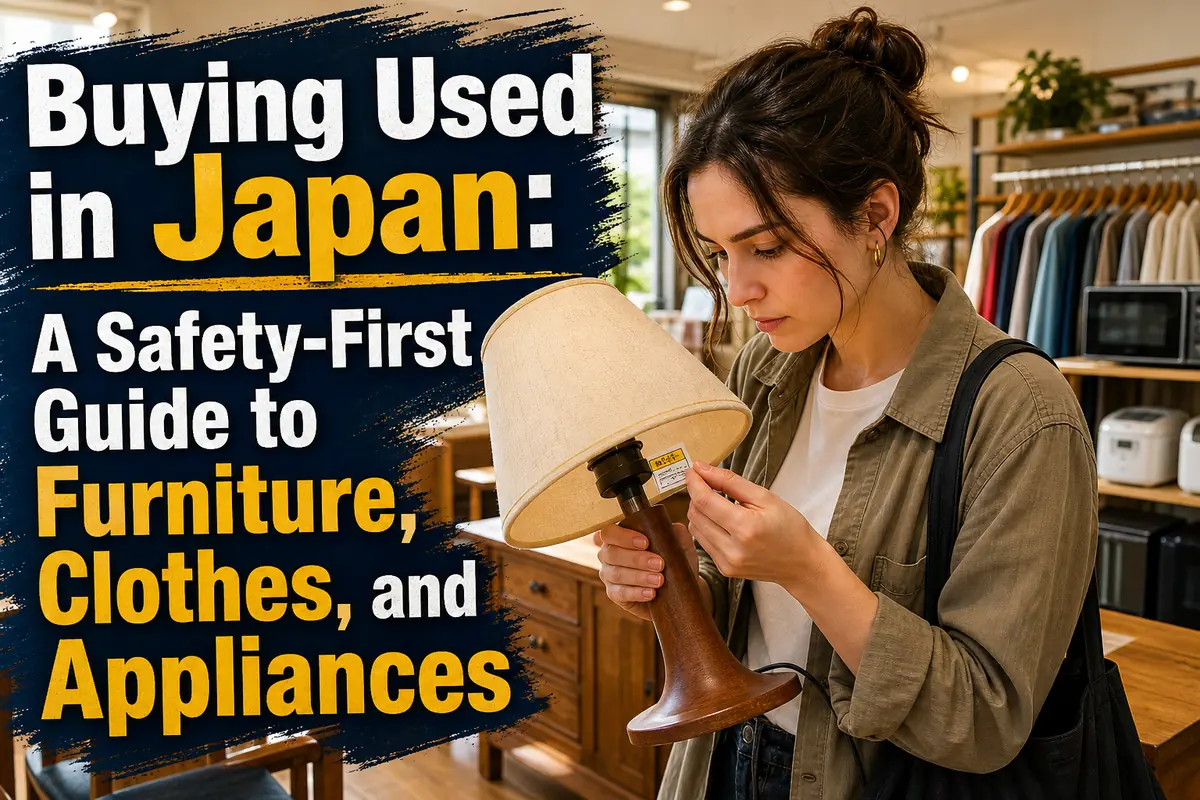
Buying Used in Japan: A Safety-First Guide to Furniture, Clothes, and Appliances
Buying secondhand can lower the cost of setting up a home in Japan, but the sticker price is only the starting point. Before paying, check the item’s condition, the store’s return policy, and—especially for furniture and appliances—the cost and method of getting it home.
For electrical products, also record the model number and manufacturing year, check for recalls, and inspect the power cord and battery. A cheap appliance is not a bargain if it is unsafe, incompatible, or expensive to deliver and discard.
This guide is for foreign residents and families furnishing a home, replacing an appliance, or buying everyday clothing in Japan.
What to check first
- Furniture: dimensions, delivery charge, assembly, stains, odors, and missing parts
- Clothes: size measurements, wear, alterations, care labels, and whether returns are allowed
- Electronics: model number, manufacturing year, recall status, accessories, voltage, frequency, battery condition, and warranty
- Every purchase: the total price, condition grade, receipt, return deadline, and excluded reasons for return
How secondhand shopping works in Japan
The basic process is simple: inspect the item, confirm the conditions of sale, pay, and arrange collection or delivery. Buying from a physical reuse store usually requires no special application or residency document.
Japan has several common types of secondhand seller:
- General reuse stores selling furniture, appliances, clothes, and household goods
- Specialist stores focused on clothing, computers, cameras, musical instruments, or luxury goods
- Charity or community shops with smaller, changing inventories
- Business-operated websites and marketplace shops
- Online flea-market applications and auctions, where individuals may sell directly to one another
The level of inspection, cleaning, warranty coverage, and customer support differs significantly. A professionally tested appliance with a short warranty should not be treated as equivalent to an untested item sold by an individual, even if the photographs look similar.
Learn the labels on the item
Useful Japanese terms include:
- 中古(chūko): used or secondhand
- リユース(reuse): reused; often used in store names and advertising
- 現状品(genjōhin): sold in its present condition, sometimes with limited testing
- ジャンク(junk): faulty, incomplete, untested, or intended for parts; do not assume it works
- 動作確認済み(dōsa kakunin-zumi): operation has been checked, although the scope of testing may be limited
- 保証(hoshō): warranty
- 返品不可(henpin fuka): no returns
- キズ・汚れあり: scratches or stains present
Ask what “tested” means. A television that powers on may not have had every input checked; a washing machine may not have completed a full wash and drain cycle.
Calculate the real cost before deciding
Compare the total cost in your home, not only the number on the tag. Large used goods often become less attractive after transport, installation, missing accessories, and future disposal are included.
Use this calculation:
Total cost = item price + delivery + stairs or special-handling fee + installation + missing parts + near-term repairs or replacement
Consumer-facing displayed prices in Japan generally include consumption tax under the total-price display rule. However, delivery and optional services may be listed separately. Confirm the final amount before payment.
Costs that are easy to miss
- Delivery outside the store’s normal area
- Extra charges for a building without an elevator
- Installation or hose connection for a washing machine
- A missing remote control, shelf, cable, adapter, or instruction manual
- Replacement batteries for a laptop, vacuum cleaner, or electric bicycle
- Cleaning costs for fabric furniture
- Disposal of the old item already in your home
Measure the complete route before ordering furniture: entrance, elevator, staircase turns, hallway, and room doorway. Also check whether legs or doors can be removed. A sofa that fits the room may still fail to pass through the building entrance.
Delivery zones and fees are operator rules, not national standards. Rural locations, remote islands, and addresses far from the shop may have fewer delivery options.
Buying used furniture without an expensive mistake
For furniture, fit and condition matter more than appearance. Inspect structural parts and confirm how the item will enter your home.
Measure before you visit
Bring these measurements on your phone:
- The available floor and wall space
- Door, hallway, staircase, and elevator dimensions
- Ceiling height where relevant
- The position of outlets, windows, vents, and curtain rails
For storage furniture, measure the item with its doors and drawers open. For a bed, confirm whether the price includes the frame, mattress, slats, and hardware.
Inspect the item closely
Check furniture from more than one angle:
- Sit on chairs and sofas to test movement or sagging
- Open every drawer and door
- Look underneath for cracks, loose joints, moisture damage, or pests
- Smell fabric surfaces for smoke, mold, or strong fragrance
- Check whether screws, shelf pins, brackets, and assembly instructions are included
- Ask whether the displayed item is the exact unit you will receive
Be more cautious with used mattresses and upholstered furniture. Cleaning methods and acceptance standards differ by seller, and some delivery or removal services exclude mattresses. If hygiene, allergies, or pest exposure are concerns, a new mattress with a used frame may be the more practical combination.
Confirm delivery in writing
Before paying, record:
- Delivery date or time window
- Total delivery and handling charge
- Whether staff carry the item into the room or only to the entrance
- Whether assembly is included
- What happens if the item cannot pass through the doorway
- Whether an existing item can be collected, and at what price
Municipal bulky-waste rules vary, so do not assume an unwanted purchase can be discarded immediately. Check your city or ward’s reservation process, fees, and collection restrictions before buying a difficult-to-move item.
How to buy secondhand clothes confidently
Use actual measurements rather than trusting the size printed on the label. Japanese sizing, imported sizing, older garments, and altered clothes may fit differently.
Check fit and condition
For clothing, inspect:
- Chest, waist, rise, inseam, sleeve, and total length
- Collar, cuffs, underarms, pockets, hems, and zipper
- Pilling, fading, stains, repairs, and missing buttons
- Fabric and care labels
- Signs that the waist, sleeves, or hem were altered
Ask whether fitting rooms are available and how many items you may take inside. If fitting is not possible, compare the garment’s measurements with clothing you already own.
For shoes, look at sole wear, heel alignment, cracks, and the interior lining. A low price does not compensate for a sole that is separating or support that has collapsed.
Wash or clean appropriately
Follow the care label rather than using the hottest wash automatically. Heat or strong cleaning products can damage wool, leather, coated fabric, or decorative parts. Items that cannot be cleaned by your preferred method may not suit a household with allergies or young children.
Brand-name goods require extra care. Check the seller’s authentication policy and return conditions. A high price, packaging, or confident description is not proof of authenticity.
Used electronics need a stricter safety check
Do not buy a used electrical product until you can identify it and check its physical condition. In February 2026, Japan’s National Institute of Technology and Evaluation, or NITE, reported 310 notified accidents involving reused products during 2020–2024; about 90% were fires. Products containing lithium-ion batteries accounted for about 30% of those accidents.
NITE’s five checks are practical for any used appliance:
- Confirm that the model is not under recall.
- Check its age, damage, and signs of malfunction.
- Inspect lithium-ion battery products especially carefully.
- Obtain the manual and confirm correct use and assembly.
- Check whether the product has been repaired or modified.
ここがポイント: A shop’s power-on test does not replace your own model-number, recall, cable, battery, and compatibility checks.
Record the model and manufacturing year
Photograph the rating label before purchase. It may show the manufacturer, model, serial number, rated voltage, power consumption, and manufacturing year.
Use the model number—not only the product name—to search the Consumer Affairs Agency recall database. If the product is recalled, do not use it until you have followed the manufacturer’s instructions.
The Consumer Affairs Agency also advises buyers of used products to check the manufacturing year and warranty. Older products may have deteriorated, and repair parts may no longer be available.
Inspect plugs, cords, adapters, and batteries
Do not buy an appliance with:
- A cut, crushed, hardened, or taped power cord
- Bent, loose, scorched, or discolored plugs
- A swollen, leaking, unusually hot, or damaged battery
- Corrosion around the battery compartment
- An unknown replacement adapter or charger
- Visible unofficial wiring or modification
- A burning smell, unusual sound, or intermittent operation
NITE has documented accidents involving modified power cords, recalled washing machines, and non-genuine laptop batteries. These examples matter because the dangerous part may not be visible during a brief store test.
Understand the PSE mark—but do not treat it as a condition report
Many regulated electrical products sold in Japan must carry a PSE mark and required supplier information. METI explains that covered products without the required PSE labeling cannot be sold or displayed for sale.
The mark concerns compliance with Japan’s product-safety framework. It does not tell you how the previous owner treated the product, whether its battery is worn, or whether every function still works. Check both the label and the actual condition.
Confirm compatibility with your home
Japan’s household supply is generally associated with 100-volt equipment, but you should rely on the rating label and manual for the specific product. Do not assume an overseas appliance or adapter is suitable merely because its plug fits.
Frequency can also matter. Eastern Japan commonly uses 50 Hz and western Japan 60 Hz. Many modern products support both, but some appliances are frequency-specific. Check the label for “50/60 Hz” or confirm the model’s manual, particularly if you may move between regions.
For smart devices, computers, and phones, also check:
- Whether an account or activation lock has been removed
- Whether the operating system still receives security updates
- Whether storage was erased correctly
- Whether network bands, SIM requirements, and accessories are compatible
- Whether the battery can still be replaced at a reasonable cost
Returns and warranties: ask before paying
Secondhand goods are often sold under stricter return conditions than new goods. Read the receipt, warranty card, shelf label, and online listing before completing the purchase.
Ask four direct questions:
- How many days do I have to report a fault?
- Is the remedy a refund, exchange, repair, or store credit?
- Are batteries, consumable parts, stains, odors, and “junk” items excluded?
- Must I return a large item to the store myself?
Keep the receipt and photograph the condition label. For an appliance, retain the model and serial-number photographs too.
Store purchase and online purchase are different
Do not assume that every purchase has a cooling-off period. Japan’s cooling-off system applies to specified transaction types and is not a general right to change your mind after ordinary shopping.
Online and mail-order sales do not have the same cooling-off system used for certain door-to-door or telephone-solicitation sales. A business seller must display its return terms. If it clearly states that returns are not accepted, that condition may control a change-of-mind return. If no return term is displayed, the Act on Specified Commercial Transactions provides a limited rule under which the buyer may cancel within eight days after receiving the goods, generally paying the return cost.
That rule concerns business-to-consumer mail order. Transactions with an individual seller can raise different issues. Check the marketplace’s buyer-protection rules, payment deadlines, inspection period, and dispute process before ordering.
A practical inspection routine
Use the same sequence every time so that a low price does not rush the decision.
Before visiting or ordering
- Measure the room and delivery route.
- Set a total budget including transport and missing parts.
- List essential functions and accessories.
- Check whether your municipality or building has special disposal or delivery constraints.
- For electronics, identify acceptable model years and repair options.
At the store
- Read every condition label.
- Inspect the item under good light.
- Test all important functions the store permits.
- Photograph the model, serial number, manufacturing year, and damage.
- Search for recalls.
- Confirm the warranty, returns, delivery, and final price.
Immediately after delivery
- Compare the item with the receipt and condition description.
- Photograph any new or undisclosed damage before extensive use.
- Read the manual and install the product correctly.
- Test it while the store’s reporting period is still open.
- Contact the seller promptly in writing if there is a problem.
Common mistakes to avoid
Most costly errors come from missing information, not from secondhand goods themselves. Watch for these traps:
- Comparing the used price with a new price but ignoring delivery and warranty differences
- Buying furniture without measuring the entrance and staircase
- Assuming “tested” means every function was examined
- Treating “junk” as a normal working product
- Buying an appliance without checking its exact model for recalls
- Ignoring a damaged cord or swollen battery because the device still turns on
- Expecting to return clothes after removing tags or washing them
- Assuming marketplace purchases have the same support as a physical store
- Discarding the receipt before the warranty or testing period ends
A polite question can prevent many of these problems. Useful phrases include:
- Kono shōhin wa dōsa kakunin-zumi desu ka? — Has this item been tested?
- Hoshō kikan wa nan-nichi desu ka? — How long is the warranty?
- Henpin dekimasu ka? — Can I return it?
- Haisōryō o fukumu gōkei wa ikura desu ka? — What is the total including delivery?
- Fuzokuhin wa subete soroっています ka? — Are all accessories included?
When language is a barrier, ask the employee to point out the return and warranty terms on the receipt rather than relying only on a spoken explanation.
If something goes wrong
Stop using an electrical product immediately if it smells burnt, overheats, sparks, smokes, makes abnormal sounds, or has a swelling battery. Unplug it only if doing so is safe, keep people away, and follow emergency guidance when there is fire or immediate danger.
For an ordinary defect or undisclosed damage:
- Photograph the problem
- Keep the item, packaging, receipt, listing, and messages
- Contact the seller promptly
- Describe the difference between the advertised condition and what you received
- Ask for the remedy stated in the seller’s policy
If you cannot resolve a consumer transaction problem, Japan’s Consumer Hotline 188 connects callers to a nearby consumer affairs consultation service. The national 188 line is primarily provided in Japanese, so ask a Japanese-speaking person for help if needed. Overseas visitors can check the Consumer Affairs Agency’s separate tourist-consultation information.
Final checklist before you pay
A secondhand purchase is ready to proceed when you can answer all of these questions:
- Does it fit the room, route, body, or intended use?
- What is the complete delivered cost?
- What damage or wear has been disclosed?
- Which functions were actually tested?
- Are all necessary parts included?
- For electronics, have you checked the model, year, recall status, cord, battery, rating label, and compatibility?
- What exactly does the warranty cover?
- When and how must a problem be reported?
- How will you eventually repair, resell, or dispose of the item?
If one of those answers is missing, pause before paying. The most useful secondhand purchase is not simply the cheapest one—it is the item whose condition, total cost, and exit plan you understand.
参照リンク
- NITE: Five checks for the safe reuse of products (Japanese)
- NITE: Risks hidden in secondhand products (Japanese)
- Consumer Affairs Agency: Starting a safe new life (Japanese)
- Consumer Affairs Agency Recall Information Site
- METI: Electrical Appliances and Materials Safety Act
- National Tax Agency: Total-price display requirement (Japanese)
- Consumer Affairs Agency: Mail-order advertising and return rules (Japanese)
- Consumer Affairs Agency: Consumer Hotline and local cooperation