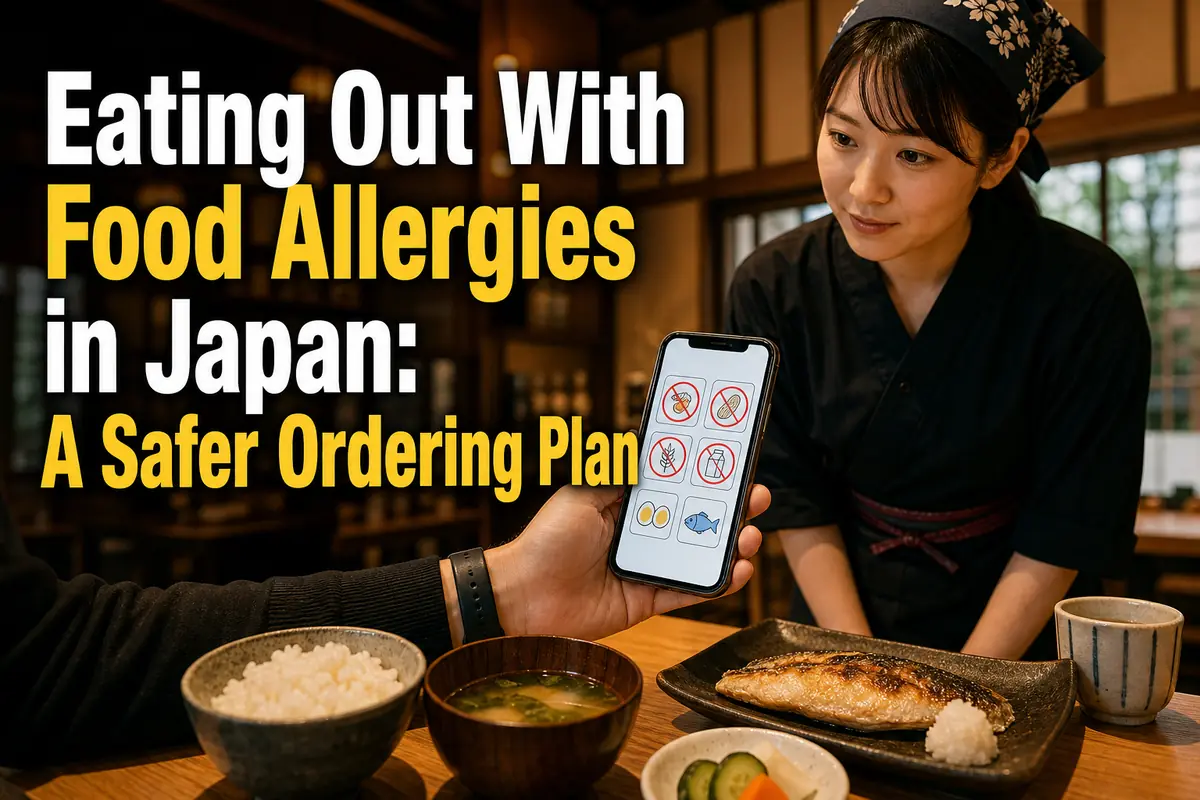
Eating Out With Food Allergies in Japan: A Safer Ordering Plan
The safest way to order at a restaurant in Japan is to contact the restaurant before visiting, name every allergen clearly, ask about ingredients and cross-contact separately, and leave if the staff cannot confirm the answer.
A menu icon, an English menu, or the phrase “allergen-free” should not be your only safety check. Japan’s mandatory allergen-labeling rules mainly protect shoppers buying packaged processed foods. Restaurants generally provide allergy information voluntarily, so the detail and reliability vary by business.
This guide is for foreign residents, families, students, workers, and visitors who manage food allergies in Japan.
The essentials
- Ask before arriving, especially if your allergy can cause a severe reaction.
- Show your allergens in writing; do not rely only on spoken English or machine translation.
- Ask whether the ingredient is in the dish and whether shared equipment creates a cross-contact risk.
- Treat an uncertain answer as a “no.” Choose another dish or restaurant.
- Carry medication prescribed for you and know that Japan’s ambulance number is 119.
The key rule: restaurant meals are different from packaged foods
Japan’s packaged-food rules do not give restaurant customers the same level of protection. This distinction should shape every decision you make when eating out.
The Consumer Affairs Agency requires specified allergens to be declared on many packaged processed foods. By contrast, restaurants, cafés, hotels, food stalls, and many takeaway counters are not covered by a uniform mandatory restaurant allergen-display system. Their menus, charts, and staff explanations are voluntary services.
That means a restaurant may:
- publish a detailed allergen chart;
- identify only a limited set of allergens;
- answer questions after checking recipes or packaging;
- offer ingredient information but make no cross-contact guarantee; or
- be unable to provide reliable information at all.
This is not simply a language problem. A server may understand your question but lack access to a complete recipe, supplier specification, or current sauce label. Ingredients can also change.
ここがポイント: An allergen chart can help you start the conversation, but it does not prove that a meal is safe for your individual allergy or free from cross-contact.
Prepare before you choose a restaurant
The most useful work happens before you sit down. Advance contact gives the restaurant time to check information and gives you time to choose another option.
Make a precise allergy list
Write the foods you must avoid, including related ingredients that may not be obvious. For example, saying “no dairy” may not communicate whether you need to avoid milk, butter, cheese, whey, casein, and food cooked on a buttered surface.
Do not use preference-based phrases such as “I do not like” or “I cannot eat much.” State that it is a food allergy and that eating even a small amount may cause symptoms if that accurately describes your condition.
Useful Japanese wording includes:
- 食物アレルギーがあります。 (Shokumotsu arerugī ga arimasu.) — I have a food allergy.
- ___を食べることができません。 (_____ o taberu koto ga dekimasen.) — I cannot eat _____.
- 少量でも症状が出ます。 (Shōryō demo shōjō ga demasu.) — Even a small amount causes symptoms.
- 原材料を確認していただけますか。 (Genzairyō o kakunin shite itadakemasu ka?) — Could you check the ingredients?
- 同じ油や調理器具を使っていますか。 (Onaji abura ya chōri kigu o tsukatte imasu ka?) — Do you use the same oil or cooking equipment?
Use only statements that match your medical needs. A translated card should support a conversation, not replace one.
The Consumer Affairs Agency provides an English Food Allergy Communication Sheet designed for smartphone use. Download it before going out; the agency notes that its interactive checkboxes may not work correctly unless the file is downloaded.
Contact the restaurant during a quiet period
Call or message before the meal. Include:
- the exact allergen or allergens;
- whether trace exposure or shared equipment is a concern;
- the date and time of the booking;
- the number of people affected;
- the dishes you are considering; and
- a request for confirmation from someone who knows the ingredients and kitchen process.
A reply such as “probably okay” is not confirmation. Ask what was checked: a recipe, a product label, the chef, or only the visible ingredients.
Prefer restaurants that can explain their process
Large chains sometimes publish standardized allergen tables, while individual restaurants may be able to speak directly with the cook. Neither format is automatically safer.
A better sign is that the business can explain:
- which recipe or supplier information it checked;
- whether substitutions occur;
- how shared fryers, grills, pans, knives, and serving tools are handled; and
- whether staff can attach an allergy note to the order.
Ask about hidden ingredients in familiar dishes
The dish name alone rarely tells you everything that matters. Sauces, stocks, toppings, batters, and preparation methods can introduce allergens.
Soy sauce and wheat
Many Japanese dishes use soy sauce directly or in a sauce, marinade, soup, or dipping liquid. Standard soy sauce commonly contains wheat. A dish that appears to be based on rice, fish, meat, or vegetables may therefore still be unsuitable for someone with a wheat allergy.
Ask about the complete seasoning, not only the main ingredient. Removing a visible sauce after preparation does not remove an allergen already used in a marinade or stock.
Dashi and seafood
Dashi is stock used in soups, sauces, simmered dishes, and some batters. It may be made with bonito, other fish, kelp, mushrooms, or a blended instant product. “Vegetable dish” does not necessarily mean that its stock is free from fish or shellfish.
Ask what the stock contains and whether the same prepared stock is used across several menu items.
Shared frying oil and cooking surfaces
Tempura, fried chicken, croquettes, seafood, and other items may share a fryer. Restaurants may also use the same grill, griddle, pan, cutting board, knife, tongs, or noodle water for different foods.
The practical questions are separate:
- Is the allergen an intentional ingredient?
- Can it enter through shared preparation?
- Can the kitchen reliably change its process for this order?
A “no” to the first question does not answer the other two.
Garnishes and final toppings
Sesame, nuts, egg, mayonnaise, dairy-based sauces, bonito flakes, and dressings may be added near the end of preparation. Ask staff to check garnishes and toppings rather than simply removing them from the finished plate.
How to order at the table
Repeat the allergy information when ordering, even if you contacted the restaurant earlier. The person who received your booking may not be serving you.
Follow this sequence:
- Show your written allergy information before choosing or confirming the dish.
- Ask for the person best able to check the recipe and kitchen process.
- Name each allergen; avoid broad phrases such as “all nuts” unless you also list the relevant nuts.
- Ask about sauces, soup stock, dressings, toppings, and shared equipment.
- Confirm the final dish and any agreed changes.
- When the food arrives, ask the server to identify the allergy-adjusted plate.
If you receive a different answer from the one given during booking, stop and ask for a new check. Do not resolve contradictory information by choosing the answer you prefer.
Understand what common menu claims do—and do not—mean
Dietary labels are not substitutes for allergy checks. They often describe ingredients or a dining style, not a medically controlled preparation environment.
“Allergen-free” or “allergy-friendly”
Ask which allergens the statement covers and whether it refers only to the recipe. A dish made without an intentional ingredient may still be prepared around that ingredient.
Vegetarian or vegan
These terms can help narrow choices, but they do not address wheat, soy, sesame, peanuts, tree nuts, or cross-contact. Definitions and kitchen practices also vary by restaurant.
Gluten-free
Ask whether the claim covers soy sauce, seasonings, fryer oil, noodle water, and preparation surfaces. People managing celiac disease and people with wheat allergy may also need different questions; explain your own restriction instead of assuming the label covers it.
Halal
Halal information concerns Islamic dietary requirements. It does not by itself indicate that a meal is free from common food allergens.
Common mistakes that increase risk
Most avoidable problems begin with an assumption. Watch for these patterns:
- Assuming a picture menu shows every ingredient.
- Asking only whether the main ingredient is present.
- Treating “no milk” as proof that butter, cream, whey, or other milk-derived ingredients were checked.
- Confusing an ingredient allergy with a dislike, intolerance, religious restriction, or dietary preference.
- Relying on an online menu that may be older than the current recipe.
- Assuming the same chain uses identical ingredients and procedures at every location.
- Believing that removing a topping makes an already-prepared dish safe.
- Using an allergy card without discussing shared equipment.
- Eating after staff say they cannot confirm the ingredients.
Staff may decline to serve an adjusted dish because they cannot control the risk. That can be frustrating, but it is more useful than false reassurance.
What changed in 2026—and why the restaurant gap remains
Cashew nuts joined Japan’s mandatory specified-ingredient category on April 1, 2026, but that change does not create mandatory allergen menus in restaurants.
Japan periodically reviews packaged-food allergen rules using evidence such as reported cases and severity. The Consumer Affairs Agency’s current information includes cashew nuts among ingredients subject to mandatory declaration for covered packaged foods. Walnuts had previously moved into the mandatory group, while macadamia nuts were added to the recommended group in 2024.
For diners, two consequences matter:
- Newer packaged products and supplier labels may provide stronger cashew information under the updated rules.
- Restaurant menus and verbal explanations remain voluntary, so customers must still ask how the restaurant obtained its information.
Do not assume that a restaurant’s allergen chart was immediately updated when national packaged-food rules changed. Ask for the chart’s date or for staff to check the current ingredient specifications.
Regional and operator differences
Your experience will vary more by restaurant and operator than by prefecture. The national distinction between packaged-food labeling and voluntary restaurant information applies across Japan, but each business chooses its own tools and procedures.
Tourist areas and large cities may have more multilingual menus. That improves communication, not necessarily kitchen control. A small restaurant may know every ingredient but have no separate equipment; a large chain may maintain extensive data but allow substitutions or warn that shared kitchens prevent guarantees.
Hotels, school cafeterias, company dining halls, hospitals, airlines, and catered events may have separate reservation deadlines or internal policies. Contact the operator responsible for the specific meal. For a school or workplace, also follow the institution’s health and emergency procedures rather than relying only on cafeteria staff.
If a reaction occurs
Treat signs of a severe allergic reaction as an emergency. Follow the emergency plan provided by your clinician and use prescribed medication as directed.
Japan’s emergency number for an ambulance is 119. The Fire and Disaster Management Agency states that ambulance service is available to anyone in Japan. When calling, give your location, explain that it may be an allergic reaction, describe the symptoms, and mention any emergency medicine used.
Ask someone to meet the ambulance if the restaurant is difficult to locate. Keep the suspected food, packaging, ingredient information, and receipt when practical; medical staff may find the details useful.
Do not depend on a restaurant to store or supply your medication. Before dining out, carry what your clinician has prescribed and make sure companions know where it is and how to follow your emergency plan.
A practical decision checklist
Before eating, you should be able to answer these questions:
- Did the restaurant identify the exact ingredients in this dish?
- Were sauces, stock, seasoning, garnishes, and substitutions checked?
- Did I ask about shared oil, equipment, surfaces, and utensils?
- Is the information current for this location and today’s recipe?
- Does the staff member understand that this is an allergy?
- Am I comfortable with the remaining uncertainty under my medical plan?
If one of the critical answers is “unknown,” the safest next action is to choose another dish, buy a clearly labeled packaged option, or leave. The unresolved issue in Japan is not a lack of goodwill; it is the absence of uniform, mandatory restaurant allergen disclosure. Until that changes, advance preparation and a willingness to walk away remain essential safety tools.
参照リンク
- Consumer Affairs Agency: Food Labelling
- Consumer Affairs Agency: Food Allergy Information
- Consumer Affairs Agency: Food Allergies When Eating Out or Buying Ready-to-Eat Meals
- Consumer Affairs Agency: English Videos About Food Allergies Outside the Home
- Fire and Disaster Management Agency: Guide for Ambulance Services