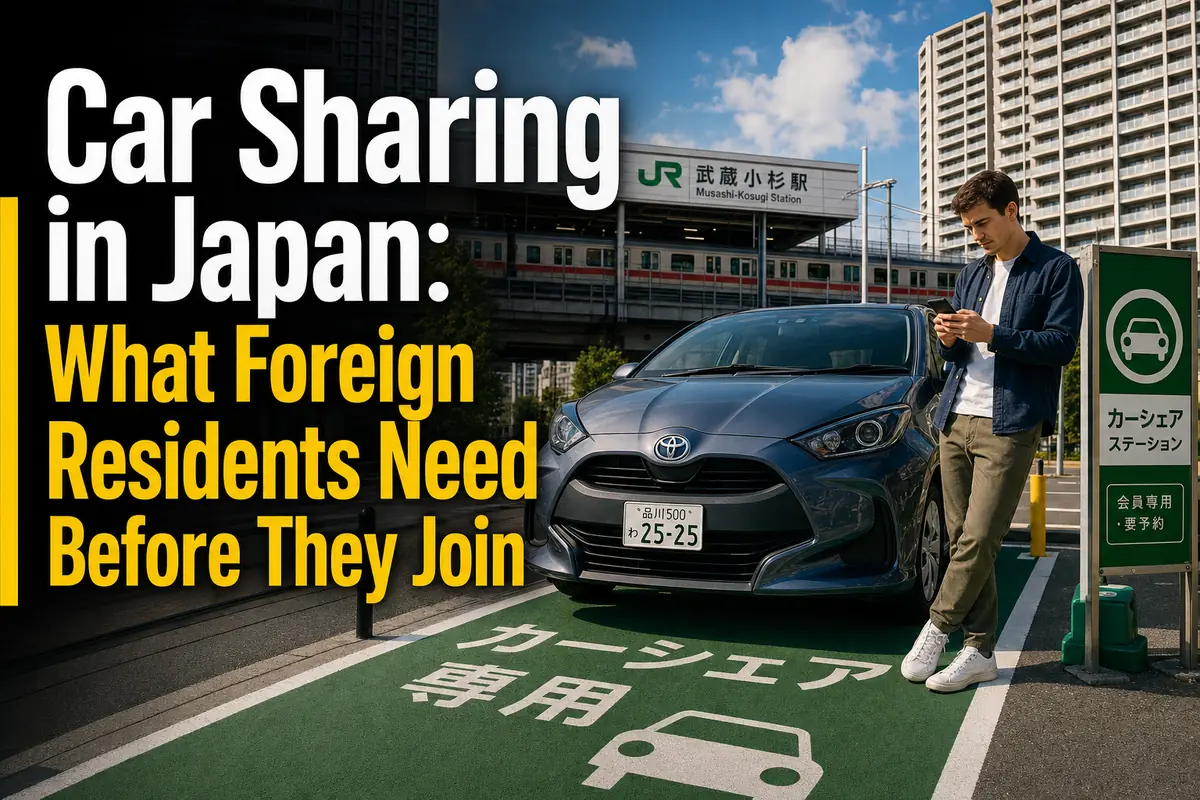
Car Sharing in Japan: What Foreign Residents Need Before They Join
Car sharing in Japan lets members reserve a nearby vehicle for a short period, unlock it with an app or registered card, and return it to the same station. Fuel and basic insurance are normally included in the usage charge.
The main barrier for foreign residents is membership eligibility. Several major operators require a Japanese-issued driver’s license even though an International Driving Permit may be legally valid for driving in Japan. In that case, renting a car is the practical alternative until you obtain a Japanese license.
Information and prices below were checked on August 1, 2026.
- Car sharing is designed mainly for residents, not short-term visitors.
- Expect time charges, possible distance charges, and sometimes a monthly fee.
- A Japanese license, a personal credit card, a Japanese contact number, and current address information are commonly required.
- Most services require the car to be returned to its original station.
This guide is for foreign residents and their families who need a car occasionally—for shopping, taking children somewhere, visiting places outside train networks, or making a short weekend trip.
First check: are you eligible to join?
Being legally allowed to drive in Japan does not automatically make you eligible for a car-sharing membership. Traffic law and an operator’s membership rules are separate requirements.
Licenses that can be valid for driving in Japan
According to Japan’s National Police Agency, a driver may use one of the following, subject to its validity and other conditions:
- A valid Japanese driver’s license
- A valid International Driving Permit issued under the 1949 Geneva Convention
- A license from Switzerland, Germany, France, Belgium, Monaco, or Taiwan, together with an authorized Japanese translation
An International Driving Permit or eligible foreign license can generally be used for no more than one year after entry into Japan, or until the document expires, whichever comes first. Special rules apply when a resident leaves Japan and re-enters after less than three months.
An IDP must be the original paper document. A digital copy displayed on a phone is not accepted.
What car-sharing companies may require
Leading services can impose narrower conditions:
- Times Car states that foreign-issued licenses and International Driving Permits are not accepted for its standard online membership application.
- Mitsui no Carshares requires a driver’s license issued in Japan in the applicant’s own name. Its rules also restrict membership for people whose license was issued less than one year earlier.
- Orix CarShare’s membership terms require individual members to have a Japanese-issued license and make Japan their main place of residence.
This difference is easy to miss. A visitor may legally rent and drive a car with a qualifying IDP but still be unable to join one of these car-sharing services.
ここがポイント: Check the operator’s membership rules before comparing prices. If it does not accept your license, a lower hourly rate is irrelevant.
Documents and preparations
A complete application usually depends on matching names, a verifiable address, and an accepted payment method. Prepare these before starting an online identity check.
Common requirements include:
- A valid Japanese driver’s license in your name
- A credit card in the same name as the applicant
- A Japanese mobile telephone number
- An email address
- A current residential address
- A smartphone capable of running the operator’s app
- A student ID if applying for a student plan
Times Car, for example, asks for additional proof when the address on the license differs from the current address. Its accepted examples include a recent utility bill, a residence certificate without a My Number printed on it, or both sides of a residence card.
Debit and prepaid cards are often excluded. Times Car requires a supported credit card with 3-D Secure authentication, while Orix also states that debit cards and electronic money cannot be registered.
Check your name before uploading anything
Foreign residents can encounter problems when romanized names appear differently across documents. Before applying, compare:
- Name order
- Middle names
- Spaces and hyphens
- The name on the license and credit card
- The address recorded on the license
Do not shorten a name simply to fit an application unless the operator instructs you to do so. Contact support when the form cannot reproduce your official name.
My Number driver’s license procedures vary
Japan introduced the option of storing driver’s-license information on a My Number Card in March 2025. Operator support is not uniform.
Orix accepts applications using a My Number driver’s license but requires a separate procedure. Other services may request data produced by the National Police Agency’s reading app, or may handle applicants who possess only the integrated card differently from holders of a conventional license.
Check the current instructions before applying or renewing your registered license information. Do not assume that scanning the front of the My Number Card is sufficient.
How membership and each trip work
After approval, most trips follow the same sequence: reserve, inspect, unlock, drive, refuel if needed, and return to the original marked space. The details of unlocking and confirming the return differ by operator.
1. Search near the places you actually use
Do not choose a service only because it has a low advertised rate. Open each operator’s station map and check availability near:
- Your home
- Your workplace or school
- A station you use on weekends
- The destination from which you are likely to start driving
Coverage is dense in many large cities but can be limited in suburban and rural areas. Even in Tokyo or Osaka, a nearby station may have only one car or may be fully booked at popular times.
2. Choose a plan and complete identity verification
The operator reviews the license, payment method, contact information, and any supporting documents. Approval may be quick, but some methods require a card or other material to arrive by post.
Do not plan an important journey for the same day as your application. Complete registration first and confirm that you can log in, reserve, and unlock an eligible vehicle.
3. Reserve enough time
Enter a start and return time in the app or website. Leave a buffer for congestion, parking, and loading luggage.
Returning late can affect the next member and may lead to additional charges or membership restrictions. If you need more time, request an extension in the app before the reservation ends. An extension may be blocked when another member has already reserved the car.
4. Inspect the vehicle before leaving
Walk around the car and check for visible damage. Report damage that is not already recorded. Inside the vehicle, locate:
- The physical key, if the car uses one after unlocking
- The fuel card
- The parking pass or station instructions
- The support telephone number
- Controls you may not recognize, including the parking brake and gear selector
Adjust the mirrors and navigation settings before moving. Japanese cars are right-hand drive, traffic keeps left, and many urban parking spaces are narrow.
5. Return it to the same station
Standard station-based car sharing is generally round-trip service. You cannot finish the trip at a convenient destination unless the operator explicitly offers a one-way option for that vehicle and route.
Return the car to its designated space, remove your belongings, switch off lights and accessories, close the windows, and follow the app’s return procedure. Confirm that the system records the trip as completed before walking away.
What car sharing costs in 2026
The real cost is usually the time charge plus any distance charge—not just the rate printed beside “15 minutes.” Monthly fees, vehicle class, long-use caps, night packages, tolls, and optional protection can change the total.
Here is a practical snapshot of entry-level personal plans from three major services. Prices are tax-inclusive and were checked on August 1, 2026.
Times Car
- Monthly basic fee: ¥880
- Basic-class time charge: ¥220 per 15 minutes
- Six-hour maximum: ¥4,290
- Distance charge: ¥20 per kilometer when the applicable time or package conditions trigger it
Times Car’s joining page says the ¥880 monthly fee applies to its standard personal plan. Check whether the monthly amount can be used against trip charges under your selected plan and promotion.
Mitsui no Carshares
- Basic plan monthly fee: ¥880
- Monthly-fee discount: up to ¥880 against usage in that month; unused value does not carry forward
- Basic-class time charge: ¥150 per 10 minutes
- Six-hour package: ¥4,280
- Distance charge for the basic class: ¥0 when both the reservation and actual use are within six hours; otherwise ¥21 per kilometer
A monthly-fee-free plan is also available, but its usage rates and reservation conditions differ. It can suit infrequent drivers, while the basic plan may work better when you expect to use at least the amount covered by the monthly discount.
Orix CarShare
Orix changed its pricing from March 1, 2026. Under the Individual A plan:
- Monthly basic fee: ¥250
- Standard-class time charge: ¥240 per 15 minutes
- Six-hour maximum: ¥4,190
- Twelve-hour maximum: ¥5,390
- Distance charge: ¥20 per kilometer, waived when both reservation and use remain within six hours, except for the night package
- Optional additional protection package: ¥660 per 24 hours
The monthly fee cannot be applied to usage charges. Orix also offers a no-monthly-fee Individual B plan with higher trip prices and a U29 plan with Individual A usage rates but no monthly fee through the member’s 30th birthday.
A simple cost example
Suppose you reserve an entry-level car for two hours and drive 25 kilometers. Before tolls or options, the time component would be approximately:
- Times Car: 8 × ¥220 = ¥1,760
- Mitsui no Carshares basic plan: 12 × ¥150 = ¥1,800
- Orix Individual A: 8 × ¥240 = ¥1,920
Distance charges may be zero for this short reservation under the published conditions, but the monthly plan cost still matters. The cheapest choice therefore depends on how often you drive, not just this one trip.
For a long journey, calculate all of the following:
- Maximum time or package price
- Distance charge from the point specified by the operator
- Expressway tolls
- Destination parking
- Optional protection
- Child-seat arrangements
- Possible extension charges
Fuel is normally included and should be paid with the card kept in the vehicle, not your personal card. Charging rules for electric vehicles and incentives for refueling vary.
Car sharing or a rental car?
Car sharing is strongest for spontaneous local trips; a rental car often makes more sense for visitors, long drives, and trips that need equipment or staff assistance.
Choose car sharing when:
- You already meet the membership requirements
- A reliable station is close to home
- You need a car for a few hours
- You want to reserve outside rental-counter hours
- You are comfortable inspecting and operating the vehicle without staff
Consider a rental car when:
- You have only an accepted International Driving Permit or eligible foreign license
- You need the vehicle for a full day or several days
- You want staff to explain the controls
- You need a child seat, winter tires, or another confirmed option
- You want airport or tourist-area availability
- The trip involves substantial distance charges
Compare the final estimate, not the headline rate. A rental price may exclude fuel but include unlimited distance, while a car-sharing price may include fuel but add a per-kilometer charge after a threshold.
Insurance does not remove every financial risk
Basic insurance and compensation are generally included, but members can still face major costs when rules are broken or the vehicle is taken out of service.
A non-operation charge, usually called an NOC, compensates the operator when a damaged or dirty vehicle cannot be rented. It is separate from ordinary repair coverage. Operators may also charge for towing, cleaning, a lost key, a missing fuel card, or an incorrectly returned vehicle.
Protection may be denied or reduced when, for example:
- An unregistered person was driving
- The driver did not report an accident to the police and operator
- The driver continued without reporting new damage
- The reservation expired without an approved extension
- The vehicle was used in a prohibited way
- The driver was intoxicated or otherwise not legally fit to drive
If an accident happens, stop safely, help anyone who is injured, call emergency services when necessary, contact the police, and then call the operator’s emergency support line. Do not make a private settlement with the other party.
Optional protection can reduce some NOC or roadside costs, but exclusions remain. Read the operator’s current compensation page before the first trip, not after an incident.
Common mistakes to avoid
Most expensive mistakes happen when a member treats car sharing like an ordinary private car. It is a timed service with another customer waiting after you.
- Assuming an IDP is enough: It may authorize driving but fail the operator’s membership rules.
- Booking the exact minimum time: Traffic or a full destination car park can make an on-time return impossible.
- Letting a family member drive: Every driver must satisfy the operator’s registration and reservation rules.
- Forgetting distance charges: A package ceiling may cover time but not kilometers.
- Ending at another station: Most cars must return to the space from which they departed.
- Paying personally for fuel: Use the in-car fuel card and follow the receipt instructions.
- Ignoring small contact: Report a scrape, collision, tire problem, or other damage immediately.
- Leaving without checking the return confirmation: An unlocked or improperly returned car may remain on the clock.
- Failing to update a renewed license: An expired registration record can suspend access even when the new physical license is valid.
Regional and household differences
The law governing your license is national, but vehicle availability and everyday usefulness are local. A service with strong coverage in central Tokyo may be sparse near a regional home, and snow-country driving introduces additional equipment and safety questions.
Before joining, check:
- Number of vehicles within walking distance
- Weekend availability
- Vehicle size and child-seat compatibility
- Winter-tire information in snowy regions
- Whether your apartment has restrictions on temporary loading
- Whether every family driver can be registered
- Support language and emergency procedures
Child seats are legally required for children under six, subject to limited statutory exceptions. Do not assume that a shared vehicle includes one. Confirm the operator’s equipment policy and use a seat suitable for the child and vehicle.
Current changes to watch
Apps, digital identity checks, and My Number driver’s-license procedures are changing faster than the basic round-trip model. Screens and unlocking methods may differ between older and newly updated vehicles.
Orix launched revised prices in March 2026 and moved newer members toward an updated app and website from June 2026. Its updated service supports smartphone or web unlocking on vehicles with the new reader, while new IC membership cards are no longer issued. Existing members may still encounter older and newer procedures during the transition.
The practical watchpoints are:
- Recheck prices immediately before joining or making a long reservation.
- Confirm how your operator handles a conventional license, dual possession, or a My Number driver’s license.
- Update license and credit-card details before they expire.
- Test the app and unlocking method before relying on the service for an urgent trip.
For most foreign residents, the next decision is straightforward: first confirm that your Japanese license and payment method qualify, then compare nearby vehicle availability, and only then compare prices. If you currently rely on an IDP, start with rental-car companies instead of completing a car-sharing application that the operator cannot approve.
参照リンク
- National Police Agency: For Holders of Foreign Driver’s Licenses
- National Police Agency: Q&A on International Driving Permits
- Times Car: Online membership requirements
- Times Car: Vehicle classes and short-use prices
- Times Car: Service information and current price table
- Mitsui no Carshares: Personal pricing
- Mitsui no Carshares: Personal price table
- Mitsui no Carshares: Membership rules
- Mitsui no Carshares: Support, insurance, and non-operation charges
- Orix CarShare: Pricing plans
- Orix CarShare: Membership terms
- Orix CarShare: How to join
- Orix CarShare: My Number driver’s-license procedure
- Orix CarShare: 2026 service comparison