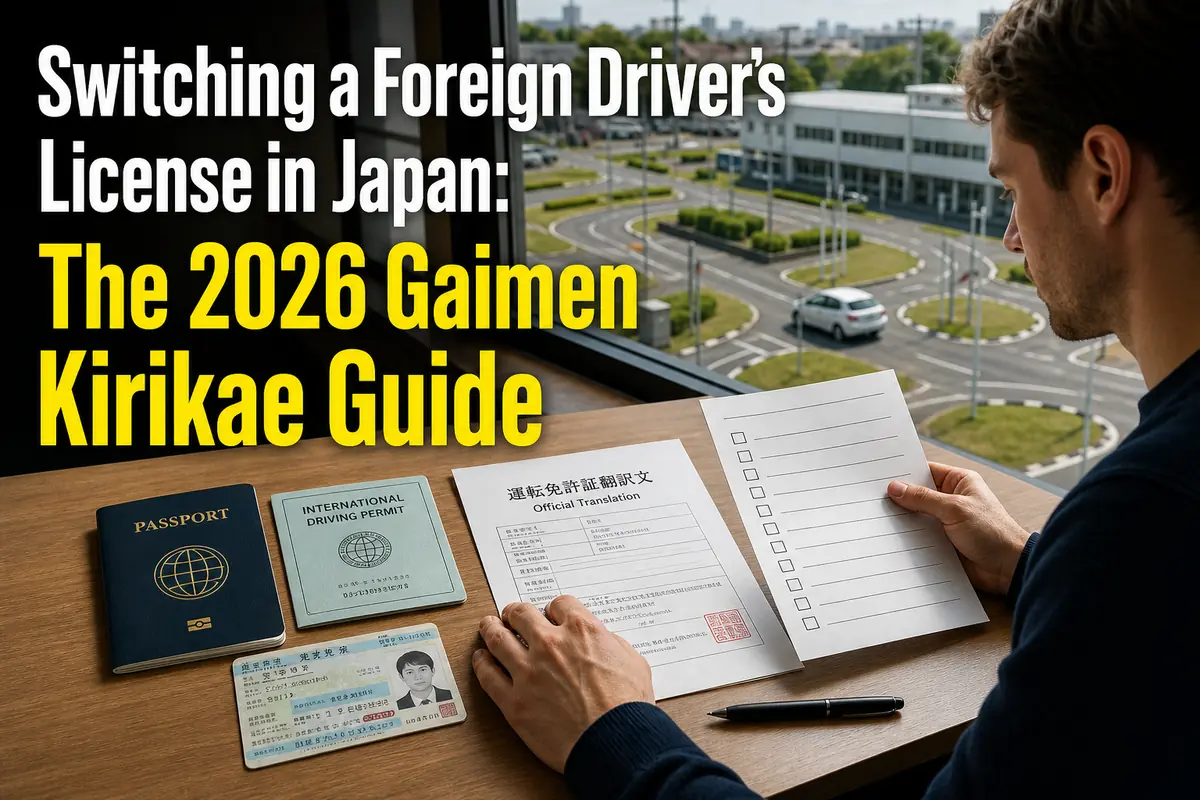
Switching a Foreign Driver’s License in Japan: The 2026 Gaimen Kirikae Guide
If you hold a valid foreign driver’s license and can prove that you lived in the issuing country for at least three months after receiving it, you may be able to obtain a Japanese license through gaimen kirikae—the foreign-license conversion process.
The procedure became stricter on October 1, 2025. Most applicants now need a resident record, and applicants who are not exempt must pass a 50-question knowledge check with at least 45 correct answers. The driving assessment also uses stricter standards.
This guide is for foreign residents and their families who plan to drive in Japan beyond the limited period allowed by an international driving permit or other temporary arrangement.
Key points as of August 2026:
- Apply through the prefectural police responsible for your registered address.
- Your original foreign license must still be valid; an international driving permit alone cannot be converted.
- You must normally prove at least three months of residence in the issuing country after the license was issued.
- Tests depend on the country, region, or US state that issued your license.
- Reservations, accepted documents, fees, languages, and waiting times vary by prefecture.
First, check whether you are eligible
Eligibility depends on your license, your residence history, and your current address in Japan. Check these points before paying for a translation.
You will generally need to meet all of the following conditions:
- You hold a current license issued by an authorized foreign government or administrative body.
- You can prove that you stayed in the issuing country or region for a total of at least three months after obtaining the license.
- You have an address in the prefecture where you apply.
- You can provide the identity and address documents required under the rules introduced in October 2025.
An expired license is generally not eligible. If your license will expire soon and you may have to wait months for a driving assessment, ask the license center whether you should renew it first.
The three-month rule is about time after issuance
The important period is not simply how long you lived in the country. It is how long you were physically present there after the relevant license was issued.
Possible evidence includes:
- Current and old passports showing entry and exit stamps
- An official driving record or license history
- Immigration or border-movement records
- Employment, school, tax, or residence records requested by the police
- Previous licenses showing the original acquisition date
This is a common problem for people whose passports have few stamps because they used automated immigration gates. It can also affect people who renewed a license shortly before moving to Japan. Obtain official records early instead of assuming the license card will be enough.
If you hold several license classes, such as car and motorcycle, the police may ask for the first acquisition date of each class.
Short-term visitors are generally outside the normal route
Since October 1, 2025, a resident record is required in principle when applying for a Japanese license. Foreign residents covered by Japan’s Basic Resident Registration system must submit a qualifying copy of their juminhyo, or certificate of residence.
People visiting Japan under a short-term stay status normally do not receive a resident record and generally cannot use this route. Limited exceptions exist for certain people outside the resident-registration system, such as diplomats and some participants in authorized events, but they require specific identity and address evidence.
Conversion is different from temporary permission to drive
Gaimen kirikae gives you a Japanese license; an international driving permit only provides temporary driving authority. They are not interchangeable.
Depending on the issuing country and document, temporary driving in Japan may be possible with:
- A Geneva Convention international driving permit
- A qualifying foreign license carried with an official Japanese translation
- Another arrangement recognized under Japanese law
These options have their own validity limits. Holding an international driving permit does not remove the need to convert your original national license, and the permit itself cannot be converted.
Conversion is usually the practical option for residents who expect to drive after their temporary permission ends, need a stable Japanese identity document for driving, or plan to own and insure a car long term.
Which examinations will you need?
The issuing jurisdiction—not your nationality—determines whether the knowledge and driving checks are waived. A citizen of one country may hold a license from another, and US licenses are handled state by state.
As listed by the Tokyo Metropolitan Police Department in July 2026, applicants with licenses from the following countries or jurisdictions are exempt from both the knowledge and driving checks:
- Iceland, Ireland, the United Kingdom, Italy, Australia, Austria, the Netherlands, Canada, South Korea, Greece, Switzerland, Sweden, Spain, Slovenia, the Czech Republic, Denmark, Germany, New Zealand, Norway, Hungary, Finland, France, Belgium, Poland, Portugal, Monaco, Luxembourg, and Taiwan
- The US states of Colorado, Hawaii, Maryland, Ohio, Oregon, Virginia, and Washington
An Indiana license is listed as exempt from the driving check, but not the knowledge check.
Exemption lists can change, and another prefecture’s page may present them differently. Confirm your exact issuing country, region, or state with the license center where you will apply.
The knowledge check became much harder in October 2025
For applicants who are not exempt, the revised check has:
- 50 questions instead of 10
- A passing score of 45 out of 50, or 90%
- No illustration-based questions
Tokyo states that the check is conducted only once in the afternoon. Available languages and daily schedules differ, so ask your prefectural license center before your appointment.
Study Japanese rules rather than relying only on driving experience from home. High-risk differences include:
- Driving on the left
- Stopping completely at stop signs and railway crossings
- Giving way to pedestrians at crosswalks
- Speed limits and road markings
- Rules for bicycles, motorcycles, and emergency vehicles
- Alcohol, seat-belt, and mobile-phone restrictions
The driving check is not a casual demonstration
The revised assessment added tasks involving crosswalks and tightened scoring for actions such as signaling and turning correctly.
Examiners look for visible, timely safety actions. A driver who has years of experience can still fail for habits that do not match Japanese test standards—for example, checking too late, positioning the car incorrectly before a turn, or failing to make a full stop.
ここがポイント: If your jurisdiction is not exempt, prepare for the conversion as a formal test of Japanese traffic rules and test-course technique—not merely proof that you can operate a car.
A practice lesson at a driving school familiar with gaimen kirikae is optional, but it can help you learn the expected observation sequence and course procedures. Prices and lesson availability are private-service matters, so compare local schools directly.
Documents to prepare
The basic checklist is only a starting point because country-specific evidence is often decisive. Always obtain the current list from your prefectural police before the appointment.
Most applicants should expect to prepare:
- A valid original foreign driver’s license
- Old licenses from the same jurisdiction, if available
- A Japanese translation accepted by the police
- Passports, including old passports relevant to the three-month rule
- A certificate of residence containing the required details
- A residence card or special permanent resident certificate, when applicable
- A photograph meeting the local size and recency rules
- Documents proving the first acquisition date if it is not shown on the license
- Documents proving residence in the issuing country after acquisition
- Country- or license-specific records requested by the police
- Application and issuance fees
- Glasses, contact lenses, or hearing aids used for driving
Tokyo’s current instructions say that an electronic license by itself is not accepted: applicants must bring the original physical license. This is especially important where a country has moved toward app-based credentials.
Check what must appear on your resident record
Do not request the shortest possible juminhyo without checking the instructions. Foreign residents may need a copy containing specified details such as nationality, residence status, period of stay, expiration date, and residence-card number.
Tokyo also requires relevant resident records to have been issued within the previous six months. Your prefecture may specify exactly which details must appear and which identifiers should be omitted.
Country-specific records can delay the application
Some license cards do not show enough information for Japanese police to confirm when or how the license was obtained. Additional requirements may include an official driving record, an original receipt, an appendix to the license, or a certificate from the issuing authority.
JAF’s translation guidance, for example, identifies additional translation materials for licenses from countries including the Philippines and China. Requirements for the police application may go further than the materials needed to produce the translation.
That distinction matters: receiving a translation does not mean the police have approved your conversion.
How to obtain the Japanese translation
Arrange the translation before your police appointment, but first confirm which issuers your prefecture accepts. JAF is a commonly used designated provider, while certain embassies, consulates, issuing authorities, and approved services may also be accepted.
For a JAF translation:
- Apply through JAF’s online translation service from within Japan.
- Upload clear, unedited images of the front and back of the valid license.
- Upload any additional country-specific document requested by JAF.
- Pay using the available online or convenience-store payment method.
- After issuance, print the translation as instructed. A PDF displayed on a phone is not a substitute for the required paper document.
JAF stopped accepting counter and postal applications in April 2025. Its published processing estimates are generally two to three business days for licenses from Switzerland, Germany, France, Belgium, Monaco, and Taiwan, and five to ten business days for other jurisdictions. Delays remain possible if documents require confirmation.
As of July 1, 2026, JAF lists the translation fee for switching to a Japanese license as ¥6,600 including tax, plus the convenience-store printing charge. Confirm the current amount when applying.
The application process, step by step
Start with your prefectural police website because the appointment system controls the rest of the process. You cannot assume that a center in another prefecture will accept your application.
1. Find the correct license center
Search for the foreign-license conversion page of the prefectural police responsible for your registered address. Check:
- Whether advance booking is mandatory
- Which centers handle your issuing jurisdiction
- Whether booking is online, by telephone, or in person
- Whether a document review happens before an examination date is assigned
- Whether an interpreter may accompany you
Tokyo, for example, uses designated driver’s license testing and issuing centers. Its Koto center only handles applicants from jurisdictions exempt from both checks, while Fuchu and Samezu handle all foreign jurisdictions.
2. Request the exact document list
Tell the center the issuing country or region, every vehicle class you want converted, the original acquisition date, and whether the license has been renewed or replaced.
Ask about unclear items before paying for certificates abroad. A document that proves the issue date may not prove the first acquisition date, and a current passport may not prove an older period of residence.
3. Obtain and print the translation
Allow time for translation review and printing. Check that your name, license number, classes, restrictions, and dates correspond to the original license. Do not alter either document yourself.
4. Attend the document screening
Staff will examine the license and supporting records. They may ask about:
- Where and when you learned to drive
- How the license was obtained
- Test and training procedures in the issuing country
- Renewal or replacement history
- Time spent in the issuing country
Answer from your actual history. Bring organized originals rather than screenshots scattered across a phone.
5. Complete the eyesight and other aptitude checks
Applicants undergo the relevant physical aptitude checks, which commonly include vision testing. Bring the corrective lenses you use for driving.
6. Take the required knowledge and driving checks
Applicants from exempt jurisdictions can skip the checks covered by their exemption. Everyone else must complete the required assessment stages.
Passing the knowledge check may not mean you can take the driving check on the same day. Tokyo’s document guidance warns that a driving-check appointment can be three to four months away, although actual waiting periods depend on the center and season.
7. Pay the final fees and receive the license
After completing all requirements, follow the center’s instructions for payment, photograph procedures, and issuance. Ask whether the license will be issued that day and which license format is available to you.
What does the conversion cost?
There is no single nationwide total because translation, certificates, photographs, lessons, retests, and prefectural procedures differ. The application fee itself also depends on the vehicle class.
Tokyo’s published fees provide a useful ordinary-car example as of July 2026:
- JAF translation for conversion: ¥6,600, plus printing
- Ordinary-license application fee: ¥2,500
- Physical license-card issuance fee: ¥2,350
- Additional category notation fee, when applicable: ¥200
Using the first three items, the basic example is about ¥11,450 plus printing and document costs. This is not a guaranteed national total.
Your actual budget may also need to cover:
- Official driving or immigration records from abroad
- Certified delivery or international postage
- Photographs
- Transport to the license center
- Interpreter assistance
- Optional driving lessons
- Repeat application or examination fees
Do not rely on Tokyo’s amounts for another prefecture. Confirm fees and accepted payment methods on the application date.
Deadlines and timing risks
The deadline that matters most is the expiration date of your foreign license. Begin while both the license and your residence evidence are easy to verify.
Build your schedule around four separate waiting periods:
- Obtaining records from the issuing country
- Translation processing
- The first available license-center appointment
- A later driving-check appointment, if required
A foreign license may be valid at the first screening but expire before a driving assessment scheduled months later. Tokyo advises applicants who need a driving check to consider this delay when booking.
Also remember that the right to drive temporarily in Japan can expire before the conversion is complete. A pending application does not extend an international driving permit or other temporary permission. If your legal driving period ends, stop driving until you hold valid authority again.
Regional differences you must confirm
National law sets the framework, but prefectural police control appointments and local processing. This is why advice from a friend in another prefecture may be incomplete.
Check your prefecture for differences in:
- Accepted translation providers
- Appointment method and waiting time
- Application centers and reception hours
- Required resident-record details
- Country-specific supporting documents
- Knowledge-check languages and schedules
- Interpreter rules
- Driving-check scheduling
- Fees and payment methods
- Same-day or later license issuance
Your employer, school, or municipality does not approve the conversion. However, they may help you obtain address documents, understand local procedures, or arrange language support. Final decisions rest with the prefectural public safety authorities and police.
Common mistakes and how to avoid them
Most preventable problems happen before the applicant reaches the test course. A careful document check saves more time than last-minute test practice.
Paying for a translation before confirming eligibility
A translation does not guarantee approval. First check license validity, residence history, and country-specific records.
Bringing only an international driving permit
The original national license is the document considered for conversion. An international permit alone is insufficient.
Assuming the newest issue date is the first license date
Renewed cards often show only a recent date. Obtain an official history that identifies when each vehicle class was first granted.
Failing to prove the three-month stay
Passport stamps may be incomplete. Request border, employment, school, tax, or residence records that the police can evaluate.
Using a digital license without the original card
Where the police require the physical original, an app or screenshot will not replace it. Ask your issuing authority what document can be provided if physical cards are no longer standard.
Studying the old 10-question format
Since October 2025, non-exempt applicants face 50 questions and need 45 correct answers. Use current study material.
Treating the driving check like everyday driving
Learn the required observation, signaling, lane-positioning, stopping, crosswalk, and turning procedures. Safe intentions must be shown through clear actions.
Letting temporary driving permission expire
Conversion processing does not extend an international permit or another temporary arrangement. Track the legal deadline separately.
Frequently asked questions
Can I convert a license from any country?
Not always. The police must be able to verify the license and obtain enough information about the issuing system. If they cannot authenticate or evaluate it, you may need to obtain a Japanese license through the standard process.
Do I need a residence card?
Many foreign residents will present a residence card, but the conversion application generally also requires an eligible certificate of residence containing specified information. Requirements differ for people outside the Basic Resident Registration system.
Can my family member apply for me?
A representative may be able to request a JAF translation under its rules, but the police conversion involves identity checks, interviews, aptitude checks, and possibly examinations. Contact the prefectural license center if disability, illness, or another circumstance affects attendance.
Is the knowledge check available in English?
Language options vary by prefecture and may change. Confirm the available languages directly with the center rather than assuming that an English translation page guarantees an English examination session.
Can I drive while waiting for the conversion?
Only if you independently hold valid legal authority to drive in Japan. Filing or booking a conversion application does not itself provide driving permission.
Will all classes on my foreign license be transferred?
Not automatically. Japanese vehicle categories may not match those abroad, and each class may require proof of its acquisition date and experience. Ask the center which Japanese class corresponds to each foreign entitlement.
Your practical action plan
Your next step is to contact the license center for your registered prefecture before ordering expensive records. Give staff the exact issuing jurisdiction and license classes so they can identify the correct checklist.
Use this order:
- Confirm that the foreign license will remain valid long enough.
- Check whether you can prove three months in the issuing country after acquisition.
- Download the country-specific checklist from your prefectural police.
- Reserve the correct license center and ask about test exemptions.
- Obtain missing license-history and residence records.
- Request an accepted Japanese translation and print it correctly.
- Study the current 50-question rules and prepare for the stricter driving check if not exempt.
- Keep checking the expiration date of any temporary permission to drive.
The biggest risk is not simply failing a test. It is discovering after a long wait that the foreign license expired, the first acquisition date cannot be proved, or the temporary right to drive has already ended. Verify those three points first.
参照リンク
- National Police Agency: For Holders of Foreign Driver’s Licenses
- National Police Agency: How to Drive in Japan and How to Obtain a Japanese Driver’s License
- Tokyo Metropolitan Police Department: Converting a Foreign Driver’s License
- Tokyo Metropolitan Police Department: October 2025 Rule Changes
- Tokyo Metropolitan Police Department: Required Documents for All Applicants
- JAF: Switching to a Japanese Driver’s License
- JAF: Applying for a Japanese Translation
- JAF: Current Translation Fees and Processing Information