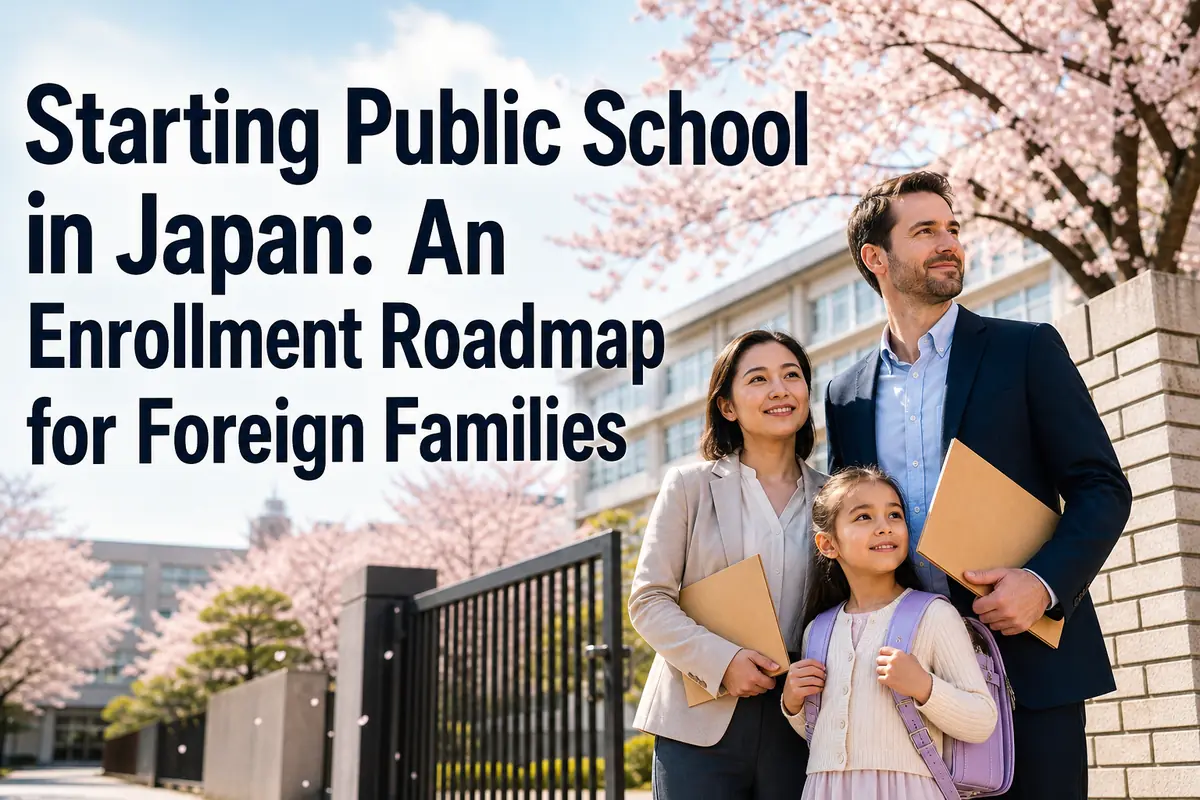
Starting Public School in Japan: An Enrollment Roadmap for Foreign Families
Foreign residents can apply to place a school-age child in a Japanese municipal elementary or junior high school. Start by contacting the board of education or school enrollment desk in the municipality where your family is registered. Your home address will usually determine the assigned school.
Public compulsory education has no admission fee or tuition, and required textbooks are provided without charge. Families still need to budget for lunches, supplies, uniforms in many junior high schools, trips, and other school activities.
This guide is for families whose child will enter first grade, transfer from overseas, or move between municipalities in Japan.
The essentials:
- Elementary school normally covers six years, followed by three years of junior high school.
- The school year starts in April and ends in March.
- A foreign-national child usually needs an enrollment application; residence registration alone may not complete the process.
- Midyear admission is possible, so families arriving after April should contact the municipality promptly.
- Documents, deadlines, language support, school-choice rules, and financial assistance differ by municipality.
First, confirm which rules apply to your child
Nationality and residence records affect the paperwork, but foreign nationality does not prevent a child from attending municipal school.
Japan’s compulsory-education obligation applies to guardians of children with Japanese nationality. A child who has only foreign nationality is not legally subject to that obligation, but may enter a public elementary or junior high school if the family applies. Once admitted, the child is generally educated under the same framework as other students.
A child with both Japanese and another nationality is treated as a Japanese national for compulsory-education purposes. Families considering an international school should check the school’s legal status and speak with their municipal board of education. Attendance at an institution that is not legally recognized as a school under Japan’s School Education Act may not count as completing compulsory education.
The age and grade structure
Japan’s standard school path is:
- Elementary school: six years, generally beginning in the April after the child turns six
- Junior high school: three years following elementary school
- School year: April through March
Grade placement is usually based on age, not only on the number of years completed overseas. However, a municipality and school may review the child’s records, Japanese ability, previous curriculum, and individual needs before confirming placement.
Do not assume that a child will automatically enter the grade that has the same name as the grade overseas. Ask the enrollment desk to confirm the Japanese grade and discuss any educational concerns before the first day.
Where to apply and when to begin
The correct first contact is usually the municipal office—not the neighborhood school and not the national government.
Look for the board of education, school affairs section, academic affairs section, or enrollment desk at the city, ward, town, or village office where the child lives. The English name varies.
Contact the office as soon as you know any of the following:
- Your child will reach elementary-school age for the next April intake.
- Your family will move to Japan with a school-age child.
- You will move to another municipality in Japan.
- Your child will leave an international or private school for a municipal school.
- Your child needs Japanese-language or disability-related support.
For a new first grader, municipal preparations may begin many months before April. As one current example, Shinjuku City sends designated-school information in August, conducts pre-enrollment health examinations from late October through November, and sends admission notices by early December for April entry. These dates illustrate the general timeline; they are not national deadlines.
A late arrival does not mean the child must wait until the following April. Municipalities accept transfers during the school year, although the family should apply promptly to reduce missed class time.
The enrollment process, step by step
Most families can move from municipal consultation to an assigned school in five practical steps.
1. Complete or confirm residence registration
After moving into a municipality, complete the required address registration at the local office. The registered address normally determines the child’s school district.
If the child is not yet listed on the resident record, or the family cannot register at the current address, do not abandon the application. Explain the situation to the board of education. Some municipalities have separate procedures for children whose actual residence and registered address differ.
2. Ask for the foreign-child enrollment procedure
Tell the municipal desk:
- the child’s full name and date of birth;
- nationality or nationalities;
- current address and planned moving date, if relevant;
- last school and grade completed;
- preferred start date;
- current Japanese-language level;
- any disability, health condition, allergy, or educational support need.
A child with only foreign nationality may require a form commonly described as a foreign-national school enrollment application. Shinjuku City, for example, calls this a foreign-national enrollment application and requires it before sending the health-examination and admission notices.
3. Prepare the documents requested locally
Requirements are not identical across Japan. A municipality may ask for some or all of the following:
- residence cards or special permanent resident certificates for the child and guardian;
- passports;
- a certificate of residence or information from the resident record;
- the municipality’s enrollment application or an admission notice already mailed to the family;
- school records, report cards, or a certificate of enrollment or withdrawal from the previous school;
- documents showing the child’s completed grade and attendance history;
- vaccination and health records;
- information about allergies, medication, disability, or required accommodations;
- proof of the guardian-child relationship if it is not clear from local records.
Bring original documents and ask whether copies or Japanese translations are required. There is no single nationwide rule requiring every document in this list.
4. Receive the assigned school and complete school-level preparation
Most municipalities use school districts based on the home address. The enrollment desk will normally issue an admission notice or other document identifying the designated school.
The school may then arrange a meeting to discuss:
- the starting date and daily schedule;
- Japanese-language assessment and support;
- supplies, indoor shoes, gym clothes, and school bags;
- lunch arrangements and food allergies;
- walking routes or commuting rules;
- emergency contacts and permission forms;
- previous learning and possible gaps between curricula.
Ask for an interpreter when arranging the meeting if the municipality provides one. Do not rely on the child to interpret sensitive discussions about health, learning, or school placement.
5. Apply separately for support when necessary
Japanese-language instruction, interpretation, special-needs consultation, and financial aid may each require a separate request. Enrollment does not always activate them automatically.
ここがポイント: The enrollment application gets the child into the school system. It does not by itself guarantee a particular school, interpreter, Japanese-language class, financial subsidy, or special-needs placement. Ask about each need directly.
What public school costs—and what it does not
Municipal elementary and junior high schools are tuition-free, but attendance is not completely cost-free.
Under Japan’s education framework, public compulsory schools do not charge tuition. Required textbooks are also supplied without charge. The national textbook program covers students at compulsory-education schools, including students who transfer and need different textbooks at the new school.
Families may still pay for:
- notebooks, stationery, art materials, and other supplies;
- school lunch;
- gym clothes, indoor shoes, and specified bags;
- a uniform, especially at junior high school;
- excursions, camps, and school trips;
- club activities and equipment;
- supplementary materials or collected activity fees;
- commuting costs where public transport is permitted or necessary.
Actual charges depend on the municipality, school, grade, and activities. Ask the school for a written annual estimate rather than budgeting from another family’s experience.
Financial assistance may cover more than lunch
Municipalities commonly operate school-expense assistance for households that meet local income or benefit-related conditions. Covered items may include supplies, lunches, trips, or other educational expenses.
The application route and deadline are local. Yokohama, for example, distributes information through schools and describes assistance for supplies, school trips, and lunches for qualifying households. Other municipalities may use different income thresholds, forms, or payment schedules.
Ask these questions:
- What is the local name of the school-expense assistance program?
- Which costs can it cover?
- What income or benefit documents are needed?
- Must the family apply every school year?
- Can a newly arrived family apply after the standard deadline?
School assignment is usually based on address
Living near a school does not always mean your child can choose it.
The municipality normally assigns a designated school according to official school-district boundaries. A road, railway, or block boundary can place nearby homes in different districts.
Some municipalities allow a change for defined reasons, such as:
- a planned move;
- a medical or disability-related need;
- serious commuting or safety concerns;
- a sibling already attending another school;
- permission to remain at the current school after moving;
- a locally operated school-choice program.
These are local exceptions, not a national right to select any public school. Capacity can also matter. In Shinjuku City, for instance, the municipal junior-high choice system for April 2027 entrants has application rules, capacity limits, and a lottery when applications exceed available places.
Apply before making plans around a preferred school. A verbal conversation with the school does not necessarily replace formal approval from the board of education.
Japanese-language support should be discussed before entry
A child does not need fluent Japanese to apply, but available support varies greatly.
Tell the municipality and school what the child can do in Japanese: speaking, listening, reading hiragana and katakana, reading kanji, and writing. Conversational ability can hide difficulty understanding textbooks or written instructions.
Ask whether the area offers:
- Japanese-language classes within the school;
- visiting language instructors;
- initial assessment or orientation centers;
- bilingual support staff or interpreters;
- translated notices and school guides;
- after-school language or study programs;
- support for guardians during meetings.
Yokohama’s multilingual school-life guide, for example, explains its local support options and everyday expectations. It is useful as an illustration, but families elsewhere must ask their own municipality what is actually available.
Keep copies of previous school records and examples of the child’s work. They can help teachers distinguish a language barrier from an unfamiliar curriculum or a separate learning need.
Health, disability, and special educational needs
Raise support needs early so that consultation can begin before placement is finalized.
A child entering elementary school in April may be invited to a pre-enrollment health examination in the preceding autumn. Families arriving later should ask whether another examination or school health check is needed.
Inform the school about allergies, regular medication, mobility needs, hearing or vision issues, developmental conditions, and previous accommodations. Bring relevant records if available, but ask before arranging expensive translations.
Special support can take different forms, including assistance in a regular classroom, instruction in a resource room, a special support class, or a special support school. Availability and assessment procedures differ locally. Request a formal educational consultation instead of assuming that a previous diagnosis will automatically produce the same placement or support used overseas.
What everyday preparation is easy to miss
The administrative application is only one part of a successful start.
Japanese public schools may expect families to prepare several school-specific items and routines. The exact rules are local, but parents should confirm:
- the route children use to walk to school and whether group travel is organized;
- rules for bicycles, buses, or being driven by car;
- the time children must arrive;
- procedures for reporting absence or lateness;
- indoor shoes, gym wear, name labels, and required bags;
- lunch service and allergy procedures;
- cleaning duties and other class responsibilities;
- emergency pickup arrangements;
- how notices, bills, and school messages are delivered;
- whether a personal device or school-issued tablet is used.
Do not buy a uniform, bag, or full set of supplies before receiving the school’s list. Colors, designs, and approved vendors may differ even between nearby schools.
Common enrollment mistakes
Most preventable problems come from assuming that one part of the process happens automatically.
Waiting for a letter without contacting the municipality
A notice may be sent only after the child appears in the relevant municipal records or after a foreign-national enrollment application. Contact the enrollment desk if nothing arrives.
Going directly to a preferred school
The school may offer information, but the municipality normally controls assignment and admission paperwork. Obtain formal instructions first.
Treating “free public school” as “no household expenses”
Tuition and textbooks are free; lunches, uniforms, supplies, trips, and activities may not be. Request an estimate and ask about assistance.
Hiding language or learning concerns
Early information helps staff prepare support. It should not be treated as a reason to delay contacting the municipality.
Missing a separate application
Enrollment, a designated-school change, Japanese-language support, financial aid, and special-needs consultation may have different forms and deadlines.
Assuming international-school attendance has the same legal status
Recognition differs among institutions. This can affect compulsory-education records and later transfers, especially for a child with Japanese nationality. Confirm the institution’s status and the municipal procedure before withdrawing from a recognized school.
If your family arrives during the school year
Midyear entry is normal enough to have a process, but documents from the previous school can speed it up.
Contact the new municipality immediately after the address is known. Ask the former school for records before leaving, including evidence of attendance, completed grades, subjects studied, reports, and any support plans.
If moving from another Japanese public school, tell both schools and both municipal offices. Textbooks can differ by district; if the new school uses different approved textbooks, the national free-textbook system covers the necessary new books.
For an overseas transfer, expect discussion about age-based placement and curriculum differences. The decision belongs to the responsible education authority and school, so avoid promising the child a particular grade before consultation.
Current planning point for April 2027 entry
As of August 2026, families preparing for April 2027 should check their municipality now rather than wait until winter.
Municipal calendars are already appearing. Shinjuku City, for example, published its 2027-entry information in 2026, with elementary-school information scheduled from August and a deadline of October 16, 2026, for its optional junior-high school-choice application.
That date applies to Shinjuku’s choice program—not to ordinary enrollment across Japan. It shows why local checking matters: optional school selection, health examinations, foreign-national applications, and standard admission notices can each follow a different calendar.
For the next practical step, search your municipality’s website for “elementary school enrollment,” “junior high school enrollment,” or “foreign child school admission,” then confirm the result by phone or at the municipal desk. Bring the child’s identity and school records, and ask specifically about assignment, costs, language support, and deadlines.
Quick application checklist
Before visiting the municipal office:
- Confirm that your address registration is complete or explain why it is not.
- Gather residence cards, passports, and previous school records.
- Write down the child’s education history and preferred start date.
- Note language, health, allergy, disability, and learning-support needs.
- Ask which school is assigned to the address.
- Request the complete list of local forms and deadlines.
- Ask about school-expense assistance before paying major costs.
- Arrange a school meeting and interpreter if needed.
- Wait for the school’s list before buying uniforms or supplies.
The most important watchpoint is the local calendar. The right to apply is broad, but the documents, notices, optional choices, and support arrangements are municipal. A call to the board of education now can prevent missed autumn procedures for an April start.
参照リンク
- MEXT: Guide for Foreign Students to Start School
- MEXT: Welcome to Japan! Guidebook for Starting School
- MEXT: Overview of Japan’s Educational System
- MEXT: Basic Act on Education
- MEXT: Free Textbook Distribution System
- Shinjuku City: Municipal Elementary and Junior High Schools
- Shinjuku City: New Enrollment Process for Elementary and Junior High Schools
- Shinjuku City: Information Sessions and Junior High School Choice for April 2027
- Yokohama City: School Life Guide
- Yokohama City: Subsidies and Other Financial Support
- Yokohama City: International Schools and Compulsory-Education Status