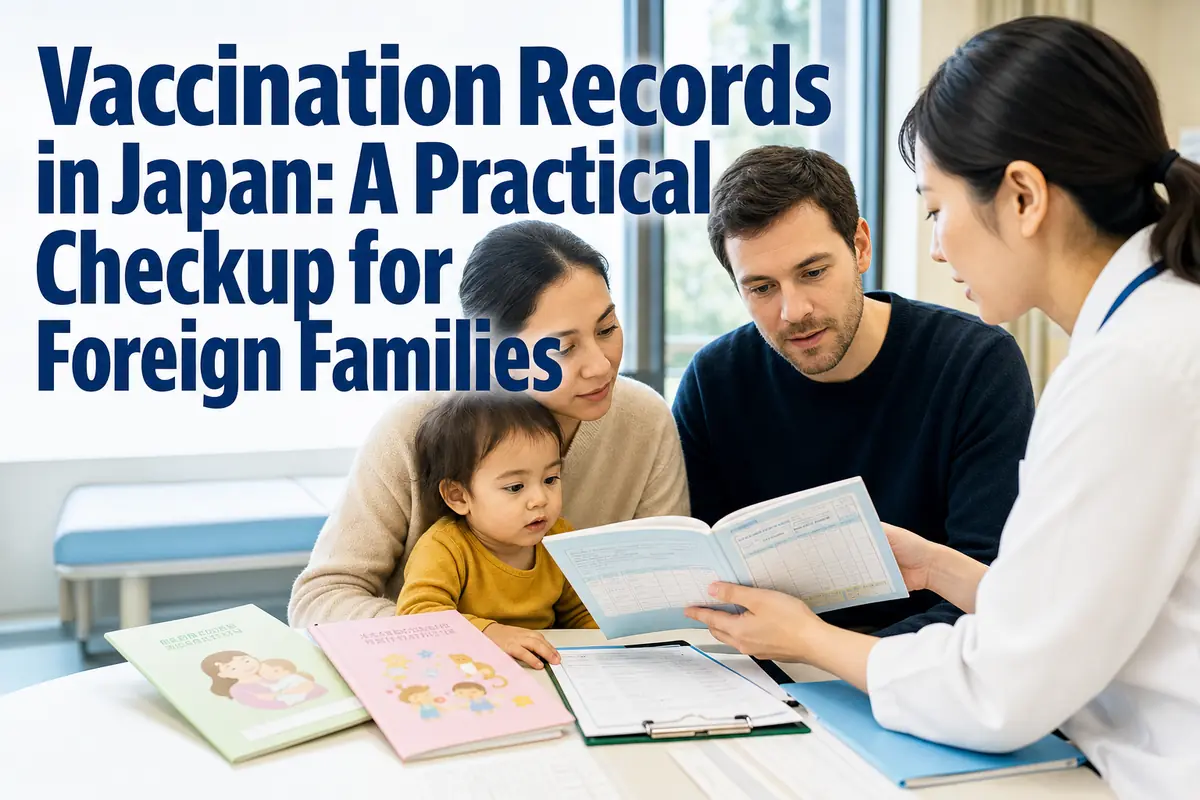
Vaccination Records in Japan: A Practical Checkup for Foreign Families
The quickest way to check which vaccinations you need in Japan is to collect your records, separate routine municipal vaccinations from optional ones, and ask your municipality or a doctor to review any gaps. Japan does not use one universal checklist for every foreign resident.
Age, previous doses, health conditions, occupation, travel plans, and the municipality where you are registered can all change the answer. This guide is for foreign residents checking their own records or arranging vaccinations for their children.
In brief:
- Bring records from every country where you received vaccinations.
- For children, contact the vaccination section of your city or ward soon after registering your address.
- Do not restart a vaccine series simply because a record uses another language or schedule; ask a doctor to assess it.
- Routine vaccinations are usually publicly funded only within the official age, timing, and local procedure.
- Adults often need an individual review because many catch-up and travel vaccinations are voluntary and self-paid.
This article reflects official information available on August 1, 2026. Vaccination schedules and seasonal programs can change, so confirm the current details before booking.
Start with three different questions
“What do I need?” can mean three different things in Japan. Identifying the right question prevents unnecessary appointments and costs.
1. Are you eligible for a routine vaccination?
Japan’s routine vaccination system, called teiki sesshu (定期接種), covers specified vaccines for people who meet conditions such as age and residence. Municipalities deliver these national programs locally.
This matters most to families with children. Routine childhood vaccines cover diseases including hepatitis B, rotavirus, pneumococcal disease, diphtheria, pertussis, polio, tetanus, Hib disease, tuberculosis, measles, rubella, chickenpox, Japanese encephalitis, and HPV infection at designated ages.
The timing can be strict. Some vaccines have narrow age limits, particularly rotavirus vaccination. Contact the municipality promptly instead of waiting for the next general health check.
2. Are you missing protection recommended for your situation?
An adult may be outside the routine program but still have a reason to discuss vaccination with a doctor. Examples include:
- no reliable record of measles vaccination;
- pregnancy planning or a family member expecting a baby;
- work in health care, education, childcare, or another setting with exposure requirements;
- an underlying condition or treatment that changes infection risk;
- overseas travel;
- a vaccine series started outside Japan but not completed.
These are individual medical decisions. A municipality can explain its programs, but a doctor should assess medical suitability and whether previous doses count.
3. Does an employer, school, or destination require evidence?
A workplace, university, training program, or overseas destination may request vaccination records even when the vaccination is not part of Japan’s routine public program.
Ask exactly what evidence is accepted. A request for “proof of immunity” might mean one of the following:
- a vaccination certificate;
- a record showing a specified number of doses;
- an antibody test result;
- a medical certificate completed on the organization’s form.
These documents are not interchangeable. Confirm the required vaccine, dose count, language, test method, deadline, and form before paying for tests or additional doses.
Build one usable vaccination record
Your first practical task is to create a dated list of doses already received. The vaccine brand is helpful, but the disease covered and date of administration are usually more important for an initial review.
Gather any available documents:
- childhood vaccination cards;
- clinic or hospital records;
- school health records;
- digital records from another country;
- COVID-19 certificates;
- military, university, or employer records;
- the Japanese Maternal and Child Health Handbook, known as the Boshi Kenko Techo (母子健康手帳), for a child.
For each dose, record:
- disease or vaccine name;
- vaccination date;
- dose number, if shown;
- product name and manufacturer, if available;
- country and medical provider;
- notes about a combination vaccine.
A combination vaccine can create confusion. For example, a record may use DTaP-IPV-Hib, while a Japanese form uses Japanese names or abbreviations for the five diseases. Do not assume that differently named products are either identical or incompatible. Let a clinician compare their components and dates.
If the record is not in Japanese
Keep the original. Add a clear translation or summary rather than writing over it.
Ask the municipality or clinic whether it needs a formal translation. Requirements differ: one office may accept an English record, while another may need the vaccine names and dates translated into Japanese. A self-prepared table can help staff understand the history, but it does not replace an original certificate when formal proof is required.
If the record is missing
Do not guess dates and present them as confirmed history. Mark them as unknown.
A doctor may consider your age, country of birth, likely childhood schedule, previous illness, exposure risk, and the reason evidence is needed. Depending on the vaccine and situation, the next step could be record retrieval, an antibody test, vaccination, or no immediate action.
Antibody testing is not a universal substitute for records. Tests are not equally useful for every disease, and the organization requesting evidence may have its own rules.
ここがポイント: Japan’s schedule is a framework for vaccinations delivered in Japan, not proof that every person arriving from abroad must begin again. Previous valid doses may count, but a municipality or clinician needs accurate dates and vaccine details to decide.
How to arrange routine vaccinations for a child
Families should contact the city or ward where their address is registered, even if the child has already received several doses overseas. The municipality manages eligibility documents and participating medical facilities.
Step 1: Register your address
Municipal vaccination administration is generally linked to residence information. After moving into a municipality, make sure the child’s address registration is complete.
If you move to another city or ward, old vaccination forms may no longer be valid. Ask the new municipality to issue the correct documents before the next appointment.
Step 2: Contact the vaccination or maternal-and-child health desk
Tell the office:
- the child’s date of birth;
- the date the family registered locally;
- which vaccines were received overseas;
- whether any series is in progress;
- the language in which you need assistance.
Do not wait only for documents to arrive by post. Yokohama, for example, tells families to contact its vaccination call center when an eligible child has not received the expected paperwork. Its English guidance also provides sample translated screening questionnaires, while requiring patients to complete the official questionnaire used for the appointment.
Step 3: Ask for an individualized schedule
Japan’s standard ages and intervals may differ from those in your previous country. A municipality or participating doctor can identify:
- doses that can be recorded as completed;
- routine doses still available within the eligible period;
- the earliest safe date for the next dose;
- doses that have become voluntary because the routine age window has passed;
- vaccines used abroad that do not have a direct equivalent in the local program.
This review is especially important for babies. Delaying the discussion can close an age-limited vaccination window.
Step 4: Confirm the provider and documents
Routine vaccination paperwork cannot necessarily be used at every clinic. Confirm that the clinic participates in the municipal program and whether an appointment is required.
A municipality may ask you to bring:
- the official screening questionnaire or vaccination ticket;
- the Maternal and Child Health Handbook;
- overseas vaccination records and translations;
- proof of address or another identification document;
- information about current medicines, allergies, and health conditions.
Yokohama’s published child-vaccination guidance, for example, lists the Maternal and Child Health Handbook or another vaccination record, proof of address, and the official screening questionnaire. Your own city may use different forms.
Step 5: Record the dose immediately
Before leaving, check that the date, vaccine, and provider have been entered in the child’s handbook or certificate. Keep a scan or photograph as a backup.
A municipal database is useful, but families still need portable records when moving within Japan, returning overseas, enrolling in school, or visiting a different clinic.
What adults should check
Adults usually need a risk-based review rather than the childhood schedule alone. Start with measles and rubella records, tetanus-containing vaccines, seasonal programs relevant to your age or health, occupational requirements, and travel plans.
Measles and rubella
Japan normally uses the combined MR vaccine for routine measles and rubella vaccination. This is different from the MMR abbreviation familiar in many countries: MMR also includes mumps.
The Ministry of Health, Labour and Welfare advises adults with uncertain measles infection or vaccination histories—particularly people working in medical or educational settings and those planning overseas travel—to consider consulting a doctor about vaccination.
This deserves attention in 2026 because the ministry issued measles alerts following increased reports in Japan and overseas. It also published supply-related updates for MR vaccine. Availability can therefore differ between clinics, even when vaccination is medically appropriate.
Do not treat your birth year as proof of vaccination. The ministry notes that people born on or after April 2, 1990, generally had access to two routine measles-containing doses, while many people born earlier received only one. Access to a program is not the same as a personal record showing completed doses.
Mumps is a separate issue
A foreign record marked MMR includes mumps, but Japan’s routine MR vaccination does not. Mumps vaccination is generally handled as a voluntary vaccination in Japan.
This difference matters when a school or employer asks for MMR evidence. Show the requesting organization your actual record and ask whether it requires mumps vaccination, measles and rubella evidence separately, or antibody results.
Influenza and COVID-19
Seasonal influenza vaccination is commonly available, but public funding is limited to specified routine-program groups and any additional local subsidy. Many working-age adults arrange it privately or through an employer.
COVID-19 vaccination also moved away from the earlier emergency mass-vaccination system. As of August 1, 2026, the health ministry’s current page says details of the fiscal 2026 routine program will be announced when decided. Do not rely on old English pages describing free vaccination tickets or schedules that ended in March 2024.
Before the autumn and winter season, check:
- the latest health ministry announcement;
- your municipality’s eligible ages and dates;
- whether your clinic offers the current product;
- the fee after any local subsidy;
- whether your employer runs a separate program.
Vaccines related to age or medical risk
Japan has routine programs for certain older adults and people with specified medical conditions. Depending on the current rules, these can include seasonal influenza, pneumococcal disease, COVID-19, and shingles.
Eligibility is not based simply on wanting the vaccine. It may depend on a particular age during the fiscal year, a defined disability or medical condition, and the municipality’s designated period. People outside the routine conditions may still be able to receive a vaccine voluntarily after medical consultation, usually at their own expense.
Routine, voluntary, and organization-based vaccination
The person who sets the conditions also determines where you must confirm the details. Mixing the three systems is a common source of wrong assumptions.
Routine vaccination
The national framework specifies diseases and eligible groups. Municipalities administer the program, issue forms, publish participating providers, and may set local procedures.
A routine vaccination is commonly provided without an out-of-pocket charge when you meet the eligibility and procedural conditions. Ask the municipality rather than assuming that any clinic visit will be free.
Voluntary vaccination
A voluntary vaccination, or nin’i sesshu (任意接種), is outside the routine entitlement for that person or timing. This does not mean that it is unimportant. It means the legal and payment route is different.
Examples can include:
- a catch-up dose outside the routine age range;
- mumps vaccination;
- seasonal vaccination for a person outside the publicly funded group;
- a vaccine requested for work, study, or travel.
Clinics set their own fees. The total may include the vaccine, consultation, certificate, translation, or antibody test. Ask for the full price and number of expected visits before booking.
Some municipalities subsidize selected voluntary vaccines. A neighboring ward may not offer the same support, so always check the website for your registered address.
Employer, school, or institutional arrangements
An employer or school may recommend vaccination, arrange a clinic, reimburse costs, or require specified evidence for a placement. This is separate from municipal eligibility.
Ask the organization:
- Is vaccination mandatory for this role or only recommended?
- Is a previous overseas dose accepted?
- Is an antibody test accepted?
- Who pays?
- Which clinic or form must be used?
- What happens if a doctor advises against vaccination?
Status of residence alone does not tell you which vaccination evidence an employer, university, hospital placement, or destination country may request. Check with the organization that issued the requirement.
Costs and deadlines to confirm before booking
The largest cost difference is usually not nationality but whether the dose is routine, subsidized, employer-funded, or fully voluntary. A resident can still be charged if the appointment falls outside the funded conditions.
Use this checklist:
- Is the vaccine routine for my age and condition?
- Must I use a municipal ticket or questionnaire?
- Is this clinic a designated provider?
- Does the funded period end on a birthday, a specific date, or the end of the fiscal year?
- Does the municipality offer a local subsidy?
- Is the consultation or certificate charged separately?
- Will my employer or school reimburse the cost?
- How many doses and visits are likely to be needed?
Routine vaccination is preventive care, so do not assume that presenting a health insurance card will automatically produce the same copayment used for treatment. Ask the clinic how the appointment will be billed.
A deadline can affect both cost and access. If a child passes the routine age limit, a later dose may become voluntary. Seasonal programs also have defined periods, and travel vaccines may require several appointments well before departure.
Pregnancy, health conditions, and vaccine safety
A schedule found online cannot replace a pre-vaccination medical review. Tell the clinic about pregnancy, pregnancy plans, immune-suppressing treatment, allergies, previous serious reactions, fever, and current illness.
Live vaccines require particular care in some circumstances. Do not choose or postpone a vaccine based only on its English name; bring the exact product record and ask a clinician.
If you cannot communicate important medical details comfortably in Japanese, ask when booking whether the clinic can provide language support. A translated sample questionnaire can help you understand the questions, but the clinic may still require its official Japanese form.
Japan has a relief system for health problems officially recognized as caused by routine vaccination. The Ministry of Health, Labour and Welfare explains the benefit categories and application route; the process normally begins through the municipality. Different legal routes may apply to vaccinations outside the routine program. Seek medical care first if you become unwell, then ask the municipality or provider which reporting and support process applies.
Travel vaccines are a separate checklist
Living in Japan does not mean Japan’s routine schedule covers the risks at your next destination. Check travel vaccines according to the country, route, season, activities, and length of stay.
Start several weeks or months before departure because some series need multiple doses. Use the Ministry of Health’s FORTH travel-health service to check destination information and find vaccination facilities.
Yellow fever is a special case. It is available only at designated facilities in Japan, and some countries require an International Certificate of Vaccination or Prophylaxis. Transit-country rules can matter as well. FORTH advises travelers to check the entire route and confirm entry requirements with the relevant embassy.
The yellow fever certificate becomes valid 10 days after vaccination and remains valid for life under the current international rule. Appointment availability and facility-specific procedures still need advance confirmation.
Common mistakes and how to avoid them
Most problems come from treating different records, funding routes, or deadlines as if they were interchangeable. These checks prevent avoidable delays.
- Waiting for a municipal letter: Contact the city or ward if an eligible child’s documents do not arrive.
- Assuming an overseas series must restart: Ask a doctor to assess vaccine components, dates, and intervals first.
- Assuming MMR and MR are the same: Japan’s MR vaccine does not include mumps.
- Using a translated sample as the official form: Municipalities may publish translations for reference but still require their own questionnaire.
- Booking any nearby clinic: Routine forms may work only at participating providers.
- Missing an age window: Ask immediately about babies, newly arrived children, and catch-up vaccination.
- Assuming health insurance sets the price: Preventive voluntary vaccinations often use clinic-set fees.
- Paying for an antibody test without checking: The requesting organization may accept only documented doses or a particular test.
- Using an old COVID-19 page: Confirm the fiscal-year program on the current ministry and municipal pages.
- Waiting until shortly before travel: Some vaccines need multiple appointments, and yellow fever certificates are not valid immediately.
A practical action plan
You can turn an uncertain history into a workable plan without deciding every vaccine yourself. Follow this order:
- Collect original records from Japan and overseas.
- Make a one-page list of diseases, dose dates, products, and countries.
- For a child, contact the municipality’s vaccination or maternal-and-child health desk.
- For an adult, book a clinic review based on age, health, occupation, family situation, and travel.
- Ask the employer, school, or destination exactly which evidence it accepts.
- Confirm eligibility, provider, fee, number of visits, and deadline before receiving a dose.
- Store the updated paper record and a digital copy.
The next watchpoint in 2026 is the fiscal 2026 COVID-19 program, whose details had not yet been published on the ministry’s current page as of August 1. Families should also continue checking measles notices and local MR vaccine availability rather than assuming every clinic has immediate stock.
参照リンク
- Ministry of Health, Labour and Welfare: Vaccination FAQ
- Ministry of Health, Labour and Welfare: Measles information in English
- Ministry of Health, Labour and Welfare: Current measles notices and vaccine updates
- Ministry of Health, Labour and Welfare: Vaccine supply information
- Ministry of Health, Labour and Welfare: Current COVID-19 vaccination information
- Ministry of Health, Labour and Welfare: Vaccination Health Damage Relief System
- City of Yokohama: Vaccinations for children
- FORTH: Vaccines for overseas travel
- Tokyo Quarantine Station: Yellow fever vaccination FAQ