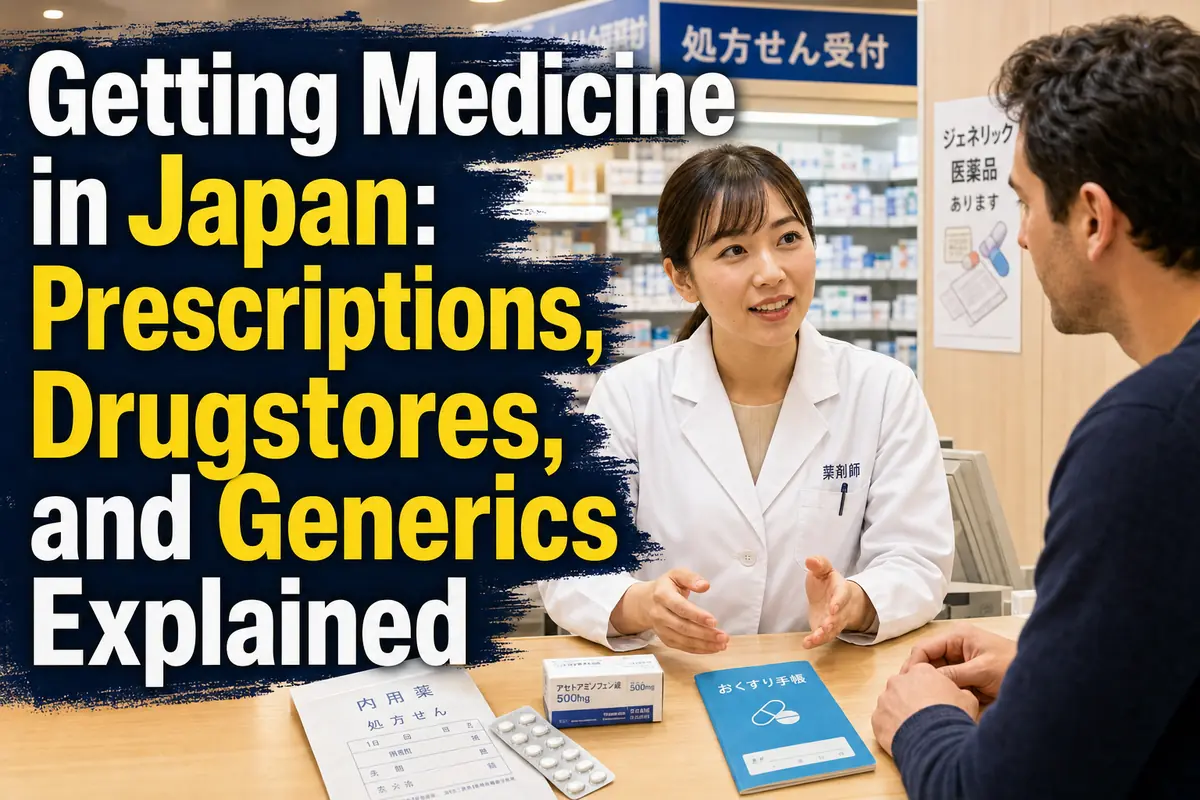
Getting Medicine in Japan: A Practical Pharmacy Guide for Foreign Residents
In Japan, a prescription from a clinic or hospital is usually filled at a separate dispensing pharmacy. Bring the prescription promptly: in most cases, it is valid for only four calendar days, including the day it was issued and any weekends or public holidays.
A regular drugstore is different. It may sell non-prescription medicine, cosmetics, food, and household goods, but it cannot replace a doctor’s prescription with an over-the-counter product simply because the symptoms seem similar.
This guide is for foreign residents, students, workers, and family members who need to collect prescribed medicine or choose a basic non-prescription treatment.
The essentials:
- Look for 処方せん受付 (shohōsen uketsuke, “prescriptions accepted”) when filling a prescription.
- Take the prescription, your health-insurance document, and your medication record if you have one.
- Ask about a generic before requesting a brand-name medicine; choosing some older brand-name products can cost extra.
- Tell the pharmacist about allergies, pregnancy, other medicines, supplements, and non-prescription products.
Dispensing pharmacies and drugstores do different jobs
The most important distinction is whether you already have a prescription. The word “pharmacy” can describe several kinds of business in English, but the signs and services differ in Japan.
A dispensing pharmacy fills prescriptions
A dispensing pharmacy is commonly called a chōzai yakkyoku (調剤薬局). It has a pharmacist who checks the prescription, prepares the medicine, explains how to use it, and reviews possible duplication or interactions.
Many clinics have one or more pharmacies nearby, but you are generally not required to use the nearest one. You can take the prescription to another insurance dispensing pharmacy if it stocks the medicine and can fill it before the prescription expires.
Useful signs include:
- 薬局 — pharmacy
- 調剤薬局 — dispensing pharmacy
- 処方せん受付 — prescriptions accepted
- 保険薬局 — pharmacy providing services under public health insurance
Opening hours matter. A drugstore may remain open late while its prescription counter closes earlier. Check the hours of the dispensing department, especially before a weekend or holiday.
A drugstore mainly sells products without prescriptions
A doraggu sutoa (ドラッグストア) may sell cold remedies, pain relievers, stomach medicine, skin products, toiletries, and groceries. Some branches also operate a prescription counter, while others do not.
Non-prescription medicines are called OTC medicines, ippan-yō iyakuhin (一般用医薬品), or over-the-counter drugs. Japan also has products that require guidance from a pharmacist. Availability may therefore depend on whether the appropriate professional is working at that time.
PMDA, Japan’s medicines regulator, distinguishes prescription drugs, OTC drugs, and “behind-the-counter” products that require a pharmacist’s advice. This matters because a package displayed in a store is not proof that every customer can buy it without consultation.
Cosmetics and quasi-drugs are not the same as medicines
Drugstores also carry many products marked 医薬部外品 (iyakubu-gaihin, quasi-drug). These include certain medicated skin, oral-care, and hygiene products. They are regulated products, but they are not interchangeable with prescription or OTC medicines.
If you need treatment for a symptom, show the pharmacist the exact product or explain the symptom instead of choosing only by packaging or an English word on the label.
How to fill a prescription step by step
The safest routine is to go to a dispensing pharmacy immediately after the medical appointment. Waiting can create a deadline problem or leave too little time for the pharmacy to obtain an out-of-stock medicine.
1. Check the issue date before leaving the clinic
A standard insurance prescription is valid for four days including the issue date. Saturdays, Sundays, and public holidays count.
For example, a prescription issued on Friday normally expires on Monday. It does not automatically remain valid until the next business day.
A doctor or dentist may specify a longer period when special circumstances, such as planned travel, justify it. This needs to be addressed when the prescription is issued. A pharmacy normally cannot extend an expired prescription by itself.
2. Find a pharmacy that accepts prescriptions
Search for a pharmacy displaying 処方せん受付. If your medicine is unusual, refrigerated, or needed urgently, call ahead when possible.
The pharmacy may not have every product in stock. It might offer to order the medicine, contact the prescriber about an alternative, or direct you to another pharmacy. Do not assume that every branch of the same chain carries the same stock.
3. Bring the necessary items
For an insurance prescription, prepare:
- The original paper prescription, or the information needed for an electronic prescription
- A My Number Card registered for health-insurance use, or another currently valid eligibility document
- Your okusuri techō (お薬手帳), the Japanese medication record, if you have one
- Payment by a method accepted at that pharmacy
- A list or photographs of medicines, supplements, and herbal products you use
A residence card is not normally the document that proves health-insurance eligibility. If you are unsure which insurance document is accepted, confirm with the pharmacy or your insurer.
4. Complete the pharmacy questionnaire
On a first visit, the pharmacy may ask about:
- Allergies and previous adverse reactions
- Pregnancy or breastfeeding
- Current illnesses
- Other prescriptions, OTC medicines, supplements, or traditional remedies
- Alcohol use or other factors relevant to the medicine
Ask for help rather than guessing. Translation support varies by pharmacy, so keeping key medical information in both English and simple Japanese can save time.
5. Speak with the pharmacist before paying
The pharmacist may ask questions, explain the dose, or contact the clinic. This is a safety check, not a second medical examination.
Before leaving, confirm:
- How much to take and at what time
- Whether “after meals” has a specific timing for this medicine
- What to do after a missed dose
- Whether driving, alcohol, food, or supplements require caution
- How the medicine should be stored
- Which symptoms require medical attention
Do not change the dose or stop an important prescription solely because the package is difficult to understand. Contact the prescribing clinic or pharmacist first.
ここがポイント: A prescription is not merely a shopping list. The pharmacist must check the prescribed medicine, your other treatments, and how it should be used before dispensing it.
What you will pay at the pharmacy
The final bill is not simply the retail price of the tablets. It can include the medicine’s regulated price and fees for dispensing, safety checks, instructions, and pharmacy services.
If public health insurance applies, the patient pays the applicable share under the insurance system. Many working-age adults pay 30%, but the percentage can differ by age, income, insurance status, public assistance, and medical-subsidy programs.
The amount may also change with:
- The medicine and quantity prescribed
- The number of days supplied
- Whether a generic is used
- The pharmacy’s applicable dispensing charges
- Time-of-day or holiday-related charges
- Special services, such as packaging doses together when appropriate
- Local or employer-related subsidy programs
Ask for an itemized receipt if you need to understand the charge or claim reimbursement elsewhere. A quoted percentage alone cannot predict the exact total.
What happens without confirmed insurance eligibility?
If the pharmacy cannot confirm coverage, you may be asked to pay the full amount temporarily. Whether and how you can later claim reimbursement depends on your insurer and circumstances.
Contact the insurer promptly and keep the prescription-related documents and receipts. Do not assume that the pharmacy can automatically refund the difference after the fact.
Generic medicines and the extra cost of some brands
A generic medicine has the same active ingredient as the corresponding original product, but its name, manufacturer, inactive ingredients, shape, or packaging may differ. Japanese authorities require approval data, including quality and bioequivalence information, for generic products.
A generic can reduce the bill, but it may not exist for every medicine or be available at every pharmacy. The pharmacist also has to follow the prescriber’s instructions on whether substitution is permitted.
Useful questions include:
- “Is a generic available?”
- “Does it contain the same active ingredient and strength?”
- “Are the tablet size, coating, or inactive ingredients different?”
- “Can I try a short supply if the prescription allows it?”
Why requesting the original brand can now cost more
Since October 1, 2024, Japan has applied an additional charge to certain long-listed original medicines when a generic exists and the patient chooses the original product without a medical reason.
Under the system, the special charge is based on one-quarter of the difference between the official prices of the original medicine and the relevant generic. The ordinary insurance copayment still applies to the insured portion, and the special charge is handled separately. The exact amount therefore depends on the product and the patient’s coverage.
The additional charge generally does not apply when:
- The doctor or dentist determines that the original medicine is medically necessary
- A pharmacist determines that substitution is unsuitable under the applicable rules
- A generic cannot be supplied because of stock or distribution conditions
- The medicine is outside the official list covered by the system
The Ministry of Health, Labour and Welfare updates the covered-product information. As of August 2026, readers should check the current official list rather than relying on an old receipt or an online product list.
If you previously had a reaction to a formulation, describe what happened. Do not merely say that you “prefer the brand.” A prescriber or pharmacist needs concrete information—such as the product, symptom, timing, and suspected ingredient—to assess whether there is a medical reason to avoid a substitution.
Buying medicine without a prescription
Use OTC medicine for appropriate minor symptoms, not as a substitute for diagnosis when symptoms are severe, persistent, or unusual. A familiar brand from another country may have a different formula in Japan, and a familiar ingredient may be sold under an unfamiliar name.
Risk categories affect how a product is sold
Japanese OTC products are divided into categories according to risk. Products requiring guidance and Class 1 OTC medicines require involvement from a pharmacist. Other categories may be handled by a pharmacist or a registered seller under the applicable rules.
In practical terms:
- Some products are kept behind a counter or in locked displays.
- Staff may ask who will use the medicine and what symptoms they have.
- A product may be unavailable when the required pharmacist is absent.
- Online sale and information requirements vary by category.
This is a national regulatory framework. Store hours, stock, language support, and the availability of a pharmacist differ by branch and location.
Information to give the pharmacist
Before buying an OTC product, mention if any of these apply:
- The medicine is for a child or an older adult
- You are pregnant, may be pregnant, or are breastfeeding
- You have asthma, glaucoma, high blood pressure, kidney or liver disease, or another ongoing condition
- You take prescriptions, sleep aids, cold remedies, pain relievers, or supplements
- You have a medicine or food allergy
- You must drive, operate equipment, or avoid drowsiness
PMDA advises people receiving treatment, those who are pregnant or breastfeeding, and those with allergies to consult a pharmacist or other qualified professional because some OTC medicines may be unsuitable.
Check active ingredients, not just brand names
Combination cold remedies may contain several ingredients. Taking one together with a separate pain reliever, antihistamine, cough medicine, or sleep aid can duplicate an ingredient or increase drowsiness.
Bring the package—or a clear photo of the ingredient panel—when asking for help. An overseas brand name alone may not tell a Japanese pharmacist which formulation you used.
Paper prescriptions, electronic prescriptions, and medication records
Electronic systems can make prescription handling easier, but they do not contain every medicine you take. Keep your own complete list.
At participating medical institutions, a prescription can be issued through Japan’s electronic prescription system. At a participating pharmacy, this can reduce the need to carry a paper prescription and can support checks of recent prescription and dispensing data.
Important limitations remain:
- Not every clinic and pharmacy supports every electronic function.
- The prescription deadline still applies.
- OTC purchases are not automatically included in the electronic prescription history.
- Consent and identification steps may be needed to share past medication information.
- A printed exchange document or prescription information may still be provided, depending on the workflow.
An okusuri techō remains useful. Pharmacies can record medicine names, doses, and dates in the paper booklet or a compatible app. Show the same record at different clinics and pharmacies so a pharmacist can spot possible duplication.
If you use an app, make sure you can access the information when your phone has no signal, loses power, or is replaced.
Common mistakes that cause delays or safety problems
Most avoidable problems come from missed deadlines or incomplete medication information. A few minutes of preparation can prevent another clinic visit.
- Waiting until the prescription expires: Four days means calendar days, not business days.
- Going to a drugstore without checking for a dispensing counter: A store can sell OTC medicine without filling prescriptions.
- Assuming the nearest pharmacy must be used: You can generally choose another insurance pharmacy, subject to stock and opening hours.
- Hiding OTC products or supplements: These can matter when checking interactions and duplicate ingredients.
- Requesting a brand without asking about the charge: Some eligible original medicines carry a special additional payment when chosen for non-medical reasons.
- Using an overseas brand name as the only reference: Formulations can differ between countries.
- Taking medicine from a previous illness: The symptom may have a different cause, and the stored medicine may be expired or inappropriate.
- Sharing prescribed medicine: The dose and safety checks were for the named patient.
- Discarding the explanation sheet immediately: It may contain dosing, storage, and warning information needed later.
Special situations to plan for
Children, travel, language barriers, and continuing treatment from overseas require extra preparation. The pharmacy can help with dispensing, but it cannot independently rewrite a prescription or diagnose a new condition.
Medicine for children
Give the child’s current age and weight. Do not estimate a child’s dose by dividing an adult tablet unless a doctor or pharmacist specifically instructs you to do so.
Ask whether a powder, syrup, or tablet is being supplied and how it should be measured or stored. Household teaspoons are not precise measuring devices.
Regular treatment started outside Japan
A foreign prescription is not automatically fillable at a Japanese pharmacy. Bring a medical summary showing the active ingredient, strength, dose, reason for use, and allergy history, then consult a medical institution in Japan before the current supply runs out.
The same brand may be unavailable or may use a different name. The Japanese clinician decides what can appropriately be prescribed under the local system.
Travel and prescription timing
If travel will make it difficult to fill a prescription within four days, discuss this with the prescriber before leaving the clinic. A pharmacy cannot simply overlook the national validity rule because the patient was away.
For ongoing medication, ask early about the appropriate supply and any documentation needed for travel. Rules for carrying medicine across borders are separate from the rules for filling it in Japan.
Language support
English service is not guaranteed, even in large cities. Useful phrases include:
- 処方せんがあります。 (Shohōsen ga arimasu.) — I have a prescription.
- ジェネリックはありますか。 (Jenerikku wa arimasu ka?) — Is a generic available?
- この薬を飲んでいます。 (Kono kusuri o nonde imasu.) — I take this medicine.
- 薬のアレルギーがあります。 (Kusuri no arerugī ga arimasu.) — I have a medicine allergy.
- 英語の説明はありますか。 (Eigo no setsumei wa arimasu ka?) — Is an English explanation available?
A translation app can support communication, but do not rely on machine translation alone for dosage or urgent safety warnings. Ask the pharmacist to confirm numbers, units, and timing.
When to see a doctor instead of self-treating
A drugstore is not an emergency service. Seek medical help when symptoms are severe, rapidly worsening, recurring, or outside the safe scope of self-care.
Examples include difficulty breathing, loss of consciousness, signs of a severe allergic reaction, sudden weakness, heavy bleeding, severe dehydration, or a suspected overdose. Call Japan’s emergency number, 119, when immediate emergency assistance is needed.
For a possible adverse reaction that is not an immediate emergency, stop and seek professional advice according to the medicine’s instructions. Keep the package, prescription information, and details of when the symptoms began.
A practical checklist before your next pharmacy visit
Go early, carry a complete medication record, and ask about generic options before the medicine is prepared. Those three actions prevent many of the most common problems.
Before leaving the clinic or home, check:
- Is the prescription still within its four-day validity period?
- Does the destination have a prescription counter, and is it open?
- Do I have valid insurance eligibility documentation?
- Have I listed prescriptions, OTC products, supplements, and allergies?
- Do I want to ask whether a generic is available?
- If I prefer an original brand, have I asked whether an extra charge applies?
- Do I understand the dose, storage instructions, and warning signs before leaving?
The next practical watchpoint is availability. Electronic prescribing is expanding and official lists of medicines subject to the brand-name special charge are updated, but individual pharmacies still differ in stock and system support. Confirm both before the prescription deadline—not after it.
参照リンク
- Ministry of Health, Labour and Welfare: Prescription validity period
- Ministry of Health, Labour and Welfare: Long-listed original medicines and special charges
- Ministry of Health, Labour and Welfare: Q&A on the special charge introduced in October 2024
- Ministry of Health, Labour and Welfare: Electronic prescription Q&A for patients
- Ministry of Health, Labour and Welfare: My Number Card as a health-insurance certificate
- PMDA: Reviews of prescription, generic, OTC, and behind-the-counter medicines
- PMDA: Promoting the use of generic medicines
- PMDA: Safety advice for OTC medicines
- PMDA: OTC medicine information search