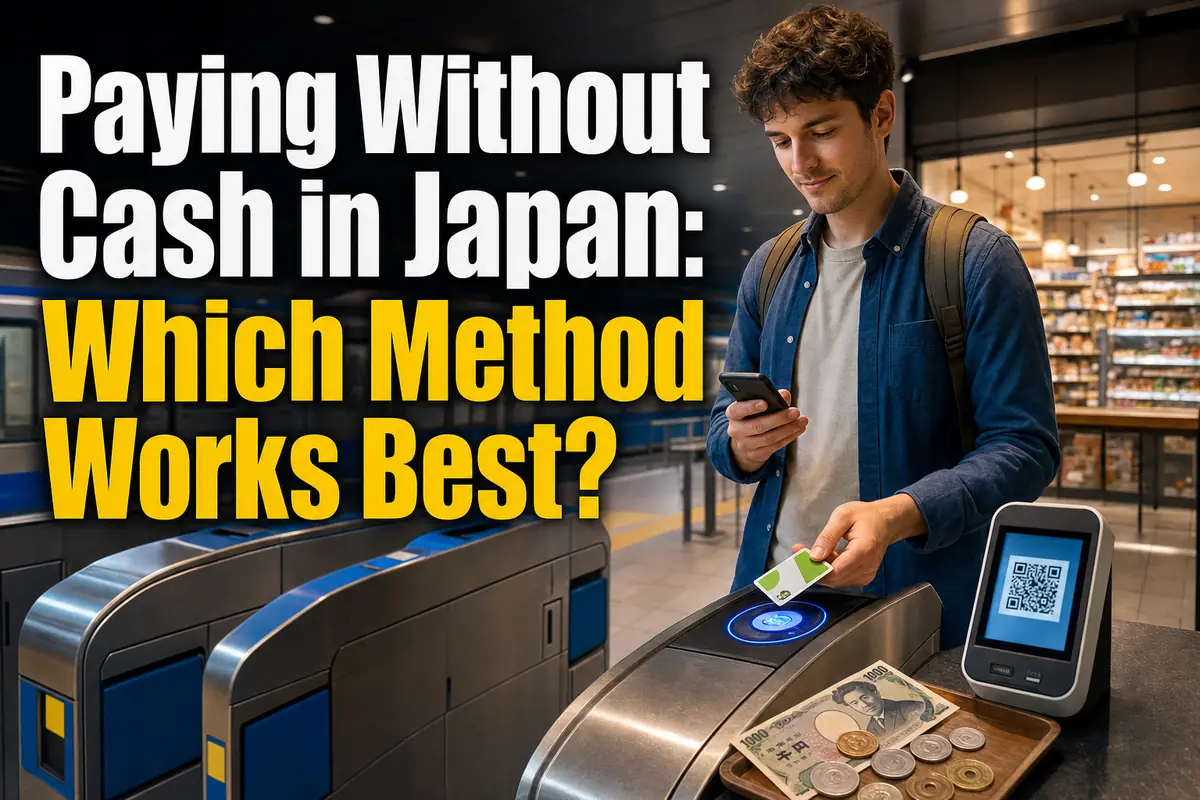
Paying Without Cash in Japan: Which Method Works Best?
For most foreign residents, the best setup is not one payment method but three: a transport IC card for trains and small purchases, a credit or debit card for larger payments, and some cash as a backup. Add a Japanese QR payment app only if its rewards or local acceptance justify the extra setup.
This matters when you commute, shop at small businesses, split household spending, or pay somewhere that accepts only selected payment brands. Japan is increasingly cashless, but acceptance is still not uniform.
The short version
- Transport IC card: fastest for trains, buses, vending machines, and small purchases.
- Credit card: usually best for larger purchases, online shopping, travel bookings, and consumer protections provided by the issuer.
- Debit card: useful for spending directly from a bank account, but refunds and temporary holds can be inconvenient.
- QR payment: useful at many shops and for rewards, but registration and funding rules can be difficult for newcomers.
- Cash: still worth carrying for emergencies and cash-only businesses.
As of August 2026, Japan’s Ministry of Economy, Trade and Industry reports that cashless payments represented 58.0% of consumer payment value in 2025. Credit cards accounted for 82.7% of that cashless value, while code payments accounted for 10.2%, electronic money for 3.7%, and debit cards for 3.4%. These figures measure payment value, not how many shops accept each method.
The best choice depends on the payment
Use each method where it solves a specific problem. Trying to force every purchase through one app or card creates more trouble than convenience.
A practical everyday arrangement looks like this:
- Commute and buy a drink: transport IC card
- Pay for groceries or household goods: credit or debit card
- Shop at a QR-focused local merchant: QR app
- Pay at a cash-only clinic, restaurant, ticket machine, or rural business: cash
- Reserve a hotel or rental car: usually a credit card, because the business may place a temporary authorization hold
ここがポイント: Japan is cashless enough that one digital method is useful, but fragmented enough that a backup remains necessary.
Transport IC cards: the fastest option for daily movement
A transport IC card is usually the first cashless tool a newcomer should obtain. Cards such as Suica, PASMO, ICOCA, Kitaca, TOICA, manaca, SUGOCA, nimoca, and Hayakaken participate in nationwide mutual-use arrangements across many transport networks and shops.
You load money in advance and tap the card or supported phone at a reader. The payment comes from the stored balance, so it is closer to prepaid electronic money than to a credit card.
Where an IC card works well
Transport IC cards are especially useful for:
- Local trains, subways, and participating buses
- Convenience stores and station shops
- Vending machines and coin lockers displaying a compatible IC logo
- Cafés, supermarkets, and other participating retailers
- Very small purchases where opening an app would be slower
A regular physical Suica can hold up to ¥20,000. JR East states that physical Suica cards are topped up with cash at compatible ticket and fare-adjustment machines; they cannot be charged there with a credit card. Mobile versions can have different funding options.
Limits that surprise newcomers
Nationwide compatibility does not mean that every journey can be completed with one tap. An IC card may not support continuous travel across separate railway IC areas. Limited express services, Green Cars, and Shinkansen travel can also require an additional ticket, reservation, or service connection.
Other practical limits include:
- A shop may accept one form of cashless payment but not transport IC cards.
- A prepaid balance is not the same as an available bank balance.
- An unregistered physical card may not be replaceable if it is lost.
- Refunds are handled by the issuing operator, not any railway company displaying the mutual-use logo.
- A low balance can stop you at a ticket gate even when another card is in your wallet.
For a regular Suica, JR East lists a ¥500 deposit and a ¥220 refund handling fee deducted from the remaining balance. The ¥500 deposit itself is returned. Terms differ for visitor products and cards issued by other operators.
Physical or mobile IC card?
Choose a physical card if you want a simple tool that does not depend on battery power, phone compatibility, or a successful foreign-card transaction. It is also easier to lend a separate card to an eligible family member, although each passenger must use an individual card and child fares require the correct child product.
A mobile IC card is more convenient when your device is supported. It can allow top-ups through a compatible payment card and may support express transit, which lets you tap without unlocking the phone each time.
JR East’s Welcome Suica Mobile service is available for supported iPhones and lets eligible visitors issue and charge a Suica using a card registered with Apple Pay. The app’s availability, device requirements, operating hours, and ability to issue or charge before arrival depend on the user’s country and settings. Long-term residents should compare it with regular mobile Suica services rather than assuming the visitor version is the best fit.
Credit cards: broad value, but not universal acceptance
Credit cards are the strongest general-purpose option for expensive purchases and online payments. They do not replace an IC card at every transit gate, and a card logo at one branch does not guarantee acceptance at every small business.
A credit card is usually the better choice for:
- Appliances, furniture, and other large purchases
- Hotel and travel reservations
- Online shopping and subscriptions
- Recurring bills when the provider supports card payment
- Purchases where the issuer’s dispute process or purchase-related benefits matter
METI’s 2025 figures show why credit cards remain central: they represented ¥134.6 trillion of Japan’s ¥162.7 trillion in measured cashless payment value.
Foreign-issued cards versus Japanese cards
A foreign-issued Visa, Mastercard, JCB, American Express, or other international card may work wherever its network is accepted, but approval is never guaranteed. The card issuer can reject a transaction because of fraud controls, overseas-use settings, insufficient available credit, or online authentication requirements.
Before relying on a foreign card:
- Tell the issuer about travel or overseas use if its policy requires this.
- Check foreign transaction and currency-conversion fees.
- Confirm that you can receive authentication messages while in Japan.
- Keep a second card from a different issuer or network.
- Know how to contact the issuer if the card is blocked.
A Japanese credit card can be convenient for domestic subscriptions and rewards, but approval depends on the issuer’s screening. Residence status, remaining period of stay, income, employment, address history, and credit information may be considered differently by each company. Having a bank account does not guarantee approval.
Choose yen at the terminal
If a terminal offers to charge a foreign card in your home currency or in Japanese yen, compare the terms carefully. Home-currency charging may include a conversion rate set by the merchant’s service provider. Paying in yen usually leaves conversion to your card network and issuer, but your issuer may still add a foreign transaction fee.
Do not accept a conversion screen automatically. Read the amount and currency before confirming.
Debit cards: simple budgeting with a few hidden complications
Debit is useful when you want purchases taken directly from your bank account. It avoids a monthly credit-card bill, but it does not behave exactly like cash.
Japan has more than one system commonly described as “debit”:
- International-brand debit: a bank-issued Visa, Mastercard, or JCB debit card used through the relevant card network
- J-Debit: a domestic service using participating Japanese bank cash cards at participating merchants
The two are not interchangeable. Look at the logo shown by the merchant and on your card.
When debit is a good fit
Debit can work well for groceries, household spending, and people who prefer not to borrow. Transaction alerts also make it easier to notice unexpected activity quickly.
However, keep enough money in the linked account. A debit transaction can fail even when another savings account at the same bank has funds.
Holds and refunds can tie up your money
Hotels, rental-car companies, fuel stations, and some online services may place a temporary authorization hold. With a credit card, this reduces available credit. With debit, it can reduce the cash available in your bank account.
Refund timing can also differ from the original payment. A merchant may approve a refund promptly while the bank or network takes additional time to restore the balance. Ask both the merchant and card issuer if money has not returned within the period they specify.
For this reason, credit is generally safer than debit for deposits and large travel holds, provided you can manage the bill responsibly.
QR payments: useful after you have settled in
QR payment apps become more attractive once you have a Japanese phone setup and a compatible funding source. They are not necessarily the easiest first payment method for a newly arrived resident.
At checkout, one of two things normally happens:
- You show a barcode or QR code for the cashier to scan.
- You scan the shop’s code, enter the amount, and show the confirmation screen.
Always check the store name and amount before approving the payment. When you enter the amount yourself, an extra zero is an expensive mistake.
Why setup can be difficult
Services such as PayPay, Rakuten Pay, d払い, and au PAY have different eligibility, identity-verification, bank-linking, card, telephone-number, and balance rules. A foreign-issued card may be unsupported even when the same card works directly at a shop.
Depending on the provider and feature, you may need some combination of:
- A Japanese mobile number
- A compatible smartphone and app-store region
- A Japanese bank account or supported card
- Identity verification
- A residence card or other accepted identification
- Name details that match the bank’s records exactly
Successful registration does not mean every funding method or transfer feature becomes available. Confirm the latest conditions on the provider’s official help pages before adding a large balance.
When QR is worth the effort
A QR app makes sense when:
- Shops near your home display that service prominently.
- Your employer, school, or household already uses it for small transfers.
- You can fund it without extra fees or repeated failures.
- Rewards are useful for purchases you would make anyway.
Do not choose an app only because of a temporary campaign. Points can expire, eligible shops can change, and reward rates may be revised.
A direct comparison for everyday situations
No method wins every category. The useful question is what happens when the payment fails, is refunded, or must be completed quickly.
Transport IC card
- Speed: excellent; tap and move
- Setup: easy with a physical card, more device-dependent on mobile
- Budget control: strong because spending is limited to the loaded balance
- Best for: transit and small daily purchases
- Main weakness: limited balance and incomplete acceptance
QR payment
- Speed: good when the app is already open and connected
- Setup: can be demanding for new residents
- Budget control: depends on whether it uses a prepaid balance, bank account, or credit function
- Best for: participating local shops, campaigns, and app-based transfers where supported
- Main weakness: service-specific eligibility and dependence on the phone, app, and network
Credit card
- Speed: good, especially with contactless payment
- Setup: easy with an existing foreign card; approval for a new Japanese card varies
- Budget control: requires attention because payment is delayed
- Best for: larger purchases, reservations, online shopping, and recurring payments
- Main weakness: possible interest, foreign transaction fees, screening, or issuer blocks
Debit card
- Speed: similar to a card-network credit card
- Setup: generally tied to a compatible bank account
- Budget control: strong because funds come from the account
- Best for: routine purchases without a later credit bill
- Main weakness: authorization holds and slow refunds can restrict access to your money
Cash
- Speed: varies
- Setup: none
- Budget control: clear and immediate
- Best for: emergencies, cash-only shops, and machines with limited payment support
- Main weakness: no remote lock or replacement for lost banknotes
Build a payment setup in four steps
Start with reliability, then add convenience. New residents do not need four apps on their first day.
1. Keep emergency cash
Carry enough yen for transport, a meal, and another essential purchase. The right amount depends on where you live and how far you travel; rural areas and small independent businesses may give you fewer cashless options.
Do not keep all your cash, cards, and phone in the same place.
2. Set up a transport IC card
Choose the card commonly issued in your region, while checking whether it carries the nationwide mutual-use symbol. Decide between physical and mobile based on your device, charging options, and need for loss protection.
Test it on a normal local trip before depending on it for a time-sensitive journey.
3. Add one general-purpose card
Use a credit card if you need hotel bookings, online purchases, or stronger separation between a disputed payment and your bank balance. Use debit if direct account deduction is more important and you can tolerate possible holds.
Keep the issuer’s contact details somewhere other than the card itself.
4. Add one QR app only if it fills a gap
Look at the payment logos where you actually shop. Choose the service with the best local usefulness and a funding method you can maintain. Complete identity verification only through the official app or website.
Common mistakes and how to avoid them
Most problems come from assuming that “cashless accepted” means every method will work. It does not.
- Mistake: asking only whether cards are accepted. Show or name the exact logo or service you plan to use.
- Mistake: boarding with too little IC balance. Check the balance before a long journey and allow for fare adjustments.
- Mistake: crossing separate IC railway areas. Check the operator’s route rules and buy the appropriate ticket when necessary.
- Mistake: relying on one foreign card. Carry another payment method in case the issuer blocks it.
- Mistake: using debit for a large hotel deposit. Ask about authorization holds before presenting the card.
- Mistake: loading too much into a prepaid app. First confirm refund, withdrawal, expiration, and account-recovery rules.
- Mistake: approving the wrong QR amount. Read the merchant name, amount, and completion screen.
- Mistake: confusing a failed screen with a completed payment. Ask the merchant to check before trying again, or you may create duplicate authorizations.
- Mistake: chasing points across several apps. Rewards rarely compensate for balances you forget or cannot easily use.
Regional and provider differences matter
Japan has national payment networks, but everyday acceptance is decided locally. A railway operator controls ticket rules, a merchant chooses payment brands, a bank sets account and debit conditions, and an app provider sets registration requirements.
Expect differences between:
- Major cities and rural communities
- Chain stores and independent businesses
- Railway areas and transport operators
- Physical and mobile versions of the same IC product
- Foreign-issued and Japanese-issued cards
- Residents, short-term visitors, adults, and children
The payment logos at the entrance or register are more useful than a broad statement that a business is “cashless.” If the purchase is important, ask before ordering or receiving a service.
What changed recently?
Cashless payment is now mainstream by value, but Japan has not become cash-free. METI’s revised domestic indicator placed the 2025 cashless ratio at 58.0%, with a 65% interim target for 2030. The ministry also warns that method totals can overlap—for example, a QR payment funded by a credit card may appear in more than one dataset.
For visitors with compatible iPhones, Welcome Suica Mobile has changed the arrival experience by allowing eligible users to issue and charge a Suica through the app. JR East nevertheless notes country, device, location-setting, and service-hour restrictions. Residents should verify whether a regular regional IC card or mobile service offers more suitable long-term features.
These changes make digital payment easier, but they do not remove three practical risks:
- A merchant may support only selected brands.
- A phone, app, network, or card issuer may fail at the moment of payment.
- Refund and recovery rules vary substantially between prepaid balances, debit, and credit.
Practical recommendation
Use an IC card for speed, a credit or debit card for reach, and cash for resilience. Treat QR payment as an optional local tool rather than a mandatory part of living in Japan.
Before your next important purchase or trip, check:
- Which exact payment logo the merchant or operator accepts
- Whether your card charges foreign or ATM-related fees
- Whether a deposit or temporary authorization hold is likely
- How you will pay if your phone battery dies
- How a lost card, device, or prepaid balance can be recovered
A cashless percentage cannot answer those questions at the register. Your best payment method is the one that works in that specific place—and leaves you with a clear backup when it does not.
参照リンク
- METI: 2025 Ratio of Cashless Payment Among the Total Amount Paid by Consumers Calculated
- Bank of Japan: Payment and Settlement Statistics, May 2026
- JR East: Suica
- JR East: Welcome Suica
- JR East: Welcome Suica Mobile
- Apple Support: Add a transit card to Apple Wallet in Japan
- Japan Post Bank: International ATM Service