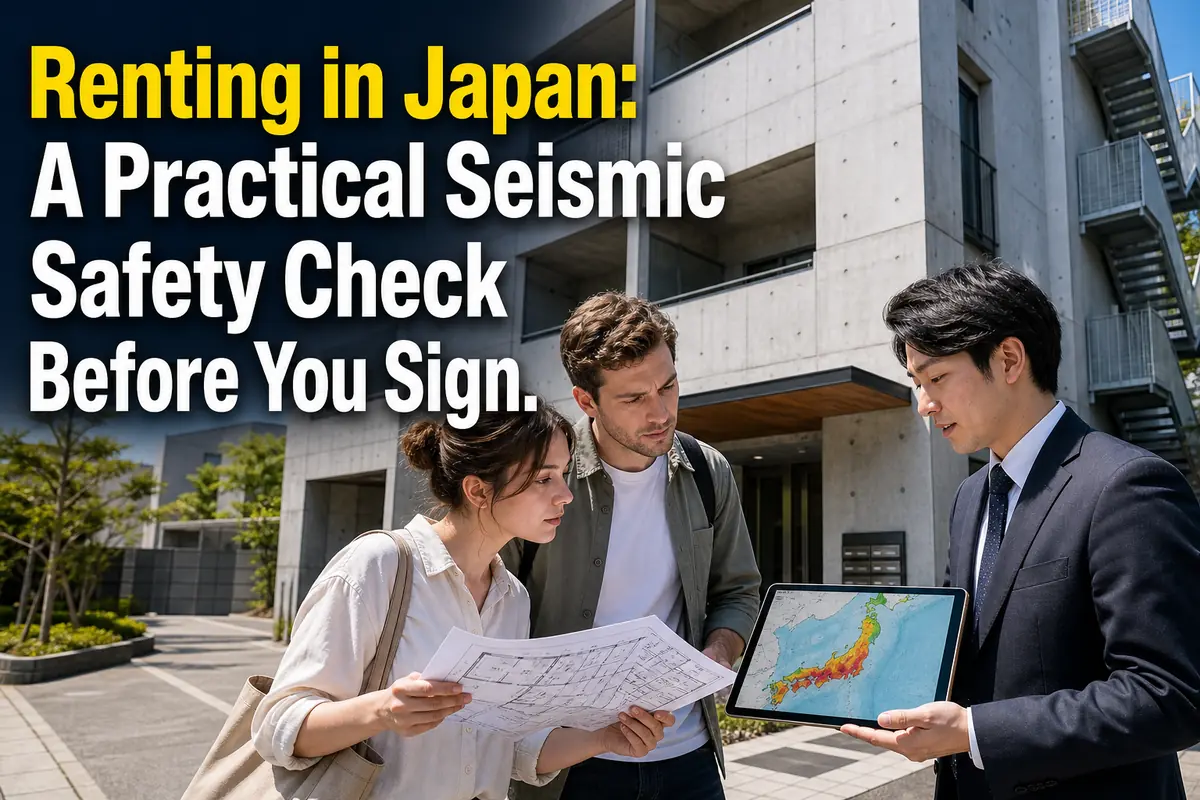
Renting in Japan: A Practical Seismic Safety Check Before You Sign
The quickest reliable check is not the building’s age alone. Ask the agent for the date of the building confirmation, its structural type, any seismic diagnosis or retrofit records, and a copy of the relevant property disclosure. Then check the address on official hazard maps.
A listing marked “built in 1982” may fall under Japan’s newer seismic standard, but the construction year is only a clue. It does not prove which rules applied, how well the building was constructed, whether it has deteriorated, or how the ground beneath it may behave.
This guide is for foreign residents and families comparing rental apartments, especially older properties. It explains what you can check yourself, what documents to request, and when unanswered questions should affect your decision.
In brief:
- Treat June 1, 1981 as a screening point, not a safety guarantee.
- Ask for the building-confirmation date rather than relying only on the completion year.
- Look for a professional seismic diagnosis, retrofit history, or housing performance evaluation.
- Check shaking, liquefaction, landslide, tsunami, and flood information separately.
- Get important answers in writing before paying or signing.
Start with the 1981 dividing line—but do not stop there
The 1981 standard is useful for narrowing your search, but it cannot certify an individual apartment building.
Japan substantially revised its seismic design requirements after the 1978 Miyagi-oki earthquake. The revised requirements commonly called the shin-taishin kijun, or New Seismic Design Standard, took effect on June 1, 1981.
Buildings associated with the earlier rules are often described as kyu-taishin, meaning the old seismic standard. Those associated with the revised rules are called shin-taishin buildings.
The difference matters because the newer framework placed greater emphasis on preventing collapse during severe shaking. Official guidance also notes that buildings constructed under the older standard suffered greater damage in the 1995 Great Hanshin-Awaji Earthquake.
Why the construction year can mislead you
Rental advertisements normally show a construction or completion date. The legal dividing point, however, relates to when the applicable building-confirmation process took place—not simply the day residents moved in.
This creates three practical cases:
- Completed well before June 1981: likely designed under the older standard unless later diagnosed and strengthened.
- Completed well after June 1981: more likely to come under the newer standard, but you should still verify the records.
- Completed around 1981 or 1982: the listing date alone is not enough. Ask for the building-confirmation date and supporting documents.
A building completed after June 1, 1981 may have begun the approval and construction process earlier. Conversely, an older building may have undergone a professional diagnosis and substantial seismic retrofitting.
ここがポイント: “Built after 1981” is a useful filter, not a pass certificate. The stronger question is: “Which standard applied, and what documents show the building’s present condition?”
A separate 2000 point for wooden housing
If you are considering a wooden apartment or detached rental, ask additional questions about buildings constructed before June 2000. Following earthquake damage and later technical reviews, requirements affecting matters such as foundations, wall balance, and structural connections were strengthened around that time.
This does not mean every pre-2000 wooden home is unsafe or every later home is safe. It means a diagnosis and retrofit history deserve more weight when comparing older wooden properties.
Ask the agent for evidence, not a verbal assurance
A useful answer identifies a document, date, or inspection—not merely that the owner believes the building is safe.
Before applying, send the real-estate agent a short written request. English may be available, but including the Japanese terms below can reduce confusion.
Ask for:
- the building-confirmation date (kenchiku kakunin-bi, 建築確認日)
- the structural type, such as reinforced concrete, steel, or wood
- any seismic diagnosis (taishin shindan, 耐震診断)
- the diagnosis date, scope, result, and name of the organization that performed it
- any seismic retrofit (taishin kaishu, 耐震改修), including the work completed and completion date
- any housing performance evaluation report (jūtaku seinō hyōka-sho, 住宅性能評価書)
- repair and major-renovation history
- the relevant section of the important-matters explanation
A practical message is:
Could you please confirm the building-confirmation date, structural type, and whether a seismic diagnosis or seismic retrofit has been completed? If records exist, may I review them before submitting an application or signing the lease?
Read the important-matters explanation carefully
Before a lease is concluded through a real-estate broker, the broker provides an explanation of legally specified important matters, commonly called jūyō jikō setsumei (重要事項説明).
For certain older buildings, information about a seismic diagnosis must be explained when such a diagnosis has been conducted and its records are available under the applicable disclosure rules. This is useful, but it has an important limit: “No diagnosis information shown” is not the same as “the building passed.” It may mean that no diagnosis was conducted or that no qualifying record is available.
Ask the agent to distinguish among these answers:
- a diagnosis was conducted and the result is available
- a diagnosis was conducted, followed by retrofit work
- no diagnosis was conducted
- the owner or agent does not have the record
- the rule does not apply to the particular property
Those are materially different situations. Request the answer by email or in the application notes so that you do not have to rely on memory after a fast verbal explanation.
Understand what the documents can—and cannot—tell you
The strongest evidence combines the original approval record with a later professional assessment of the actual building.
No single paper answers every safety question. Use the records as layers.
Building confirmation and inspection records
A building confirmation checks whether the design complies with applicable requirements. A completion inspection record indicates that the completed work went through the prescribed inspection process.
These documents help establish dates and regulatory history. They do not show whether later alterations, corrosion, water intrusion, ground movement, or poor maintenance have affected the building.
Seismic diagnosis report
A professional seismic diagnosis examines the building using drawings, construction information, on-site conditions, and an evaluation method suited to the structure. The report is far more informative than a visual check by a prospective tenant.
When a report exists, ask:
- Was the entire building assessed or only one part?
- Which evaluation method and target standard were used?
- What did the conclusion recommend?
- Were recommended improvements completed?
- Has the building changed since the diagnosis?
A result without its date and scope is difficult to interpret. If the report is technical or only in Japanese, ask the agent for a written summary and consider obtaining independent professional advice before making a high-stakes decision.
Seismic retrofit records
“Renovated” does not necessarily mean “seismically strengthened.” New flooring, kitchens, paint, or bathroom equipment can make an apartment look modern while leaving the main structure unchanged.
Ask whether the work involved structural elements such as:
- columns, beams, walls, or braces
- foundations
- structural connections
- reduction of excessive building weight
- reinforcement based on a seismic diagnosis
Request the completion date and the contractor or designer’s documentation. Cosmetic renovation and structural retrofit should never be treated as interchangeable labels.
Housing performance evaluation
Japan’s Housing Performance Indication System allows homes to be assessed under common criteria, including structural stability. A formal evaluation can make comparisons easier because it uses defined categories and grades.
Not every rental property has such an evaluation. Its absence is therefore not unusual. If one exists, confirm whether it is a design-stage evaluation or a construction-stage evaluation, what dwelling or building it covers, and which seismic grade appears in the report.
Compare the structure, condition, and contents together
A building’s code era matters, but its structural system, maintenance, layout, and unsecured contents also shape real-world risk.
Common listing labels include:
- RC: reinforced concrete (tekkotsu concrete is different; confirm the exact label)
- SRC: steel-reinforced concrete
- S or steel frame: steel construction, sometimes described as light or heavy steel
- Wood: timber construction
Do not rank these labels by name alone. Building height, design, construction quality, deterioration, irregular shape, foundation, and ground conditions all matter. A well-documented older building that was diagnosed and strengthened may present a clearer case than a newer building with missing records and visible maintenance problems.
What you can observe at a viewing
A tenant cannot perform a seismic diagnosis, but a viewing can reveal questions worth escalating.
Look for:
- large or repeated diagonal cracks in walls
- exposed or rusting reinforcement
- concrete pieces that appear to be breaking away
- obvious leaning or uneven floors
- doors and windows that bind in several parts of the building
- severe water intrusion or corrosion
- damaged exterior corridors, stairs, or railings
- additions or removed walls that appear inconsistent with the original structure
- heavy objects placed where they could block an exit
Small surface cracks do not automatically mean structural failure, and a freshly painted wall does not prove good condition. Photograph concerns with permission and ask the manager what caused them, whether they were inspected, and what repairs were completed.
Check the route out, not only the room
Your apartment may remain usable while the shared exit route becomes dangerous. Walk from the unit to street level and check:
- whether there are two practical escape directions
- whether corridors and stairs are clear
- whether emergency lighting and exit signs are present where expected
- whether exterior walls, tiles, glass, signs, or equipment could fall near the exit
- whether the entrance uses an automatic lock that has an emergency-release method
- where residents assemble after evacuation
For upper-floor units, consider how you would manage if elevators stopped. For ground-floor units, check whether tsunami, flood, or landslide risks create a different evacuation priority.
Check the land separately from the building
A strong building does not remove risks created by soft ground, liquefaction, a steep slope, tsunami exposure, or blocked evacuation routes.
Use at least two public tools before committing to an address.
J-SHIS for expected shaking and ground conditions
The National Research Institute for Earth Science and Disaster Resilience operates J-SHIS, the Japan Seismic Hazard Information Station. Its maps provide information such as probabilistic shaking estimates, scenario-earthquake results, active faults, and ground amplification.
Search the property location and compare it with another apartment you are considering. Use the map to understand relative site conditions—not to predict the exact date or outcome of a future earthquake.
Government and municipal hazard maps
The national Hazard Map Portal links disaster-risk information and maps published by municipalities. Depending on the area, you can check risks including:
- liquefaction
- tsunami inundation
- landslides
- flooding and prolonged inundation
- local terrain and elevation
- designated emergency evacuation sites
Coverage and presentation vary by municipality. Some local maps contain more detail than the national portal, so follow the link to the city or ward map and check its publication date and legend.
Do not use a flood map as a substitute for an earthquake map, or a seismic map as a substitute for a tsunami evacuation plan. They answer different questions.
Use a five-step check before paying or signing
The safest workflow is to verify the building and location while you still have several apartments to choose from.
1. Screen the listing
Record the completion date, construction type, number of floors, address, and management company. Flag buildings completed around 1981–1982 and older wooden properties for additional checks.
2. Check official maps
Search the exact address on J-SHIS and the national or municipal hazard maps. Save screenshots or links for each candidate so you can compare them consistently.
3. View the whole property
Inspect shared corridors, stairs, external walls, entrance areas, bicycle parking, retaining walls, and the route to open space—not only the apartment interior.
4. Request records in writing
Ask for the building-confirmation date, diagnosis records, retrofit history, housing performance documents, and the applicable important-matters information.
If the agent says a document is unavailable, ask whether it does not exist, is held by the owner, or simply has not yet been requested.
5. Decide before committing money
Review unresolved questions before paying an application fee, deposit, or other money. Ask whether a payment is refundable and under what conditions. Rental application practices and cancellation consequences can vary, so obtain the terms in writing.
Common mistakes that weaken the check
Most errors come from treating one convenient fact as a complete safety assessment.
Avoid these shortcuts:
- “It was built in 1982, so it must be fine.” Verify the confirmation date and available records.
- “RC means earthquake-proof.” No structural label guarantees zero damage.
- “It was renovated recently.” Confirm whether the work was structural or cosmetic.
- “No diagnosis is mentioned, so there was no problem.” Missing information is not a passing result.
- “The station area is convenient, so evacuation will be easy.” Check narrow streets, falling-object risks, slopes, waterways, and designated evacuation sites.
- “A low floor is always safer.” Lower floors can face different flood or tsunami risks; upper floors can create evacuation difficulties.
- “Furniture is my problem after moving in.” It is part of the safety decision now. Check where tall furniture can be anchored and whether the lease limits drilling or wall fixtures.
What to do when the owner has no records
Missing documents do not automatically prove danger, but they increase uncertainty—and that uncertainty should affect your choice.
Your next step depends on the alternatives available.
If comparable apartments have clear records, choosing the better-documented property may be the simplest response. If the undocumented apartment is unusually affordable or well located, ask whether the owner will obtain records, explain past structural work, or permit an expert inspection.
For an older building, consider contacting the municipality’s building or seismic-resistance consultation desk. Local governments may maintain information about diagnosis programs, retrofit support, designated routes, or buildings subject to particular local measures. They may not be able to evaluate a private rental for you, but they can explain the local system and direct you to qualified professionals.
Walk away or obtain specialist advice if:
- the agent gives contradictory dates
- a claimed retrofit has no identifiable scope or record
- serious visible deterioration is dismissed without an inspection history
- you are pressured to sign before receiving the important-matters explanation
- the evacuation route appears unsafe or inaccessible for a household member
- the remaining uncertainty is larger than the rent saving justifies
Questions foreign renters often ask
These short answers can help you decide what to ask next, but the property documents remain the controlling evidence.
Is every pre-1981 apartment unsafe?
No. Some older buildings have been professionally diagnosed and strengthened, while others may have characteristics that performed well. The date tells you that further checking is important; it does not provide an individual verdict.
Is every post-1981 apartment safe?
No building can be guaranteed to avoid all earthquake damage. Later standards improve the starting point, but construction quality, maintenance, later alterations, ground conditions, and earthquake characteristics still matter.
Can I demand a new seismic diagnosis as a renter?
You can ask, but an ordinary rental applicant generally cannot assume the owner must commission a new diagnosis merely because it is requested. The broker should explain the information required for the transaction, and local rules or a building’s specific status may matter. Seek advice from the relevant municipal office or a qualified professional if the answer affects your decision.
Does earthquake insurance prove the building is resistant?
No. Insurance addresses financial loss under its policy terms. It is not a structural assessment and should not replace a diagnosis or document review.
Should I reject an apartment near an active fault?
A fault map is one part of the decision. Strong shaking can occur away from mapped active faults, and site conditions can amplify motion. Compare the full J-SHIS information, the building evidence, and local evacuation risks rather than using distance from one fault as a yes-or-no test.
Your final pre-contract checklist
Do not sign until you can state what is known, what remains unknown, and why the remaining risk is acceptable to your household.
Confirm these points:
- [ ] Building-confirmation date checked
- [ ] Structural type confirmed from documents
- [ ] Seismic diagnosis status clearly identified
- [ ] Retrofit scope and date reviewed, if applicable
- [ ] Important-matters explanation received and understood
- [ ] J-SHIS location checked
- [ ] Municipal hazard maps checked
- [ ] Shared stairs, corridors, and exits viewed
- [ ] Furniture anchoring options considered
- [ ] Household evacuation needs discussed
- [ ] Unanswered questions and refund terms recorded in writing
The practical decision is rarely “old versus new.” It is documented versus assumed. When two apartments otherwise meet your needs, prefer the one whose approval history, present condition, ground risk, and evacuation route you can verify before the contract becomes binding.
参照リンク
- Ministry of Land, Infrastructure, Transport and Tourism: Housing performance and evaluation systems
- MLIT: Support for Foreign Nationals Looking for Rental Housing
- MLIT: Seismic diagnosis and retrofit guidance
- MLIT: Building safety and seismic-resistance Q&A
- Geospatial Information Authority of Japan: Hazard Map Portal
- J-SHIS: Japan Seismic Hazard Information Station
- J-SHIS: Guide to using seismic hazard maps
- Tokyo Metropolitan Government: Disaster preparedness guide in English