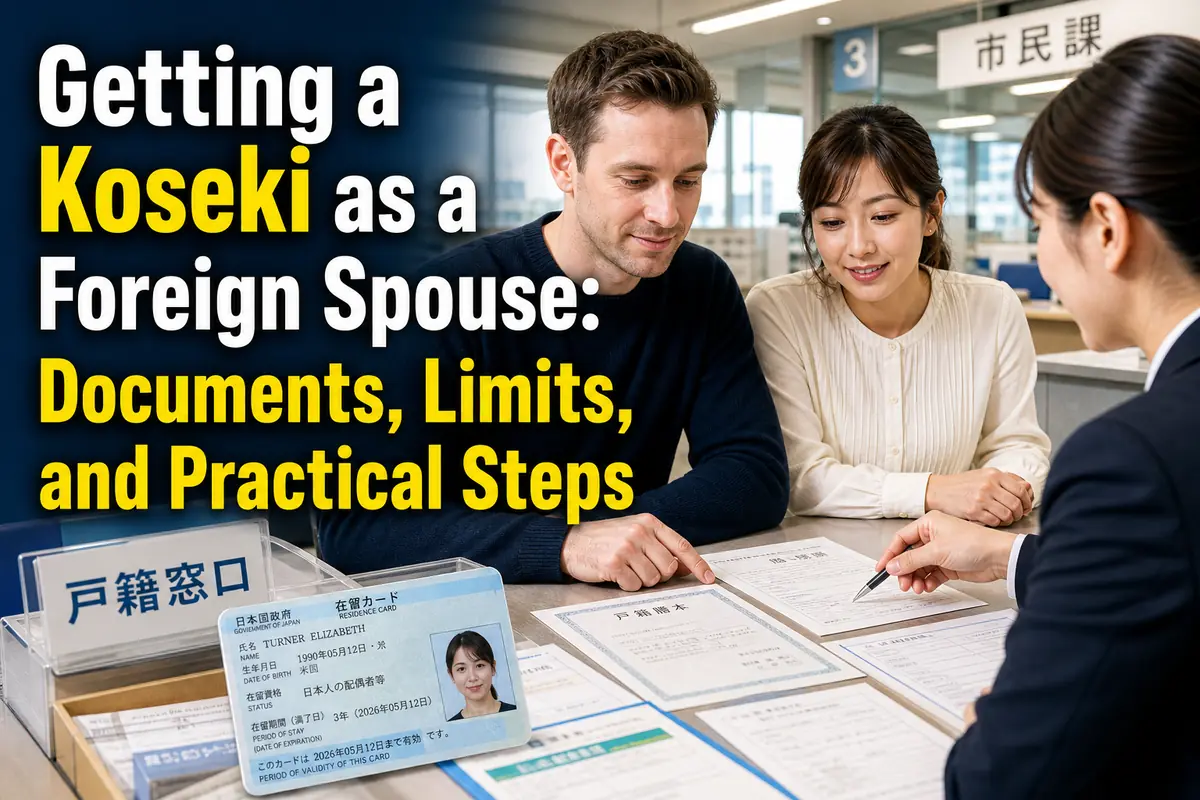
Getting a Koseki as a Foreign Spouse: Documents, Limits, and Practical Steps
A foreign national does not receive a personal koseki simply by marrying a Japanese citizen. The marriage is normally recorded in the Japanese spouse’s family register, and the foreign spouse is identified there as the spouse.
If you need proof of the marriage, you may usually request a certificate from that register as the legal spouse. However, you cannot obtain unrelated family records or use the koseki as proof of your own nationality, address, or residence status.
This guide is for foreign spouses, international couples, and family members who need documents for immigration, inheritance, childbirth, overseas procedures, or other official applications.
The essentials
- A koseki is created for Japanese nationals, not for foreign nationals.
- A marriage between a Japanese citizen and a foreign national is recorded in the Japanese spouse’s koseki after the required notification is accepted.
- A legal spouse can generally request the relevant certificate, subject to identity and relationship checks.
- A standard current koseki certificate generally costs ¥450 per copy; archived records commonly cost ¥750.
- Since March 1, 2024, certain full certificates can be requested at municipal offices outside the registered domicile, but the service has important restrictions.
What a koseki actually records
The central point is simple: a koseki is a record of Japanese nationals and their legally recognized family relationships.
The Ministry of Justice describes family registration as the system that records relationships from birth to death and certifies Japanese nationality. Municipal governments operate the system under national law.
A current family register may show information such as:
- The Japanese nationals registered in that koseki
- Their names and dates of birth
- Parent-child relationships
- Marriage, divorce, adoption, and death events
- The registered domicile, called honseki
- Information identifying a foreign spouse when an international marriage has been recorded
The foreign spouse’s name may therefore appear in the Japanese spouse’s record. This does not mean that the foreign spouse has become a registered member of the koseki or acquired Japanese nationality.
ここがポイント: The document belongs to the Japanese family-registration system. It can record a Japanese citizen’s marriage to a foreign national without creating a koseki for that foreign national.
What you can obtain as a foreign spouse
Your right to request a document depends on your legal relationship to the person in the register and on the type of certificate requested.
A certificate from your Japanese spouse’s current koseki
A foreign spouse can generally request the Japanese spouse’s current family-register certificate. A municipality may ask for enough information to locate the record and confirm the relationship.
The two common certificate names are:
- Koseki tōhon / certificate of all registered matters: A full certificate covering everyone currently registered in that koseki
- Koseki shōhon / certificate of individual matters: A certificate limited to one registered person
Ask the receiving organization which version it requires. An immigration office, foreign embassy, court, pension office, or overseas authority may insist on a full certificate even when a partial certificate appears to contain the relevant event.
Older or closed records when there is a valid need
Marriage, divorce, death, succession, and changes to a family register can move information into earlier records. Depending on the purpose, you may need:
- Joseki: A register from which all members have been removed
- Kaisei-gen-koseki: An older register retained after the official format was revised
These records are often needed for inheritance or to trace earlier family events. A current certificate may not reproduce every historical entry.
Access is not unlimited. The office must still confirm that you are an eligible requester or that you have a legitimate statutory reason.
A certificate showing an accepted notification
A juri shōmeisho, or certificate of acceptance, confirms that a municipal office accepted a notification such as a marriage, divorce, birth, or death notification.
It can be useful when:
- The updated koseki is not yet available
- Both spouses are foreign nationals and therefore have no Japanese koseki
- An overseas authority wants evidence that Japan accepted the notification
- The receiving organization specifically asks for a certificate of acceptance
This certificate is not interchangeable with a koseki certificate. Confirm the exact document name before applying.
What you cannot obtain or prove
Marriage does not provide unrestricted access to every record connected to your spouse’s relatives.
You do not get a separate Japanese koseki
Foreign nationals do not normally have their own koseki. Two foreign nationals who marry in Japan cannot obtain a koseki certificate proving their relationship because neither person is entered as a Japanese national.
They may instead need a certificate of acceptance, a marriage certificate from their country, or another document specified by the receiving authority.
You cannot automatically request records for collateral relatives
Being married to a Japanese citizen does not normally give you direct access to every koseki belonging to that citizen’s:
- Siblings
- Aunts or uncles
- Cousins
- Other collateral relatives
- Parents when the requested record does not include your spouse and you have no separate qualifying relationship or justified purpose
A proxy request may be possible for some ordinary requests if an eligible person provides a valid power of attorney. This is different from requesting the record in your own right, and it is not available under the nationwide wide-area issuance procedure.
A koseki does not prove your current address
A koseki is tied to a registered domicile, not necessarily the place where anyone currently lives. For current address and household information, the relevant document is usually a jūminhyō, or residence certificate.
A foreign resident’s jūminhyō may show details such as:
- Current registered address
- Name and date of birth
- Nationality or region
- Household relationship
- Residence status information when requested and permitted
The registered domicile shown in a koseki and the residential address shown on a jūminhyō serve different purposes.
A koseki does not replace immigration documents
The Japanese spouse’s koseki may help prove a marriage in a residence-status application. It does not itself grant or extend a status of residence.
Immigration may also require application-specific evidence, including a foreign marriage certificate, translations, financial records, questionnaires, or proof of the couple’s circumstances. Use the current checklist for the exact residence status and application type.
Which document should you request?
Choose the document by the fact you need to prove—not by the document name that sounds most official.
To prove a recorded marriage to a Japanese citizen
Start by asking whether the receiving organization wants:
- A current koseki tōhon
- A koseki shōhon for the Japanese spouse
- A certificate of acceptance
- Both a Japanese koseki and a foreign marriage certificate
For immigration procedures, follow the Immigration Services Agency’s checklist rather than relying on a document used in an earlier application.
To prove your current household or address
Request a jūminhyō from the municipality where your address is registered. Check whether the receiving organization needs household relationships, nationality, or residence-status details displayed.
To prove a marriage between two foreign nationals
A Japanese koseki is not available. Possible documents include:
- A certificate of acceptance from the municipality that accepted the notification
- A marriage certificate issued by the relevant foreign authority
- A certificate or extract issued by an embassy or consulate, where available
The correct document depends on the receiving country and institution.
For inheritance or a historical family link
Ask whether the procedure requires records extending from a particular person’s birth to death. If so, one current koseki will probably be insufficient. Older koseki, removed registers, and foreign civil-status documents may all be required.
How to request your Japanese spouse’s koseki
The safest route is to identify the purpose and exact certificate before visiting an office.
Step 1: Ask the receiving organization what it accepts
Confirm all of the following:
- Full or individual certificate
- Current record or historical records
- Required issue date, such as within three months
- Original or copy
- Need for translation
- Need for an apostille or other authentication for overseas use
Japanese municipal offices issue koseki certificates in Japanese. They do not generally prepare a translation for the destination authority.
Step 2: Confirm the registered domicile
You will usually need the exact honseki and the name of the head person shown at the beginning of the koseki, often called the hittōsha.
Honseki is not necessarily your spouse’s present address. If neither spouse knows it, the Japanese spouse may be able to confirm it through a jūminhyō that includes registered-domicile information, subject to local procedures.
Step 3: Choose the request route
Common routes include:
- In person at the municipality holding the koseki
- By post to that municipality
- Through a municipal online service, where offered and where the requester meets its conditions
- Through wide-area issuance at another municipality for eligible full certificates
Local options vary. For example, Yokohama states that applications may be available at counters, by post, or online in qualifying cases, while directing foreign spouses seeking their Japanese spouse’s records to the municipality of the spouse’s registered domicile. Check the office that will process your request rather than assuming every city offers the same channels.
Step 4: Prepare identification and relationship evidence
For a counter request, prepare:
- The municipal application form
- Valid identification, such as a residence card or other accepted government-issued ID
- The Japanese spouse’s honseki and hittōsha name
- The required fee
- Evidence of the marriage if the office cannot confirm the relationship from its accessible records
- A power of attorney if you are acting as a proxy rather than requesting as the spouse
Requirements differ by request method. Postal applications may also require copies of identification, a return envelope, postage, and an accepted form of payment.
Step 5: Check the certificate before leaving
Confirm that the names, marriage event, and other required details appear. Newly submitted marriage or divorce information may not be reflected immediately, especially when multiple municipalities are involved.
Costs and processing time
Municipal guidance commonly lists these statutory certificate fees:
- Current full or individual koseki certificate: ¥450 per copy
- Joseki or kaisei-gen-koseki certificate: ¥750 per copy
- Related documents, including a koseki address-history record or certificate of acceptance: fees vary by document and municipality
Add postage, payment-instrument charges, translation fees, and authentication costs when applicable.
A straightforward counter request may be completed during the visit. Postal, historical, and wide-area requests take longer. A recently filed marriage may also require time before it appears in the Japanese spouse’s record.
Do not book a visa appointment or overseas submission deadline on the assumption that every certificate will be issued on the same day.
Wide-area issuance: the important current change
Since March 1, 2024, Japan’s wide-area issuance system has allowed eligible people to request certain koseki certificates at a municipal counter outside the registered domicile.
It can reduce travel, but it is narrower than an ordinary request to the honseki municipality.
What the system generally covers
Eligible people include the person registered, a spouse, direct ancestors, and direct descendants. Covered documents include full current koseki certificates and certain full archived certificates.
What it does not cover
The wide-area route generally does not accept:
- Requests by a proxy using a power of attorney
- Postal applications
- Individual or partial koseki certificates
- Koseki address-history certificates
- Some records that have not been computerized
- Third-party requests based on a special justified purpose
The requester must appear personally and present an accepted government-issued photo ID. Offices may need to contact the honseki municipality, so issuance can take a long time or require another visit.
For a foreign spouse, relationship verification can be the difficult part because the foreign national is not a registered koseki member. Contact the intended counter in advance and ask what evidence it wants. If time is short, applying directly to the honseki municipality may be more predictable.
Common mistakes and how to avoid them
Asking for “my koseki”
A foreign spouse should usually ask for the Japanese spouse’s koseki certificate showing the marriage. This wording helps the clerk understand which record and relationship are relevant.
Using the present address as the honseki
These addresses may be different. Verify the honseki before submitting a postal request or visiting a distant office.
Requesting a partial certificate without checking
A partial certificate may omit another family member or event required by the receiving authority. Ask whether a full certificate is mandatory.
Assuming the marriage appears immediately
Acceptance of a marriage notification and completion of the koseki entry are separate processing stages. If the certificate is urgent, ask whether a certificate of acceptance can be used temporarily.
Assuming Japanese proof is sufficient overseas
A foreign authority may require a translation, apostille, consular authentication, or a separate certificate from the foreign spouse’s country. Confirm this with the destination authority before paying for documents.
Confusing marriage registration with immigration status
A legally recorded marriage does not automatically create or renew a status of residence. Immigration applications remain separate procedures.
Regional and individual differences
The legal foundation of the koseki system is national, but practical service details vary by municipality.
Check locally for:
- Counter locations and opening hours
- Accepted identification
- Postal-payment methods
- Online eligibility
- Whether relationship evidence is required
- Processing time for recent notifications
- Availability and operating hours of wide-area issuance
- Multilingual assistance
Your nationality, place of marriage, residence status, and intended use can also change the required document set. Overseas marriages may require foreign certificates and Japanese translations before the event can be entered in the Japanese spouse’s koseki.
Practical checklist before applying
Before you request a certificate, make sure you can answer these questions:
- What exact fact must the document prove?
- Does the receiving authority require a tōhon, shōhon, historical record, or acceptance certificate?
- What are the honseki and hittōsha name?
- How recent must the certificate be?
- Can you prove your identity and relationship?
- Will you apply at the honseki municipality or use wide-area issuance?
- Is a Japanese translation, foreign translation, apostille, or other authentication required?
- Has enough time passed for a recent marriage or other event to appear?
The most useful next step is to contact both the receiving organization and the municipal koseki counter. Ask the first one what it will accept, then ask the second one how to obtain that exact document. This avoids the most expensive mistake: collecting a valid certificate that does not satisfy the procedure for which you need it.
Information checked on August 1, 2026. This article provides general procedural guidance, not legal or immigration advice.
参照リンク
- Ministry of Justice — Family Registration
- Ministry of Justice — International Marriage and Overseas Birth Koseki Q&A
- Shinjuku City — Family Register
- Yokohama City — About the Family Register System
- Yokohama City — Certificates of Family Register and Resident Certificates
- Yokohama City — Wide-Area Issuance of Family Register Certificates
- Osaka City — Wide-Area Issuance of Family Register Certificates
- Ministry of Foreign Affairs — Family Registration and Nationality Notifications
- Immigration Services Agency — Online Applications by Foreign Nationals and Family Members