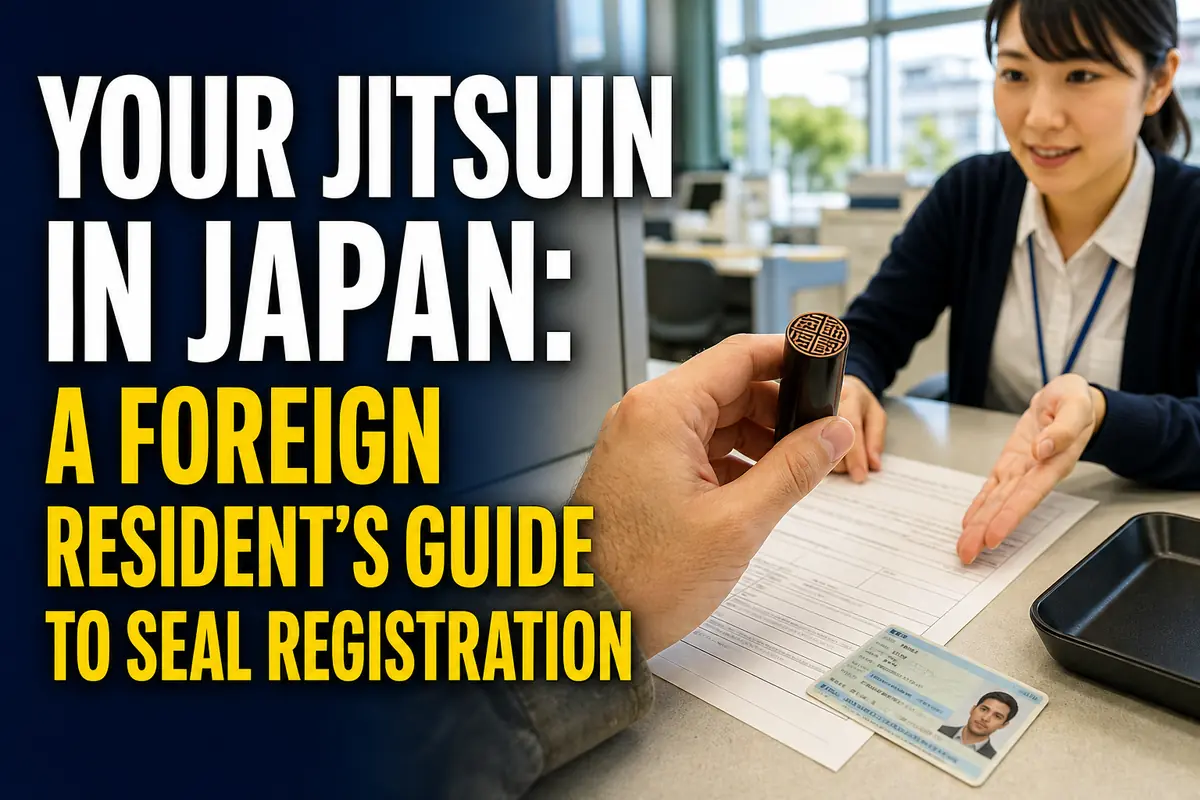
Your Jitsuin in Japan: A Foreign Resident’s Guide to Seal Registration
A jitsuin is a personal seal registered with the municipality where you live. You do not need one for ordinary daily life, but you may be asked for one when buying a car or property, arranging certain loans, or completing other high-value transactions.
Registration is handled locally, not through a single national application. In most cases, you take an acceptable seal and valid identification to your city or ward office. The exact rules—including eligible names, fees, counters, and whether registration can be completed on the same day—depend on your municipality.
This guide is for foreign residents who are registered on a Japanese municipality’s resident record, especially those preparing for a major contract.
The essentials:
- Confirm that the organization handling your transaction actually requires a registered seal.
- Ask your municipality which version of your name can appear on the seal before ordering it.
- Bring the seal and the identification specified by your municipality.
- Keep the registered seal and the seal registration card separate and secure.
- Request a seal registration certificate only when you need to submit one.
What are inkan, jitsuin, and an inkan certificate?
The important distinction is registration, not the appearance of the object. A seal becomes your jitsuin only after its imprint has been accepted and registered by your municipality.
Several similar Japanese terms can cause confusion:
- Inkan or hanko: General words for a personal seal or stamp.
- Mitome-in: An everyday seal used for routine acknowledgment. It is not necessarily registered.
- Ginkō-in: A seal designated for use with a bank account. Banks increasingly offer other authentication methods, and requirements vary by bank.
- Jitsuin: The particular seal registered with your municipality.
- Inkan tōroku: The act or system of registering that seal.
- Inkan tōroku-shō: The seal registration card issued after registration. This is not the certificate itself.
- Inkan tōroku shōmeisho: The certificate of seal impression, commonly called an inkan shōmeisho. It shows that the printed seal impression is registered to you.
A signature, an everyday seal, and a registered seal are therefore not interchangeable in every transaction. The business, lender, dealer, or professional handling the procedure should tell you which form of authentication it accepts.
Do foreign residents need to register a seal?
Most foreign residents never need a jitsuin for routine tasks. Register one when a specific transaction requires it, not simply because you have moved to Japan.
Situations in which a registered seal and certificate may be requested include:
- purchasing or selling real estate;
- buying, selling, or registering certain motor vehicles;
- entering some loan or guarantee arrangements;
- preparing particular notarized or registration documents;
- authorizing another person in a transaction that requires strong identity verification.
These are examples rather than a universal list. Some organizations accept a signature, electronic authentication, or another identity-verification method. Ask the recipient exactly what it needs before spending money on a custom seal or obtaining certificates.
There is no general deadline requiring every resident to register. However, a time-sensitive purchase can be delayed if your seal is rejected or if your identity cannot be confirmed immediately. Begin by checking the requirements several weeks before a major transaction.
Who can register?
Eligibility is set by the municipality maintaining your resident record. Registration is generally intended for people listed in that municipality’s Basic Resident Register.
Age and capacity rules can also apply. For example, Minato City states that registered foreign residents aged 15 or older can register. Yokohama also uses age 15 as its threshold, subject to its other conditions.
Before visiting the office, confirm:
- that your resident registration is current;
- the minimum age in your municipality;
- whether an applicant under guardianship needs to attend with a legal representative;
- whether you must apply personally or whether a representative is allowed;
- what identification a representative and applicant must provide.
Short-term visitors and people without a municipal resident record should not assume they can use this system. If a transaction involves a nonresident, ask the receiving organization what alternative evidence it accepts.
The name on the seal is the main issue for foreign residents
A seal can be the correct size and still be rejected because its inscription does not match the name recorded by the municipality.
Municipalities normally compare the seal with information on your resident record. Depending on your municipality and record, an acceptable seal might use:
- your full registered name;
- your family name or given name;
- a combination permitted by local rules;
- a registered Japanese alias, known as a tsūshō;
- a katakana rendering recorded for seal-registration purposes.
Do not assume that a shortened name, nickname, middle-name omission, initials, or your preferred katakana spelling will be accepted. Minato City, for example, says that the registered name and seal must match the name under which the owner is registered as a resident.
Yokohama’s current rules provide a useful example of the extra preparation foreign residents may need. A kanji name or registered alias must appear on the resident record before it can be used for registration. A resident from a non-kanji-using country who wants a katakana-name seal may first need that reading recorded in the remarks section of the resident record.
That example does not automatically apply throughout Japan. Ask your own city or ward office these questions:
- Which exact forms of my name are currently eligible?
- Must a katakana reading or alias be recorded first?
- Is my proposed family-name-only or given-name-only seal acceptable?
- Can the counter check a design or written inscription before I order the seal?
ここがポイント: Contact the municipality before the seal shop. A custom-made seal can still be unusable if its inscription does not match the local resident-record rules.
Choosing a seal that the office can accept
Municipal rules cover both the inscription and the physical seal impression. Common reasons for rejection include a seal that is too small or large, easily deformed, damaged, unclear, or decorated with information unrelated to the registered name.
As one municipal example, Yokohama accepts an impression that fits inside a square whose sides are at least 8 millimetres and no more than 25 millimetres. Its rules exclude items such as deformable rubber seals, unclear impressions, seals without an appropriate outer border, and designs containing nicknames, symbols, occupations, or illustrations.
Other municipalities may word or apply their standards differently. Before ordering, check:
- permitted dimensions;
- acceptable name combinations and scripts;
- whether an outer border is required;
- whether machine-made or mass-produced seals are accepted;
- whether another household member may register an identical or very similar impression;
- whether damage, chips, or unclear characters make the seal unacceptable.
A self-inking stamp is a poor choice for this purpose because its impression and body may not satisfy local durability requirements. Choose a durable seal that produces a clear, repeatable imprint.
What to prepare before going to city hall
The basic checklist is short, but local confirmation prevents a wasted visit.
Bring or prepare:
- the seal you want to register;
- valid identity documentation accepted by the municipality;
- your residence card or Special Permanent Resident Certificate when required;
- the local application form, if it can be prepared in advance;
- any authorization letter required for a representative;
- any additional document required for a registered alias or katakana reading;
- a payment method if your municipality charges a registration or card fee.
The Shinjuku City foreign-language guide instructs applicants to bring the seal and a valid residence card or Special Permanent Resident Certificate and apply in person. Yokohama’s English guide lists the same two basic items.
Do not rely on a passport alone unless your municipality explicitly accepts it for this procedure. Identification standards and same-day verification methods differ.
How registration usually works
The normal process has five stages.
1. Confirm the transaction requirement
Ask the receiving organization whether it needs:
- the registered seal itself;
- one or more seal registration certificates;
- a certificate issued within a particular period;
- another identity or address document;
- an original rather than a copy.
A company’s request that a certificate be “recent,” such as issued within three months, is not automatically a nationwide validity rule. It may be that organization’s acceptance condition.
2. Check your municipality’s rules
Use the official website for the municipality where your resident record is held. Confirm the eligible counter, opening hours, identification, fees, accepted seals, and treatment of foreign names.
The registration counter may be limited to the city or ward office responsible for your address. A service corner that issues certificates may not accept new seal registrations.
3. Apply at the designated counter
Complete the application and present the seal and required identification. The clerk checks your identity, resident record, and seal impression.
Some municipalities can finish registration immediately when the applicant presents qualifying government-issued photo identification. Other identity-verification routes may involve a guarantor or a confirmation letter mailed to the applicant’s registered address.
Yokohama, for example, describes three routes: government-issued photo identification, a registered-seal guarantor, or postal confirmation. Its postal route can take around one week. These are Yokohama procedures, not national options guaranteed in every city.
4. Receive the seal registration card
After approval, the municipality issues a card or equivalent registration credential. Check the printed or displayed information before leaving.
The card matters. At many municipal counters, presenting it is central to requesting a certificate, and the person requesting the certificate may not need to bring the registered seal itself. Rules for representatives vary, so never hand the card to someone without understanding what they can obtain with it.
5. Store the seal and card separately
Keeping both together makes unauthorized use easier if they are lost or stolen. Store them in separate secure places, and do not use your jitsuin as a casual household stamp.
How to obtain the seal registration certificate
Registration and certificate issuance are separate actions. Once registered, request a certificate when a bank, dealer, buyer, notary, or other organization asks for it.
Depending on the municipality, certificates may be available from:
- the city or ward office;
- a branch office or administrative service counter;
- a convenience-store kiosk using a My Number Card;
- an online municipal service;
- another locally designated counter.
At a municipal counter, you may need the seal registration card and an application showing the registrant’s identifying details. The registered seal itself is not always required for certificate issuance.
Convenience-store issuance is not automatic everywhere
Japan’s official convenience-store certificate service can provide documents including seal registration certificates. However, your municipality must participate and must offer that particular certificate. You also need a My Number Card or, where supported, a smartphone carrying the required electronic certificate.
The general service operates from 6:30 a.m. to 11:00 p.m., but municipalities can restrict the available hours, certificates, stores, and devices. Maintenance closures also occur. Check your municipality before relying on a kiosk for an urgent transaction.
Fees vary
There is no single fee to quote for all of Japan. Registration, replacement-card, counter-certificate, kiosk, and online fees can differ.
For a concrete example, Yokohama’s English page lists ¥300 per certificate at the counter. Treat this as a local example, not a national price. Seal-making costs are separate and depend on the seller, material, size, and customization.
Moving, leaving Japan, and changing your name
A registered seal is tied to a municipal resident record. A move can therefore affect it even when the physical seal remains unchanged.
Moving within the same municipality
Your registration may continue after an internal address change, but confirm this when submitting your moving notification. A move between wards can be treated differently depending on the city’s system.
Moving to another municipality
Expect to register again at the new city or ward office. Shinjuku states that residents moving out must return the registration card and complete a new registration at their new address.
Do not assume that presenting the old card or certificate transfers the registration. Check whether your former municipality requires the card to be returned or a cancellation notice to be filed.
Leaving Japan
Departure procedures can end the underlying resident registration and invalidate the seal registration. Shinjuku states that its registration is deleted when the registered person leaves Japan and must be completed again after a later return and new resident registration.
Changing your legal name or registered alias
A marriage, divorce, other legal-name change, or deletion of a registered alias can make the existing seal inconsistent with your resident record. Ask the municipality whether cancellation is automatic and whether a new seal must be made and registered.
Common mistakes that cause delays
Most avoidable problems happen before the applicant reaches the counter.
- Ordering the seal first: The chosen spelling or script may not be recorded or permitted.
- Confusing the card with the certificate: Registration produces the card; you request certificates separately.
- Assuming every office offers the same service: A branch may issue certificates but not register seals.
- Expecting guaranteed same-day completion: The identity-verification route may require postal confirmation.
- Using a nickname or shortened name: The inscription may not match the resident record.
- Buying an unsuitable stamp: Size, material, border, damage, or an unclear impression can cause rejection.
- Requesting certificates too early: The recipient may impose a recent-issue condition.
- Carrying the seal and card together: Losing both creates a greater security risk.
- Forgetting to act after a move or name change: The old registration may no longer be usable.
What to do if the seal or card is lost
Contact the municipality promptly if the registered seal or registration card is missing. Ask how to suspend or cancel the registration and what is required for re-registration.
If you suspect theft or unauthorized use, also contact any bank, dealer, lender, legal professional, or other organization involved in a current transaction. The municipal cancellation procedure does not automatically notify private organizations.
Do not simply make another seal and continue using the old certificate. Re-registration may create a new record or card, and fees or additional identity checks may apply.
A practical action plan
If a transaction is approaching, use this order:
- Ask the recipient precisely which seal-related documents it requires.
- Check the official seal-registration page for your municipality.
- Confirm the exact version of your name that can be engraved.
- Ask whether a katakana reading or alias must first be added to your resident record.
- Order a compliant seal only after receiving that answer.
- Check whether your identification allows same-day registration.
- Register early enough to allow for postal verification or a second visit.
- Obtain the requested number of certificates close to the submission date.
- Store the jitsuin, registration card, and unused certificates separately.
Municipal pages and service arrangements change. The information in this guide was checked on August 1, 2026, but your own municipality and the organization receiving the certificate have the final practical requirements. The next action is not to buy a seal—it is to confirm the accepted name, procedure, and timing with both of them.
参照リンク
- Yokohama City: Seal registration
- Yokohama City: Detailed seal registration rules and identity-verification methods
- Minato City Living Guide: Personal Seal Registration
- Shinjuku City: Personal Seal Registration Procedures and Personal Seal Registration Certificate
- Local Government Information Systems service: Convenience-store certificate issuance