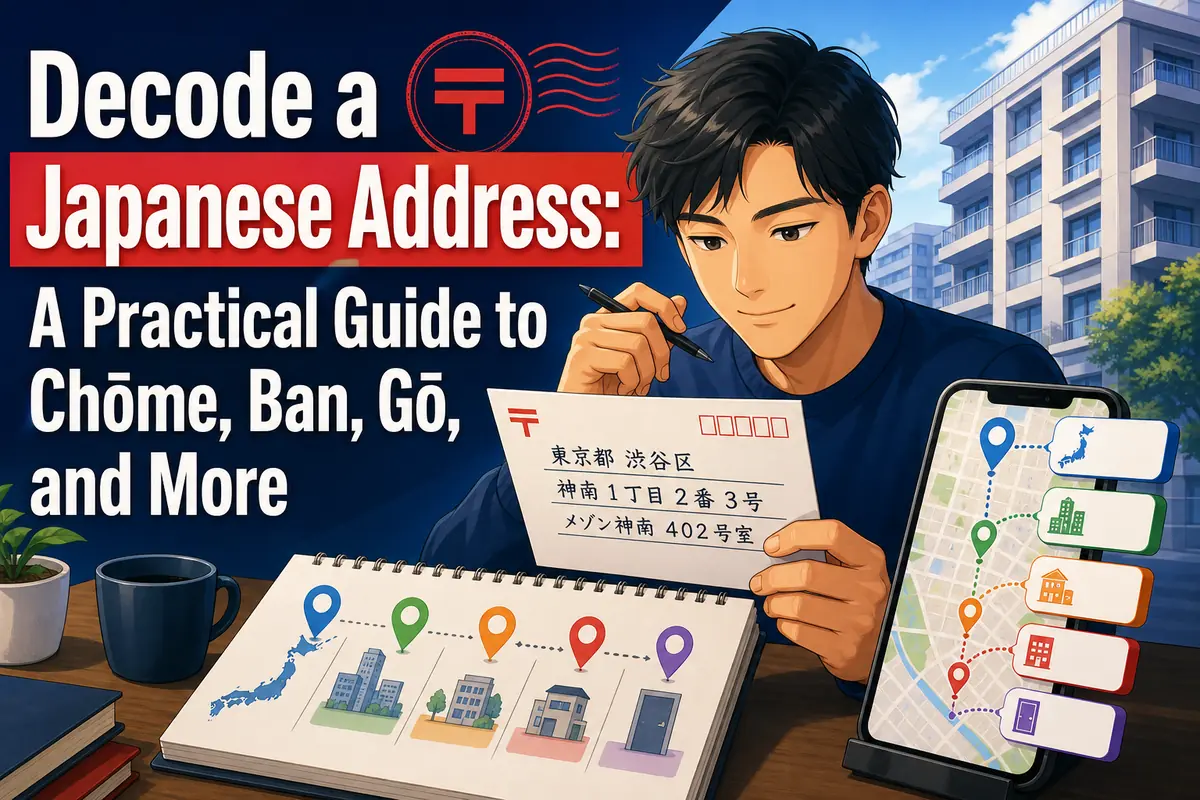
Decode a Japanese Address from Postal Code to Apartment Number
A Japanese address usually moves from the largest area to the smallest: prefecture, municipality, neighborhood, block, building, and room. The numbers often identify areas or buildings rather than describing a street.
For example, read this fictional address in the following order:
〒160-0022 東京都新宿区新宿3丁目12番5号 サンプルハイツ402号室
Sample Heights 402, 3-12-5 Shinjuku, Shinjuku-ku, Tokyo 160-0022
It breaks down as:
〒160-0022: postal code東京都: Tokyo Metropolis新宿区: Shinjuku Ward新宿3丁目: Shinjuku, third chōme12番5号: block 12, building or entrance number 5サンプルハイツ402号室: Sample Heights, room 402
This guide is for foreign residents and their families who need to complete forms, receive deliveries, describe a location, or check whether an address has been copied correctly.
The basic order of a Japanese address
Start with the prefecture and keep narrowing the location. Most addresses contain several of the layers below, although the exact system differs by municipality.
- Postal code
- Prefecture or equivalent
- Municipality
- Local area or neighborhood
- Chōme, when used
- Block and building numbers, or a land-lot number
- Building name
- Floor or room number
- Recipient’s name
Japanese domestic writing normally presents these elements from large to small. Romanized addresses are often written in the opposite direction for international readers, but changing the order does not change the address itself.
ここがポイント: A string such as
3-12-5is not automatically a street number. It may represent chōme, block, and building numbers—but in another locality it may refer to land-lot numbering. Keep the official Japanese address available instead of trying to reconstruct it from the hyphens alone.
Prefectures: to, dō, fu, and ken
The prefecture is the broadest administrative area normally shown in an address. Japan has 47 prefectures, but their suffixes are not all the same.
- Tokyo-to (東京都): Tokyo Metropolis
- Hokkaidō (北海道): Hokkaido
- Osaka-fu (大阪府) and Kyoto-fu (京都府): urban prefectures
- Ken (県): the suffix used by the other 43 prefectures
In English, Tokyo, Osaka Prefecture, and Fukuoka Prefecture are all understandable. On an official or delivery form, however, copying the spelling provided by the municipality, landlord, employer, school, or service provider is safer than inventing a translation.
The prefecture matters because the same town or neighborhood name can appear in more than one part of Japan. It also helps delivery services and online systems resolve incomplete location data.
Cities, wards, towns, and villages
The element after the prefecture identifies the municipality or an urban subdivision. These endings explain what kind of area you are looking at.
- Shi (市): city
- Ku (区): ward
- Chō or machi (町): town
- Son or mura (村): village
The kanji 町 can be read as either chō or machi. The correct reading is part of the place name; it should not be guessed from the character alone.
Tokyo’s special wards
Tokyo’s 23 special wards appear directly after 東京都, as in:
東京都新宿区 — Tokyo-to, Shinjuku-ku
In an English address, this may be written as Shinjuku-ku, Tokyo or Shinjuku City, Tokyo, depending on the organization’s preferred English style. Use the version requested by the form or shown on the relevant ward’s official website.
Wards inside designated cities
A ward can also sit inside a city. In that case, both names are necessary:
神奈川県横浜市中区
Kanagawa Prefecture → Yokohama City → Naka Ward
Leaving out 横浜市 changes the administrative chain and may cause a form to reject the address.
What chōme, ban, and gō mean
In areas using the residential address system, chōme, ban, and gō narrow the location step by step. They are commonly compressed into numbers separated by hyphens.
Consider:
新宿3丁目12番5号
Chōme: a numbered neighborhood section
3丁目 means the third section of the named neighborhood. It is normally romanized as 3-chome or included as the first number in a shortened address.
The 3 does not mean Third Street. It identifies a subdivision of Shinjuku.
Ban: the block number
12番 identifies a block or district unit under the residence-indication system. In a shortened address, it becomes the middle number.
Gō: the building or entrance number
5号 identifies a building or entrance within that block. In the shortened form, it becomes the final number.
The full expression:
新宿3丁目12番5号
is therefore often written as:
新宿3-12-5
This shorthand is convenient, but the omitted labels carry meaning. If you only see 3-12-5, verify the Japanese form before deciding that the numbers always mean chōme–ban–gō.
Why not every address follows chōme–ban–gō
Japan uses more than one address-location system, so the familiar three-number pattern is not universal. The Digital Agency notes that address and location information has historically been divided between systems connected to residence indication and real-estate registration.
Land-lot addresses and banchi
Places without residence indication may use a land-lot number, commonly called banchi. An address might contain forms such as:
123番地123番地4123-4
These numbers come from parcels of land. They do not necessarily follow the visible order of buildings along a road. Subdivision and historical land records can also make nearby numbers look irregular.
This distinction matters when completing government, banking, housing, or utility paperwork. A parcel number from a property document is not always interchangeable with the residential address used for mail.
Ōaza and aza
Rural and older addresses may contain ōaza (大字) or aza (字). These are local territorial divisions that can sit between the municipality and the lot number.
Do not delete them merely because an English form has no field with the same label. They may be essential parts of the location name. If the form offers only broad fields, keep the elements together in an address-line field and preserve their order.
Local conventions
Some areas have additional conventions. Kyoto addresses, for example, can include street names and direction words used to clarify a location. Rural municipalities may omit chōme or use long place names before a lot number.
The address printed on official local records or supplied by the property manager should take priority over a generic template. A nationwide explanation can show how to read the layers, but it cannot replace the municipality’s official spelling and numbering.
Building names, floors, and room numbers
A complete apartment address needs the building and room details after the geographic address. Reaching the correct block is not enough when several households or buildings share the same base address.
A typical ending might look like:
サンプルハイツ402号室
or:
サンプルビル4階
Useful terms include:
- 号室 (gōshitsu): room or unit
- 階 (kai/gai): floor
- 棟 (tō): building or block within a complex
In romanized writing, clear forms include:
Sample Heights, Room 402402 Sample HeightsSample Building, 4F
Do not assume that room 402 is always on the fourth floor. That pattern is common, but the property’s numbering scheme controls the actual location.
Building names can also be difficult to romanize because they may combine Japanese and foreign words. For deliveries and registrations, use the spelling shown in the lease, welcome documents, building sign, or service provider’s database. Keeping a copy of the Japanese building name helps drivers and local staff recognize it.
Postal codes and the 〒 symbol
A Japanese postal code has seven digits and usually appears as 123-4567. The symbol 〒 marks a postal code in Japanese writing, but it is not one of the digits.
For the fictional example:
〒160-0022
- Postal code:
160-0022 〒: postal mark
Many online forms split the code into three-digit and four-digit boxes. Others accept seven digits without the hyphen. Follow the format shown by the form rather than adding spaces or symbols it does not request.
A postal code can help an online system fill the prefecture, city, or neighborhood automatically. You must still check the result. A code may cover multiple local areas, and automatic completion will not add the correct building or room number.
How to write the address in Japanese and Roman letters
Use the format required by the recipient instead of applying one universal English order everywhere. Domestic registrations, Japanese online shops, and international mail labels have different layouts.
For a Japanese domestic form
Keep the large-to-small structure used by the form:
- Postal code
- Prefecture
- Municipality and ward
- Neighborhood and numbers
- Building and room
- Recipient’s name
If the form is in Japanese, enter kanji or kana exactly as provided when possible. Some systems reject Roman letters, long strings, or punctuation even when the address is correct.
For an English-language form
Separate the address according to the field labels rather than forcing the full string into one box. A practical version of the fictional example is:
- Address line 1: 3-12-5 Shinjuku
- Address line 2: Sample Heights 402
- City/Ward: Shinjuku-ku
- Prefecture/State: Tokyo
- Postal code: 160-0022
- Country: Japan
Some databases expect Shinjuku in the city field and do not provide a separate ward field. If the form accepts free text, retain both the ward and neighborhood somewhere in the address.
For mail sent from outside Japan
Japan Post’s international-mail guidance presents an address in the order commonly used for overseas mail: building and room, house number and local area, city and prefecture, then postal code and country. It recommends the English alphabet and Arabic numerals as a general rule.
Write JAPAN clearly as the final line so the postal service in the sending country can route the item internationally. The Japanese delivery portion can then be handled from the postal code and domestic address.
A practical method for decoding any address
Work from fixed administrative layers first, then identify the local numbering system. This prevents a building number from being mistaken for a street or postal code.
Step 1: Find the postal code
Look for 〒 or a seven-digit pattern such as 123-4567. Set it aside; it is a routing code, not part of the chōme–ban–gō sequence.
Step 2: Identify the prefecture
Look for 都, 道, 府, or 県. Keep the suffix when copying the Japanese address.
Step 3: Find the municipality and ward
Look for 市, 区, 町, or 村. Remember that a designated city can be followed by a ward, so there may be two administrative layers before the neighborhood.
Step 4: Separate the neighborhood name from its numbers
Check for 丁目, 番, 号, 番地, 大字, or 字. These labels reveal more than hyphens do.
Step 5: isolate the building and unit
Anything after the geographic number may be a building, tower, dormitory, company site, floor, or room. Look for 階, 棟, and 号室.
Step 6: verify rather than translate creatively
Compare the result with at least one reliable record:
- lease or housing contract
- residence record or municipality document, when relevant
- utility or property-management paperwork
- employer or school registration record
- official municipality address search
- Japan Post postal-code information
For important applications, use the version requested by the organization. Differences in spacing or romanization may look harmless to a person but fail an automated identity check.
Common mistakes that cause delivery or form problems
Most problems come from missing small details, not from misunderstanding the prefecture. Check the following before submitting an address.
- Dropping the room number: The package reaches the building but cannot be matched to the household.
- Omitting a city before a ward: This is especially risky in designated cities such as Yokohama.
- Treating every hyphen as chōme–ban–gō: The address may use land-lot numbers instead.
- Removing ōaza or aza: These can be official parts of a rural address.
- Translating a building name: The result may no longer match the lease, nameplate, or delivery database.
- Using an old address: Postal redirection does not update banks, government bodies, employers, schools, or subscriptions.
- Trusting postal-code autofill without checking it: The suggested area may be incomplete or require a choice.
- Confusing the address with directions: A station exit, nearby road, or landmark can help a visitor, but it is not necessarily part of the official address.
- Using inconsistent romanization: Variations such as
chome,chōme, andchomemay be readable, but matching systems can be less flexible.
When a service compares an address with identity documents, consistency matters more than producing elegant English. Copy the registered version first; add a reader-friendly romanized version only where the form allows it.
Addresses on maps are not always enough
An official address identifies an area or building, but it may not place a map pin at the correct entrance. Large complexes can have several gates, buildings, or reception desks under related address data.
For a visitor or delivery, provide practical details separately:
- official address in Japanese
- building and room number
- entrance or tower name
- map pin supplied by the property or venue
- phone number, when appropriate
- delivery instructions supported by the service
Do not replace the official address with a landmark. Use the landmark as an additional navigation aid.
What is changing in Japan’s address data
Japan is working toward more consistent digital address data, but residents still need to preserve the official local form of their address. The Digital Agency’s Address Base Registry project is intended to develop address and location information as public basic data.
The agency explains that address information has not historically been managed as one centralized national dataset. Its English project page lists the official release of town-area data in June 2025 and, as of its March 30, 2026 update, continuing work involving block, house, and lot-number data.
For foreign residents, the practical meaning is limited but important:
- Digital services may become better at sharing standardized place data.
- Local spelling, building names, and unit numbers can still differ between databases.
- A map location, residential address, and real-estate parcel reference should not be assumed to be identical.
- Current forms may continue to divide addresses into fields in different ways.
There is no need to rewrite an address simply because national data infrastructure is developing. Continue using the official address recognized by the relevant municipality and organization.
Quick answers to frequent questions
Is a Japanese address based on streets?
Usually not in the way addresses are in many English-speaking countries. Most Japanese addresses identify administrative areas and numbered blocks, buildings, or land parcels. Local exceptions and street-based directions exist.
Is 3-12-5 always chōme 3, block 12, building 5?
No. That is a common reading where residence indication is used, but another address may use land-lot numbers. Check the unshortened Japanese notation.
Should I translate 区 as “ward” or “city”?
Either may appear in official English usage, especially for Tokyo’s special wards. For applications, follow the wording used by the ward or the organization receiving the address. Preserve -ku when that reduces ambiguity.
Can I omit the prefecture if I have the postal code?
Do not omit it unless the form explicitly does so after verified automatic completion. A full address is easier to check and more resilient when data is entered manually.
Do macrons such as ō matter?
They clarify pronunciation, but many forms do not accept them. Use the romanization shown by the official source or the form. For delivery, correct place names, numbers, postal code, and country are more important than adding a macron yourself.
Which version should I use for a bank or government procedure?
Use the address format requested by that institution and match the supporting document it asks you to provide. If your lease, residence information, and service records show different forms, ask the relevant office which version it needs before submitting the application.
Keep these two versions ready
The most reliable habit is to save both the official Japanese address and a carefully checked Roman-letter version. Include the postal code, full administrative chain, building name, and room number in both.
Before using the address, check:
- Does it include the prefecture, municipality, and ward where applicable?
- Are chōme, block, house, or lot numbers copied in the correct order?
- Are the building and room details complete?
- Does the spelling match the document or service being used?
- Is the address current?
The next time a form shows only Address line 1, City, and State, do not guess from the hyphens. Identify the administrative layers first, keep the building details intact, and adapt the same verified address to the available fields.