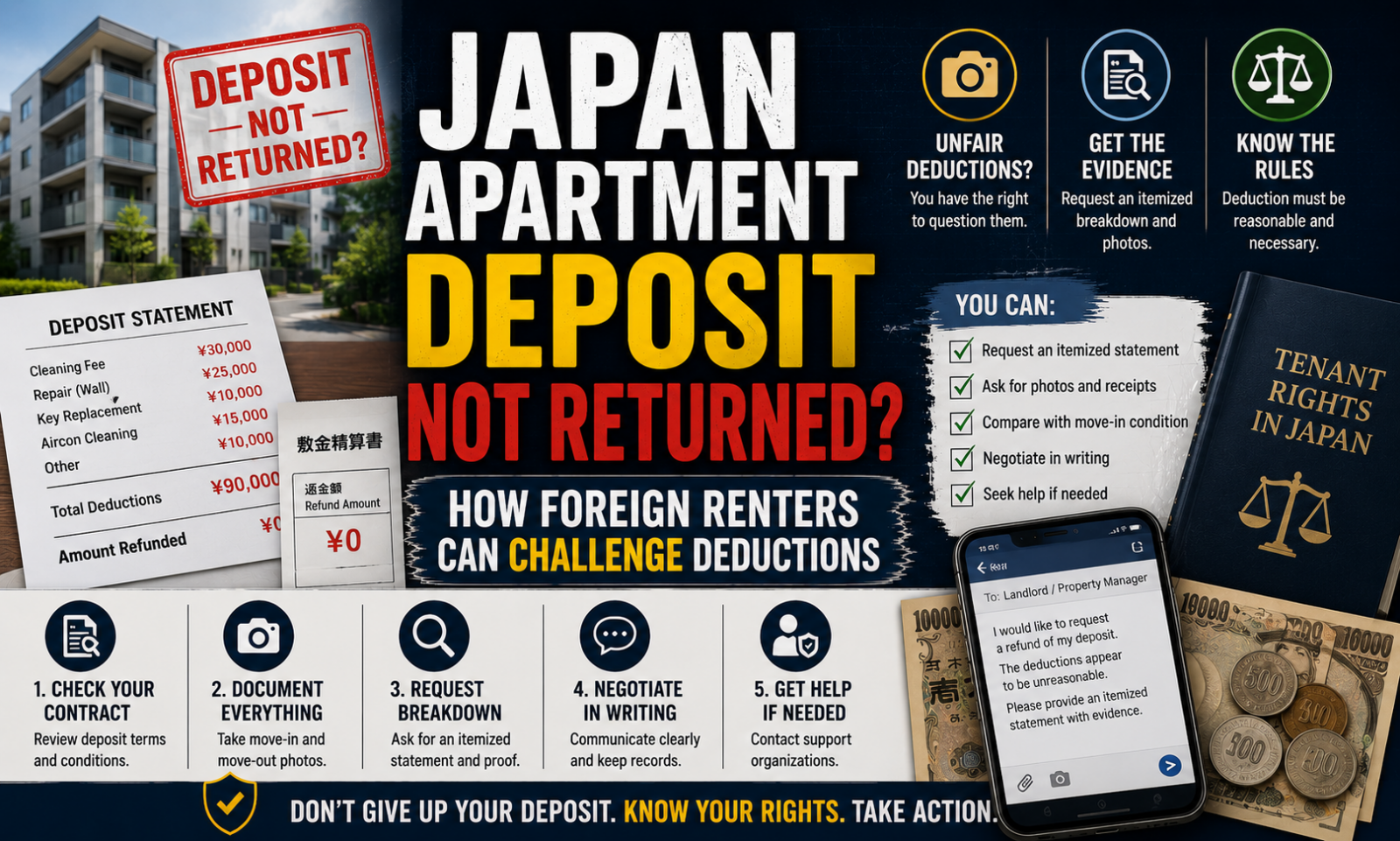
Japan Apartment Deposit Not Returned? What Foreign Renters Should Do Next
If your apartment deposit in Japan is not returned, do not assume the landlord can keep it automatically. Under Japan’s Civil Code, the landlord must return the remaining deposit after deducting unpaid rent or other valid lease-based charges once the lease ends and the unit is handed back.
The practical issue is usually not whether a deposit exists. It is whether the deductions are valid, clearly explained, and supported by the contract and the condition of the room.
- Check your contract and the final settlement sheet first.
- Ask for a written breakdown of every deduction.
- Compare each charge with Japan’s normal wear-and-tear rules.
- If the explanation is weak, object in writing and keep records.
- If needed, use a consumer center or summary court procedure.
Who This Guide Is For
This guide is for foreign renters in Japan, especially students, workers, and long-term residents, who have already moved out or are about to move out and are worried that their shikikin deposit will not be returned fairly.
It matters most when:
- the management company says the deposit is fully consumed but gives little detail
- you are charged for cleaning, wallpaper, flooring, or fixture replacement
- the landlord stops replying after move-out
- you are leaving Japan soon and need a clear paper trail fast
What the Basic Rule Is in Japan
Japan’s legal starting point is simpler than many renters think.
Under Civil Code Article 622-2, the landlord must return the remaining deposit after deducting money the tenant still owes under the lease. Under Article 621, the tenant is not responsible for ordinary wear from normal use or aging of the property.
The Ministry of Land, Infrastructure, Transport and Tourism, usually called MLIT, gives the main practical guideline used in deposit and move-out disputes. Its position is that “restoration to original condition” does not mean making the apartment look exactly like the day you moved in. It mainly means paying for damage caused by negligence, improper use, or use beyond the ordinary way of living.
ここがポイント: In Japan, a deposit is not a free repair fund for the landlord. It can be used for unpaid rent and valid tenant-side damage, but not for normal aging or ordinary daily wear.
What Charges Are Often Valid and What Charges Often Are Not
Before you argue about the full deposit, separate the bill into items.
Charges that often fall on the tenant
- unpaid rent or unpaid common-area fees
- damage caused by carelessness, misuse, or unauthorized modifications
- grease, mold, or water-area dirt that got worse because of poor cleaning or poor ventilation
- pet damage, cigarette stains, strong odors, or large wall holes
- lost or damaged keys
Charges that often fall on the landlord
- ordinary aging of the room and fixtures
- marks left by normal furniture placement
- discoloration from sunlight
- equipment failure caused by age, not misuse
- routine professional cleaning that is part of ordinary turnover, unless a valid special contract clause says otherwise
This is where many disputes start. A landlord may send one large number called “cleaning and restoration,” but that label alone does not prove the whole amount is your responsibility.
Step by Step: What to Do If the Deposit Is Not Returned
Start with documents, not phone calls alone.
1. Read the lease section on deposit, cleaning, and special clauses
Look for terms such as:
shikikindepositgenjo kaifukurestoration to original condition- house cleaning fee
- air-conditioner cleaning fee
- key replacement
- special provisions or
tokuyaku
A contract may validly shift some costs to the tenant through special clauses. But the clause still needs to be clear enough for you to understand what you agreed to.
2. Ask for an itemized settlement in writing
If you only received a message like “the deposit was used for repairs,” ask for:
- a line-by-line breakdown
- the reason for each deduction
- photos or inspection notes
- invoices or estimates if available
- the date the remaining balance will be transferred
Keep the request by email, app message, or letter so you can show the timeline later.
3. Compare the bill with the move-in and move-out condition
Your strongest evidence is usually:
- photos and video from move-in
- the move-in checklist
- photos from move-out day
- inspection notes signed at handover
- messages where you reported earlier damage
If you never documented the room, the dispute becomes harder, but not impossible. You can still ask the landlord to prove why each item is your burden.
4. Object clearly and narrowly
Do not send an emotional message saying everything is wrong. Mark the exact items you dispute.
A practical objection can say:
- you accept unpaid rent if it is correct
- you want explanation for specific repair items
- ordinary wear and aging should not be charged to the tenant
- you request the undisputed balance to be returned by a specific date
That approach often works better than a broad complaint because it shows you are disputing evidence, not refusing all payment.
5. Use a local consumer consultation desk if talks stall
If the landlord or management company ignores you or keeps repeating the same unsupported claim, contact a consumer consultation desk.
The Consumer Affairs Agency’s 188 hotline connects callers to a nearby consumer affairs center. These centers do not act like a court, but they are often the fastest public starting point for rental disputes, especially if you need help understanding whether the explanation is reasonable.
6. Consider summary court mediation or a small claims action
If the amount is meaningful and negotiation fails, the next step may be the summary court.
The Supreme Court explains that a small claims action can be used for money claims of up to 600,000 yen. In principle, it is designed to finish quickly, often in one day. Court mediation is another option if both sides may still settle.
Two practical points matter here:
- court proceedings in Japan are conducted in Japanese
- you need organized evidence, not just a general complaint
For many foreign residents, that means bringing a Japanese-speaking friend, support person, or professional adviser before filing anything.
Common Mistakes That Make Deposit Disputes Worse
A weak case usually gets weaker for the same few reasons.
- signing the final inspection sheet without reading it
- agreeing verbally and keeping no written record
- throwing away move-in photos after living there for years
- assuming all cleaning fees are illegal
- assuming all contract clauses are automatically enforceable
- waiting until after leaving Japan to start asking questions
One more point: there is no single nationwide fixed deadline that guarantees your deposit will be returned within a set number of days in every rental contract. Timing often depends on the contract and settlement process. That is why a dated written demand matters.
When Contract Terms Change the Result
National law sets the framework, but your actual outcome can still change with the contract.
Pay special attention to these situations:
- a fixed cleaning fee written clearly into the lease
- special clauses about air-conditioner cleaning
- company housing or school-arranged housing with separate rules
- damage that includes both ordinary wear and tenant fault
In those mixed cases, ask how the landlord calculated your share. MLIT’s guidance also says elapsed time matters. If a fixture or wallpaper has aged during a long tenancy, charging the tenant the full replacement cost can be difficult to justify.
Current Status as of May 8, 2026
As of May 8, 2026, the main national framework is still the same:
- the post-April 1, 2020 Civil Code rules on lease deposits remain the legal baseline
- MLIT still points tenants and landlords to its restoration guideline
- MLIT also continues to provide multilingual move-out materials and a checklist for foreign residents
So the most useful update is not a brand-new law. It is that foreign renters now have easier access to official multilingual material that helps them challenge vague claims with the right vocabulary and documents.
Practical Takeaway
If your deposit has not come back, the key question is not “Can the landlord deduct something?” The answer to that is yes.
The real question is whether each deduction is tied to the lease, supported by evidence, and consistent with Japan’s rule that normal wear and aging are not the tenant’s bill.
Check the contract. Demand an itemized statement. Keep everything in writing. If the explanation still does not hold up, take the file to a consumer center or the summary court before the trail goes cold.
参照リンク
- Japanese Law Translation – Civil Code
- MLIT – Guidelines on Troubles Related to Restoration to Original Condition
- MLIT – Support for Foreign Nationals in Looking for Rental Housing
- MLIT PDF – Points for restoring rental housing to its original condition when you move out
- Consumer Affairs Agency – Consumer Hotline 188
- Supreme Court of Japan – Questions and Answers on Civil Proceedings in Summary Court