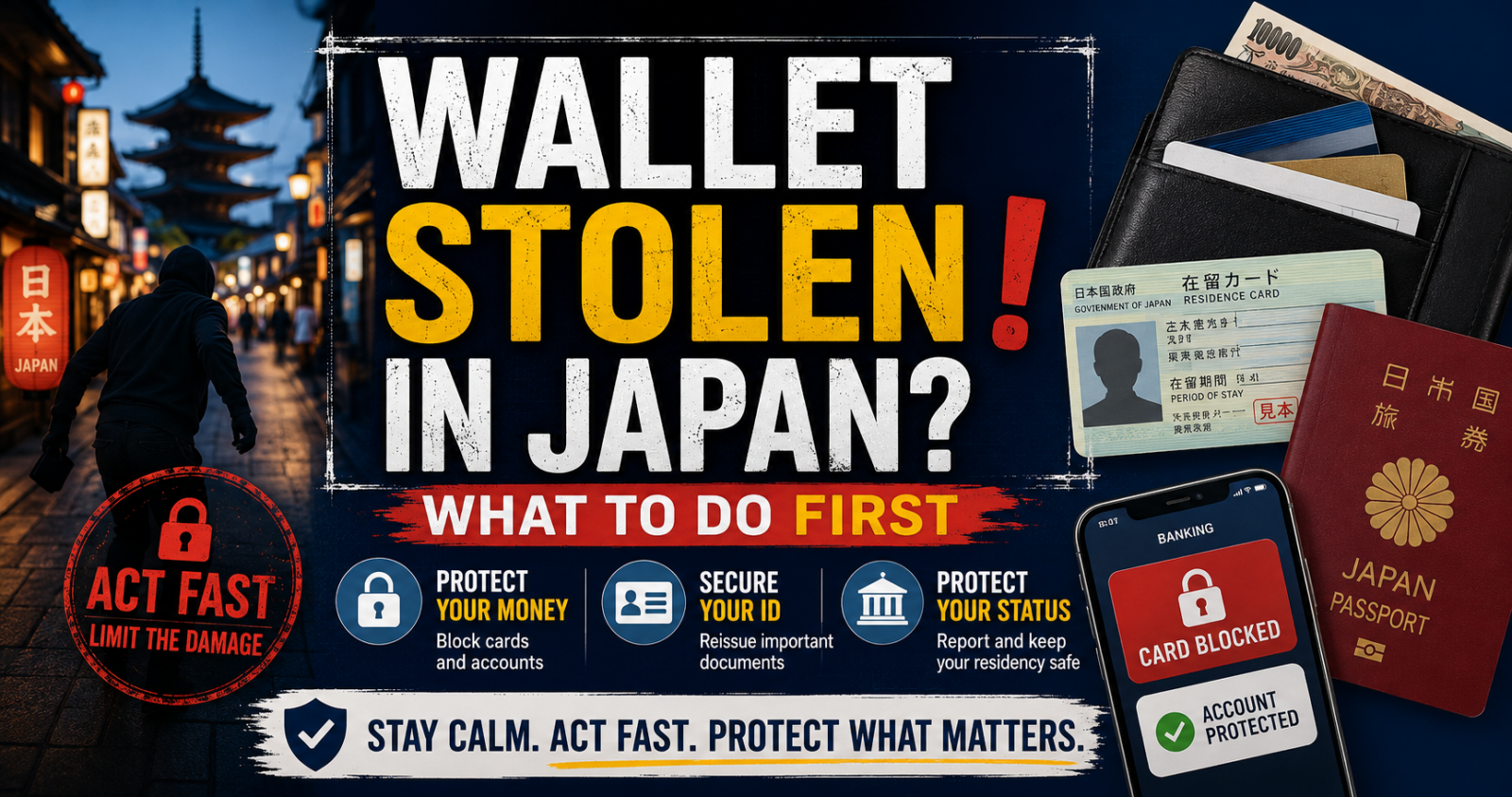
Wallet Stolen in Japan? What to Do First to Protect Your Money, ID, and Resident Status
If your wallet is stolen in Japan, the right order is simple: freeze cards first, contact the place or transport operator where it disappeared, file a police lost-property report, and then replace any official ID that was inside.
For foreign residents, this matters more than the cash. A stolen wallet can affect your bank access, your residence card, your My Number card, and even how you receive insured medical care.
- Stop card use immediately through your bank, credit card issuer, and any payment apps linked to those cards.
- If the wallet may have been left on a train, bus, taxi, in a store, or in a building, contact that operator or facility first.
- File a lost-property report at a police box (
koban) or police station as soon as possible. - If your residence card was inside, apply for reissuance within 14 days after you learn of the loss.
- If your My Number card was inside, suspend it right away and arrange a replacement through your municipality.
Who this guide is for
This guide is for tourists, students, workers, and long-term residents in Japan.
It matters most when your wallet held more than cash, such as:
- a residence card
- a My Number card
- a bank cash card or credit card
- a commuter pass or IC card
- a health insurance document
If you only lost a little cash, the problem is annoying. If you lost identity cards tied to your legal stay or medical access, the problem becomes a paperwork issue very quickly.
What to do in the first 30 minutes
Start with the steps that reduce damage.
1. Freeze bank cards, credit cards, and app-based payments
Do this before anything else.
Japanese police and the National Police Agency both tell people to contact the issuer immediately when lost items include a cash card, credit card, or phone. That is the fastest way to reduce fraud.
If your wallet also had cards linked to Apple Pay, Google Pay, or other wallet apps, suspend those cards too.
2. Contact the place where it likely disappeared
In Japan, many wallets are turned in to staff before they ever reach the police.
If there is a realistic chance you left it somewhere, contact:
- the railway company
- the bus operator
- the taxi company
- the store, restaurant, hotel, or building management
This is especially important in the first few hours. Operators and stores often keep found items for a short period before handing them to police.
3. File a police lost-property report as soon as possible
Even if you think the wallet was stolen, filing the report still matters.
The police use that report to match your description with property that gets turned in later. The report should include where and when you lost it, card numbers or identifying details if known, and distinctive features of the wallet.
ここがポイント: A police lost-property report helps police match a found wallet to you, but it does not by itself prove theft and does not start a search investigation. Freeze cards first, then file the report quickly.
Two details matter here:
- Japan’s National Police Agency says found items reported to police are generally kept for 3 months.
- The Tokyo Metropolitan Police also notes that, as a rule, they need a Japanese phone number to contact you if something is found, and they generally do not make international calls.
If you are sure the wallet was stolen or you already see suspicious card use, tell the police those facts when you report it.
If your foreign resident documents were inside
This is the part many new residents underestimate.
Residence card: do not wait
If your residence card was in the wallet, you need to move faster than you would for an ordinary lost bank card.
The Immigration Services Agency says people who lost a residence card because of loss or theft must apply for reissuance within 14 days from the day they learned of the loss.
In practice, that means you should prepare for immigration with:
- your passport, if you still have it
- the police report acceptance number, if you filed one
- a written explanation of the loss or theft
- a photo, if required
The Immigration Services Agency also says police notification is needed for loss or theft cases, and a police acceptance number is required in the statement used for the application.
If you miss the 14-day period, the agency says extra explanation documents are required. That is avoidable paperwork, so do not leave this for later.
My Number card: suspend it immediately
If your My Number card was inside the wallet, suspend it first and sort out reissue second.
The Digital Agency says the My Number toll-free number is 0120-95-0178, and the loss or theft suspension line is handled 24 hours a day, 365 days a year. Foreign-language support is also available through dedicated numbers.
After suspension, contact the municipality where your resident record is registered if you need reissuance.
This is not only about identity. In 2026, the My Number card can also affect how you access healthcare and other daily procedures.
Health insurance after the 2025 change
This is one of the biggest practical changes for residents.
According to the Digital Agency, all old health insurance cards expired on December 1, 2025, and they are no longer valid from December 2, 2025. The system has shifted to My Number card-based use, plus backup documents issued by your insurer.
That means if your stolen wallet contained the My Number card you use as your health insurance card, you should not assume you are stuck without care.
You may still be able to receive insured treatment by using:
- your My Number card after suspension is resolved and use is restored, or
- a certificate of eligibility or Eligibility Confirmation Form issued by your insurer, employer-side health plan, or local government
This matters for:
- employees on company health insurance
- family members on that insurance
- residents enrolled in National Health Insurance through their city or ward
If you have a clinic visit coming up, call your insurer, employer HR office, or municipal National Health Insurance desk the same day.
Cards, cash, and transport passes
A stolen wallet in Japan often creates three separate problems at once: banking, transport, and proof of identity.
Cash and card misuse
If someone uses your cards before you stop them, the bank or card company process becomes separate from the police process.
Do not assume the police report alone will block transactions. It will not.
Keep a simple record of:
- the time you noticed the loss
- the time you froze each card
- the last place you used the wallet
- any suspicious transactions you see afterward
That record helps when you speak to banks, card companies, or insurance providers.
IC cards and commuter passes
If your wallet held Suica or PASMO, the reissue rules depend on the operator and whether the card was personalized.
Operator rules are not uniform, but one pattern is clear:
- named or registered cards may be suspended and reissued
- anonymous cards may not be recoverable in the same way
PASMO’s rules say a lost blank PASMO cannot be reissued, while a named PASMO can be suspended and reissued if the conditions are met. JR East gives similar guidance for named Suica and commuter-pass Suica.
If the stolen wallet had your daily commuter card, contact the issuing railway company quickly. That can save both stored value and the cost of buying a new pass.
What happens if the wallet is found later
Japan’s lost-property system is useful, but it has a few rules people do not expect.
- If the wallet is found and turned in, police can contact you based on the report details you filed.
- If the found item includes a Japanese-issued bank card, credit card, or phone, the issuer or carrier may contact you after police notification.
- If the finder asks for a reward, the National Police Agency says the reward is generally 5% to 20% of the property’s value, plus certain storage costs.
That last point surprises many people, but it is part of the system.
Common mistakes to avoid
These mistakes create the most trouble:
- Waiting for the police report before freezing cards.
- Assuming a station, store, or taxi company already sent the wallet to police.
- Forgetting that a residence card loss has a 14-day reissuance deadline.
- Thinking the old paper health insurance card is still valid in 2026.
- Leaving Japan without giving police or a trusted contact in Japan a local phone number when follow-up may be needed.
If you are about to leave Japan and the wallet is still missing, give police a contact person in Japan if possible. Tokyo police specifically advise this for people who must leave before the item is found.
Latest practical status as of May 8, 2026
A few current points matter right now:
- Residence card reissuance still requires action within 14 days after you learn of the loss.
- My Number loss suspension is available 24/7 by phone.
- Old health insurance cards are already invalid nationwide after December 2, 2025.
- Lost-property search and contact procedures still vary by prefecture, railway company, and facility.
So the safe approach in 2026 is not to rely on one office.
Use this order instead:
- Stop financial damage.
- Contact the place where the wallet likely disappeared.
- File the police report.
- Replace immigration and municipal ID documents.
- Fix healthcare and commuting access before the next workday.
Final checklist
Before the day ends, make sure you have done these things:
- frozen bank and credit cards
- contacted the likely station, store, taxi, or facility
- filed a police lost-property report
- noted the police acceptance number
- started residence card reissuance if needed
- suspended your My Number card if needed
- checked how you will access healthcare and commuting tomorrow
That last point is the real test. A stolen wallet in Japan becomes manageable once you can still identify yourself, get to work or school, and pay safely the next day.
参照リンク
- National Police Agency: What is a Lost Property Report?
- National Police Agency: If you lost property in a facility or store
- National Police Agency: Lost property information site
- Tokyo Metropolitan Police: If you’ve lost something
- Immigration Services Agency: Reissuance of residence card due to loss or theft
- Digital Agency: Inquiries about My Number System
- Digital Agency: My Number Card security and loss procedures
- Digital Agency: Use of health insurance card in My Number Card
- JR East: Reissue of Suica after loss
- PASMO: Terms including reissue upon loss