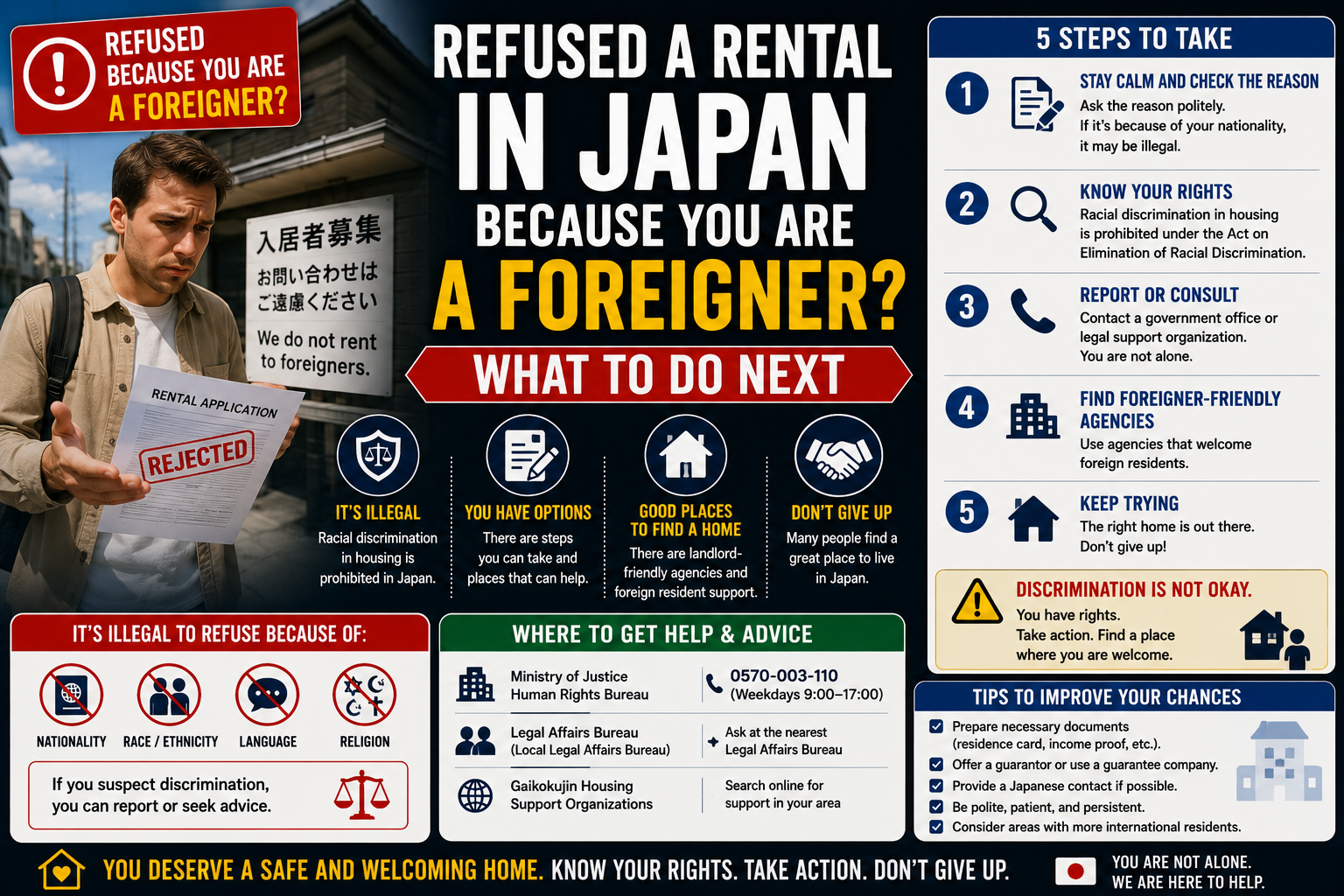
Refused a Rental in Japan Because You Are a Foreigner? What to Do Next
If a landlord or real estate agent tells you that foreigners cannot rent, do not treat it as something you just have to accept quietly. Save the evidence, ask for the exact reason, and contact an official consultation desk quickly. In Japan, the Ministry of Justice’s human rights bodies accept consultations from people who were refused housing because of nationality, and there are also practical housing routes that can keep your move from stopping there.
This guide is for foreign residents, students, workers, and people preparing to move in Japan. It matters most when you are apartment hunting, renewing a lease search after a rejection, or trying to understand whether a refusal was about your documents or about your nationality.
- If you hear “no foreigners,” keep screenshots, emails, listing pages, and notes from the call or visit.
- Ask whether the problem is nationality itself or a specific screening issue such as income, guarantor, or occupancy rules.
- Contact an official consultation desk, especially the Ministry of Justice human rights service, while the details are still fresh.
- Keep the housing search moving in parallel by using foreign-language rental guides and housing channels that already accept foreign residents.
What counts as a discrimination problem in a rental search?
The clearest case is simple: you are told that the owner, management company, or agent will not accept foreigners.
That can happen in a few forms:
- An agent says the listing is not available to foreigners before checking your income or documents.
- A landlord accepts Japanese applicants but rejects you after learning your nationality.
- You are asked for extra conditions that are not being applied to other applicants in the same situation.
- A listing looks open, but the explanation changes as soon as you say you are not Japanese.
That said, not every rejection is the same. Japanese rentals often involve strict screening for income, employment stability, number of occupants, guarantor arrangements, and emergency contact details. The practical question is not only whether you were rejected, but why.
If the reason is vague, ask for a concrete answer. You are trying to separate a nationality-based refusal from an ordinary screening issue that you may be able to fix.
What to do right away
A calm, organized response works better than arguing in the office.
1. Save proof before the listing changes
Keep anything that shows what happened:
- Listing URL and screenshots
- Emails, chat logs, or text messages
- The property name, agency name, branch, and staff name
- The date, time, and what you were told
- Any phrase close to “foreigners not accepted” or “owner does not rent to foreigners”
If the conversation was only verbal, write a memo immediately after. A same-day memo is much more useful than trying to remember details later.
2. Ask for the exact reason
Use a short question such as:
- “Is the problem my nationality, or is there another screening condition?”
- “If it is not nationality, what document or requirement is missing?”
- “Would a guarantee company, higher deposit, or Japanese-speaking support person solve it?”
This matters because some refusals are bluntly discriminatory, while others are tied to requirements you can actually meet.
3. Separate the screening issue from the nationality issue
In practice, these are the most common non-nationality issues to check:
- Income level or unstable employment
- No Japanese emergency contact
- Problems with guarantor or guarantee company screening
- Too many planned occupants for the unit
- Short visa period left compared with the lease term
- Inability to communicate about the contract, building rules, or move-out procedures
Even when one of these is the stated issue, ask whether an alternative is possible. A different guarantee company, a bilingual support person, or a clearer document set can change the answer.
Where to report it and where to get help
ここがポイント: If you were refused because of nationality, report it. If you also need a place to live soon, report it and continue the search at the same time.
Ministry of Justice human rights counseling
The Ministry of Justice’s Human Rights Bureau specifically says you can consult them if you were refused as a tenant because of your nationality. Their human rights bodies can accept a consultation, and they may start remedy procedures depending on the case.
Useful routes include:
- Foreign-language Human Rights Hotline:
0570-090-911 - Human rights counseling on the internet
- Face-to-face counseling at Legal Affairs Bureaus and District Legal Affairs Bureaus
This is the most important official contact if the problem is clearly discrimination.
Local multilingual consultation desks
Local support differs by city and prefecture, but many areas have consultation desks for foreign residents. In Tokyo, for example, readers can use:
- Tokyo Metropolitan Government Foreign Residents’ Advisory Center
- Tokyo Multilingual Consultation Navi:
0120-142-142
These desks may not decide a legal dispute, but they are useful when you need help understanding the system, finding the next office, or speaking to another support body in your language.
Legal information and legal aid
If the issue is becoming a legal dispute, Houterasu, the Japan Legal Support Center, offers multilingual information services. Its civil legal aid is available to foreign nationals who are lawfully residing in Japan and meet the financial conditions.
That matters when you need more than general advice and want to understand your legal options, cost support, or referral routes.
How to keep your apartment search moving
Reporting the problem is important, but it does not automatically produce a new lease. Keep a second track running: find housing through channels that are already designed to work for foreign residents.
Use the official rental guides in foreign languages
The Ministry of Land, Infrastructure, Transport and Tourism provides rental guides and sample documents in 14 languages. These include practical explanations about the rental process, contract procedures, and move-in or move-out points.
Why this helps:
- You can prepare the right documents before the next application.
- You can understand common Japanese rental terms more clearly.
- You can show agents that you already understand the contract process and building rules.
Look at safety-net housing routes
Japan’s housing safety-net system includes registered rental housing that does not refuse certain groups defined as people needing housing support. Official system information states that foreign nationals are included in that broader support framework.
This does not mean every listing is automatic approval. Each property can still have screening conditions. But it does mean there is an official route where “we do not accept foreigners” is not the starting point.
Ask better questions at the next agency
Instead of asking only “Do you have apartments for foreigners?” ask:
- “Do you handle applications with a guarantee company instead of a Japanese personal guarantor?”
- “Can the owner accept a tenant with an English explanation of the contract?”
- “What income documents do you need for screening?”
- “Is there any issue if my emergency contact is in Japan but not a relative?”
Those questions move the conversation from stereotype to requirements.
National rules, local reality, and why the answer changes by area
There is no single shortcut that forces every private landlord in Japan to accept every applicant. The actual result depends on the landlord, the management company, the guarantee company, the city, and how much local support exists in your language.
That is why readers get different outcomes in different places.
- In large cities, you may find more agents used to foreign tenants and more multilingual support.
- In smaller markets, fewer agents may handle foreign-language communication, even when the refusal is not openly about nationality.
- Safety-net housing options vary by area and by listing.
- Local consultation services also vary in language coverage and appointment systems.
So the national rule is the support framework. The local reality is the day-to-day search experience.
Common mistakes that make a bad situation worse
These are the errors that cost people time:
- Arguing on the spot and leaving with no record of what was said
- Accepting a vague refusal without asking whether it was about nationality or screening
- Stopping the apartment search completely after filing a complaint
- Applying again without fixing obvious document gaps
- Not checking guarantee company options
- Ignoring local consultation desks because they seem “non-legal”
The goal is not only to prove a point. It is to protect your position and get housed.
Latest status to check in 2026
As of May 8, 2026, the core official support routes are still active:
- The Ministry of Justice continues to provide human rights counseling for foreigners, including consultation about being refused an apartment because of nationality.
- The Immigration Services Agency’s foreign residents support portal continues to update practical support information, and its guidebook materials were updated again in 2026.
- MLIT’s multilingual rental guides, contract samples, and move-out check materials remain publicly available.
That means the basic response has not changed: document the refusal, use the official counseling channels, and switch quickly to housing routes that are already structured for foreign residents.
The practical bottom line
If you face rental discrimination in Japan, the fastest useful response is this:
- Save proof.
- Ask for the exact reason.
- Report nationality-based refusal to the Ministry of Justice human rights service.
- Keep applying through foreigner-ready or safety-net routes.
The next thing to watch is not another abstract debate about fairness. It is whether you can turn the next application into a cleaner file: clearer documents, a workable guarantor plan, and an agent or owner who is prepared to deal with foreign tenants from the start.
参照リンク
- Ministry of Justice: What We Do | Human Rights Bureau
- Ministry of Justice: Counseling Centers | Human Rights Bureau
- Ministry of Justice: Human Rights Counseling for Foreigners
- MLIT: Support for Foreign Nationals in Looking for Rental Housing
- MLIT: Housing Safety Net System
- Safety Net Housing Information System: About the system
- Immigration Services Agency: Foreign Residents Support Portal
- Immigration Services Agency: Life and Work Guidebook
- Tokyo Intercultural Portal Site: Consultation Desks in Tokyo
- Japan Legal Support Center (Houterasu): Multilingual Information Service
- Japan Legal Support Center (Houterasu): Civil Legal Aid