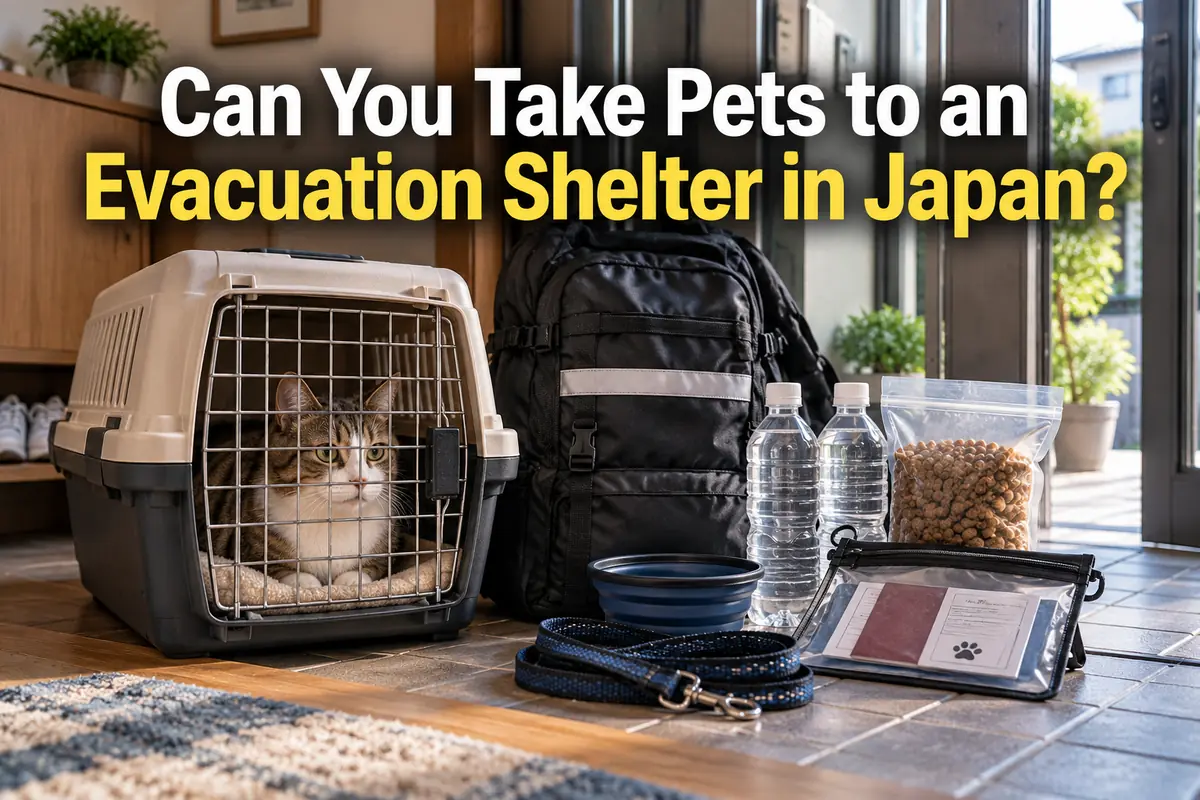
Can You Take Pets to an Evacuation Shelter in Japan?
You can evacuate with your pet to a shelter that accepts animals, but acceptance does not guarantee that your pet can stay beside you in the sleeping area. Before an emergency, confirm the rules for your specific shelter, prepare a carrier and supplies, and arrange a second place your pet could stay.
Japan’s Ministry of the Environment advises owners to check local pet-evacuation arrangements in advance. Shelter conditions are set locally; national guidance does not promise the same facilities everywhere. In an emergency, protect yourself first and follow public authorities’ instructions. Ministry of the Environment: pet disaster preparedness.
This guide is for foreign residents with pets, especially people moving to a new municipality, living alone, or spending the day away from home for work or study.
Here is what to prepare:
- Confirm both whether your animal is accepted and where it will stay.
- Practise using the carrier before you need to leave quickly.
- Stock food and water for at least five days, ideally seven or more.
- Make a backup arrangement if the shelter cannot meet your pet’s needs.
Understand what “evacuating with pets” actually means
Taking your pet to safety and sharing a room with it are separate questions.
The Japanese term 同行避難 — dōkō hinan means evacuating together with your pet. It describes the evacuation action, rather than a promise of shared accommodation.
You may also see 同伴避難 — dōhan hinan in local materials. Do not rely on that label alone: ask whether owners and pets actually occupy the same room, a separate pet room, or different areas of the site.
Yokohama’s earthquake guidance explicitly explains that dōkō hinan does not mean keeping pets in the owner’s room at the shelter. This distinction matters when choosing a backup for an animal that cannot cope with separation. Yokohama: earthquake pet preparedness.
Shelter rules also protect people with allergies or a fear of animals. The Ministry asks owners to respect local instructions and consider other evacuees. Arriving with a calm, contained animal helps everyone use the shelter safely.
ここがポイント: Ask two questions: “Can my pet come to this shelter?” and “Where will my pet stay after we arrive?” A yes to the first does not answer the second.
Check the exact shelter before an emergency
Your plan needs a named destination and its conditions, rather than a general statement that your city supports pet evacuation.
Start with your municipality’s disaster-management office and the office responsible for animal welfare. Search the municipal website using your city or ward name plus ペット 同行避難, meaning “pet evacuation together.”
Useful words include:
- 避難所 — hinanjo: evacuation shelter.
- 一時飼育場所 — ichiji shiiku basho: temporary pet-keeping area.
- 一時預かり — ichiji azukari: temporary care or boarding.
Save the shelter’s Japanese name, address, rules and a map offline. A translated page is helpful, but keeping the original wording makes it easier to match signs and ask staff for directions.
Questions worth asking
Use this checklist when contacting the municipality:
- Does this shelter accept my species, size and number of animals?
- Are the arrangements different for earthquakes and heavy rain?
- Is the pet area indoors, outdoors, or under cover?
- What carrier or cage must I bring?
- What information or records are requested at reception?
- Who feeds the animals and cleans the area?
- What alternative is available if this location cannot accept us?
For birds, rabbits, reptiles and other animals, name the species explicitly. A page describing dogs and cats does not establish arrangements for every pet. Ask your veterinarian how to manage species-specific needs, including temperature control or medication, if normal equipment becomes unavailable.
Check the route as well as the destination
As a planning exercise, walk the route in ordinary conditions with the equipment you intend to carry. Can one person manage the animal, their own emergency bag and the pet supplies? What changes if there are two carriers?
Record an alternative route and destination. A plan that depends on one person, one road and one building has little room for disruption.
Prepare a carrier your pet can use calmly
A carrier is useful only if you can get your pet into it and move it safely.
The Ministry recommends getting animals accustomed to carriers or cages during everyday life. Its English guide describes gradual practice using food or treats, then increasing the time with the door closed. Ministry of the Environment: English pet disaster guide.
Before buying equipment, ask the intended shelter whether it has specific requirements. Then check the manufacturer’s size and weight limits and try carrying the occupied carrier at home.
A practical equipment check should cover:
- Doors, fasteners and handles that close and hold securely.
- Ventilation that remains clear when the carrier is packed for travel.
- A label with your name and reachable contact details.
- Cleaning materials stored where you can reach them without unpacking everything.
Keep the carrier accessible. Storing it behind heavy boxes creates another task at the moment you need to leave.
If your pet becomes distressed during practice, ask your veterinarian or a qualified trainer for help before an emergency. Medication decisions belong with your veterinarian; do not improvise sedation during evacuation.
Pack supplies and a short pet information sheet
Prepare your pet’s essentials separately from the household emergency bag so they are easy to find.
The Ministry’s owner guidance recommends food and drinking water for at least five days, ideally seven days or more. It also prioritizes medication, therapeutic food, containment equipment, toilet supplies and identifying information. Ministry of the Environment: owner preparedness checklist.
Food, water and daily care
Build the kit around what your animal already uses:
- Regular food, plus prescribed food where applicable.
- Drinking water and bowls.
- Prescribed medication, with written instructions.
- Toilet pads or litter, waste bags and cleaning supplies.
- Spare leash or other appropriate containment equipment.
- Towels and a familiar item.
For a food calculation, multiply the normal daily amount by the number of days. An animal eating 80 grams a day needs 560 grams for seven days. This is a packing example, not a feeding recommendation.
Ask your veterinarian about a suitable water reserve and medicine storage. Refill the kit as you use supplies, and review expiry dates.
Records that another person can understand
Prepare a one-page sheet with:
- Your pet’s name, species, appearance and a recent photo.
- Your contact details and a backup contact.
- Veterinary clinic details.
- Current medication, relevant health conditions and feeding instructions.
- Vaccination records and identification details, where applicable.
Keep paper copies in a waterproof pouch and copies on your phone. If possible, add brief Japanese labels beside the English information.
These records help explain care needs and identify the animal. They are not a universal shelter-entry permit; ask your municipality what its reception process requires.
Choose a backup that you have actually discussed
A second destination should be an agreed arrangement, with conditions you understand.
Yokohama’s earthquake guidance asks owners to consider several options, including staying at home when appropriate, temporary care elsewhere and evacuation to a local disaster shelter. Its current page lists a February 2026 revision of the earthquake pet guideline and was updated on August 12, 2026. These are local planning materials, not a nationwide admission rule.
Staying at home
Consider this option only when home is safe and official instructions allow it. Write down what would make you leave and where you would go. A pet’s dislike of a carrier should not determine whether you remain in a dangerous location.
Friends, relatives or boarding facilities
Ask a proposed caregiver directly:
- Can they accept this animal, including its health or behaviour needs?
- How long could it stay?
- Who supplies food and medication?
- How will you transfer it safely?
- What happens if their home or facility is affected too?
For paid boarding, request the rate, admission conditions and collection arrangements in advance. Include transport and possible veterinary costs in your budget rather than assuming all emergency care will be free.
A car requires a separate safety plan
A vehicle may seem convenient because it keeps the pet close. It also creates risks. The Ministry’s English guide discusses heatstroke and blood-clot problems associated with prolonged car-based evacuation.
Do not treat a parked car as an automatic substitute for shelter accommodation. Ask local authorities about permitted locations and safer alternatives, and never leave an animal in a vehicle that could become dangerously hot.
Heavy-rain arrangements can differ from earthquake arrangements
Confirm the rules for the disaster you are preparing for, even within the same municipality.
Yokohama’s flood and storm guidance, updated July 1, 2026, directs residents to ward-specific shelter information. It requires pets to remain in cages in designated areas and owners to bring their supplies.
The city also describes conditional temporary boarding through participating veterinary clinics for generally healthy dogs and cats. It applies when qualifying evacuation information at alert level 3 or above is issued and municipal shelters open. Acceptance must be confirmed with the clinic. Boarding is generally free, but emergency treatment may involve charges. Yokohama: flood and storm pet arrangements.
This example shows why “my vet can take the pet” needs checking: eligibility, opening conditions and availability all matter. Outside Yokohama, ask whether your own municipality has any comparable arrangement.
For forecast storms, discuss temporary care before travel becomes dangerous. Decide how you will monitor official information and when you need to act; do not wait until departure becomes difficult to start searching for a caregiver.
Make arrival and daily care easier
At the shelter, ask staff where to register and where your animal must go before entering the living area.
As a practical arrival checklist:
- Keep the animal contained while speaking to reception staff.
- Explain its species, number and any urgent care needs.
- Show your information sheet if requested.
- Ask about feeding, cleaning, waste disposal and access to the pet area.
- Tell staff promptly if the arrangement cannot meet an essential care need.
Do not assume someone else will feed or supervise your pet. Write a care schedule if several household members or owners are sharing tasks, so feeding and medication are neither missed nor repeated.
If the animal goes missing, contact the municipality’s animal-welfare office and provide identifying information. Avoid entering unsafe areas to search.
Avoid the mistakes that leave a plan unfinished
The most useful final check is whether your plan still works when its easiest option fails.
Common gaps to fix include:
- Checking only the nearest shelter: confirm animal acceptance and a second destination.
- Buying a carrier without practising: test both the animal’s response and your ability to carry it.
- Keeping all information online: save maps, contacts and records offline and on paper.
- Naming a backup caregiver without asking them: agree on species, care needs, duration and costs.
- Leaving the workday unresolved: decide who can help if you are away, without asking anyone to enter danger.
Before the next storm season—or after moving—make one concrete call to your municipal office. Confirm your animal’s eligibility, the exact pet-keeping area and the alternative destination. Those three answers turn a packed bag into a usable evacuation plan.
参照リンク
- Ministry of the Environment: Pet disaster preparedness
- Ministry of the Environment: English disaster preparedness guide for pet owners
- Ministry of the Environment: Japanese owner preparedness checklist
- Yokohama: Earthquake pet preparedness and shelter planning
- Yokohama: Flood and storm pet evacuation arrangements